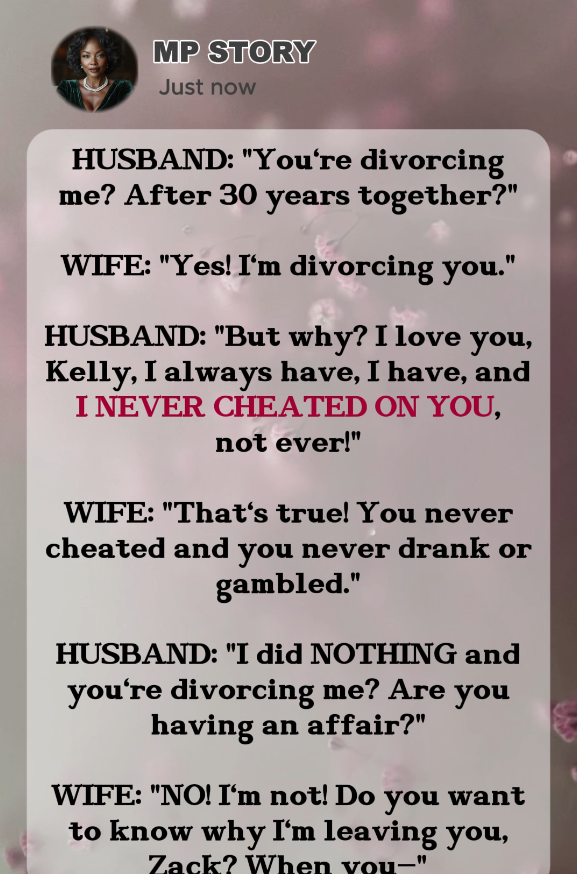
The husband, Zack, uses his lack of “bad” behaviors (cheating, drinking, gambling) as a shield, believing that as long as he hasn’t actively destroyed the marriage, he is entitled to keep it. However, the wife, Kelly, is divorcing him precisely because of his passivity.
In the full version of this viral script, Kelly’s explanation usually follows this path:
- The Emotional Burden: She explains that while he did “nothing” wrong, he also did “nothing” right. He was a spectator in his own life.
- The “Invisible Labor”: She recounts years of making every decision, managing every crisis, and carrying the emotional weight of the family alone while he simply existed in the same space.
- The Breaking Point: She often cites a specific moment—like a health scare or a family emergency—where he stood by and “did nothing” to support her, forcing her to realize she was already effectively single.
Why This Story Resonates
This narrative is a critique of the “Minimalist Husband.” It addresses the “Walkaway Wife Syndrome,” where a woman appears to leave “out of nowhere” after 30 years. In reality, she has been communicating her loneliness for decades, but because the husband wasn’t “doing anything wrong” (like cheating), he never felt the need to change.
The Common Ending
The story usually ends with a “mic drop” moment where Kelly reveals she has already moved her things, bought a small house of her own, and is looking forward to finally having one less person to take care of. She isn’t leaving for another man; she is leaving for herself.
Would you like me to find a specific video version of this story, or perhaps another “One Final Decision” family drama?