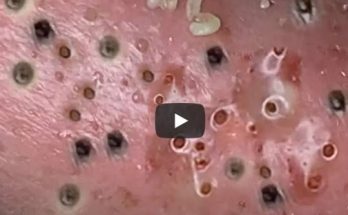
The second image, focused on the cheek, presents a dramatic, dense field of open pores, illustrating an advanced stage of comedonal acne and likely a procedural aftermath.
1. Widespread, Dilated Pores and Impacted Comedones
The entire field is covered in open pores, many of which contain dark, impacted material.
-
The Lesions: These are numerous, deeply set open comedones (blackheads). The consistent, ring-like pattern suggests long-standing, chronic clogging that has led to the permanent dilation of the pore openings. The darkness signals deep impaction and oxidation of the keratin and sebum plug.
-
Potential Diagnosis: This level of density and chronic impaction is highly characteristic of conditions like Acne Conglobata (in its non-inflammatory stage) or extremely severe, persistent comedonal acne.
2. Signs of Pre-Existing/Inflammatory Lesions
Interspersed among the blackheads are a few areas of residual inflammation (redness) and some pustule-like lesions with yellowish tips.
-
The Mix: This indicates the co-existence of non-inflammatory and inflammatory processes, which is typical of moderate-to-severe acne vulgaris. The blackheads represent the chronic, non-ruptured clogs, while the red/yellow spots show where rupture and immune response have occurred.
3. Post-Procedural Appearance
Many of the circular, open pores appear clean or empty, sometimes with a grayish/pink ring around them.
-
The Interpretation: Given the professional context of such images, it is highly likely that many of these lesions have already undergone extraction. The clear, circular pattern suggests the technician has used an extractor tool—possibly a sharp loop or a round suction device—to meticulously clear the hardened, impacted material from each pore. The remaining open pores are the vacated follicular openings.