My Aunt Left Me Her House, Her Car, and $120,000—But One Sentence in Her Will Changed Everything
The first thing I inherited from my aunt was a house that smelled like dust, old wood, and secrets.
The second was a silver sedan with 87,000 miles on it.
The third was nearly $120,000 in savings.
But the last thing she left me was something I wouldn’t understand until I discovered a locked drawer in her kitchen—and read the handwritten note hidden inside.
That note began with seven words.
“Do not sell this house until you know.”
Know what?
I had no idea.
And by the time I discovered the answer, I understood why my aunt had made me promise not to sell the property for an entire year.
Because the house wasn’t simply a house.
It was the only place in town where twelve people had been waiting for the truth to come out.
And my aunt had spent the last twenty-three years making sure they would never forget what happened.
My name is Emily Carter. I was thirty-four when my aunt Margaret died.
She was my mother’s older sister, a quiet woman who lived alone in a two-story house on a tree-lined street in a small town called Bellwood.
She never married. She had no children. She rarely visited anyone, and she never spoke much about her past.
To most people, Margaret was simply the old woman who lived at the end of Willow Lane.
To me, she was the person who had made sure I never felt alone.
When my father abandoned our family, she brought groceries to our apartment.
When my mother died of cancer, Margaret sat beside me in the hospital hallway until sunrise.
When I lost my job at twenty-nine and couldn’t afford rent, she let me stay in her guest room for six months without asking for a single dollar.
She never offered long speeches about love.
She showed it by remembering what I needed before I knew how to ask.
And when she died at seventy-eight, I thought losing her would be the hardest thing I would ever experience.
I was wrong.
Three days after the funeral, I sat inside the office of her attorney, Richard Hayes, expecting to hear that Margaret had left me a few sentimental belongings.
Perhaps her jewelry.
Maybe the old photograph albums she kept in the upstairs closet.
Instead, Richard adjusted his glasses, opened a thick folder, and said, “Your aunt left you everything.”
I stared at him.
“Everything?”
“The house on Willow Lane, the silver sedan, all personal possessions, and her financial accounts. The current combined value of her savings and investments is approximately $119,600.”
I blinked.
“I’m sorry. How much?”
“Approximately one hundred nineteen thousand six hundred dollars.”
For several seconds, I couldn’t speak.
My aunt had never appeared wealthy. She wore the same brown coat every winter, repaired her shoes instead of replacing them, and complained that restaurant coffee cost too much.
I had assumed she lived on a modest pension.
I had never imagined she had saved that much money.
“What about the house?” I asked.
Richard glanced at the document in front of him.
“The property has an estimated market value of $286,000 in its current condition. More, if renovated.”
I felt dizzy.
Almost $120,000 in savings, a car, and a house worth hundreds of thousands of dollars.
It was more money than I had ever imagined inheriting.
For the first time in years, I could picture a future without constantly worrying about bills.
I could pay off my debts, repair my aging car, and stop renting a tiny apartment where the upstairs neighbors sounded like they were bowling at midnight.
Perhaps I could even start the small bookkeeping business I had dreamed about for years.
Then Richard turned to the final page.
“There is one condition.”
My excitement faded.
“What condition?”
He slid the document toward me.
“You cannot sell, transfer, or enter into a binding agreement to sell the house for twelve months after your aunt’s death.”
I read the sentence twice.
“Why?”
“Your aunt was very specific about this provision.”
“But why would she care what I do with a house I inherit?”
Richard folded his hands.
“She left a separate letter explaining her instructions. You may read it after you take possession of the property.”
“Why not now?”
“Because she requested that the letter remain sealed until you moved into the house.”
I stared at him.
“That makes no sense.”
“I understand.”
“No, I don’t think you do. The roof leaks. The kitchen cabinets are falling apart. The upstairs bathroom barely works. I’ve seen the place.”
Richard nodded.
“I know.”
“So she leaves me a house that needs tens of thousands of dollars in repairs, then tells me I can’t sell it for a year?”
“Yes.”
I leaned back in my chair.
For one ugly moment, I considered refusing the inheritance.
I could walk away, find a smaller apartment, and avoid the headache.
But then I remembered Margaret sitting beside me in the hospital when my mother died, holding my hand without saying a word.
I remembered the six months she gave me when I had nowhere else to go.
I remembered the envelope of grocery money she once slipped into my coat pocket, pretending she had found it on the sidewalk.
She had done so much for me.
The least I could do was honor one final request.
“Fine,” I said. “I’ll move in.”
Richard nodded as though he had expected that answer.
“Your aunt believed you would.”
At the time, I thought he was merely being polite.
I would later remember those words with a chill running down my spine.
Because Margaret hadn’t simply expected me to move into her house.
She had been counting on it.
I moved into Willow Lane on a rainy Saturday in early October.
The house looked worse from the inside than it had from the street.
The wallpaper was peeling in the hallway. Several floorboards creaked beneath my feet. The kitchen faucet dripped constantly, and the basement smelled so damp that I immediately decided I would never go down there without a flashlight.
Margaret’s furniture remained exactly where she had left it.
Her reading glasses sat beside the living-room lamp.
A half-finished crossword puzzle lay on the coffee table.
In the upstairs bedroom, her slippers were neatly arranged beside the bed.
It felt less like moving into a new home and more like trespassing in a place where someone had simply stepped outside for a moment.
For the first few weeks, I concentrated on practical things.
I changed the locks, hired a plumber, cleaned the carpets, and began sorting through the paperwork in Margaret’s desk.
Her finances were straightforward. Richard had already arranged the transfer of the savings, and the car title arrived in the mail within days.
Nothing strange happened.
No mysterious visitors.
No unexpected letters.
No hidden compartments.
I began to relax.
Maybe the twelve-month restriction was simply an eccentric request from an elderly woman who couldn’t bear the thought of her home being sold immediately after her death.
Margaret had always been sentimental about certain things.
Perhaps the house was one of them.
By the end of the third week, I was almost grateful for the restriction.
The house was growing on me.
Morning sunlight spilled across the dining-room floor. Birds gathered in the old maple tree outside the kitchen window. The neighborhood was quiet, and for the first time since my mother’s death, I felt as though I belonged somewhere.
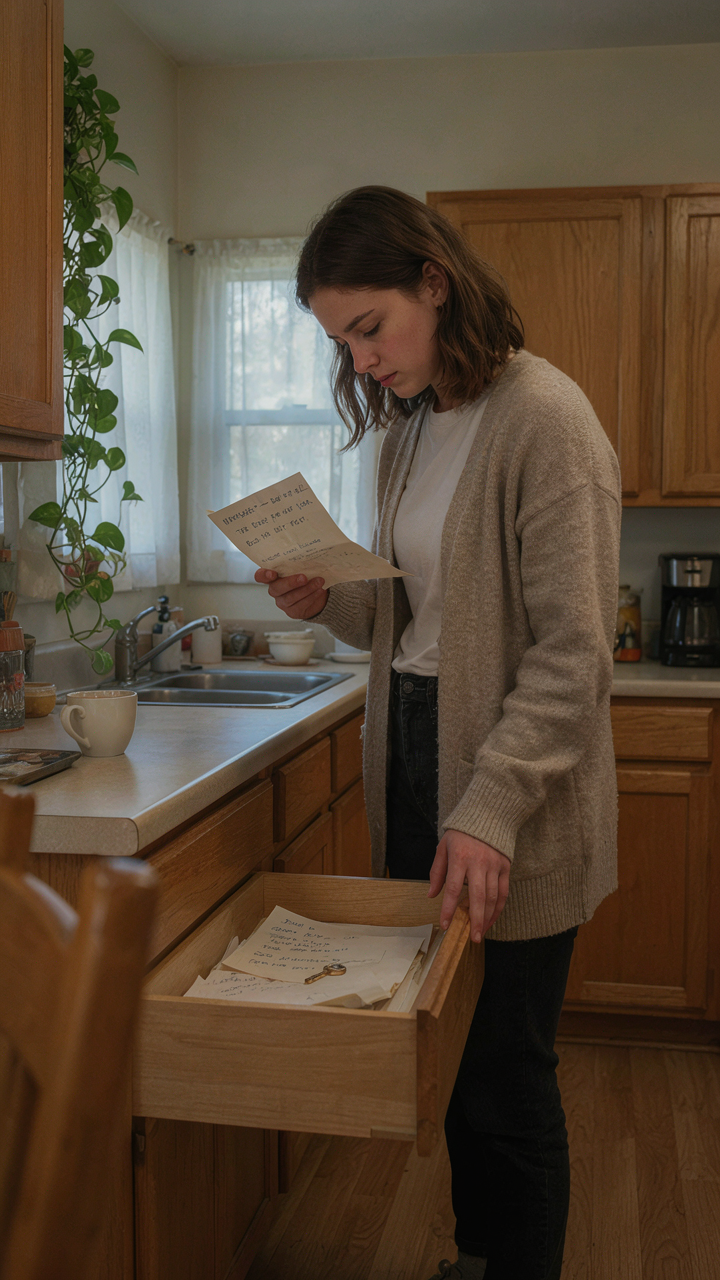
Then, on a Thursday afternoon, I found the drawer.
I was cleaning the kitchen cabinets when I noticed something strange beneath the bottom shelf of an old wooden cabinet.
The shelf appeared slightly crooked.
When I pulled it forward, I found a small brass key taped underneath.
I stared at it.
Margaret had been meticulous about household organization. She labeled jars, recorded appliance warranties, and kept spare batteries in a tin marked BATTERIES.
She would never have hidden a key beneath a shelf without a reason.
I began searching the cabinets.
Behind a stack of old plates, I found a narrow drawer built into the cabinet’s side. It had a tiny keyhole that I had never noticed.
The brass key fit perfectly.
The drawer opened with a soft click.
Inside lay a folded sheet of paper, a black notebook, and a bundle of photographs secured with a faded blue ribbon.
My heart began beating faster.
I unfolded the paper first.
The handwriting was unmistakably Margaret’s.
The note read:
Emily,
If you are reading this, you have moved into the house, and I am no longer here to explain what I should have told you years ago.
I am sorry.
You will find a list of names and dates in the notebook. Do not call these people. Do not send them letters. And do not tell anyone what you have found until you understand why the names are here.
For twenty-three years, I kept a promise that should never have been made.
Now it is your turn to decide whether that promise deserves to survive.
Begin with the first name.
Look behind the loose brick in the basement wall.
And remember this: the person who tells the truth first is not always the person who has told the truth.
Love always,
Aunt Margaret.
I read the note three times.
Then I opened the notebook.
Twelve names were written on the first page.
Each name had a date beside it.
Some dates were from the late 1990s. Others were from the early 2000s.
Beside each name, Margaret had written a short phrase.
Thomas Reed — October 14, 2003 — $8,000.
Helen Morris — February 9, 2004 — Refused to sign.
Daniel Price — June 17, 2005 — Witness.
Ruth Bennett — November 2, 2006 — Never told her daughter.
And so on.
The final entry was dated just six months earlier.
Michael Carter — April 11 — He knows where the money went.
I stopped breathing.
Michael Carter was my father.
The man who had abandoned my mother when I was twelve.
The man who had disappeared from our lives, leaving behind unpaid bills, unanswered questions, and a birthday card that arrived three years late.
I had not seen him in almost twenty years.
I looked at the date again.
Six months earlier.
Margaret had written his name only six months before she died.
Why?
And what money had he taken?
I grabbed my phone and called Richard Hayes.
He answered after two rings.
“Emily?”
“I found the letter.”
There was a long pause.
“What letter?”
“The one Aunt Margaret left in the kitchen.”
Another pause.
Then his voice became careful.
“Did you find a notebook as well?”
My stomach tightened.
“You knew about it?”
“I knew your aunt had kept certain records.”
“What records?”
“Emily, I think you should follow her instructions before drawing conclusions.”
“She mentioned my father.”
Richard exhaled slowly.
“Then you have found the part she was most afraid to explain.”
I gripped the phone.
“What does that mean?”
“I cannot tell you everything over the telephone. But if you have the notebook, you should look behind the loose brick in the basement.”
“You knew about the brick too?”
“I knew Margaret wanted you to find it.”
I felt a wave of anger.
“Why is everyone speaking in riddles?”
“Because your aunt spent twenty-three years trying to protect people who were not always honest with her. She wanted you to see the evidence before anyone could influence what you believed.”
“Evidence of what?”
Richard’s voice softened.
“Of something that happened to your mother.”
The room seemed to tilt.
“My mother?”
“Yes.”
“What happened to her?”
“I think you should open the wall first.”
He ended the call after promising to meet me the following morning.
I stood in the kitchen for several minutes, unable to move.
Then I took the flashlight from the utility drawer and headed downstairs.
The basement was colder than the rest of the house.
A single bulb hung from the ceiling, illuminating a concrete floor, a rusted furnace, and shelves stacked with jars of screws and nails.
The walls were made of old brick, most of it painted white.
I searched for nearly twenty minutes before noticing a section behind the furnace where the paint had cracked.
One brick looked slightly different from the others.
I pressed it.
It moved inward.
With a screwdriver, I worked the brick loose and pulled it from the wall.
Behind it was a small cavity.
Inside lay a metal cash box.
I carried it upstairs and placed it on the kitchen table.
The box was locked.
For a moment, I considered waiting for Richard.
Then I noticed a tiny envelope taped to the underside.
Inside was another key.
The lock opened immediately.
The first thing I saw was a photograph of my mother.
She looked about thirty-five, with her dark hair tied back and a smile I remembered from childhood.
Beside her stood Margaret.
They were holding a large manila envelope between them.
On the back of the photograph, Margaret had written:
The day we decided to tell the truth.
I turned it over again, hoping the picture might explain itself.
It didn’t.
Beneath it were bank statements, carbon copies of old checks, several notarized documents, and a yellowed newspaper clipping.
The headline read:
LOCAL CHARITY INVESTIGATED AFTER DONATION RECORDS DISAPPEAR.
I sat down.
The article described a community relief fund established in 1998 to help families facing medical emergencies, housing crises, and unexpected financial hardship.
The fund had been created after a devastating winter storm left several families in Bellwood without homes.
My mother had volunteered as its bookkeeper.
Margaret had served on the committee.
And Thomas Reed, the first name in the notebook, had been the fund’s treasurer.
According to the article, more than $180,000 had gone missing over several years.
The investigation had ended without charges.
The committee had claimed that poor recordkeeping, administrative errors, and a series of unauthorized withdrawals had made it impossible to determine exactly where the money went.
The fund eventually closed.
I stared at the article.
My mother had worked for that organization.
She had told me about it when I was young, describing how they helped families buy heating oil, repair damaged roofs, and keep children in school.
She had never mentioned missing money.
I began examining the bank statements.
At first, the numbers made little sense.
Deposits appeared on one page. Withdrawals appeared on another. Several checks had been written to businesses I didn’t recognize.
But the dates kept repeating.
Every few months, money had been transferred into an account belonging to a company called Bellwood Property Services.
The company had no visible connection to the relief fund.
I looked at the paperwork more closely.
One document listed the company’s registered owner.
Michael Carter.
My father.
I felt sick.
According to the records, he had received payments totaling more than $74,000.
But that wasn’t the worst part.
Several checks bore what appeared to be my mother’s signature.
I knew her handwriting.
I had watched her write grocery lists and birthday cards for years.
The signatures on the checks looked similar, but something about them felt wrong.
The letters were too careful.
The curves too deliberate.
Someone had been copying her name.
And the last document in the box was a letter written by Margaret.
It was dated twenty-three years earlier.
I know what happened to the money.
I know who signed the checks.
I know who is being blamed.
But I am afraid that if I tell the truth, the person I am trying to protect will lose everything.
I have been told that silence is the only way to keep the family together.
I am beginning to understand that silence is what is destroying it.
I put the letter down.
My mother had died believing she had failed in some way.
I remembered her final year, when she had become withdrawn and anxious. She spent hours sorting through paperwork and occasionally woke in the middle of the night, convinced someone had been outside the house.
When I asked what was wrong, she always said the same thing.
“It’s grown-up business, sweetheart. You don’t need to worry.”
I had believed her.
Now I wondered how much she had suffered while trying to protect me.
I looked again at the list of names.
Twelve people.
Twelve dates.
Twelve pieces of a story Margaret had carried alone for twenty-three years.
The next morning, I would begin asking questions.
But before I could reach for my phone, someone knocked on the kitchen door.
Three sharp knocks.
I froze.
It was nearly nine at night.
Through the frosted glass, I could see the silhouette of a man.
When I opened the door, a gray-haired stranger stood on the porch holding a folded newspaper.
He looked past me into the kitchen.
Then he noticed the notebook on the table.
His face changed.
“You found it,” he whispered.
“Who are you?”
“My name is Thomas Reed.”
The first name on the list.
He stepped back as if he expected me to slam the door in his face.
“I know what Margaret told you,” he said. “And I know why she left that house to you.”
“Then start talking.”
He looked toward the street.
“Not here. Not where anyone can see us.”
I should have refused.
I should have called the police.
But something in his expression made me hesitate.
He looked frightened.
Not guilty.
Frightened.
“Please,” he said. “Your aunt spent twenty-three years trying to fix what we did. If you have the notebook, then the people who wanted it buried may already know.”
I stared at him.
“Who wanted it buried?”
Thomas swallowed.
“Your father.”
Thomas sat at my kitchen table until nearly midnight.
He explained that the relief fund had been established in 1998, with donations from local businesses, churches, and ordinary families.
My mother had volunteered to keep the books because she was careful with numbers.
Margaret had helped distribute assistance to families who needed it.
Thomas managed the bank account.
And my father, Michael, had offered to handle certain property-related expenses through his small contracting company.
“At first, everything was legitimate,” Thomas said. “Your father repaired a few houses for families who needed help. He charged reasonable rates. Everyone trusted him.”
“What changed?”
“More money started moving through his company. Invoices appeared for repairs that had never been completed. Materials were billed twice. Checks were written against estimates no one had approved.”
“Why didn’t you stop him?”
Thomas lowered his eyes.
“Because I signed some of the checks.”
The admission landed between us like a stone.
He explained that my father had told him the committee had approved the expenses. When Thomas questioned the figures, Michael showed him paperwork that appeared to support the transactions.
By the time Thomas realized something was wrong, thousands of dollars had already disappeared.
“I should have gone to the police,” he said. “Instead, I convinced myself it was an accounting mistake.”
“And my mother?”
“She discovered the missing money.”
“Did she know my father was responsible?”
“Yes.”
I felt my fingers tighten around my mug.
“What did she do?”
“She confronted him. She told him she was going to bring the records to the authorities.”
Thomas stared at the tabletop.
“Your father threatened to destroy her reputation. He said he would tell everyone she had been taking money herself. He had copies of checks with her signature.”
“The forged signatures.”
Thomas nodded.
“He said he would make sure she went to prison. He also threatened to use your name.”
“My name?”
“He told her that if she exposed him, he would claim she had used the money to support you. He said he could make the evidence look as though she had been stealing for years.”
I could barely speak.
“So she stayed quiet?”
“For a while.”
“And Margaret?”
“Margaret believed she could solve it privately. She thought your father might repay the money if the committee avoided a public scandal.”
“Did he?”
Thomas shook his head.
“He promised. He lied.”
I looked toward the metal box on the counter.
“What happened to the money?”
“Some went to pay off debts. Some went into property purchases. Some disappeared into accounts we never found.”
“And why did the investigation end?”
Thomas took a long breath.
“Because the evidence was incomplete. Your father denied everything. Your mother was too frightened to testify. The committee members blamed each other. And several people signed statements saying they believed the transactions had been approved.”
“Who signed?”
He opened the newspaper he had brought.
Inside was an old photocopy of a committee meeting record.
I recognized several names from Margaret’s notebook.
One belonged to the former mayor.
Another belonged to the owner of a local hardware store.
And another belonged to a woman named Helen Morris.
The same Helen who had refused to sign something.
“What did they sign?” I asked.
“A statement claiming that the missing money was the result of bookkeeping mistakes and that no one could be held responsible.”
“Even though they knew?”
“Some knew. Some suspected. Others simply wanted the scandal to end.”
I stared at him.
“And my aunt kept this information all these years?”
“She kept the documents. She kept copies of everything. She tried to get people to admit what happened, but most of them were afraid of your father or ashamed of what they had done.”
“Why didn’t she go to the police herself?”
Thomas looked toward the window.
“Because she made a promise to your mother.”
“What promise?”
“That she would protect you from the scandal until you were old enough to understand it.”
I felt anger rise in my chest.
“I’m thirty-four years old.”
“I know.”
“And my mother has been dead for years.”
“I know that too.”
“Then why didn’t Margaret tell me?”
Thomas had no answer.
For a moment, neither of us spoke.
Then he reached into his coat and pulled out a small envelope.
“Your aunt gave me this two months ago. She told me to deliver it only if you found the notebook.”
Inside was a photograph of a younger Margaret standing outside a courthouse.
Beside her was a woman I didn’t recognize.
On the back, she had written:
Helen Morris. The only person who tried to stop him.
Thomas stood.
“You need to find Helen,” he said. “She’s the only one who knows where the original bank records went.”
“Where does she live?”
“Three streets from here. But there’s something you should know.”
He looked at me with an expression I would never forget.
“Your father visited her last month.”
Then he left.
And for the first time since moving into Margaret’s house, I understood why she had forbidden me to sell it.
She hadn’t wanted me to preserve the walls.
She had wanted me to uncover what they had witnessed.
Helen Morris lived in a small blue bungalow behind the old library.
I found her the next afternoon sitting on her front porch, wrapped in a knitted cardigan despite the warm weather.
She was eighty-one, with silver hair and sharp, watchful eyes.
When I introduced myself, she immediately asked whether I had found Margaret’s notebook.
I nodded.
She closed her eyes.
“Then Margaret finally did it.”
“Did what?”
“Left the truth to someone who wasn’t afraid of losing her reputation.”
I sat beside her.
“Can you tell me what happened?”
Helen looked down at her hands.
“Your mother discovered the fraud. Margaret discovered it too. But your father had something neither of them expected.”
“What?”
“He knew how to make honest people look dishonest.”
She explained that Michael had used the relief fund’s money to cover personal debts and finance property purchases.
When the discrepancies were discovered, he began creating documents that suggested my mother had authorized the payments.
He used her real signature on legitimate paperwork and copied it onto fraudulent checks.
Then he told committee members that she had been diverting money to support her household.
“He knew your mother was proud,” Helen said. “He knew she would be devastated if people believed she had stolen from families who were already struggling.”
“Did she confess to anything?”
“No. She denied taking the money. But she refused to accuse your father publicly because she feared what he might do to you.”
Helen reached for a glass of water.
“Your father had threatened to seek custody if she was charged with fraud. He told her he would make sure you ended up with him.”
I stared at her.
“He abandoned us.”
“Years later. At the time, your mother was terrified he might take you away.”
The memory of my childhood rearranged itself in my mind.
The late-night arguments.
The locked bedroom door.
My mother’s sudden silence whenever someone mentioned money.
The way she had held me tightly before sending me to school.
I had believed she was simply sad about her marriage.
Now I understood she had been fighting a battle I was too young to see.
“What happened to the original records?” I asked.
Helen hesitated.
Then she stood and went inside.
She returned carrying a small cardboard box.
“I kept copies,” she said. “The originals were supposed to be delivered to the investigator, but someone removed several files from the committee office before the investigation began.”
“Who?”
“Your father.”
“How do you know?”
“Because I saw him carrying the box out.”
Helen handed me a thick envelope.
Inside were copies of bank transfers, receipts, and a handwritten ledger.
The ledger recorded each questionable payment.
One entry caught my eye.
October 14, 2003 — $8,000 — Thomas Reed.
The first name on Margaret’s list.
Another read:
February 9, 2004 — Helen Morris — refused to approve revised statement.
The dates matched the notebook exactly.
But the final pages revealed something even more disturbing.
For years, my father had transferred money to a company registered under a different name.
That company had purchased a small commercial property outside Bellwood.
The property was later sold for a substantial profit.
A portion of the proceeds had been deposited into an account belonging to a woman named Patricia Lane.
I recognized the name from one of Margaret’s photographs.
Patricia had been my father’s business partner.
And according to the ledger, she had received more than $41,000.
“Who is she?” I asked.
Helen’s expression hardened.
“The person your father claimed was only his accountant.”
I felt a chill.
“Was she more than that?”
Helen looked away.
“She was his mistress.”
The words seemed to echo across the porch.
My father had not only stolen from a charity.
He had used the money to build another life while my mother struggled to keep ours together.
“Does Patricia still live here?”
“No. She moved away years ago.”
“Do you know where?”
Helen gave me an address.
Then she placed a hand over mine.
“Emily, before you go looking for your father, you need to understand something. Your aunt didn’t leave you this house because she thought you were the strongest person in the family.”
“Why, then?”
“Because you were the only one who hadn’t been paid to stay quiet.”
Patricia Lane lived in a retirement community two hours from Bellwood.
I drove there the following morning, carrying copies of the documents and the photograph from Margaret’s box.
She answered her apartment door wearing a cream-colored sweater and a gold bracelet.
When I introduced myself, she stared at me for several seconds.
Then she stepped aside.
“I wondered when someone would come.”
I placed the documents on her dining table.
“I want to know what happened to the money.”
Patricia sat down.
For a long time, she said nothing.
Then she began to cry.
She told me that she had worked for my father in the early 2000s and had been romantically involved with him.
She knew money was moving through his business, but she believed the payments were legitimate.
When she discovered that some invoices were fraudulent, she confronted him.
He told her that the money had been borrowed temporarily and that everything would be repaid.
She believed him.
By the time she realized the truth, he had placed some of the proceeds into an account in her name.
“He told me it was for our future,” she said. “He said he wanted to leave your mother and start over.”
“Did you know where the money came from?”
“Not at first.”
“And later?”
Patricia covered her face.
“Yes.”
The confession was almost inaudible.
“Why didn’t you tell anyone?”
“Because I was afraid. He said I could be charged too. He told me the documents showed that I had approved the transactions.”
“Did you?”
“Some. I signed paperwork I didn’t understand. But I never knew the full amount.”
She went to her bedroom and returned with an old leather folder.
Inside were letters from my father, bank records, and a handwritten statement.
“I kept these because I knew one day someone would ask,” she said.
One letter was dated twenty-three years earlier.
My father’s handwriting was unmistakable.
If anyone asks about the transfers, tell them the expenses were approved by the committee. Margaret will never risk exposing the family. Your mother will never let Emily be dragged into this.
I read the sentence again.
Your mother will never let Emily be dragged into this.
My father had known exactly what my mother would sacrifice to protect me.
And he had used that love as a weapon.
Patricia signed a statement describing her role and gave me permission to provide copies of the records to an investigator.
Before I left, she asked a question.
“Did Margaret ever forgive me?”
I thought about the note in the kitchen drawer.
The list of names.
The dates.
The twenty-three years of silence.
“I don’t know,” I said honestly.
Patricia nodded, tears slipping down her cheeks.
“That’s fair.”
I drove back to Bellwood with the folder on the passenger seat.
For the first time, I had something more powerful than suspicion.
I had evidence.
But I still hadn’t confronted my father.
And I knew that conversation would change everything.
Michael Carter lived in a modest house on the other side of the state.
I found his address through public records.
When I arrived, he opened the door wearing a checked shirt and a look of mild annoyance.
For a moment, we simply stared at each other.
He had aged. His hair was almost entirely gray, and the lines around his eyes were deeper than I remembered.
But his expression was the same.
The same impatience.
The same certainty that he could control any conversation if he spoke first.
“Emily,” he said.
Not sweetheart.
Not my daughter.
Just Emily.
“What are you doing here?”
I held up the folder.
“I found Aunt Margaret’s records.”
His expression changed.
Only slightly.
But I saw it.
“Your aunt was an old woman who spent too much time worrying about things that didn’t concern her.”
“She knew what you did.”
He laughed without humor.
“Knew what? That I helped a charity when no one else wanted to get their hands dirty?”
“She knew you stole money.”
His jaw tightened.
“Be careful what you accuse me of.”
I opened the folder and showed him a copy of the ledger.
Then the bank statements.
Then Patricia’s signed statement.
His face grew pale.
“You have no idea what you’re looking at.”
“Then explain it.”
He glanced toward the street.
“Come inside.”
I refused.
“I’m fine here.”
He lowered his voice.
“Your mother made mistakes. Margaret exaggerated everything. You were a child. You don’t understand what was happening.”
“I understand that $180,000 disappeared.”
“Some of that money was spent on legitimate repairs.”
“Then why did you create false invoices?”
“I didn’t.”
“Why did you copy my mother’s signature?”
His eyes flashed.
“You need to stop.”
“No.”
The word surprised both of us.
For most of my life, I had imagined what I would say if I ever saw my father again.
I thought I would cry.
I thought I would demand to know why he had left.
Instead, I felt strangely calm.
“You left my mother to carry the shame,” I said. “You let people believe she had stolen money from families who needed help. You let her die thinking she had failed to protect me.”
Michael’s expression hardened.
“Your mother chose to stay quiet.”
“Because you threatened her.”
“She was always dramatic.”
I felt something inside me go cold.
“You don’t get to call her dramatic.”
He folded his arms.
“You came here because you want money. That’s what this is about, isn’t it? Margaret left you a house and a little inheritance, and now you’re hoping to squeeze something else out of me.”
I almost laughed.
“You think this is about money?”
“Everything is about money.”
“No. That’s what you believe.”
I placed the folder against the doorframe.
“An investigator will be receiving copies of these records. Patricia has given a statement. Helen has records too. Thomas is prepared to explain what he signed.”
Michael stared at me.
“You wouldn’t dare.”
“I already did.”
For the first time, I saw fear in his eyes.
Not concern about his reputation.
Not embarrassment.
Fear.
He looked at the documents again.
Then he said something I had never expected.
“Margaret promised me she would keep this buried.”
I felt my pulse quicken.
“She promised you?”
He realized his mistake too late.
For a moment, he said nothing.
Then he stepped closer.
“You have no idea what that woman did to keep this family from falling apart.”
“Tell me.”
“She knew the truth would destroy your mother.”
“My mother already knew.”
“She knew what it would do to you.”
I shook my head.
“No. You knew what it would do to you.”
His face darkened.
“You should go.”
“I will. But I’m going to ask you one question first.”
He stared at me.
“Did you ever feel sorry for what you did?”
He looked away.
That was his answer.
I turned and walked toward my car.
Behind me, he called my name.
For one foolish second, I thought he might apologize.
Instead, he shouted, “You have no idea how much I sacrificed for this family!”
I stopped.
Then I turned around.
“You sacrificed nothing. You took what belonged to other people and made my mother pay for it.”
I drove away without looking back.
The investigation took four months.
It was neither quick nor dramatic.
There were interviews, document reviews, legal consultations, and long conversations with people who had spent decades convincing themselves that silence was easier than truth.
Richard Hayes helped organize the records and connect me with an attorney experienced in financial misconduct cases.
The evidence was complicated because the transactions were old, several witnesses had died, and the original charity had long since dissolved.
Some legal claims could no longer be pursued.
Other matters required careful examination before authorities could determine whether charges were possible.
I learned that justice did not always arrive with handcuffs and a courtroom confession.
Sometimes it arrived as a stack of documents that finally made it impossible for people to keep telling the same lie.
The most important discovery came from a bank archive.
Among the surviving records was an account that had received several transfers from my father’s company.
The account belonged to the relief fund itself.
And it had been used to repay some of the stolen money.
Not all of it.
But enough to reveal something Margaret had never told me.
She had spent years trying to recover the funds quietly.
She had persuaded several committee members to return money they had received under false pretenses. She had sold personal investments to help reimburse families whose assistance had been delayed.
And she had used part of her own savings to cover emergency grants when the charity’s accounts ran dry.
That explained the $119,600 in her estate.
It was not a fortune accumulated through some secret business.
It was what remained after years of careful saving and quiet restitution.
She had been living modestly because she had spent so much of her life trying to repair damage she had not caused.
But there was another document.
A letter from my mother, written in the final year of her life.
Richard delivered it to me after the investigator confirmed that it belonged with the family records.
I sat in the living room, surrounded by the furniture I had once considered old and useless, and opened the envelope.
My dearest Margaret,
I know you are tired.
I know you believe that if you keep working long enough, you can make everything right.
But I need you to understand that none of this was your fault.
Michael made his choices. I made mine. I stayed quiet because I was afraid of losing Emily, and because I believed that protecting her meant keeping the world from knowing what had happened.
I was wrong about one thing.
Silence does not protect the people we love. It only teaches them to live with questions they should never have had to ask.
If Emily ever learns the truth, please tell her I was not ashamed of her.
I was ashamed that I let fear make so many decisions for me.
I wanted her to grow up believing people could be trusted.
Perhaps the best thing you can leave her is the truth, even if it arrives too late for me.
I love you.
Anna.
I pressed the letter against my chest.
For years, I had wondered why my mother never fought harder.
Why she let my father leave.
Why she never told me the truth about the charity.
I had mistaken her silence for weakness.
Now I understood that she had been frightened, isolated, and manipulated by someone she once loved.
She had made mistakes.
She had allowed fear to shape her decisions.
But she had never stolen that money.
And she had never stopped loving me.
I cried for a long time that afternoon.
Not because I had inherited a house.
Not because my father might face consequences.
I cried because I finally understood my mother.
And because I wished I could tell her that she no longer needed to be afraid.
The following spring, I received a letter from Richard.
It contained the final report from the investigation and a sealed envelope marked:
OPEN ONLY AFTER YOU HAVE READ THE REPORT.
The report confirmed that the records supported allegations of financial misconduct involving the former relief fund. It also explained which transactions could be verified and which could not be conclusively established because of missing documents and the passage of time.
The evidence had been referred to the appropriate authorities for further review.
Several former committee members acknowledged signing statements they knew were incomplete. Others admitted that they had ignored warnings because they wanted to protect the charity’s reputation.
My father’s role was documented in the surviving financial records, although not every missing dollar could be traced.
There would be no neat ending in which every person responsible received exactly what they deserved.
But the official record no longer treated my mother as the likely culprit.
That mattered more to me than I could explain.
I opened the second envelope.
Inside was a final letter from Margaret.
Emily,
If you have reached this point, you now know more about our family than I ever wanted you to need to know.
I have spent twenty-three years believing that keeping the peace was the same as doing the right thing.
It was not.
I told myself I was protecting your mother. Then I told myself I was protecting you. Eventually, I realized I was protecting the people who benefited from our silence.
I cannot change the years I wasted.
I cannot give your mother the peace she deserved.
And I cannot make your father become the man we hoped he would be.
But I can give you a choice.
You can keep the house. You can sell it when the year is over. You can leave Bellwood and never think about any of this again.
I do not want you to spend your life repairing my mistakes.
I only ask that you remember the people whose names you found in that drawer. Some were guilty. Some were frightened. Some were simply too tired to fight.
Do not confuse forgiveness with pretending nothing happened.
Do not confuse anger with justice.
And never believe that loving someone requires you to protect their lies.
The house is yours.
So is the truth.
What you do with either one is your decision.
All my love,
Aunt Margaret.
I read the letter twice.
Then I folded it carefully and placed it in the drawer beside the notebook.
For the first time, I understood the condition in the will.
Margaret hadn’t forbidden me to sell the house because she wanted to control my life from beyond the grave.
She had wanted to give me enough time to understand what I was inheriting.
Not just the property.
Not just the savings.
The consequences of a promise made by frightened people who believed silence would keep them safe.
The twelve-month restriction had forced me to stay long enough to discover the truth.
And now the year was almost over.
On the anniversary of Margaret’s death, I stood in the kitchen where I had found the locked drawer.
The house had changed.
I had repaired the roof, replaced the broken cabinets, and restored the wooden floor in the living room.
The plumbing worked.
The upstairs bathroom no longer leaked.
The garden was full of flowers that Margaret had planted years earlier.
But I had kept the old kitchen cabinet exactly as it was.
The drawer still opened with the same brass key.
The notebook still rested inside.
I had considered selling the house several times during the investigation.
The money would have been useful.
I could have moved somewhere smaller, paid off the remainder of my debts, and started over.
But every time I imagined leaving, I remembered the people whose names were written in that notebook.
I remembered Helen sitting on her porch.
I remembered Thomas admitting what he had signed.
I remembered Patricia handing me the letters she had kept for decades.
And I remembered my mother, believing she had failed me because she had been too frightened to tell the truth.
I decided to keep the house.
Not because I believed it was haunted by the past.
Because I believed it could be used to do something better with the future.
With part of the inheritance, I established a small community assistance fund in my mother’s name.
It wasn’t a recreation of the old charity. I wanted something more transparent.
Every donation would be recorded.
Every payment would require independent approval.
Annual financial statements would be available for public review.
No single person would control the accounts.
And anyone who needed assistance would be able to apply without being made to feel ashamed.
I used the remaining funds to help local families with emergency heating bills, temporary housing, and medical expenses.
It wasn’t enough to solve every problem in Bellwood.
But it was a beginning.
On the first day the fund opened, Helen arrived carrying a small envelope.
Inside was a photograph of my mother and Margaret standing outside the old relief office.
Helen had written a note on the back.
For the women who tried to do the right thing, even when they were afraid.
I framed the photograph and hung it in the hallway.
Beneath it, I placed a small brass plaque.
It read:
TRUTH IS NOT THE ENEMY OF FAMILY. SILENCE IS NOT THE SAME AS LOVE.
A few weeks later, I received a final letter from my father.
It was short.
He wrote that he regretted how things had turned out. He claimed he had made decisions under pressure and that he had never intended for my mother to suffer.
He asked whether we could meet.
I read the letter several times.
Part of me wanted to throw it away.
Another part wanted to hear him admit what he had done.
I wanted an apology that named the people he had hurt.
I wanted him to say my mother’s name without blaming her.
I wanted him to acknowledge that I had grown up with questions he had deliberately left unanswered.
But I had learned something during the year I spent uncovering Margaret’s secret.
An apology was not something I could force from another person.
And forgiveness was not a debt I owed simply because someone shared my blood.
So I wrote back.
I told him I was willing to speak with him if he was prepared to discuss the truth honestly.
I would not pretend the past had never happened.
I would not hide the records.
And I would not accept an apology that blamed my mother for his choices.
I mailed the letter.
He never responded.
For a while, his silence hurt.
Then, slowly, it stopped being the center of my life.
I had a home to care for.
A small business to build.
Families to help.
And a mother whose memory I could finally honor without carrying the shame that had never belonged to her.
Two years after Margaret’s death, I found myself sitting in the kitchen on a quiet Sunday morning.
Sunlight fell across the table.
The old maple tree outside had turned bright green.
I was drinking coffee from my aunt’s favorite chipped mug when I noticed a small envelope tucked behind the notebook in the drawer.
I was certain I had searched that drawer dozens of times.
Yet there it was.
My name was written across the front.
Inside was a single sheet of paper.
Emily,
There is one more thing I need you to know.
The twelve names in the notebook were not simply the names of people who knew what happened to the money.
They were the names of people who had a chance to stop it.
Some failed.
Some tried.
Some changed their minds when the consequences became frightening.
But there was one person who never had the chance to choose.
Your mother.
She was blamed for decisions she did not make, judged by people who never asked her side, and forced to live with the fear that telling the truth might cost her the daughter she loved.
When you found the notebook, you may have wondered why I did not simply hand the records to the police years ago.
The answer is that I was afraid too.
I told myself I needed more evidence. I told myself I needed to protect you. I told myself tomorrow would be a better day.
And tomorrow became twenty-three years.
Please do not make the same mistake.
When you know something is wrong, do not wait for the perfect moment to speak.
There may never be one.
Love,
Margaret.
I sat very still.
Then I folded the letter and placed it beside my mother’s photograph.
For the first time, I didn’t feel angry with my aunt for keeping the truth from me.
I understood her fear.
But I also understood why she had finally chosen to leave me the key.
She couldn’t undo the past.
She couldn’t bring my mother back.
She couldn’t make my father honest.
All she could do was leave me the evidence and trust me to make a different choice.
And that was what I had done.
I had refused to sell the house before I understood it.
I had listened to people who had been silenced.
I had allowed the truth to be recorded, even when it was uncomfortable.
And I had learned that a family could survive the truth, but it could not heal while everyone was pretending nothing had happened.
Sometimes I still thought about the money.
Nearly $120,000 in savings.
A house worth hundreds of thousands.
A car that started every morning.
On paper, those were the things I had inherited.
But they were not what changed my life.
What changed my life was a small brass key taped beneath a kitchen shelf.
A notebook filled with twelve names.
And a woman who had waited twenty-three years to give me the choice she wished she had made sooner.
My aunt left me her house, her car, and nearly $120,000.
I thought the inheritance would make my life easier.
Instead, it showed me how much pain a family could hide behind closed doors.
And how much courage it sometimes takes to open them.
Because the greatest inheritance isn’t always the money someone leaves behind.
Sometimes, it’s the truth they finally trust you to tell.