My grandmother passed away on a cold Tuesday morning, and her will shocked everyone.She left nothing to anyone.Not my mother.Not my uncles.Not my cousins.Not even me.
The lawyer read the document twice because nobody in the room seemed to understand what he was saying.
“Under the terms of the will,” Mr. Collins said carefully, “Mrs. Beatrice Whitmore leaves no direct inheritance to any named relative.”
My uncle Raymond laughed.A short, nervous laugh.“That can’t be right.”“It is.”
“What about the house?”Mr. Collins folded his hands over the document.“The house is not being left to a family member.”Silence.Then everyone started talking at once.
My mother demanded to see the will.My aunt accused the lawyer of hiding something.
Raymond stood up and began listing everything he believed belonged to him.
The antique dining table.Grandma’s jewelry.Her silverware.
The paintings.Even the old grandfather clock that hadn’t worked in fifteen years.I sat quietly at the end of the table, staring at the empty chair where Grandma had always sat.
For the first time, I realized something.I didn’t care about any of it.I had spent the last three years taking care of her.
I drove her to doctor appointments.
I bought her groceries.
I learned how to organize her medications.
I sat beside her when she couldn’t sleep.
When her hands became too weak to button her cardigan, I buttoned it.
When she forgot what day it was, I never made her feel ashamed.
And when she asked the same question five times in one afternoon, I answered it five times.
I never did those things because I expected an inheritance.
I did them because she was Grandma.
My grandmother had raised me for part of my childhood.
She had been the person who showed up when everyone else was busy.
So when she died, I didn’t want her house.
I wanted one more conversation.
One more cup of tea.
One more afternoon sitting beside her while she complained about the weather.
Instead, I was sitting in a room full of relatives fighting over things she had touched.
The argument became louder.
Raymond was now accusing my mother of taking Grandma’s earrings.
My cousin Melissa was opening drawers.
Someone had already removed a crystal vase from the mantel.
“Stop!”
The word escaped my mouth before I could think.
Everyone looked at me.
I stood.
My chest felt tight.
“She’s been dead for less than an hour, and you’re already dividing up her life.”
Nobody answered.
I grabbed my coat and walked outside.
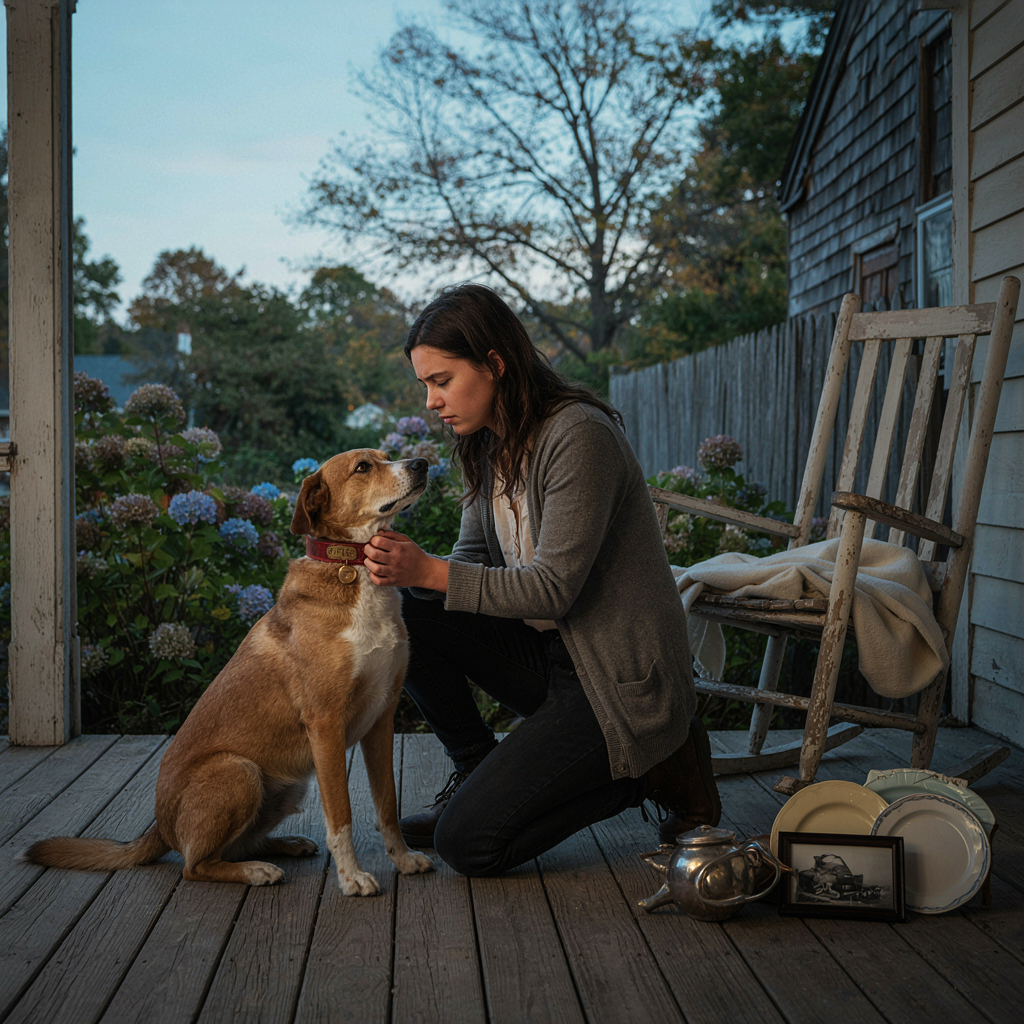
The back porch was exactly as I remembered it.
The old wooden boards creaked beneath my shoes.
A wind chime moved gently in the breeze.
And beside Grandma’s empty rocking chair sat Berta.
Her old brown-and-white dog.
Berta was nearly thirteen years old.
Her muzzle had turned gray.
Her eyesight wasn’t what it used to be.
But she was sitting perfectly still beside that empty chair.
Waiting.
My heart broke.
“Hey, girl.”
Berta looked at me.
Then she looked at the rocking chair.
I knelt beside her.
“She isn’t coming back.”
Berta rested her head against my knee.
I cried into her fur.
Maybe it was grief.
Maybe it was exhaustion.
Maybe it was the realization that the person who had always made me feel safe was finally gone.
Whatever it was, I couldn’t leave that dog there.
Not with relatives fighting inside.
So I took Berta home.
That night, I gave her water and made her a bed beside my couch.
She refused to lie down.
Instead, she kept staring at the front door.
“Grandma isn’t coming through there either,” I whispered.
Berta eventually curled up.
Around midnight, I noticed something strange.
Her collar was loose.
I reached down to adjust it.
The collar had always been old, but I’d never really examined it.
I turned it over.
My fingers touched something hard underneath the leather.
I frowned.
There was a small stitched section that didn’t belong.
I grabbed scissors.
Carefully, I cut the thread.
A tiny brass cylinder slipped out.
I caught it in my palm.
My heart began pounding.
There was something rolled inside.
A piece of paper.
I unfolded it.
There were only six words.
“Look where the bluebird sings.”
I stared at the sentence.
Then I laughed nervously.
“Grandma…”
Of course.
Even after death, she had managed to make a puzzle.
I spent the next twenty minutes thinking about every bluebird in her house.
Then I remembered.
The kitchen.
Grandma had a tiny ceramic bluebird hanging above the old pantry door.
I had given it to her when I was nine.
I grabbed my keys.
I almost called my mother.
Then I stopped.
Something inside me said not to.
I drove back to Grandma’s house.
The driveway was dark.
Everyone had gone home.
I unlocked the back door using the spare key Grandma had given me years ago.
Inside, the house smelled exactly like her.
Cinnamon.
Old wood.
Lavender soap.
For a moment, I couldn’t move.
Then I walked into the kitchen.
The ceramic bluebird was still hanging above the pantry.
I reached behind it.
My fingers touched an envelope.
It had my name on it.
ELENA.
My hands started shaking.
I opened it.
Inside was another note.
“If you’re reading this, they already know the will says nothing.”
I swallowed.
The next line made my stomach drop.
“That’s exactly what I wanted them to believe.”
I sat down at the kitchen table.
I read the rest.
Grandma explained that she had deliberately created a will leaving nothing to the family.
But that wasn’t her final plan.
The house, she wrote, had been transferred months earlier into a private trust.
The trust was controlled by an independent attorney.
And there was only one person named as its beneficiary.
Me.
I covered my mouth.
But there was more.
The money wasn’t simply the value of the house.
Grandma had owned several investments.
A small commercial building.
Shares in a regional company.
Two rental properties.
And a collection of rare coins.
Together, according to her letter, they were worth more than $2.8 million.
I stared at the number.
Then I kept reading.
“Elena, I know you will wonder why I didn’t tell you.”
“Because you were the only person who never asked.”
My eyes filled with tears.
“Your relatives loved the idea of what I owned. You loved me.”
I couldn’t breathe.
The letter continued.
Grandma said she had spent the previous two years quietly documenting everything happening around her.
Who visited.
Who asked about her finances.
Who pressured her to change her will.
Who borrowed money.
Who disappeared whenever she needed help.
Then came the part that made my blood run cold.
She had discovered someone had been accessing her bank account.
Not stealing enormous amounts.
Small withdrawals.
$200.
$400.
$600.
Amounts designed not to trigger immediate suspicion.
She had confronted nobody.
Instead, she installed a small security camera in her study.
The recordings were stored remotely.
And she had given access to the files to Mr. Collins.
I kept reading.
“If they accuse you of taking anything from my house, do not defend yourself.”
“Let them talk.”
“Let them search.”
“Let them show everyone exactly who they are.”
A strange calm came over me.
Grandma had known.
She had known all of this was coming.
I folded the letter.
Then I noticed something written at the bottom.
“Berta knows where the second key is.”
I looked at the dog.
Berta was sitting beside the kitchen doorway.
I laughed through my tears.
“You’re kidding me.”
Berta tilted her head.
I followed her gaze.
She was looking toward the hallway.
More specifically, toward Grandma’s old coat closet.
I opened it.
Several coats hung inside.
Grandma’s blue winter coat.
Her green raincoat.
A black wool jacket.
And an old beige cardigan.
Berta walked straight to the cardigan.
She sniffed it.
Then scratched the floor.
I moved the cardigan.
Underneath it was a loose floorboard.
My heart began racing again.
I lifted it.
There was a small metal box.
Inside was a key.
And a flash drive.
The key had a tag.
SAFE DEPOSIT BOX — 1147
I sat on the floor.
I understood now.
Grandma hadn’t trusted anyone with the entire secret.
She had divided it into pieces.
The first piece was hidden in Berta’s collar.
The second was behind the bluebird.
The third was under the floor.
And somehow, Berta had been trained to lead me from one to the next.
I took the flash drive home.
I didn’t open it until the next morning.
There were videos.
Dozens of them.
The first showed my uncle Raymond entering Grandma’s study.
He opened a drawer.
He removed an envelope.
The second showed my aunt Caroline searching through Grandma’s jewelry box.
The third showed my cousin Melissa taking photographs of financial documents.
Then came something worse.
Raymond was speaking to someone on the phone.
“If she doesn’t change the will,” he said, “we’ll challenge it.”
The voice on the other end was my mother.
I froze.
I replayed it.
Again.
And again.
My mother.
The woman who had spent the entire previous evening screaming that the will had to be wrong.
She had known.
Maybe not everything.
But enough.
I sat in silence for several minutes.
Then my phone rang.
It was Mr. Collins.
“Did you find it?”
“Yes.”
“All of it?”
“Not yet.”
He was silent.
Then he said, “Your grandmother instructed me to tell you something only after you found the drive.”
“What?”
“She said, ‘Tell Elena not to feel guilty.’”
I closed my eyes.
Mr. Collins continued.
“She knew you’d blame yourself.”
“I already do.”
“She said you’d think maybe you should have visited more.”
My throat tightened.
“She said you’d think you should have noticed she was afraid.”
I couldn’t answer.
“She said none of that was your fault.”
I began crying.
Mr. Collins gave me time.
Then he said, “There’s one more thing.”
“What?”
“Your grandmother wanted the family meeting held tomorrow morning.”
“Why?”
“To reveal the real will.”
My stomach turned.
“Why didn’t she simply leave everything to me?”
“Because she wanted the truth to come out first.”
The next morning, everyone returned to the house.
The atmosphere was completely different.
Nobody knew what was coming.
Raymond arrived first.
He was carrying a folder.
My mother came next.
She wouldn’t look at me.
Caroline sat on the sofa.
Melissa kept checking her phone.
Mr. Collins stood near the fireplace.
I sat quietly beside Berta.
The lawyer opened his briefcase.
“I believe everyone here is aware of the preliminary will that was read yesterday.”
Raymond nodded.
“It’s fraudulent.”
Mr. Collins didn’t react.
“That document was genuine,” he said.
Everyone stared.
“But it was not the final estate plan.”
Raymond’s face changed.
“What does that mean?”
“It means Mrs. Whitmore deliberately created a document that appeared to leave her estate to no family member.”
My mother whispered, “Why?”
Mr. Collins looked directly at her.
“Because your grandmother believed the contents of her true estate plan would be endangered if certain people knew about it.”
The room went silent.
He placed another document on the table.
“This is the actual trust agreement.”
Raymond reached for it.
Mr. Collins pulled it away.
“I’ll read it.”
He did.
The house.
The investments.
The rental properties.
The commercial building.
The coin collection.
Everything was transferred into the trust.
And the beneficiary was me.
Raymond exploded.
“You can’t be serious!”
“She was mentally incompetent!”
Mr. Collins calmly replied, “Mrs. Whitmore underwent three independent cognitive evaluations during the year before the trust was created.”
Raymond stopped.
“All three concluded she had full testamentary capacity.”
Caroline began crying.
Melissa whispered, “But she promised me the jewelry.”
Mr. Collins looked at her.
“Your grandmother never promised you anything.”
Then he placed a folder on the table.
“This contains financial records.”
My mother suddenly stood.
“We don’t need this.”
“Yes,” Mr. Collins said. “You do.”
He opened the folder.
“Over the past eighteen months, Mrs. Whitmore’s accounts were accessed without authorization.”
Raymond’s face went pale.
“That’s an accusation.”
“No,” Mr. Collins said. “It’s an audit.”
He pushed several pages forward.
“These withdrawals were made using an account access code assigned to a family member.”
Nobody spoke.
Then he looked at Raymond.
“The security footage shows you entering the study.”
Raymond stood.
“You’re lying.”
Mr. Collins connected the flash drive to a laptop.
The first video played.
Raymond entering the room.
Opening the drawer.
Removing the envelope.
Everyone watched.
Then another.
Caroline searching through the jewelry.
Then another.
Melissa photographing bank statements.
My mother began shaking.
Then came the recording of Raymond speaking to her.
“If she doesn’t change the will, we’ll challenge it.”
My mother covered her face.
I stared at her.
“Mom?”
She couldn’t look at me.
Raymond shouted.
“That recording proves nothing!”
Mr. Collins calmly replied, “Actually, it proves quite a lot.”
He opened another folder.
“Your grandmother reported suspected financial exploitation to her bank six weeks before her death.”
Everyone froze.
“She didn’t press criminal charges because she wanted to give the family an opportunity to admit what they’d done.”
My mother began sobbing.
“I didn’t take anything.”
I looked at her.
“You knew.”
She wiped her eyes.
“I knew Raymond was borrowing money.”
“From Grandma?”
“He said she gave it to him.”
Raymond shouted, “Don’t blame me!”
Mr. Collins raised his voice.
“Enough.”
The room became silent.
“There is one final instruction from Mrs. Whitmore.”
He handed me an envelope.
My name was written on it in Grandma’s handwriting.
I opened it.
Inside was a single page.
I read it aloud.
“My dearest Elena,
If you’ve reached this point, I know you’re hurting.
You may feel angry.
You may feel betrayed.
You may even feel guilty for being the one who received what everyone else wanted.
Don’t.
I didn’t leave you my estate because you cared for me.
I left it to you because I watched what you did when you believed there was nothing to gain.
You brought groceries.
You fixed my broken heater.
You sat beside me when I was afraid.
You never once asked what would happen to my house.
That is why I trusted you with it.
But I don’t want you to keep everything.”
I stopped.
Everyone stared.
I continued.
“The house should remain a home.
Sell what you don’t need.
Keep Berta comfortable.
And use part of the estate to create something for people who have no family to care for them.”
My voice broke.
“She had already chosen a name.”
I read the final paragraph.
“The Whitmore House Foundation.”
Grandma wanted her home transformed into a small assisted-living residence for elderly people who had nowhere else to go.
The property would remain in trust.
The money would fund its operation.
And Berta would live with me until the end of her life.
I lowered the letter.
Nobody spoke.
For several seconds, the only sound was Berta’s breathing.
Then my mother whispered, “She really thought of everything.”
I looked at her.
“She did.”
Raymond walked toward the door.
Mr. Collins stopped him.
“One more thing.”
Raymond turned.
“The unauthorized withdrawals total $46,800.”
His face collapsed.
“Your grandmother instructed me to report them if the family disputed the trust.”
Raymond said nothing.
He walked out.
Caroline followed.
Melissa stayed seated, crying.
My mother remained.
Eventually she looked at me.
“I was jealous,” she whispered.
I didn’t answer.
“She loved you more.”
“No,” I said quietly.
“She trusted me more.”
That hurt her.
But it was true.
Months passed.
The legal battle was ugly.
Raymond tried to challenge the trust.
He failed.
The bank records and security footage made that impossible.
The $46,800 was recovered through the estate proceedings.
The house remained mine legally, but I never thought of it that way.
It was Grandma’s house.
So I kept it almost exactly as she left it.
The rocking chair stayed on the porch.
The bluebird remained above the pantry.
The kitchen still smelled like cinnamon.
And Berta slept every night beside the same chair.
The Whitmore House Foundation opened the following spring.
We renovated the downstairs rooms and converted the upstairs bedrooms into comfortable private spaces.
Six elderly residents moved in first.
People who had spent years alone.
People whose families had disappeared.
People who had nowhere else to go.
Every Sunday, I cooked dinner for them.
Sometimes I would sit on the porch with Berta.
She grew slower every month.
Her eyes became cloudy.
But she still looked toward the rocking chair.
One evening, almost a year after Grandma died, I sat beside her.
I placed my hand on her head.
“You miss her too, don’t you?”
Berta leaned against me.
I looked at the empty rocking chair.
For the first time, I didn’t feel that terrible ache.
I felt grateful.
Then I noticed something.
A tiny bluebird had landed on the porch railing.
I smiled.
“Grandma?”
The bird flew toward the garden.
Berta watched it.
Then she stood.
She walked to the old flower bed beside the porch and began scratching the soil.
I laughed.
“Oh, come on.”
She scratched again.
I grabbed a gardening glove and dug where she had been pawing.
My fingers hit something metal.
My heart stopped.
I pulled out a small tin box.
Inside was another letter.
I recognized the handwriting immediately.
I sat on the porch and opened it.
There were only three lines.
“Elena,
If you found this, Berta did her job.
Now you finally know the whole truth.”
Underneath was a photograph.
It showed Grandma when she was young.
Standing beside a man I had never seen before.
On the back, she had written:
“Your grandfather didn’t die when you were told he did.”
I stared at the photograph.
My hands went cold.
For almost my entire life, I had believed my grandfather had died before I was born.
Grandma had always refused to discuss him.
But now there he was.
Alive.
Young.
Smiling.
And standing beside a second person.
A woman.
On the back of the photograph was one final sentence.
“Before you search for him, ask yourself why I spent sixty years making sure nobody found him.”
I looked toward the road.
The sun was disappearing behind the trees.
Berta sat beside me.
The house was quiet.
For a moment, I almost put the photograph back.
Then I remembered Grandma’s final lesson.
She had never been afraid of the truth.
She had simply waited until the right person was ready to hear it.
I looked down at the photograph again.
And for the first time, I realized that the inheritance Grandma had left me was never the money.
It was the truth.
And somehow, I knew the biggest secret of her life had only just begun.