My Parents Threw Me Out at Sixteen. Eighteen Years Later, They Came for My Uncle’s $42 Million Fortune.
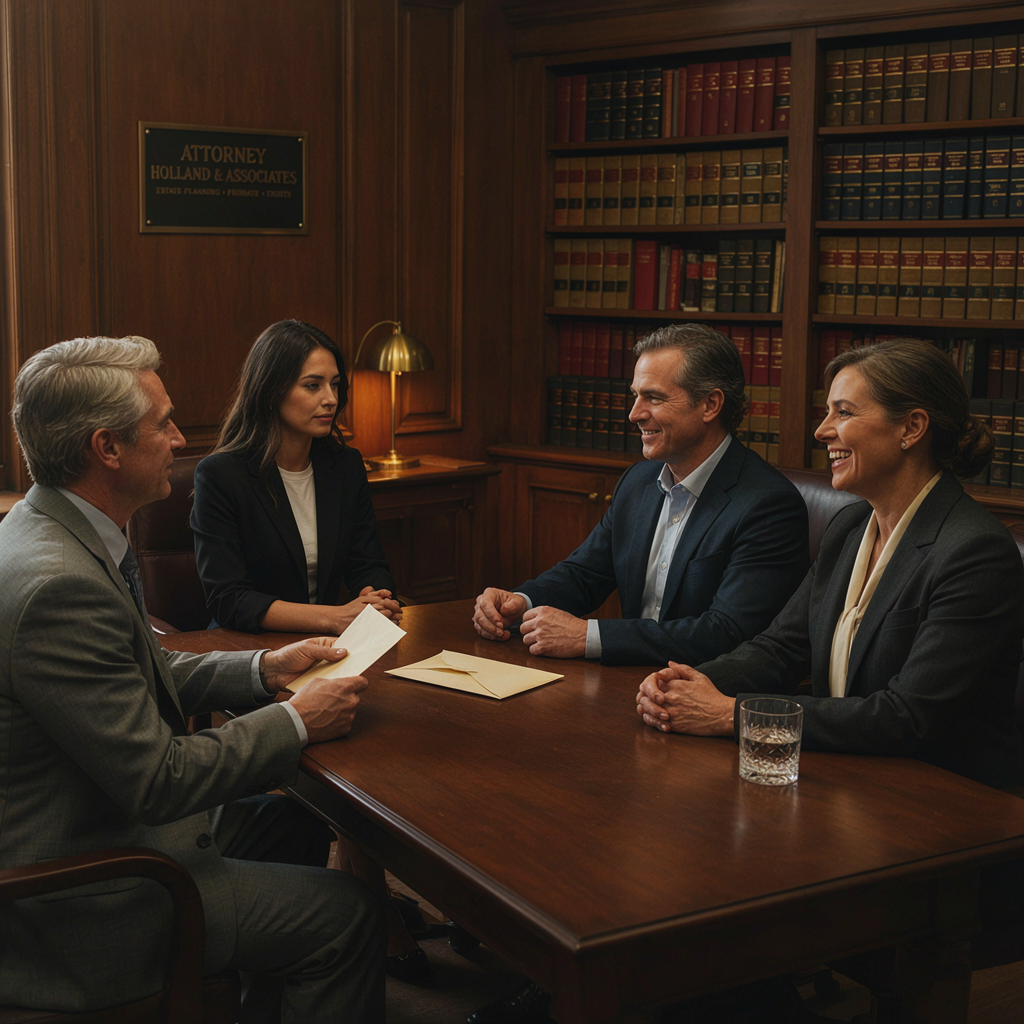
The first thing my mother said when I walked into the attorney’s office was, “We’re family.”She said it with a laugh.Not a nervous laugh.Not an embarrassed laugh.
A confident one.The kind of laugh a person gives when they believe the outcome is already decided.
My father sat beside her, adjusting the expensive watch on his wrist.
He looked older than I remembered, but not softer.
Some people age.Others simply become more expensive versions of the same person.My mother leaned toward me across the conference table.”Don’t make this awkward,” she whispered.
“Whatever Uncle Richard left, we’ll divide it fairly.”I stared at her.For eighteen years, she hadn’t called me.
Not once.Not on my seventeenth birthday.Not when I graduated high school.
Not when I finished college.Not when I got married.
Not when my husband and I bought our first house.Not even when she learned that I had a daughter.Eighteen years of silence.And now, suddenly, we were family.
I said nothing.The attorney, Mr. Bennett, sat at the head of the table with a thick leather folder in front of him.
My parents had arrived twenty minutes early.
I had arrived exactly on time.
There were six people in the room.
My parents.Me.
Mr. Bennett.
His assistant.
And my uncle’s longtime accountant, Mr. Harris.
Richard had been my father’s older brother.
But to me, he had been something much more important.
He had been the only adult who ever looked at me and saw a child instead of an inconvenience.
He was the man who taught me how to ride a bicycle.
The man who stayed awake with me when I had nightmares.
The man who showed up at my school science fair when my parents forgot.
The man who once drove four hours through a snowstorm because sixteen-year-old me called him from a gas station and said two words.
“Uncle Richard?”
He had answered immediately.
“Where are you?”
I never told him how much those words meant.
Where are you?
Not—
What did you do?
Why are you bothering me?
Why can’t you handle it yourself?
Just—
Where are you?
Now he was gone.
And my parents were sitting in his lawyer’s office, preparing to collect a share of his forty-two-million-dollar estate.
Or so they thought.
Mr. Bennett opened his folder.
“We are here to execute the final will and testament of Richard James Carter.”
My mother’s smile widened.
My father’s fingers tapped the table.
Mr. Bennett continued.
“The estate includes liquid assets, investment accounts, commercial property, residential property, two companies, and several trusts.”
My father nodded approvingly.
Then my mother whispered,
“Forty-two million.”
She said it almost reverently.
I looked down at my hands.
I wasn’t thinking about the money.
I was thinking about a cardboard box.
A cardboard box sitting on a sidewalk eighteen years earlier.
My entire childhood had fit inside it.
I was sixteen when my parents threw me out.
It happened on a Tuesday.
I remember because I had a chemistry test the next morning.
I had spent the afternoon studying at the kitchen table.
My mother walked in carrying a stack of mail.
She dropped it beside me.
“We’re selling the house.”
I looked up.
“What?”
“We’re moving.”
“Where?”
She shrugged.
“Somewhere smaller.”
My father came in behind her.
He had already made the decision.
I could see it in his face.
“I can’t afford to keep supporting you,” he said.
I laughed because I thought he was joking.
“I have school.”
“You’re sixteen.”
“Exactly.”
My mother crossed her arms.
“You’re old enough to figure something out.”
I stared at them.
“What does that mean?”
My father sighed.
It was the sigh of someone exhausted by a problem he had created.
“It means you’re going to stay somewhere else.”
I didn’t understand.
“With who?”
Neither answered.
My stomach tightened.
“Mom?”
She looked away.
“Your aunt lives across town.”
“I barely know Aunt Linda.”
“Then you’ll get to know her.”
“Is this because I got a C in chemistry?”
“No.”
“Because I broke the lamp?”
“No.”
“Then why?”
My father looked directly at me.
“Because you’re not our responsibility anymore.”
I remember the silence afterward.
It was so complete that I could hear the refrigerator humming.
I whispered,
“I’m your daughter.”
My mother said nothing.
My father did.
“That doesn’t mean we owe you the rest of our lives.”
An hour later, my belongings were in two cardboard boxes.
They put them outside.
I stood on the porch wearing the blue hoodie Richard had given me for Christmas.
I remember looking at the front door.
I remember thinking they would change their minds.
They didn’t.
My father closed the door.
The lock clicked.
I waited.
Five minutes.
Ten.
Then twenty.
Nobody opened it.
I walked away.
I never went back.
Aunt Linda took me in temporarily.
But temporary became permanent.
I finished school.
Worked evenings.
Went to college.
Graduated.
Built a career.
Met my husband.
Had a daughter.
Bought a house.
Built a life.
And through all of it, there was one constant.
Richard.
He never treated me like a burden.
He never asked why my parents had abandoned me.
He already knew.
Because he had confronted them.
He had told me that years later.
“They were angry because I refused to give them money,” he said.
I had stared at him.
“What money?”
He smiled sadly.
“That’s a story for another day.”
That day never came.
Because Richard died suddenly at seventy-two.
A heart attack.
And three weeks later, I was sitting in his attorney’s office.
With the two people who had abandoned me.
Mr. Bennett reached for a document.
“The will was executed seven years ago.”
My father leaned back.
“Seven years?”
“Yes.”
My mother smiled.
“Richard always said family was important.”
Mr. Harris lowered his eyes.
I noticed.
That was the first thing that made me uneasy.
My father said,
“Naturally, he would have made provisions for his siblings.”
Mr. Bennett didn’t answer.
He turned another page.
My mother glanced at me.
“You know, sweetheart, whatever happened when you were young is behind us.”
Sweetheart.
I almost laughed.
She hadn’t called me that in eighteen years.
“You should really let go of old resentments,” she continued.
I looked at her.
“Do you remember my sixteenth birthday?”
Her expression changed.
“What?”
“You forgot it.”
She waved her hand.
“That was a long time ago.”
“You threw me out four months later.”
My father frowned.
“This isn’t the place for this.”
“You’re right.”
I looked toward Mr. Bennett.
“I’m here because of Uncle Richard.”
My mother smiled.
“Exactly.”
Mr. Bennett cleared his throat.
“I need everyone to listen carefully.”
The room became quiet.
He opened the leather folder.
“The first portion of the will is standard.”
He read several legal paragraphs.
Then he stopped.
He reached for a smaller envelope.
It was sealed with dark red wax.
My name was written across the front.
My mother’s smile disappeared.
My father leaned forward.
“What is that?”
Mr. Bennett looked at him.
“This is an accompanying letter.”
“From Richard?”
“Yes.”
“Why haven’t we seen it?”
“Because Richard gave explicit instructions that it was to be opened only after his death, during the formal reading of his will, with all named beneficiaries present.”
My father frowned.
“I’m his brother.”
“I know.”
Mr. Bennett looked at the envelope.
Then at me.
Then at my parents.
Finally, he broke the seal.
The paper inside was handwritten.
He read the first paragraph.
Then stopped.
He slowly looked up.
Straight at my parents.
The confidence vanished from their faces.
My mother whispered,
“What does it say?”
Mr. Bennett looked at my father.
“Richard wrote this.”
He began reading.
“If you are hearing this letter, then I am gone. And if my brother and his wife are sitting in that room expecting to inherit from me, there is something they need to understand first.”
My father stiffened.
Mr. Bennett continued.
“For eighteen years, they have allowed everyone to believe that they abandoned their daughter because of financial hardship. That is not true.”
My mother shook her head.
“No.”
Mr. Bennett kept reading.
“They abandoned her because they believed I would eventually give them money.”
Silence.
My father’s face turned pale.
I looked at him.
He didn’t look back.
Mr. Bennett continued.
“They demanded access to my investments when my business began to grow. When I refused, they told me I would regret choosing money over family.”
My mother whispered,
“That’s a lie.”
Mr. Harris finally spoke.
“No, Margaret.”
She turned toward him.
He looked devastated.
“I was there.”
My mother froze.
Mr. Bennett continued.
“When they threw my niece out, I offered to take her in permanently. They refused because they were embarrassed. They told me she was ungrateful and difficult.”
I closed my eyes.
I had never told Richard everything.
But somehow, he knew.
The letter went on.
“They then told me they wanted nothing to do with her. I disagreed.”
My father’s voice shook.
“Richard was bitter.”
Mr. Bennett ignored him.
“I secretly established a trust for her.”
My eyes opened.
My mother stared at me.
“What trust?”
Mr. Bennett turned another page.
“There’s more.”
He read:
“For the next eighteen years, I funded her education, though she never knew the source.”
I gasped.
“What?”
Mr. Harris nodded.
“Yes.”
I looked at him.
“You’re saying…”
“Your college tuition,” he said quietly. “Your scholarship was funded through one of Richard’s private trusts.”
I couldn’t breathe.
I remembered the scholarship.
The anonymous foundation.
I had always thought I had been lucky.
Richard had known.
All these years.
He had been protecting me from a distance.
Mr. Bennett continued.
“I did this because I wanted her to believe she earned her life. She did.”
Tears filled my eyes.
My father suddenly stood.
“This is ridiculous.”
Mr. Bennett calmly looked at him.
“Please sit down.”
“You can’t disinherit me because of some old family dispute.”
“I’m not the one disinheriting you.”
He tapped the will.
“Your brother did.”
My father sat.
My mother looked at me.
“You knew about this.”
“No.”
“You’re lying.”
“I didn’t know.”
Mr. Bennett turned the page.
“The will is quite explicit.”
He began reading the distribution.
“To my brother, Robert Carter, I leave…”
My father leaned forward.
My mother held her breath.
“…one dollar.”
My father stared.
“One dollar?”
Mr. Bennett nodded.
“To Margaret Carter, one dollar.”
My mother slammed her hand onto the table.
“That’s impossible!”
Mr. Bennett continued.
“To several charitable organizations, a total of approximately seven million dollars.”
My mother stared at him.
“Then where is the rest?”
Mr. Bennett looked at me.
“To my niece, Emily Carter.”
My heart stopped.
He continued.
“The remaining estate, valued at approximately thirty-five million dollars at the time of this document’s preparation, including all controlling interests in Carter Holdings, is to be transferred to Emily Carter.”
My father stood again.
“No.”
Mr. Bennett didn’t flinch.
“My brother specifically stated that the trust and estate were structured so that his decision could not be overturned based on claims of family entitlement.”
My mother looked at me as though I had become a stranger.
“But she’s just…”
She stopped.
“She’s what?”
I asked.
My mother couldn’t finish.
Mr. Bennett folded the letter.
But then he said,
“There’s one final paragraph.”
Everyone went still.
He unfolded it again.
“I want Emily to know something. The money is not my apology. It is my answer.”
I felt my throat tighten.
Mr. Bennett read the final lines.
“I could never give her back the eighteen years they stole. I could never give her back the nights she cried alone, the birthdays they missed, or the years she spent wondering why she wasn’t worth staying for.”
My mother’s eyes filled with tears.
But I didn’t feel satisfaction.
Only sadness.
“So I leave her something else.”
Mr. Bennett paused.
Then continued.
“Freedom.”
The room fell silent.
My father tried to fight the will.
Of course he did.
Within forty-eight hours, his attorney filed a challenge.
They claimed Richard had been mentally incompetent.
They claimed I had manipulated him.
They claimed there had been undue influence.
They claimed Richard had been suffering from dementia.
Every accusation collapsed.
Medical records showed Richard was mentally competent until the day he died.
His doctors confirmed it.
His accountant confirmed it.
His attorney confirmed it.
And then came the evidence Richard had saved.
Emails.
Bank records.
Letters.
Audio recordings.
He had documented everything.
Including the night my parents threw me out.
Not the actual event.
But what happened afterward.
My father had called Richard.
The recording was played in court.
My father’s younger voice filled the room.
“You wanted her? Fine. She’s your problem.”
Richard’s voice answered.
“She’s not a problem.”
My father laughed.
“Then take her.”
Richard said,
“I will.”
My father replied,
“Good. Because we’re done.”
Then came the words that broke something inside me.
“We’re not her parents anymore.”
The recording ended.
My father’s attorney withdrew from the case three days later.
The will stood.
Completely.
Three months later, I stood inside Richard’s old house.
It was enormous.
But somehow, it still felt like him.
Books everywhere.
Old photographs.
A worn leather chair.
A chessboard.
And on the wall, a photograph of me at sixteen.
I was holding a bicycle.
Richard stood beside me.
I had forgotten that photograph existed.
Mr. Harris walked in carrying a small wooden box.
“Richard left this for you.”
I opened it.
Inside was a key.
And a handwritten note.
“Backyard shed.”
I smiled through tears.
I walked outside.
The shed was dusty.
Inside were boxes.
Dozens of them.
School reports.
Birthday cards.
Photographs.
Letters.
My life.
Richard had kept everything.
There were letters I had written him from college.
Cards from my wedding.
A photograph of my daughter as a baby.
I stared at it.
I hadn’t sent that photograph to him.
I had posted it online.
He had printed it.
There was also a letter.
My name was on the front.
I opened it.
“Emily,
If you’re reading this, you finally know.
You may be angry with me for keeping some things from you.
But I wanted you to grow up knowing that your life belonged to you.
Not to your parents.
Not to me.
Not to money.
You.
I watched you build everything yourself.
Please don’t let the inheritance convince you that you were finally worthy.
You were worthy when you were sixteen.
You were worthy when you stood on that sidewalk with two boxes.
You were worthy when nobody called.
You were worthy every single day.
The money changes your circumstances.
It doesn’t change your value.”
I sat on the floor and cried.
Not because I had inherited thirty-five million dollars.
Because someone had finally told me what I had needed to hear at sixteen.
You were worthy.
Six months later, my parents came to my house.
I was outside with my daughter.
She was riding a pink bicycle.
When I saw my parents standing at the gate, my entire body went cold.
My mother looked smaller.
My father looked exhausted.
I walked toward them.
“What do you want?”
My mother began crying.
“We made mistakes.”
I said nothing.
My father looked down.
“We’re sorry.”
The words sounded strange.
Almost foreign.
I had imagined this moment a thousand times.
In every version, I screamed.
Instead, I felt tired.
“You didn’t make a mistake,” I said.
My father looked up.
“You made a choice.”
My mother wiped her eyes.
“We were struggling.”
“You weren’t struggling when you bought the new house.”
She flinched.
“You weren’t struggling when you bought Dad a new car.”
My father looked away.
“You weren’t struggling when I was sleeping in Aunt Linda’s spare room.”
Silence.
“And you weren’t struggling when you ignored me for eighteen years.”
My mother whispered,
“We want to make things right.”
“You can’t.”
She stepped closer.
“Emily…”
I held up my hand.
“No.”
My daughter came running toward me.
“Mommy!”
I knelt and hugged her.
Then I looked back at my parents.
“This is my family.”
My mother stared at the little girl.
“She’s beautiful.”
“I know.”
“Can we meet her?”
I shook my head.
“No.”
My father looked hurt.
“You would deny us our granddaughter?”
I stood.
“You denied yourself a daughter.”
He had no answer.
I opened the gate.
“Goodbye.”
My mother began crying harder.
My father stared at me for several seconds.
Then they walked away.
I watched until they disappeared around the corner.
My daughter tugged on my hand.
“Mommy?”
“Yes?”
“Who were those people?”
I looked down at her.
I could have said they were grandparents.
But grandparents are people who show up.
People who love.
People who stay.
So I smiled.
“Just people from a long time ago.”
She nodded.
Then grabbed my hand.
“Come ride bikes.”
I laughed.
“Okay.”
And we did.
A year after Richard died, I opened Carter Holdings for the first time as its owner.
The employees had known Richard for decades.
Many were nervous about me.
I wasn’t.
I knew exactly what I wanted to do.
I kept every employee.
Raised wages.
Expanded benefits.
Created scholarships.
And established a foundation in Richard’s name.
Its purpose was simple.
To help teenagers who had been abandoned by their families.
The first scholarship was called the Richard Carter Freedom Scholarship.
The first recipient was a sixteen-year-old girl whose parents had thrown her out after they divorced.
When I met her, she was sitting nervously across from me.
She reminded me of myself.
She kept apologizing.
“I’m sorry I’m taking your time.”
I smiled.
“You’re not.”
She looked confused.
“You’re not a burden,” I said.
Her eyes filled with tears.
And suddenly, I understood what Richard had meant.
Money wasn’t the answer.
It never had been.
The answer was making sure another sixteen-year-old didn’t stand on a sidewalk holding two cardboard boxes, wondering whether she was worth loving.
Two years after the inheritance, I received one final letter.
It came from my father.
He didn’t ask for money.
He didn’t ask for forgiveness.
He simply wrote:
“Your mother and I are selling our house and moving closer to your uncle’s cemetery. I don’t expect you to respond. I just wanted you to know that I finally understand what Richard meant.”
I kept reading.
“He said the money was his answer.”
My father’s handwriting became shaky.
“I thought his answer was punishment.”
Then:
“I was wrong.”
I folded the letter.
I didn’t forgive him.
Not then.
Maybe I never would.
But I didn’t hate him anymore either.
Some wounds don’t need to be reopened just because the person who caused them finally understands.
I drove to Richard’s grave that afternoon.
I sat beneath the old oak tree beside the cemetery.
For a while, I said nothing.
Then I whispered,
“You were right.”
The wind moved through the branches.
I smiled.
“You were right about everything.”
I placed a small photograph beside his grave.
It was my daughter riding her bicycle.
On the back I had written:
“She has everything you wanted me to have.”
A safe home.
A loving family.
A childhood.
And freedom.
I sat there until sunset.
Then I stood and walked away.
I never looked back.
Not because I had forgotten what happened.
But because I had finally stopped needing the people who caused it to give me permission to move forward.
My parents had thrown me out when I was sixteen.
They thought they were getting rid of a burden.
They didn’t know they were giving me the chance to become someone they could never control.
Eighteen years later, they walked into an attorney’s office expecting forty-two million dollars.
Instead, they received one dollar each.
And I received something worth far more.
Not revenge.
Not money.
Not even justice.
I received proof that the person who had loved me when everyone else abandoned me had never stopped believing in me.
Richard didn’t leave me a fortune.
He left me a life.
And for the first time in eighteen years, I understood something I had spent my childhood believing was impossible:
Sometimes the family that breaks your heart is not the family that defines you.
Sometimes you have to walk away from the people who gave you your name…
to find the people who teach you what it means to be loved.