The Announcement He Never Expected
I was sixty-four years old, and for the first time in thirty-five years, I was standing in a room where nobody needed anything from me.That alone felt strange.
Usually, if someone called my name at work, it meant something had gone wrong.
A client was furious.A shipment had disappeared.
A new employee had made a mistake.
A manager needed a report by morning.Someone’s computer had crashed five minutes before an important presentation.
For thirty-five years, I had been the woman people called when things fell apart.
And somehow, I had become proud of it.
I started at Whitaker & Sons Manufacturing when I was twenty-nine, fresh out of a marriage that had ended quietly and carrying a secondhand purse that had cost me twelve dollars.
My first job was receptionist.I answered phones.I sorted mail.I made coffee.I learned everyone’s birthdays.I learned which executives wanted black coffee and which wanted cream.
I learned that Mr. Whitaker’s father hated meetings before nine in the morning and that his son, Daniel, hated them after four.
I learned the rhythm of the company.
And slowly, almost without noticing, I became part of its heartbeat.
Thirty-five years later, I wasn’t the receptionist anymore.I was the operations coordinator.I handled emergencies.I trained new managers.I reviewed contracts.
I knew which clients were likely to complain and which ones needed a phone call before they even realized there was a problem.
People joked that I knew everything.
The truth was simpler.
I paid attention.
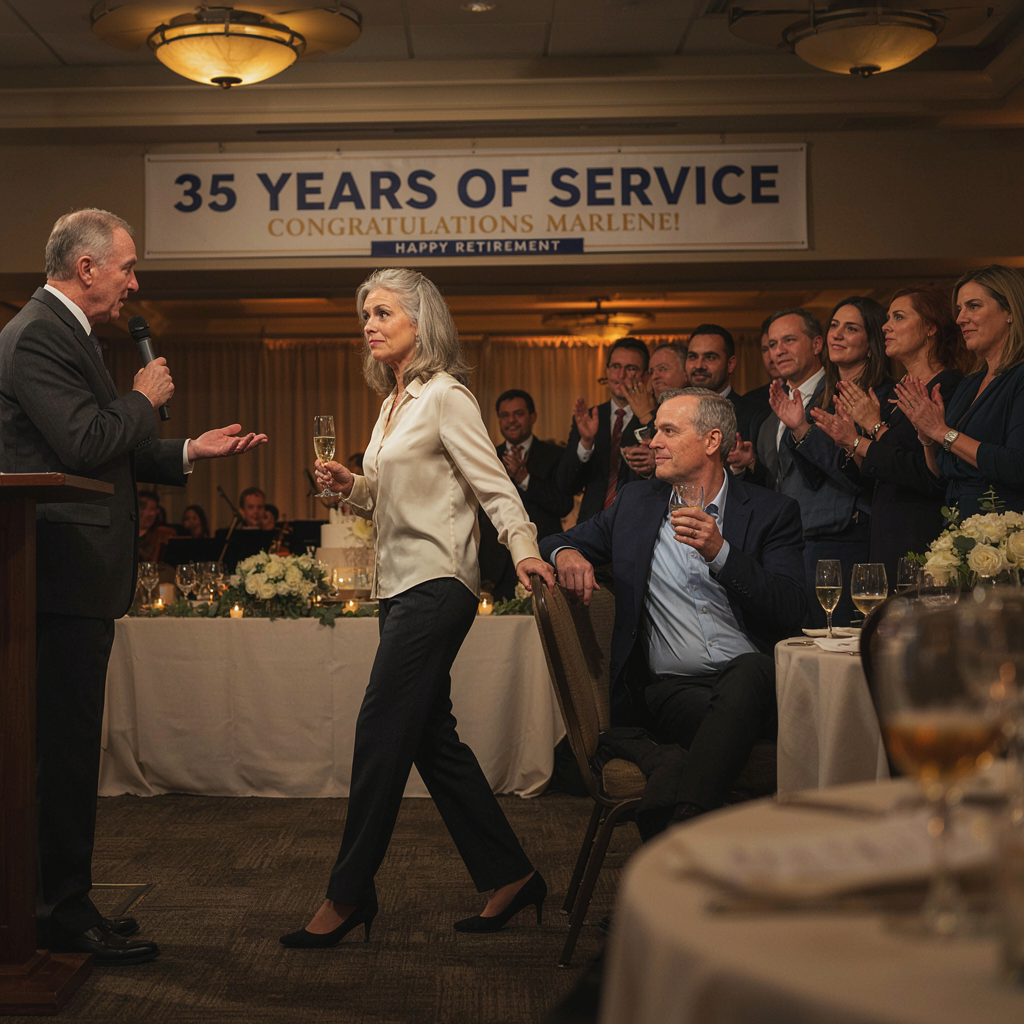
That evening, my coworkers had filled the company banquet room with flowers, balloons, photographs, and a ridiculous gold banner that read:
CONGRATULATIONS, MARLENE!
There were photographs of me at twenty-nine.
Me at forty.
Me standing beside a company truck during a snowstorm.
Me holding a cake at the twentieth anniversary celebration.
There were photographs I didn’t even remember anyone taking.
My coworkers gave speeches.
Some cried.
I cried more.
Then Mr. Whitaker stood at the front of the room and raised his glass.
“Thirty-five years,” he said. “That’s longer than some of our employees have been alive.”
Everyone laughed.
I smiled.
He continued.
“Marlene came here as a receptionist. But somewhere along the way, she became the person this company depended on.”
The room applauded.
I looked down at my hands because I couldn’t bear to let everyone see how much those words affected me.
For once, I felt seen.
Not as someone’s wife.
Not as someone’s mother.
Not as the woman who remembered everyone’s appointments.
Me.
Marlene.
The woman who had spent thirty-five years building something.
Then my husband stood up.
His name was Roy.
We had been married for thirty-eight years.
I looked at him, confused.
He tapped his glass with a spoon.
“Since everyone’s celebrating new beginnings…” he said with a smile, “I’m filing for divorce.”
The room went completely silent.
I honestly thought I’d misheard him.
Then he laughed.
Not nervously.
Not awkwardly.
He laughed like he’d just delivered the punchline to a joke.
A few people shifted uncomfortably.
Someone whispered my name.
Roy looked directly at me.
“Maybe Marlene can stop pretending her little office job made her important.”
My face burned.
For thirty-five years, I had learned how to remain calm when everything fell apart.
But suddenly, I couldn’t breathe.
I pushed my chair back.
I wanted to leave.
I wanted to disappear.
I wanted to become invisible.
I was halfway to the door when Mr. Whitaker grabbed the microphone.
“Actually,” he said quietly, “I was saving this announcement for last.”
Roy’s smile vanished.
Mr. Whitaker turned toward the room.
Then he looked directly at Roy.
“I think it’s time everyone knew exactly how important Marlene’s little office job has been.”
Nobody moved.
Mr. Whitaker held up a folder.
“Because for the past eighteen months, Marlene has been working with our board on something that will affect every person in this room.”
My heart began pounding.
I hadn’t expected this.
Not tonight.
Not after Roy’s humiliation.
Mr. Whitaker smiled.
“Marlene, would you please come back up here?”
I stood frozen near the door.
“Why?”
“Because,” he said, “you deserve to hear this announcement from me.”
Slowly, I returned to the front.
Mr. Whitaker handed me the microphone.
Then he said four words that changed everything.
“We want you as CEO.”
The room exploded.
Applause.
Cheers.
People stood.
Someone whistled.
I stared at Mr. Whitaker.
“I don’t understand.”
He laughed.
“You will.”
He opened the folder.
“Three years ago, when my father retired, he asked me to review the company’s long-term leadership structure. Your name was on the list.”
I shook my head.
“I was never interested in being CEO.”
“That’s why we trusted you.”
He explained that the board had been watching me for years.
Not because I demanded attention.
Because I solved problems.
During a major supplier crisis, I had saved the company almost a million dollars.
During a restructuring, I had prevented dozens of employees from losing their jobs.
When Daniel Whitaker became president, I had quietly trained him on systems that no executive had understood.
And when the company faced an internal compliance problem eighteen months earlier, I had discovered something even more important.
Someone had been stealing from the company.
Millions.
The investigation had started because of a discrepancy I noticed in a spreadsheet.
I had reported it.
I had worked with auditors.
I had helped uncover the scheme.
And the person responsible had been a senior executive.
The board had been so impressed by my judgment that they had spent the past year preparing me for a leadership role.
Mr. Whitaker looked at the crowd.
“Starting next month, Marlene will become the company’s Chief Executive Officer.”
The applause returned.
I couldn’t speak.
Then I heard a chair scrape behind me.
Roy.
He had gone pale.
But I wasn’t looking at him.
For the first time in my life, I was looking at myself.
And I realized something.
I didn’t need to be important because someone said I was.
I had been important all along.
Roy simply hadn’t noticed.
The party continued, but everything had changed.
People came to hug me.
My coworkers cried.
Some apologized for not knowing.
Others told me stories about moments when I’d helped them.
One young employee named Emily approached me.
“You don’t know this,” she said, “but when I first started here, I was thinking about quitting.”
“Why?”
“My husband had just left. I was pregnant. I thought I couldn’t handle work and everything else.”
I remembered her.
I remembered telling her to take things one day at a time.
“I told you to stay,” I said.
Emily laughed through her tears.
“You told me I was stronger than I thought.”
She squeezed my hand.
“I never forgot that.”
Roy stood near the exit.
He looked uncomfortable.
Eventually, he approached me.
“Can we talk?”
I stared at him.
“Not here.”
“Then somewhere private.”
I nodded.
We walked into the hallway.
He closed the door.
For a moment, neither of us spoke.
Then he sighed.
“Marlene, I didn’t know about the CEO thing.”
“No.”
“I thought tonight was going to be simple.”
“Your plan was simple?”
He looked away.
“I wanted to end things.”
“You could have told me at home.”
“I wanted you to understand how I felt.”
I almost laughed.
“You wanted to humiliate me in front of my coworkers because you were unhappy?”
His jaw tightened.
“You’re never home.”
“I worked.”
“You lived for that company.”
“I worked because we needed money.”
“We don’t need money anymore.”
I stared at him.
That sentence told me everything.
He had been waiting for retirement.
He wanted a different life.
And apparently, I wasn’t part of it.
“Is there someone else?” I asked.
He didn’t answer.
I didn’t need him to.
“Who?”
He sighed.
“Linda.”
My stomach dropped.
Linda.
His golf partner’s wife?
“No.”
“Yes.”
“How long?”
“About a year.”
A year.
While I had been working late.
While I had been planning my retirement.
While I had been helping him choose a new car.
While I had been believing we were simply getting older together.
He had been building another life.
I closed my eyes.
“Does she know you’re married?”
“Yes.”
“Does she know you announced our divorce tonight?”
He hesitated.
“She knew I was going to.”
I nodded slowly.
That hurt more than I expected.
Not because I loved him anymore.
But because thirty-eight years deserved better than a microphone and a champagne glass.
“You’ve already made your decision,” I said.
“Yes.”
“So have I.”
He looked surprised.
“What does that mean?”
“It means I’m not going home with you tonight.”
I stayed at my daughter’s house.
Her name was Rachel.
When she opened the door and saw my face, she didn’t ask questions.
She simply hugged me.
I cried in her arms.
Not because I wanted Roy back.
Because I was mourning the woman I had been.
The woman who had believed marriage meant growing old beside the same person.
The woman who had spent years making excuses.
The woman who thought sacrifice was the same thing as love.
Rachel made tea.
We sat at the kitchen table until three in the morning.
Finally she asked, “Mom, what are you going to do?”
I looked at her.
“I don’t know.”
She smiled.
“Good.”
“Good?”
“Yes. For once, you get to decide.”
Those words stayed with me.
For once, I get to decide.
The next morning, I received an email from Mr. Whitaker.
He had attached the official offer.
CEO.
Full executive authority.
A salary nearly four times what I had been making.
A company vehicle.
Retirement benefits.
And something that mattered even more.
A seat on the board.
I stared at the screen.
Then I laughed.
At sixty-four, after being told my career was a “little office job,” I had just been offered the highest position in the company.
I accepted.
Not to punish Roy.
Not to prove anything.
Because I wanted it.
That was the part I found most surprising.
I wanted something for myself.
The divorce proceedings were surprisingly quick.
Roy wanted the house.
I didn’t fight him.
He wanted the furniture.
He could have it.
He wanted the lake cabin.
I gave it to him.
My lawyer looked at me strangely.
“You realize you’re giving up quite a lot?”
“I know.”
“What do you want?”
I thought about it.
“The retirement account in my name. My car. My personal savings. And the company stock I’ve earned.”
“That’s reasonable.”
“And I want the photographs.”
My lawyer smiled.
“The family photographs?”
“Yes.”
Roy could keep the furniture.
The house.
The cabin.
The expensive television.
The fancy grill.
But he wasn’t getting thirty-eight years of my memories.
Those belonged to me.
Three months later, the divorce was final.
Roy married Linda less than a year afterward.
I heard they moved to Florida.
I didn’t attend the wedding.
I didn’t send a gift.
I didn’t send a message.
I simply continued living.
And something extraordinary happened.
I became happy.
Not constantly.
Not magically.
But genuinely.
My first day as CEO was strange.
I walked through the lobby and the receptionist stood up.
“Good morning, Ms. Bennett.”
I smiled.
“Good morning.”
She looked nervous.
I recognized that look.
I had worn it myself thirty-five years earlier.
So I stopped.
“What’s your name?”
“Jessica.”
“How long have you been here?”
“Three months.”
“Do you like it?”
She blinked.
“Yes.”
“Good. Keep learning.”
Then I walked upstairs.
My office was enormous.
Too enormous.
I didn’t like it.
So I moved my desk closer to the window.
I put a photograph of my parents on the shelf.
Another of Rachel.
Another of the old reception desk where I had started.
And one photograph from the retirement party.
The one where I was laughing.
Before Roy stood up.
Before the announcement.
Before everything changed.
I kept it because I realized something.
That photograph wasn’t ruined by what happened afterward.
It was proof that joy had existed before the betrayal.
And joy would exist afterward.
Six months into my new position, I received an unexpected letter.
It was from Roy.
I almost threw it away.
Instead, I opened it.
He wrote that Florida hadn’t been what he expected.
Linda had left him.
The marriage had lasted eleven months.
She had apparently been more interested in his money than in him.
He wrote that he had made a terrible mistake.
He said he missed me.
He said he wanted to talk.
At the bottom, he wrote:
I didn’t understand what I had until it was gone.
I sat there for a long time.
Then I wrote one sentence back.
That was your mistake, Roy—not mine.
I never sent it.
Instead, I tore the letter in half.
Then I went back to work.
A year after my retirement party, the company held another celebration.
This time, it wasn’t for me.
It was for the employees.
We had record profits.
Employee turnover was down.
Several young managers had been promoted.
The company had opened a scholarship program for employees’ children.
And I had started something else.
A mentorship program for women over fifty who believed their careers were already over.
At the first meeting, twenty-seven women showed up.
Some were nervous.
Some were angry.
Some had been told they were too old to change.
I stood in front of them.
“I’m sixty-five,” I said.
They laughed.
“So I know something about being told that.”
Then I told them about the retirement party.
About Roy.
About the microphone.
About the silence.
I didn’t tell them every detail.
I didn’t need to.
The lesson wasn’t about revenge.
It wasn’t about becoming CEO.
It wasn’t even about divorce.
It was about the danger of letting someone else’s opinion become your identity.
“Never let someone convince you that your value depends on whether they appreciate you,” I told them.
“Sometimes people don’t recognize your worth because they’re too busy benefiting from it.”
The room became quiet.
Then one woman raised her hand.
“What happened to your husband?”
I smiled.
“He became part of my past.”
“And are you happy?”
I looked around the room.
At the women listening.
At the life I had built.
At the future waiting outside.
“Yes,” I said.
“For the first time, I know exactly who I’m happy with.”
“Who?”
I smiled.
“Me.”
Two years later, I was standing on the same stage where Roy had announced our divorce.
Mr. Whitaker was beside me.
The company had just completed its biggest expansion in history.
He handed me the microphone.
“I have one more announcement,” he said.
Everyone laughed.
I took the microphone.
“Don’t worry,” I said. “Nobody’s getting divorced tonight.”
The room erupted.
I smiled.
Then I looked toward the back.
For a moment, I imagined the woman I had been that night.
Sixty-four.
Embarrassed.
Heartbroken.
Ready to disappear.
I wished I could go back and whisper something into her ear.
You’re going to be okay.
More than okay.
You’re going to discover that the life you thought had ended was actually the beginning of something better.
I looked around the room.
“I used to think retirement meant life was slowing down,” I said.
“But I’ve learned that sometimes retirement is simply the moment you finally stop living for everyone else.”
The applause began.
I continued.
“I spent thirty-five years helping people solve their problems. And I don’t regret a single day.”
I paused.
“But I wish I’d learned sooner that I deserved to solve one problem for myself.”
I smiled.
“How to live my own life.”
The room stood.
Everyone applauded.
And this time, when I looked toward the microphone, I wasn’t afraid of what someone might say.
Because I finally understood.
A person can announce your ending.
They can embarrass you.
They can leave you.
They can tell you that everything you’ve accomplished doesn’t matter.
But they cannot decide what happens next.
That part belongs to you.
And when the applause finally faded, I set down the microphone.
I didn’t walk away from the stage.
I walked toward the future.
And for the first time in thirty-eight years, I wasn’t walking beside anyone.
I was walking entirely on my own.
And I had never felt less alone.