The Fortune They Thought I Had Lost
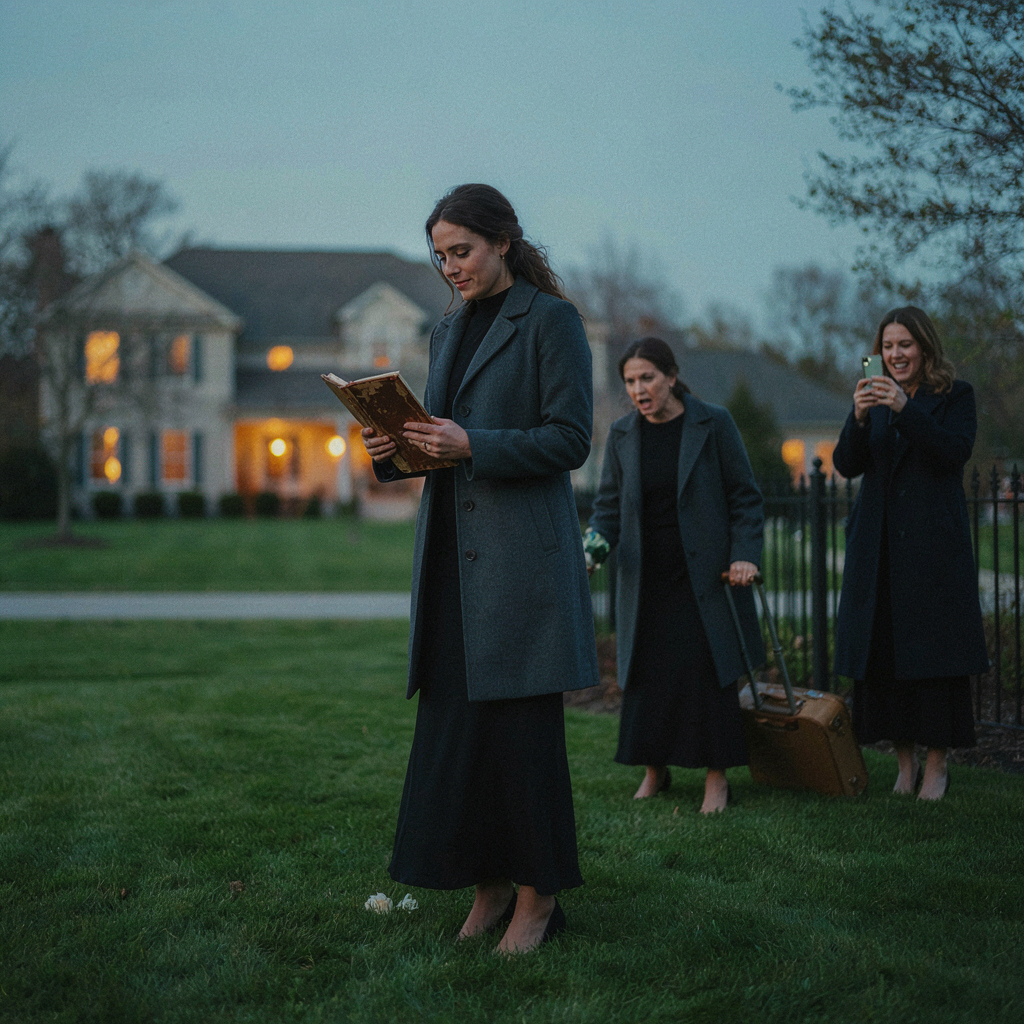
The morning after my husband’s funeral, my mother-in-law dragged my suitcase across the lawn and threw it beside the driveway.The suitcase landed in the mud with a heavy thud.
I stared at it.Then I looked at her.Evelyn Hart stood on the front steps of the house where I had lived with her son for eleven years.
She was dressed in black, but there was nothing mournful about her expression.
Her lips were pressed into a thin, satisfied smile.
Behind her stood my sister-in-law, Melissa, holding up her phone.Recording.Of course she was recording.Evelyn folded her arms.”Now that Terence is gone,” she said coldly, “you get nothing.”
My throat tightened.Melissa laughed.”Make sure you get her face,” she said. “This is going to be priceless.”
I looked down at the suitcase.
Inside were a few dresses, toiletries, two pairs of shoes, and the clothes I had worn during the last week of Terence’s illness.
My entire life reduced to one muddy suitcase.I slowly bent down and picked it up.My wedding ring was still on my finger.My wedding album was half buried in the mud.
I reached down and rescued it.The leather cover was stained brown.I wiped it with my sleeve.
Evelyn watched me.”You should be grateful we’re letting you leave with that,” she said.
I looked at her.Then at Melissa.Then at the enormous house behind them.
For eleven years, they had made sure I understood one thing.I was never truly family.I was Terence’s wife.Nothing more.And now Terence was dead.So, according to them, I was nothing at all.
I swallowed the ache in my throat.Then I quietly said,”You’re right.”Evelyn raised an eyebrow.”I have nothing.”
Melissa grinned at the camera.”Did you hear that?”I turned away.
Neither of them saw the envelope hidden inside my coat.
Neither knew about the private meeting I had held with Terence’s attorney two weeks before his death.
Neither knew about the inheritance.
Five hundred million dollars.
And I intended to keep it that way.
Because I had made Terence a promise.
And because, in the end, I wanted to know exactly who loved me…
and who only loved what they thought I could give them.
Six months earlier, my life had been ordinary.
At least, that’s what everyone believed.
Terence and I lived quietly.
We weren’t flashy.
We didn’t drive around in exotic cars.
We didn’t wear designer clothes.
We didn’t host extravagant parties.
Terence had always been private about money.
Very private.
When we married, I knew he had built a successful technology company.
I knew he had investments.
I knew his business was worth far more than most people could imagine.
But I didn’t know how much.
Terence never talked about his net worth.
He once told me, “Money is useful, Claire. But it’s dangerous when people know exactly how much you have.”
I laughed.
“Are you saying you’re secretly a billionaire?”
He smiled.
“No.”
“Millionaire?”
“Maybe.”
“That’s suspicious.”
He kissed my forehead.
“I’d rather you love me for who I am.”
“I already do.”
“I know.”
That conversation came back to me constantly after he died.
Because two weeks before his death, Terence had finally told me the truth.
We were sitting in our bedroom.
He looked tired.
Not sick.
Just tired.
He handed me a folder.
“Claire, there’s something you need to know.”
I opened it.
Inside were documents.
Investment accounts.
Company shares.
Trust agreements.
International holdings.
My eyes widened.
“Terence…”
“I know.”
“How much?”
He didn’t answer immediately.
Instead, he looked at me.
“About five hundred million, depending on valuations.”
I stared at him.
Five hundred million dollars.
It was so enormous that my brain refused to process it.
“Why didn’t you tell me?”
“Because I wanted one person in my life who didn’t look at me like a walking bank account.”
My heart broke.
“Did you think I did?”
“No.”
He reached for my hand.
“Never you.”
Then he squeezed my fingers.
“But my family…”
He didn’t finish.
He didn’t need to.
I knew.
His mother had always been obsessed with money.
His younger sister Melissa had borrowed money from Terence repeatedly.
And his older brother Howard had spent years treating Terence like an ATM.
They all believed Terence owed them something.
Because he was successful.
Because he had more.
Because they were family.
Terence had tried to set boundaries.
They never respected them.
“If something happens to me,” he said, “I need you to do something.”
“What?”
“Don’t tell them about the inheritance.”
I frowned.
“Why?”
“Because I want you to see who they really are.”
I stared at him.
He looked almost ashamed.
“That’s cruel.”
“Maybe.”
“Terence…”
“I need to know, Claire.”
I squeezed his hand.
“What are you expecting?”
He looked down.
“My mother will probably tell you the house belongs to her.”
“Does it?”
“No.”
“Then what?”
“She’ll tell you everything belongs to Howard.”
“Does it?”
“No.”
“Then what are you worried about?”
Terence looked at me.
“I’m worried they won’t see you as my wife anymore.”
He paused.
“They’ll see you as an obstacle.”
Those were some of the last serious words we ever shared.
Three days later, Terence collapsed.
Six days after that, he died.
And everything changed.
The funeral was beautiful.
Hundreds of people attended.
Business partners.
Employees.
Friends.
Neighbors.
People who had known Terence before the money.
People who had known him because of the money.
I stood beside his coffin and accepted condolences until my face hurt from pretending to be strong.
Howard barely looked at me.
Melissa cried loudly whenever anyone important walked past.
Evelyn spent most of the afternoon telling people how devastated she was.
But I noticed something.
They weren’t grieving the same way I was.
I had lost my husband.
They had lost access to him.
The difference became obvious the next morning.
Evelyn appeared at the house at eight.
Howard arrived ten minutes later.
Melissa came behind him.
No flowers.
No food.
No condolences.
Just paperwork.
Howard walked into the kitchen and dropped a folder onto the counter.
“We need to discuss the estate.”
I stared at him.
“It’s been less than twenty-four hours.”
“Exactly,” he said.
Evelyn walked in behind him.
“Claire, you need to understand that Terence always intended to provide for his family.”
“I was his family.”
She laughed.
“You were his wife.”
The distinction was deliberate.
Howard opened the folder.
“The house belongs to the family trust.”
I knew that was a lie.
Terence had told me otherwise.
But I said nothing.
“The accounts are being reviewed,” Howard continued. “Until everything is settled, you should leave.”
“Leave?”
“Yes.”
Evelyn stepped closer.
“This was never your house.”
I looked around.
Our photographs were still on the walls.
Our wedding picture stood above the fireplace.
Terence’s favorite chair was beside the window.
Our life was everywhere.
But they wanted me gone.
“Where am I supposed to go?”
Evelyn shrugged.
“That’s your problem.”
Then she dragged my suitcase outside.
The humiliation happened exactly as I described.
And after I walked away, I sat in a small hotel room for three hours.
I cried.
Not because of the money.
Not because of the house.
Because I had loved these people.
Or at least, I had tried to.
I had spent Thanksgiving dinners listening to Evelyn complain about me.
I had bought Melissa gifts.
I had helped Howard when his business failed.
I had visited Evelyn in the hospital.
I had treated them like family.
And the morning after Terence died, they put my suitcase in the mud.
That was the moment I understood Terence’s warning.
They hadn’t lost a son, brother, or relative.
They had lost their source of money.
Two days later, Terence’s attorney, Samuel Reed, called me.
“Claire, we need to meet.”
“I know.”
“Are you somewhere private?”
“Yes.”
“Good.”
I met him in his office.
Samuel had represented Terence for almost twenty years.
He placed a thick binder in front of me.
“The estate is yours.”
I stared at him.
“All of it?”
“Nearly all.”
“What about his family?”
“They receive what he specifically left them.”
“How much?”
Samuel gave me a list.
Evelyn received a trust worth five million dollars.
Howard received two million.
Melissa received one million.
Several charities received significant donations.
And I received everything else.
The number at the bottom was almost impossible to comprehend.
$500,000,000.
I closed my eyes.
Samuel watched me.
“There’s one condition.”
“What?”
“Terence wanted you to wait.”
“Wait for what?”
“He instructed me not to publicly disclose the full value of the estate for six months.”
I opened my eyes.
“Why six months?”
Samuel gave me a sad smile.
“Because he wanted you to have time to learn who was grieving for him… and who was grieving for his money.”
I started crying.
“That sounds like him.”
Samuel nodded.
“He loved you very much.”
I wiped my eyes.
“Did he know they would throw me out?”
“I believe he suspected it.”
“Did he know they would lie?”
“He prepared for that too.”
Samuel slid another document across the desk.
“Your husband transferred ownership of the house to you three years ago.”
I stared at the paper.
“And the family trust?”
“Controlled by you.”
I almost laughed.
“They think the house belongs to them.”
“It doesn’t.”
“Can they challenge it?”
“They can try.”
“Will they?”
Samuel smiled faintly.
“Probably.”
I looked at the documents.
Then I thought about Evelyn’s face.
Melissa’s phone.
The muddy wedding album.
I made my decision.
“Don’t tell them.”
Samuel nodded.
“About the money?”
“About any of it.”
The next six months were the strangest period of my life.
At first, I was lonely.
Then I became observant.
Evelyn called twice a week.
Not to ask how I was.
To ask when the estate would be settled.
“Claire, surely you understand that Terence wanted his mother taken care of.”
“I do.”
“I haven’t received anything.”
“I’ll speak with the attorney.”
She sighed dramatically.
“You’re becoming very difficult.”
I said nothing.
Howard called next.
“Claire, we need to talk about the company.”
“What about it?”
“Terence promised me a position.”
“He didn’t mention that.”
“Well, he did.”
“Then perhaps you should speak with his attorney.”
He hung up.
Melissa was different.
She texted constantly.
At first, she apologized.
“I’m sorry about what happened that day.”
Then:
“I was grieving.”
Then:
“I hope you understand.”
Then:
“Can you help me with something?”
She needed $80,000 for a business.
I didn’t respond.
A week later:
“Terence would have helped me.”
I replied with one sentence.
“I know.”
She never answered.
I began receiving invitations to family events.
I declined all of them.
Meanwhile, I quietly rebuilt my life.
I bought a small apartment.
I hired a grief counselor.
I started volunteering at a children’s hospital because Terence had always loved children.
And I learned something important.
Money didn’t make grief easier.
But it did give me the freedom to discover who I was without them.
Then came the charity gala.
The Hart Foundation hosted it every year.
It was their biggest event.
Three hundred guests.
Politicians.
Celebrities.
Executives.
Journalists.
The ballroom glittered beneath enormous crystal chandeliers.
Howard was hosting.
Evelyn sat at the head table.
Melissa had somehow become the event’s social media director.
The family had spent weeks preparing.
They wanted everyone to believe the Hart family remained powerful.
They had no idea I was coming.
At exactly eight o’clock, the ballroom doors opened.
I walked in wearing a simple black gown.
No diamonds.
No entourage.
Just me.
The room went quiet.
I could feel dozens of eyes turning toward me.
Howard froze.
Evelyn’s smile disappeared.
Melissa lowered her phone.
Someone whispered,
“Isn’t that Terence’s widow?”
I walked forward.
Slowly.
Calmly.
Howard stepped away from the stage.
“Claire.”
“Howard.”
He looked nervous.
“You weren’t invited.”
“I know.”
Evelyn approached.
“What are you doing here?”
I smiled.
“I received an invitation.”
“From whom?”
I held up the card.
“Your foundation.”
Her face tightened.
“This is a private event.”
I glanced around the ballroom.
“Then why did you invite me?”
She didn’t answer.
Howard stepped between us.
“Claire, this isn’t the place.”
I looked at him.
“You’re right.”
Then I took one more step.
“I came here because there is something you need to understand.”
The room had gone completely silent.
Howard swallowed.
“You don’t belong here.”
I smiled.
“That’s interesting.”
“Claire…”
I turned toward the microphone.
Howard tried to stop me.
But Samuel Reed appeared beside the stage.
He nodded.
Howard’s face went pale.
Because he knew Samuel.
Everyone in the room knew who he was.
The attorney who had handled Terence’s estate.
I took the microphone.
Then I looked directly at Howard.
And said the sentence that changed everything.
“Terence left me five hundred million dollars—and this entire foundation.”
Silence.
Absolute silence.
Someone dropped a glass.
It shattered against the marble floor.
Evelyn’s face went white.
Melissa’s phone slipped from her hand.
Howard stared at me as though I had become a stranger.
But I wasn’t finished.
I turned toward the guests.
“The house you threw me out of belongs to me.”
A murmur spread through the ballroom.
“The company shares you thought would disappear are mine.”
Another gasp.
“And every dollar you spent telling people I was penniless came from a story you invented.”
Howard shook his head.
“No.”
Samuel stepped forward.
“The documents are legally binding.”
Evelyn grabbed my arm.
“You can’t do this.”
I gently removed her hand.
“I didn’t do anything to you.”
I looked at her.
“You did this to yourselves.”
Melissa suddenly started crying.
“Claire, I’m sorry.”
I looked at her.
“You were sorry six months ago.”
“I was grieving.”
“So was I.”
She lowered her head.
“But you were holding a camera.”
She froze.
I continued.
“You recorded me while my suitcase sat in the mud.”
“I didn’t mean—”
“You did.”
Then I looked at Howard.
“And you lied about the house.”
He couldn’t speak.
Evelyn finally whispered,
“Why didn’t you tell us?”
I smiled sadly.
“Because Terence asked me not to.”
She looked stunned.
“He knew?”
“Yes.”
“About what?”
“About all of it.”
I let that sentence sit.
Then I said,
“He knew exactly how you would behave.”
Evelyn’s knees nearly buckled.
The following morning, every major newspaper carried the story.
Not because I wanted publicity.
Because Melissa’s recording from six months earlier had resurfaced.
Someone had posted it online.
Millions of people watched Evelyn throw my suitcase onto the lawn.
Millions heard her say,
“Now that Terence is gone, you get nothing.”
Then they saw the gala.
They saw the revelation.
The public reaction was immediate.
People condemned the family.
Howard resigned from several boards.
Melissa’s social media accounts exploded.
Evelyn stopped appearing in public.
But I didn’t celebrate.
Because revenge had never been the point.
Justice was.
There was one final thing I needed to do.
I returned to the house.
The same house where my suitcase had landed in the mud.
I walked into the living room.
Terence’s chair was still there.
His books were still on the shelves.
Our wedding photograph still hung above the fireplace.
I sat down.
For the first time in six months, I allowed myself to cry.
Samuel stood quietly near the door.
“You okay?”
I nodded.
“I think so.”
He handed me an envelope.
“Terence left this for you.”
My hands trembled.
Inside was a handwritten letter.
I unfolded it.
My dear Claire,
If you’re reading this, I’m gone.
I’m sorry.
I know you may hate me for leaving you with this mess.
But I need you to remember something.
You are not what people think you are.
You are not my money.
You are not my wife.
You are not my widow.
You are Claire.
The woman who laughed at my terrible cooking.
The woman who stayed beside me when I was sick.
The woman who never asked how much I had.
The woman I loved.
If my family treats you badly, don’t waste your life trying to make them understand your worth.
Walk away.
And if they ever discover what you have…
watch what they do.
Then you’ll know whether they loved you.
I folded the letter against my heart.
Samuel quietly left the room.
I looked around the house.
“I miss you,” I whispered.
Then I smiled through my tears.
“You were right.”
A year after Terence’s death, I transformed the Hart Foundation.
I changed its mission.
Instead of hosting glamorous galas, we funded scholarships.
We built clinics.
We supported families facing medical debt.
We helped widows who had been abandoned.
We funded programs for children who had lost parents.
And I created one program in Terence’s name.
The Terence Hart Legacy Scholarship.
The first recipient was a seventeen-year-old girl named Maya.
Her father had died unexpectedly.
Her mother worked two jobs.
Maya wanted to become a doctor.
At the scholarship ceremony, she hugged me.
“Thank you.”
I smiled.
“Don’t thank me.”
“Why?”
“Because one day, you’ll help someone else.”
She nodded.
“I promise.”
And I believed her.
Because that was what I had learned.
Money could buy houses.
It could buy companies.
It could buy hospitals.
But it couldn’t buy loyalty.
It couldn’t buy love.
It couldn’t buy character.
Those things had to exist before the money arrived.
Three years later, I received a letter from Evelyn.
It was only one page.
She asked to see me.
I almost threw it away.
Instead, I agreed.
We met at a quiet café.
She looked older.
Smaller.
She stared at her hands.
“I’m sorry.”
I said nothing.
“I’ve replayed that day hundreds of times.”
Still nothing.
“I thought you had nothing.”
I looked at her.
“And now?”
She smiled bitterly.
“Now I know you had everything.”
I shook my head.
“No.”
She looked confused.
“I had money.”
I touched the wedding ring still hanging from a chain around my neck.
“What I had was Terence.”
Her eyes filled with tears.
“I know.”
“I lost him.”
“I know.”
“And the money didn’t bring him back.”
She lowered her head.
“I was cruel.”
“Yes.”
“Can you forgive me?”
I took a long breath.
“Forgiveness isn’t the same as trust.”
She nodded.
“I understand.”
I stood.
“I hope you have a peaceful life, Evelyn.”
She looked up.
“Does that mean you forgive me?”
I smiled.
“It means I don’t want to carry what you did anymore.”
Then I walked away.
People often asked me why I had hidden five hundred million dollars.
They expected a complicated answer.
It wasn’t.
I wanted to know what remained when people believed there was nothing left to gain.
I learned more in those six months than I had learned in my entire life.
I learned that some people only respect wealth.
Some people only respect power.
Some people respect neither.
And some people will love you even when they believe you’re standing empty-handed in the mud.
Those are the people worth keeping.
I never married again.
I didn’t need to.
I built a life that belonged entirely to me.
I traveled.
I worked.
I helped people.
I laughed again.
And every Christmas, I visited Terence’s favorite cemetery.
I would sit beside his grave and tell him everything.
About the foundation.
About the scholarship students.
About the people we helped.
About the ridiculous things that happened.
Sometimes I’d laugh.
Sometimes I’d cry.
And sometimes I’d simply sit there in silence.
One December afternoon, I placed a small photograph beside his headstone.
It was from the first scholarship ceremony.
Maya stood in the center, wearing her graduation cap.
I smiled.
“You were right, Terence.”
The wind moved gently through the trees.
“I finally know who stayed.”
I looked down at my wedding ring.
Then at the photograph.
“I didn’t have nothing.”
I smiled.
“I had the truth.”
And somehow, that was worth more than five hundred million dollars.
Because the fortune had never been the greatest inheritance Terence left me.
The greatest inheritance was the lesson.
Never measure people’s love by what they say when you are wealthy.
Measure it by how they treat you when they think you have nothing.
That was the day I discovered who my family really was.
And the day I finally became free.