The homeless woman stood outside my office every morning at exactly 7:45.I knew because I started noticing her after my third week at the company.
She was always there before I arrived.Rain or shine.Hot or cold.
She stood beneath the narrow awning of the building across from ours, wrapped in a faded gray coat that looked several sizes too large.
Her silver hair was usually tied loosely behind her head, and she carried a battered canvas bag that seemed to contain everything she owned.
She never shouted.Never chased people.Never held a cardboard sign with a dramatic message.She simply stood there and asked.“Spare change, please?”
Most people walked past her as if she were invisible.Some pretended to check their phones.
Others crossed the street.A few laughed.
One morning, two junior executives from my office walked past her, joking loudly.
“Maybe she should try getting a job,” one said.The woman lowered her eyes.She didn’t respond.I remember feeling uncomfortable, but I did nothing.
At the time, I was too busy trying to build my own career.
I was thirty-four years old and had spent the previous eight years climbing the corporate ladder at Hargrove & Pierce, one of the biggest investment firms in the city.
I was a senior financial analyst.My office was on the twenty-second floor.My salary was good.My apartment was comfortable.My life looked successful from the outside.
And I had convinced myself that being successful meant keeping your problems separate from everyone else’s.
Then came the coldest winter our city had seen in years.
The temperature dropped below freezing for nearly a week.
The woman was still there.
Every morning.
But on that particular Thursday, something was different.
She was shaking.
Not the ordinary shivering you might expect from someone standing in the cold.
Her entire body trembled violently.
Her lips had turned blue.
She tried asking a businessman for money, but the words barely came out.
“Please…”
The man ignored her.
I stopped walking.
I looked at her.
She looked at me.
For some reason, I couldn’t keep going.
I reached into my pockets.
Nothing.
No wallet.
I’d left it in my desk drawer upstairs.
I looked at my watch.
8:02.
I was already late for a meeting.
Then I looked at my coat.
It was an expensive wool coat my mother had given me when I got promoted.
I took it off.
“Here.”
The woman stared at it.
Then at me.
“You’ll freeze.”
“I’ll survive.”
I draped it around her shoulders.
For a moment, she simply stood there.
Then something changed in her eyes.
She looked directly into mine.
Not like a stranger.
Not like someone grateful to a passerby.
Like someone who had been waiting for me.
“You finally stopped,” she whispered.
I frowned.
“What?”
She smiled.
It was a strange smile.
Almost sad.
Almost relieved.
Then she reached into her canvas bag.
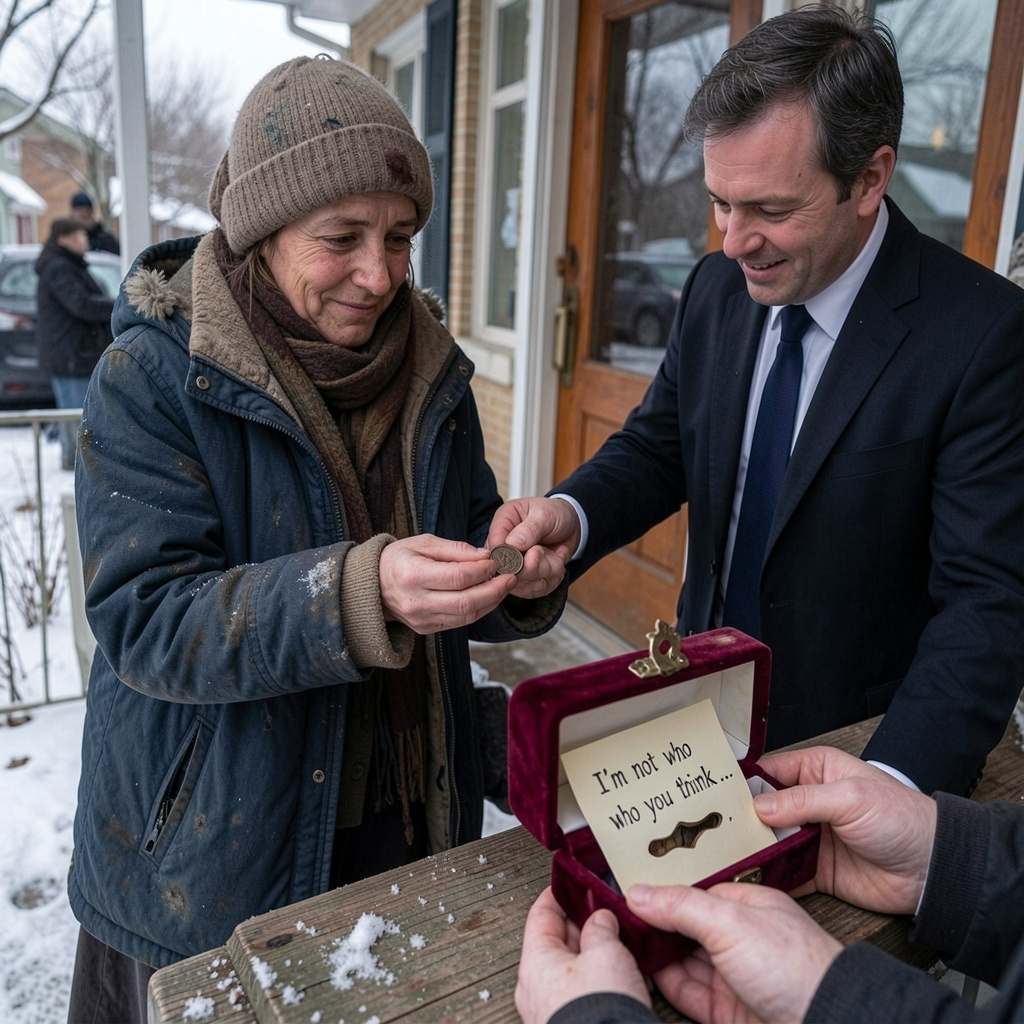
From somewhere beneath a folded blanket, she pulled out a small rusty coin.
She pressed it into my palm.
“Keep this.”
I looked down.
It was old.
Very old.
Darkened with age.
There was a strange symbol carved into one side—a circle surrounding what looked like a key.
“What is it?”
“You’ll know when it’s time to use it.”
I laughed nervously.
“I don’t think I need—”
“Keep it.”
Her voice was suddenly firm.
I slipped it into my pocket.
Then I ran into my building.
I didn’t know that the simple act of giving away my coat would destroy everything I had built.
My boss, Richard Vale, was waiting for me outside the conference room.
Richard was the kind of man who could make a room go silent simply by walking into it.
He was forty-nine, perfectly dressed, perfectly groomed, and completely obsessed with appearances.
He glanced at my shirt.
Then at the coat I wasn’t wearing.
Then through the glass doors toward the street.
His face changed.
“What did you do?”
I blinked.
“Excuse me?”
He pointed outside.
“You gave your coat to that woman.”
“Yes.”
“In front of our clients.”
“I don’t see the problem.”
“You don’t see the problem?”
His voice rose.
Several people turned.
“She is a homeless woman standing outside this building. You work for Hargrove & Pierce. Do you understand what you made us look like?”
“I made us look like human beings.”
Silence.
Richard stared at me.
That sentence was the beginning of the end.
He called me into his office.
Thirty minutes later, I was fired.
No warning.
No performance review.
No severance negotiation.
He said I’d demonstrated “poor judgment inconsistent with the firm’s professional standards.”
I walked out carrying a cardboard box containing eight years of my life.
The woman was gone.
I searched for her.
Nothing.
For the next two weeks, I couldn’t find another job.
Every interview seemed to collapse for some mysterious reason.
One company called me after a final interview and said they’d decided to “go in another direction.”
Another canceled my interview altogether.
A recruiter who had initially been enthusiastic stopped answering my calls.
Then, one night, I came home and froze.
A small velvet box sat on my porch.
There was no return address.
No note.
No name.
Just a strange slot carved into the side.
I picked it up.
It was heavier than it looked.
Then I remembered the coin.
My heart began pounding.
I pulled it from my pocket.
It fit the slot perfectly.
Click.
The box opened.
Inside was a folded sheet of paper.
My hands shook as I unfolded it.
Six words were written at the top.
I’m not who you think I am.
I read the sentence again.
Then again.
Below it was another line.
And neither is your former boss.
I stopped breathing.
The letter continued.
My name is Evelyn Hart.
Thirty-two years ago, I founded Hargrove & Pierce with my husband, Jonathan.
Richard Vale was not our partner.
He was our attorney.
I stared at the page.
That couldn’t be true.
Everyone at the firm knew Richard had been one of the original founders.
He had told the story dozens of times.
He’d built the company.
He’d sacrificed everything.
But the letter continued.
Jonathan died twenty-one years ago.
I was forced out of the company shortly afterward.
Richard told everyone I had stolen money from the firm.
He fabricated documents.
He transferred ownership.
And when I tried to expose him, he threatened my children.
I sat down on the porch.
My hands had gone cold.
The woman outside my office.
The woman in the gray coat.
Evelyn Hart.
The woman whose name was engraved on the original bronze plaque inside Hargrove & Pierce.
I kept reading.
I spent years trying to get evidence.
Richard destroyed most of it.
But he made one mistake.
He forgot about the vault.
There was a photograph tucked behind the letter.
It showed the lobby of Hargrove & Pierce thirty years earlier.
Standing in the center were three people.
Jonathan Hart.
A younger Evelyn.
And a young Richard Vale.
On the back of the photograph was an address.
My stomach tightened.
It was the address of an abandoned warehouse on the edge of the city.
At the bottom, Evelyn had written:
Go alone.
I didn’t sleep that night.
The next morning, I drove there.
The warehouse looked abandoned.
The front doors were chained shut.
But around the back, I found a small metal door.
The rusty coin fit another lock.
Click.
The door opened.
Inside was a narrow staircase.
I followed it underground.
At the bottom was a room filled with boxes.
Documents.
Bank records.
Contracts.
Photographs.
And one enormous steel cabinet.
Evelyn was sitting in a chair beside it.
She looked completely different.
The gray coat was gone.
Her hair was neatly tied back.
She wore a dark blue suit.
She looked like a wealthy executive.
“Hello,” she said.
I stared at her.
“You’re Evelyn Hart.”
“Yes.”
“You founded the company.”
“Yes.”
“Why were you begging for change?”
She looked away.
“Because Richard destroyed my reputation. My accounts. My legal identity. Everything.”
“But you’re alive.”
“Alive doesn’t mean free.”
She pointed toward the boxes.
“I needed someone inside the company who Richard didn’t suspect.”
I understood.
“Me.”
She nodded.
“You were the only person who ever stopped.”
I remembered the mornings.
The people who ignored her.
The executives who laughed.
“You deliberately stayed outside my building.”
“I knew eventually someone would help me.”
“Why me?”
“Because I watched you.”
That frightened me.
“For how long?”
“Three years.”
I stood up.
“You watched me for three years?”
“I watched everyone.”
She reached into a box and pulled out a folder.
Inside were performance reports.
Mine.
Emails.
Financial reviews.
Notes about employees.
Richard had been monitoring everyone.
But there was more.
She showed me documents proving that Richard had been secretly moving company assets into shell corporations.
Millions of dollars.
Over decades.
“He wasn’t just stealing from you,” I whispered.
“No.”
She looked at me.
“He’s been stealing from the company.”
“How much?”
She handed me a report.
I stared at the number.
$86 million.
My knees nearly gave out.
“Why haven’t you gone to the police?”
“Because Richard owns half the lawyers in this city.”
Then she pointed to the steel cabinet.
“And because this is what I was missing.”
She inserted the rusty coin into a tiny circular slot.
The cabinet opened.
Inside was a single black box.
Evelyn lifted it carefully.
“My husband recorded Richard.”
She pressed a button.
A voice filled the room.
Richard.
Young, confident, arrogant.
“I’ll handle the ownership transfer.”
Another voice replied.
Jonathan.
“You’re my attorney, Richard. Not my partner.”
Richard laughed.
“You won’t be around long enough to worry about it.”
The recording ended.
I looked at Evelyn.
“Did he kill your husband?”
“I don’t know.”
Her eyes filled with tears.
“But I know he wanted him gone.”
That was when I realized something.
Richard hadn’t fired me because I’d embarrassed the company.
He had fired me because I had been kind to the one person he feared.
He must have recognized Evelyn.
Or perhaps he’d recognized the coin.
Maybe he’d known exactly what she was doing.
We spent the next three days preparing.
Evelyn contacted a federal investigator she trusted.
I copied every document.
Bank statements.
Contracts.
Audio recordings.
Transfer records.
Everything.
But Richard discovered us before we were ready.
I received a message at 11:47 p.m.
Unknown number.
You should have stayed unemployed.
Then another.
People who dig into the past usually regret it.
I showed Evelyn.
She looked at the screen.
“It’s time.”
The next morning, we walked into Hargrove & Pierce.
Together.
Richard was standing in the lobby.
He froze when he saw her.
For the first time in my life, I saw fear on his face.
“Evelyn.”
She smiled.
“Hello, Richard.”
Nobody moved.
Employees stared.
Clients stared.
The receptionist dropped her pen.
Richard recovered quickly.
“You need to leave.”
Evelyn stepped forward.
“No.”
He lowered his voice.
“You have no legal right to be here.”
“I founded this company.”
“You were removed twenty-one years ago.”
“By you.”
His face tightened.
Then he looked at me.
“You.”
I said nothing.
“You have no idea what you’ve involved yourself in.”
“I know enough.”
He laughed.
“You’re a fired employee.”
“No,” Evelyn said.
Richard turned toward her.
“She means nothing to you.”
Evelyn smiled.
“She means everything to me.”
Richard frowned.
I didn’t understand.
Evelyn looked at me.
Then she said something that changed everything.
“You’re Jonathan Hart’s daughter.”
The lobby disappeared around me.
“What?”
She nodded.
“Your mother wasn’t your biological mother.”
I couldn’t speak.
“My father?”
“Jonathan.”
I stared at her.
“No.”
She handed me a document.
My birth certificate.
My original one.
The father listed was Jonathan Hart.
The mother was Evelyn Hart.
I looked up.
“You’re my mother?”
Her eyes filled with tears.
“Yes.”
I stepped backward.
All those years.
All those questions about why my childhood photographs seemed incomplete.
Why my mother had refused to talk about my birth.
Why I’d always felt that something about my family history was missing.
Richard had taken me away from her.
She explained everything.
After Jonathan died, Richard threatened Evelyn.
He told her that if she tried to fight him, he would make sure her daughter disappeared forever.
So Evelyn had hidden me.
She had arranged for me to be raised by another family.
She watched from a distance.
She knew where I lived.
She knew when I graduated.
She knew when I got hired.
She knew when I was promoted.
But she never approached me.
Because Richard was watching.
Until I stopped to help a freezing woman on the sidewalk.
Richard’s obsession with appearances had finally exposed him.
He had fired me publicly.
That created the perfect reason for me to leave the company.
And the perfect opportunity for Evelyn to tell me the truth.
Richard suddenly laughed.
“You think a recording from thirty years ago is going to destroy me?”
A voice answered from behind him.
“It will.”
Two federal investigators entered the lobby.
Richard’s face went pale.
They showed him the warrant.
He looked at Evelyn.
Then at me.
“You don’t understand,” he whispered.
Evelyn stepped closer.
“No, Richard.”
Her voice was calm.
“For thirty years, you thought I was powerless.”
She held up the rusty coin.
“You forgot that I knew where you buried the key.”
Richard was arrested that morning.
The investigation lasted almost a year.
They uncovered dozens of shell companies.
Bribed officials.
Forged documents.
Hidden accounts.
And evidence connecting Richard to Jonathan’s mysterious death.
The company survived.
Barely.
But Evelyn regained control.
She sold part of her ownership and created a foundation for homeless families.
When reporters asked why she had spent years living on the street, she gave them a simple answer.
“I wanted to know what people did when they thought nobody important was watching.”
Months later, she invited me to her office.
The old office.
The one that had once belonged to my father.
On the wall was a photograph of Jonathan.
Beside it was another photograph.
Me as a child.
I stared at it.
“You had that?”
“For twenty-four years.”
“Why didn’t you come for me?”
She looked at the floor.
“Because I thought protecting you meant staying away.”
I took her hand.
“You were wrong.”
She nodded.
“I know.”
We sat together in silence.
Then she reached into her pocket and pulled out another rusty coin.
She placed it on the desk.
“I had two.”
I laughed.
“You’re kidding.”
“No.”
She pushed it toward me.
“Your father believed every locked door should have two keys.”
I looked at the coin.
“What does the second one open?”
She smiled.
“I don’t know.”
That night, I returned home.
For the first time in months, I wasn’t unemployed.
I wasn’t afraid.
I wasn’t wondering why my life had suddenly collapsed.
I understood.
Sometimes losing everything isn’t the end.
Sometimes it is the only way to discover what was built on top of the truth.
I placed the coin beside my bed.
Then I noticed something I’d never seen before.
There was writing around its edge.
Tiny letters.
I picked it up and held it beneath the lamp.
My heart stopped.
The words were simple.
There is still one secret Richard never found.
I immediately called Evelyn.
She answered on the first ring.
“What’s wrong?”
I read the words to her.
There was silence.
Then she whispered:
“Oh my God.”
“What?”
“I thought that secret died with your father.”
My pulse quickened.
“What secret?”
She took a breath.
“Your father didn’t die because of Richard.”
I froze.
“What are you saying?”
“He wasn’t the only person who disappeared that night.”
“Who else?”
“My brother.”
I sat down.
“Your uncle?”
“Yes.”
“What happened to him?”
Evelyn’s voice trembled.
“We thought Richard killed him too.”
“Then where is he?”
“I don’t know.”
Another silence.
Then she said something that made every hair on my arms stand up.
“The coin isn’t a key.”
I looked at it.
“Then what is it?”
“It’s a message.”
“What message?”
She whispered:
“It means your uncle is alive.”
I stared at the coin.
For thirty years, I had believed my family was gone.
My father was dead.
My mother had abandoned me.
My uncle had disappeared.
Richard Vale had stolen our history.
But now, for the first time, I understood why the homeless woman had looked at me with those knowing eyes.
She hadn’t been asking me for money.
She had been waiting to see whether I was still capable of recognizing family.
The next morning, Evelyn and I returned to the warehouse.
We searched every box.
Every photograph.
Every document.
Until, beneath a loose floorboard, we found an envelope.
My name was written across it.
The handwriting was my father’s.
Inside was a single photograph.
My father.
My mother.
My uncle.
And me.
On the back were six words.
If you’re reading this, I’m sorry.
Below that was an address.
Not a cemetery.
Not a hospital.
Not a grave.
A small coastal town hundreds of miles away.
And beneath the address were four words that made my hands shake.
He has been waiting.
I looked at Evelyn.
She was crying.
I folded the photograph.
“We’re going.”
She nodded.
We left that afternoon.
And for the first time in my life, I wasn’t walking toward a mystery.
I was walking toward my family.
The woman everyone thought was homeless had never been homeless.
The executive everyone thought was untouchable was a criminal.
The company I thought had fired me had actually forced me onto the path to the truth.
And the rusty coin I’d almost thrown away?
It had been waiting thirty years for me to finally understand its purpose.
Sometimes kindness doesn’t save someone else.
Sometimes kindness is the hand that quietly opens the door to the life you were meant to have.
And sometimes the stranger standing on the corner isn’t a stranger at all.
Sometimes she’s the mother who’s been waiting her entire life for her child to stop walking past her.