The Vanity Nobody Wanted
My husband fought me for everything in the divorce.The house.The cars.The camper we had used maybe twice.Even the ridiculous outdoor furniture set he had spent three years complaining about.
Every negotiation felt like a battle over something neither of us had really wanted until the moment the other person asked for it.
If I said I wanted the blue SUV, suddenly it was the only vehicle he had ever loved.
If I said I didn’t care about the camper, he insisted it had sentimental value.
When I offered to let him keep the house if he stopped dragging the divorce through another six months of paperwork, he demanded half the furniture, half the tools, and the antique dining table my father had given us.
By the end, I was exhausted.I didn’t want to win anymore.
I wanted to sleep without waking up angry.
I wanted to open my bank account without wondering what fresh argument was waiting.
Most of all, I wanted to stop seeing my husband’s face across a conference table while attorneys discussed our lives as though they were dividing up a warehouse.
So I let him have almost everything he wanted.
There was one thing he never asked for.
His grandmother’s old vanity.
It was an ugly thing, honestly.
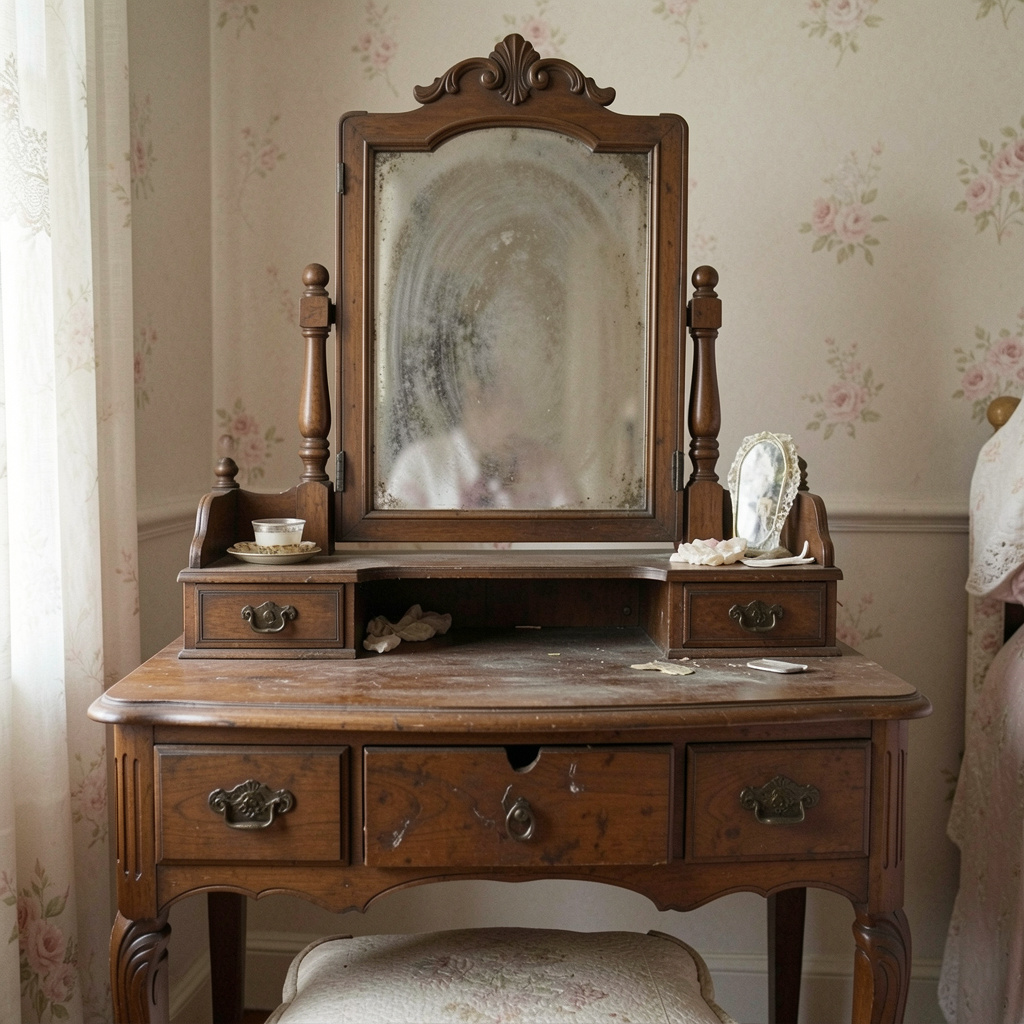
Tall and narrow, made from dark wood that had faded almost gray with age. The mirror was cloudy around the edges, and one of the little brass handles was missing. It had belonged to his grandmother, then sat in his parents’ hallway for decades.
When we got married, his mother eventually gave it to us.
My husband hated it.
“Why would anyone want that thing?” he’d said the first time it arrived at our house.
I told him it had character.
He called it junk.
So when the movers were loading everything after the divorce, I pointed to the vanity.
“That belongs to your family.”
He looked over his shoulder.
Then he laughed.
“You can have the ugly thing.”
One of the movers glanced at me.
My husband shrugged.
“Nobody wants it.”
I didn’t argue.
I watched them carry it into my new apartment.
For nearly a year, it sat in the spare room.
Mostly, it became a place to throw things.
Laundry.
Mail.
Winter blankets.
A broken lamp.
Sometimes I would walk past it and remember my husband’s laugh.
You can have the ugly thing.
Nobody wants it.
Eventually, even I stopped seeing it as anything more than an old piece of furniture.
Until one rainy afternoon, I decided to sell it.
I had posted several things online and was trying to clear out the spare room.
I pulled open the middle drawer.
It jammed halfway.
I frowned and tugged harder.
Nothing.
I tried lifting it.
Still nothing.
Something was catching behind it.
I crouched down and looked underneath.
Nothing.
I pulled the drawer all the way out as far as it would go, then reached into the narrow gap behind it.
My fingers touched something.
Paper.
I froze.
It was tucked deep inside the back of the vanity.
I pulled it free.
It was an envelope.
Yellowed.
Thick.
And on the front, written in faded blue ink, were six words that made my heart stop.
For the woman who finds this.
I stared at it for a long time.
Then I locked the spare-room door.
I had no idea that opening that envelope would change everything I thought I knew about my marriage.
The first thing inside was a photograph.
A young woman stood beside the vanity.
She looked to be in her twenties.
Beautiful.
Dark hair.
Serious eyes.
And wearing the same small gold necklace I had seen in my husband’s childhood photographs around his grandmother’s neck.
I turned the picture over.
On the back was a date from nearly sixty years earlier.
Then I found a handwritten letter.
My hands began to shake as I read.
“To whoever owns this vanity now,
If you are reading this, then someone has finally moved the back panel.”
I looked at the vanity.
The back panel?
I reread the sentence.
The letter continued.
“This piece of furniture was never meant to be valuable because of the wood. Its value is in what it holds.”
I stopped breathing.
I looked toward the door.
For a ridiculous second, I wondered if my ex-husband somehow knew.
Then I remembered his laugh.
You can have the ugly thing.
I read on.
“My husband believed he had hidden everything from me. He was wrong.”
The letter was signed by my husband’s grandmother.
Her name was Eleanor.
I knew almost nothing about her.
She had died before my husband and I met.
He rarely talked about her.
According to family stories, she had been a quiet woman who spent most of her life taking care of everyone else.
But this letter made her sound completely different.
Eleanor wrote about her marriage.
About money.
About betrayal.
And then she wrote something that made my stomach drop.
“My husband did not build this family’s wealth honestly.”
I sat down on the floor.
The room suddenly felt too small.
Eleanor described how her husband had secretly moved money between accounts, purchased properties under other people’s names, and manipulated business records.
But there was more.
She said she had discovered that he intended to leave their children almost nothing because he planned to transfer the family business to someone outside the family.
She had confronted him.
He threatened her.
So she began collecting evidence.
Receipts.
Bank statements.
Property documents.
Copies of letters.
She hid them inside the vanity.
And then came the sentence that changed everything.
“I have done this because I know my husband intends to destroy the evidence when he realizes I know.”
I stared at the paper.
The family business.
The properties.
The money.
I suddenly understood why my ex-husband had always been obsessed with his family’s financial history.
He had told me the family had “lost everything” after his grandfather died.
That was why he had supposedly needed to build everything himself.
That was why he had always been so proud of being “self-made.”
But Eleanor’s letter suggested something very different.
I searched the back of the vanity.
There was a thin wooden panel.
I pressed against it.
It moved.
Behind it was a shallow compartment.
Inside were dozens of envelopes.
I spent the next three hours sitting on the floor reading.
The documents weren’t just about Eleanor’s husband.
They continued for decades.
Business transfers.
Property deeds.
Tax records.
Bank statements.
Letters between attorneys.
And then I found something much more recent.
A folder with my ex-husband’s name on it.
My hands went cold.
The documents were from just before our marriage.
There were records showing that he had inherited a significant amount of money from a family trust.
He had never told me.
Instead, he had claimed he had “nothing” when we married.
I kept reading.
The money had been moved through several accounts.
Then used as collateral for property purchases.
One of those properties was the house we had just fought over.
The house I had helped pay for during our marriage.
The house he had insisted was primarily his because his income had been higher.
I stared at the documents.
Then I found a second folder.
This one contained correspondence between my husband’s father and an attorney.
There was a reference to the trust.
And another phrase that made my heart pound.
Beneficiary rights.
I called my divorce attorney.
It was after business hours, but I left a message.
Then I called again.
Then I stopped myself.
I didn’t want to sound hysterical.
So I photographed everything.
Every page.
Every signature.
Every account number.
Every date.
The next morning, my attorney called.
“Where did you get these?”
I told her.
There was silence.
Then she said, “Don’t touch anything else.”
I swallowed.
“Is it important?”
“It’s potentially very important.”
She asked me to bring the documents to her office.
I did.
She spent nearly two hours reviewing them.
Finally, she looked up.
“Your husband may have lied about marital assets.”
I laughed bitterly.
“That’s not exactly surprising.”
“No,” she said. “But this is different.”
She pointed to one document.
“These records indicate that some assets may have been transferred into trusts before and during your marriage. We need to determine whether those transfers were legitimate.”
I stared at her.
“What happens if they weren’t?”
“Then your divorce settlement may have been based on incomplete financial disclosure.”
I felt something inside me shift.
For months, I had thought I had lost.
The house.
The cars.
The camper.
The savings.
My peace.
But suddenly I wondered if the one thing my husband had never fought for was the one thing he should have been terrified of losing.
The vanity.
My attorney hired a forensic accountant.
The investigation took weeks.
Then months.
What they found was staggering.
My husband had not been as financially successful as he claimed.
He had benefited from a family trust that had been quietly funding his lifestyle for years.
Some assets had been transferred into accounts controlled by relatives.
Others had been listed under shell companies.
And several transfers had occurred shortly before our divorce.
My husband had fought over the house because he wanted me to believe it was the most valuable thing on the table.
It wasn’t.
The real value was hidden elsewhere.
And the documents in the vanity provided the trail.
There was only one problem.
We had already finalized the divorce.
My attorney explained that reopening a divorce settlement wasn’t simple.
But fraud changed things.
If my husband had deliberately concealed assets, the court could reconsider the settlement.
So we filed.
My ex-husband received the notice on a Tuesday.
He called me that night.
I almost didn’t answer.
But curiosity won.
“Where did you get those documents?”
His voice was different.
No arrogance.
No sarcasm.
Fear.
I said nothing.
He continued.
“Those papers don’t mean anything.”
“I didn’t say anything about papers.”
Silence.
Then he whispered, “The vanity.”
I closed my eyes.
There it was.
The truth.
He knew exactly what was inside.
“Funny,” I said. “I thought nobody wanted it.”
He hung up.
The next morning, his attorney contacted mine.
They wanted to negotiate.
For the first time in two years, my ex-husband wasn’t demanding something.
He was offering.
Money.
Property.
A percentage of the business.
Anything to prevent the documents from becoming part of the public record.
My attorney asked what I wanted.
I thought about the woman who had written those letters.
Eleanor.
She had hidden the truth inside a piece of furniture because she believed someday another woman might need to find it.
I realized I wasn’t fighting for the house anymore.
I wasn’t even fighting for the money.
I was fighting because my husband had spent years convincing me that I was stupid for trusting him.
That I had been lucky to get what I got.
That I should be grateful he was willing to let me walk away.
And now I knew the truth.
I had not been weak.
I had simply been exhausted.
There is a difference.
We went to court.
The forensic accountant presented the evidence.
My ex-husband’s attorney tried to argue that the documents were irrelevant.
Then my attorney produced the bank records.
Property transfers.
Trust documents.
Correspondence.
One by one, the story unraveled.
My husband had hidden millions in assets.
Not all of it belonged to him personally.
But enough of it had been concealed from the divorce proceedings to change the settlement dramatically.
The judge ordered further financial disclosure.
The process took another six months.
By the end, I received a settlement far larger than anything I had originally asked for.
The house was sold.
The proceeds were divided according to the revised settlement.
Several concealed assets were brought into the accounting.
And my ex-husband lost the image he had worked so hard to protect.
But something unexpected happened after everything was over.
I didn’t feel victorious.
I felt free.
One evening, I stood in the spare room.
The vanity was still there.
I ran my fingers across the scratched wood.
For years, I had thought it was ugly.
Now I saw it differently.
It wasn’t beautiful because of its appearance.
It was beautiful because Eleanor had trusted a stranger she would never meet.
She had believed that someday someone would find the truth.
And someone did.
I decided not to sell it.
Instead, I had the vanity restored.
The cloudy mirror was polished.
The missing brass handle was replaced.
The wood was carefully repaired without removing its scars.
When it was finished, I placed it in my bedroom.
The restoration revealed something I had never noticed.
Carved into the underside of the middle drawer were tiny initials.
E.R.
And beneath them, another message.
Three simple words.
Remember yourself.
I cried when I saw them.
Not because I was sad.
Because I finally understood.
For years, I had defined myself through my marriage.
Wife.
Partner.
Caretaker.
The person who compromised.
The person who kept the peace.
The person who gave up what mattered because fighting seemed too exhausting.
My husband had taken the house.
He had taken the cars.
He had taken the camper.
He had taken things I thought I needed to rebuild my life.
But he couldn’t take the woman I became after leaving him.
And he certainly couldn’t take the truth.
A year later, I hosted a small dinner at my new home.
The vanity stood against the bedroom wall.
A friend asked me where I found it.
I smiled.
“My ex-husband gave it to me.”
She laughed.
“Really?”
I nodded.
“He told me nobody wanted it.”
She looked at the beautiful restored wood and polished mirror.
“Well, he was wrong.”
I touched the drawer.
“Yes,” I said. “He was.”
Then I opened it.
Inside was Eleanor’s original letter.
I had placed it there carefully in a protective sleeve.
Alongside it was a copy of the final court judgment.
And beneath both was a photograph of me standing beside the restored vanity.
I had written one sentence on the back.
Some things are only worthless until you discover what they’ve been hiding.
I never saw my ex-husband again after the final hearing.
People told me he had moved to another state.
Some said he was rebuilding his life.
Others said he was still fighting with his family over the money.
I didn’t care.
My life had become quieter.
Better.
I bought a small house with big windows and a garden.
I traveled.
I took classes I had postponed for years.
I made friends who didn’t know me as someone’s wife.
And every morning, when sunlight touched the vanity mirror, I could almost imagine Eleanor standing there decades earlier, writing her letter and hoping someone would eventually understand.
Sometimes the things we dismiss are the things that save us.
Sometimes the thing everyone laughs at is the thing holding the truth.
And sometimes, when someone tells you that you can have the ugly thing because nobody wants it…
You should take it.
Because they might have just handed you the one thing they were most afraid you’d find.
The vanity had sat in my spare room for almost a year.
I had planned to sell it for maybe a hundred dollars.
Instead, it gave me back my life.
And that was worth far more than everything my husband had fought so hard to keep.