Four Words in Orange Paint
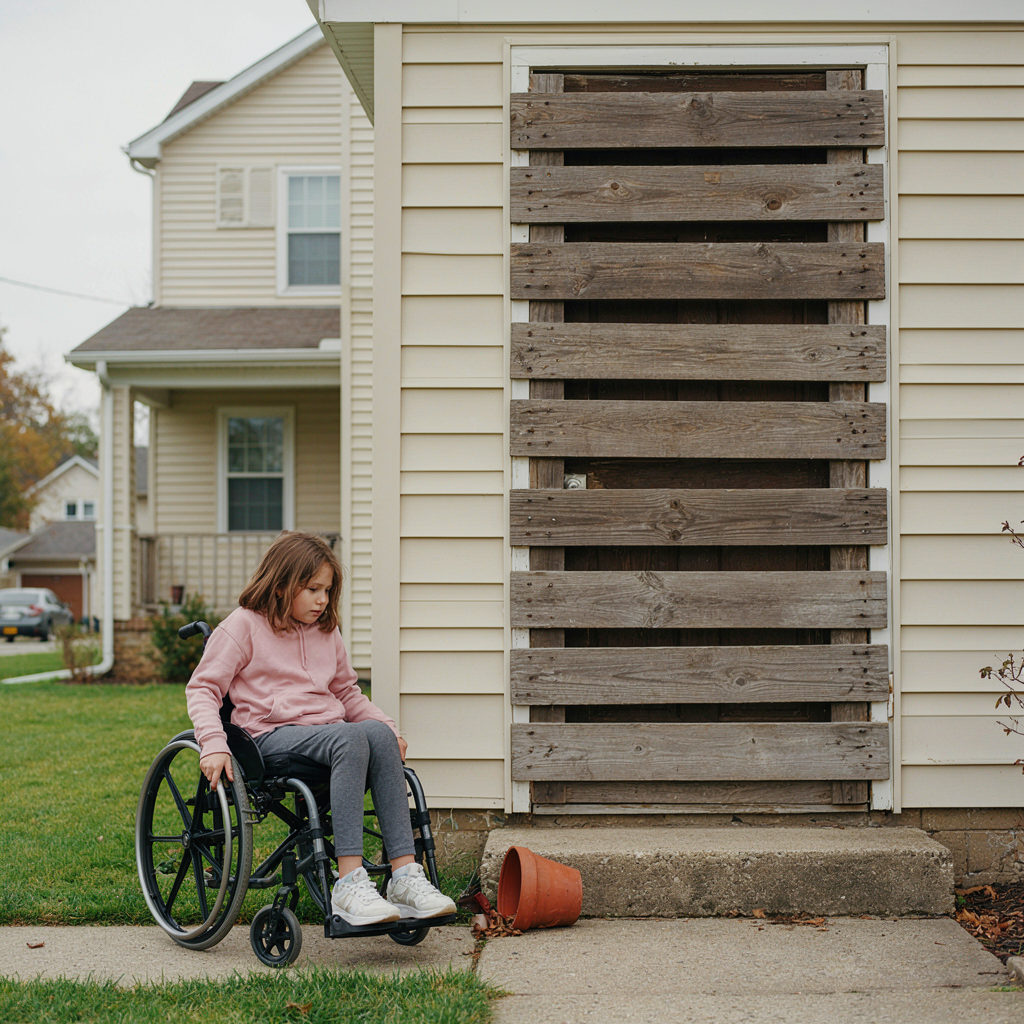
The first thing my daughter said was, “Mom, I can’t get inside.”She didn’t cry.That was somehow worse.She just sat in her wheelchair at the bottom of the porch steps, staring at the pile of lumber blocking our front door.
The boards were still dusty from the ramp.Our ramp.
The one I had spent six months saving for, three weeks measuring, and two weekends helping a contractor build so my daughter could enter our home without being carried.
Now it was lying in pieces across the porch like someone had deliberately thrown a bridge into a river and then laughed at the people who needed it to cross.
I looked at the man standing beside his truck.
My neighbor, Greg.
He had one hand on his hip and the other holding a cordless drill.“Greg,” I said slowly, “what did you do?”He shrugged.“Fixed the problem.”“What problem?”He pointed toward our driveway.“I’m building my garage. Your stupid ramp crosses the property line.”
I looked at the ramp.Then at him.Then at my daughter.“Where is the survey?”
He laughed.“Don’t need one. I know where my property ends.”
“You tore apart my daughter’s wheelchair ramp.”
“Yeah.”
“You didn’t ask me?”
“It was on my property.”
“No, it wasn’t.”
His smile disappeared.
“You want to make this difficult?”
“I want my daughter to be able to get into her house.”
He glanced at her.
Then he looked back at me.
“Move if you don’t like it.”
Those words would eventually cost him far more than rebuilding a ramp.
But at that moment, all I could think about was my daughter sitting outside her own home.
Her name is Lily.
She was eleven years old.
She had been born with a condition that affected her legs and made walking impossible. She was bright, funny, stubborn, and completely unimpressed by people who treated her differently.
The ramp mattered to her.
Not because it was beautiful.
It wasn’t.
It was pressure-treated wood, painted a soft gray, with sturdy railings and a gentle slope.
It mattered because Lily could use it herself.
Before we built it, getting into the house meant either carrying her or using the portable metal ramp we kept in the trunk of my car.
Every trip home involved planning.
Rain made the portable ramp slippery.
Snow made it dangerous.
When I was sick, we had to wait for someone to help.
The new ramp had changed everything.
Lily could come home from school, roll up the ramp, unlock the door, and enter her own house.
Independence.
That was the word her occupational therapist used.
I called it freedom.
Greg called it a “stupid ramp.”
I pulled out my phone.
He noticed.
“What are you doing?”
“Recording.”
His face hardened.
“You better not.”
“I’m documenting what happened.”
“You’re trespassing on my property.”
I almost laughed.
“You’re standing on my porch.”
He pointed toward the pile.
“That ramp was on my side.”
“Then prove it.”
He stepped closer.
“I told you. Move if you don’t like it.”
I kept recording.
He climbed into his truck and drove away.
Lily watched him disappear around the corner.
Then she looked at me.
“Mom?”
“Yeah?”
“Can we get inside?”
That question broke me.
I had been angry.
Now I was furious.
I called the contractor who had built the ramp.
He arrived twenty minutes later, walked around the debris, and shook his head.
“I didn’t build over a property line,” he said.
“Can you prove that?”
“I have the plans.”
“Send them to me.”
He did.
I opened the folder on my phone.
There was the original drawing.
There was the setback measurement.
There was the permit number.
And there was the property survey we’d used.
The ramp was entirely on our property.
Not partly.
Not by an inch.
Entirely.
Greg’s new garage, however, was another story.
I hadn’t paid much attention to it.
He’d started construction two weeks earlier.
The garage was enormous.
Much larger than the small workshop he’d originally told everyone he was building.
Two stories.
Stone facade.
Black-framed windows.
A concrete driveway leading toward it.
I’d assumed he had obtained whatever permits were required.
Now I wasn’t so sure.
I called the city building department.
I explained what happened.
The person on the phone asked me whether anyone was injured.
“No.”
Whether my daughter was unable to access the house.
“Yes.”
Whether I had photographs.
“Yes.”
Whether I had a permit for the ramp.
“Yes.”
“Email everything you have,” she said.
So I did.
I sent photographs of the destroyed ramp.
The permit.
The original plans.
The survey.
The contractor’s statement.
And the video.
At 10:17 that morning, I received an email.
An inspector would come out.
At noon.
I thought it would take days.
Instead, at exactly 12:03, a white city vehicle pulled up outside my house.
A man stepped out carrying a measuring wheel.
Under one arm was a folding ruler.
In his other hand was a tablet.
His name was Daniel Ortiz.
He introduced himself calmly.
“I’ve reviewed the complaint.”
He looked at Lily.
Then at the broken ramp.
“Is this the ramp?”
“Yes.”
“Was it permitted?”
“Yes.”
“Was it inspected?”
“Yes.”
“Was it completed?”
“Yes.”
He nodded.
Then he started measuring.
He measured from the edge of our house to the property marker.
Then from the property marker to the ramp.
Then from the ramp to the sidewalk.
He took photographs.
He checked the permit on his tablet.
Then he asked me something I hadn’t expected.
“Do you know where your neighbor’s property marker is?”
I pointed.
“Right there.”
He walked over.
He crouched.
Brushed dirt away.
And found the metal marker.
He stood up.
Then he walked toward Greg’s garage.
I followed.
Daniel measured from the marker to the garage foundation.
Once.
Twice.
Then a third time.
He entered numbers into his tablet.
His expression changed.
Not dramatically.
Just enough for me to notice.
“Is something wrong?” I asked.
He didn’t answer immediately.
Instead, he walked toward the front of the garage.
He took out a folding ruler.
Measured the setback from the sidewalk.
Then he looked at the building plans on his tablet.
He compared the two.
Then he looked at me.
“Do you know if your neighbor has a permit amendment?”
“I don’t know.”
He nodded.
“Stay here.”
He crossed the street.
Greg was apparently home because his truck was parked beside the garage.
A few seconds later, Greg came outside.
He looked annoyed.
“What?”
Daniel introduced himself.
“I’m with the city building department.”
Greg’s posture changed.
“What’s this about?”
“I need to inspect the garage.”
“You have an appointment?”
“No.”
“I don’t have time for this.”
Daniel calmly held up his tablet.
“There appears to be a discrepancy between the approved plans and the structure.”
Greg looked at me.
His eyes narrowed.
“You called them?”
“I reported what happened to the ramp.”
“This has nothing to do with my garage.”
Daniel said, “Actually, it might.”
Greg folded his arms.
“My contractor handled everything.”
“Who is your contractor?”
Greg gave him a name.
Daniel typed it in.
Then asked for the permit number.
Greg hesitated.
That hesitation lasted perhaps three seconds.
But I noticed.
Daniel did too.
Greg finally gave him the number.
Daniel checked it.
Then looked at the garage.
Then back at the tablet.
“Mr. Miller,” he said, “this structure doesn’t appear to match the approved site plan.”
Greg laughed nervously.
“It’s basically the same.”
“No.”
Daniel’s voice was quiet.
“It’s not.”
Greg started explaining.
The explanation became increasingly complicated.
He talked about measurements.
Contractors.
Construction changes.
An emergency.
A misunderstanding.
A setback variance that he said was “being processed.”
Daniel listened.
Then asked one question.
“Was the variance approved?”
Greg said nothing.
Daniel turned around.
He walked back toward the property line.
He measured again.
This time, he didn’t use the measuring wheel.
He used the folding ruler.
He measured the distance between the garage foundation and the property line.
Then he looked at the garage’s side wall.
He looked at the plans.
Then he looked at me.
“Mrs. Harper?”
“Yes?”
“Your ramp wasn’t on his property.”
I already knew that.
But hearing a city inspector say it felt different.
“It’s approximately eighteen inches inside your property line.”
I nodded.
“And his garage?”
He looked toward Greg.
“Approximately eighteen inches over it.”
Silence.
Greg’s face went pale.
“You’re wrong.”
Daniel shook his head.
“I measured it twice.”
“You must have the wrong survey.”
“I used the recorded property survey.”
“I hired a surveyor.”
“Then you should contact that surveyor.”
Greg pointed at me.
“She put that ramp there to interfere with my construction.”
Daniel didn’t even look at him.
“She had a valid permit.”
“She knew I was building.”
Daniel finally turned.
“Did you have an approved permit for the garage as currently constructed?”
Greg didn’t answer.
Daniel looked down at his tablet.
“I’ll take that as a no.”
Greg’s voice rose.
“You can’t just tell me to tear down a building.”
“I didn’t say that.”
“You’re threatening me.”
“No.”
Daniel closed the tablet.
“I’m informing you that the city will issue a stop-work order and a correction notice.”
Greg stared at him.
“For the garage?”
“For the garage.”
Then Daniel walked back across the street.
He stopped beside me.
“There’s something else.”
“What?”
He pointed toward the garage.
“The approved plans show a single-story structure.”
I looked.
The garage had two floors.
I felt my stomach drop.
“And the second floor?”
“Not approved.”
I looked at Greg.
He was standing completely still.
Daniel walked toward his vehicle.
Then stopped.
He opened the rear hatch.
Inside were several cans of marking paint.
He took out an orange one.
He walked back toward the garage.
Greg followed him.
“What are you doing?”
Daniel didn’t answer.
He walked to the property line.
Then he marked the pavement.
One orange line.
Then another.
He walked along the side of the garage.
The orange line continued.
Straight across the concrete.
Right beneath the garage’s foundation.
Greg stared.
“You can’t do that.”
Daniel turned toward him.
And then he said four words.
“Nothing crosses this line.”
Those four words changed the rest of Greg’s summer.
The city posted the stop-work order that afternoon.
The garage was frozen exactly where it stood.
No construction.
No deliveries.
No workers.
No permits issued for further work.
And because part of the foundation crossed onto our property, the city also notified the property enforcement department.
Greg came to my door that evening.
I didn’t answer.
He knocked again.
“Sarah!”
I stood inside with Lily.
She was watching television.
“Mom?”
“Stay here.”
I went to the door but didn’t open it.
“What?”
“This is ridiculous.”
I said nothing.
“You called the city over a ramp.”
“No.”
“You did.”
“I called because you destroyed an accessible entrance to my home.”
“You know what I mean.”
“No, Greg. I don’t.”
He lowered his voice.
“Look, I made a mistake.”
I almost opened the door.
Almost.
Then I remembered my daughter sitting outside.
“I need you to understand something,” I said through the door.
“What?”
“You don’t get to decide whether my daughter deserves access to her own home.”
Silence.
Then he said, “I’ll pay to rebuild it.”
“You should.”
“Tomorrow.”
“You’ll need to rebuild it according to the permit.”
“I know.”
“And you’re going to pay for the damage.”
“Yes.”
“And you’re going to stay away from my daughter.”
He didn’t answer.
“Greg?”
“Fine.”
He walked away.
The next morning, a survey crew arrived.
Not hired by me.
By the city.
They confirmed what Daniel had found.
Greg’s garage crossed the property line.
The encroachment wasn’t eighteen inches everywhere.
It varied.
At one corner, it was nearly two feet.
The second-floor structure extended even farther.
And the driveway he’d poured beside the garage crossed onto our property too.
Then they found something else.
A drainage pipe from Greg’s garage ran underground and discharged directly toward our foundation.
That explained why we’d suddenly started getting water in the basement.
I had blamed the heavy rain.
It wasn’t the rain.
It was his construction.
The city issued additional violations.
Unauthorized structure.
Property-line encroachment.
Unapproved second floor.
Improper drainage.
And failure to comply with the approved site plan.
Greg hired a lawyer.
Then another.
He tried arguing that the property line was unclear.
The city produced the recorded survey.
He argued that the garage was already too far along to change.
The city said that wasn’t their problem.
He claimed he had relied on a contractor.
The contractor produced signed drawings showing exactly where the garage was supposed to go.
Then Greg made his biggest mistake.
He came back to my house.
This time, he wasn’t angry.
He was desperate.
“I need you to sign an agreement.”
“What agreement?”
“A temporary easement.”
“No.”
“You haven’t even read it.”
“I don’t need to.”
“It would solve everything.”
“It would solve your problem.”
He looked at Lily.
She was sitting behind me.
He sighed.
“Please.”
I stared at him.
“You tore apart her ramp.”
“I said I was sorry.”
“You told her to move if she didn’t like it.”
“I was angry.”
“You weren’t angry at me.”
He said nothing.
“You were angry that her ramp was in the way of your garage.”
He looked away.
I continued.
“You didn’t check the property line.”
Nothing.
“You didn’t check the permit.”
Nothing.
“You didn’t ask me.”
Nothing.
“You just destroyed the only accessible entrance my daughter had.”
His face tightened.
“I made a mistake.”
“Yes.”
He looked at the agreement.
“If you don’t sign this, I might have to tear the garage down.”
I took a breath.
“That isn’t my decision.”
“It could be.”
“No.”
“You own the property.”
“Yes.”
“Then you can give me permission.”
“No.”
His voice cracked.
“Why?”
I looked at Lily.
She was watching him.
Then she looked at me.
I crouched beside her.
“You remember what you said that morning?”
She nodded.
“I couldn’t get inside.”
I looked back at Greg.
“That is why.”
He left.
Three weeks later, the city issued its final determination.
The garage had to be modified.
The portion crossing the property line had to be removed.
The unauthorized second floor had to be demolished.
The drainage system had to be corrected.
The driveway had to be cut back.
And the property had to be restored.
Greg fought it.
He appealed.
He hired attorneys.
He attended hearings.
He submitted revised drawings.
He requested variances.
Every attempt failed.
The problem wasn’t simply that he had built too close.
It was that he’d built almost everything wrong.
He had assumed nobody would check.
Until he tore down my daughter’s ramp.
That was his mistake.
The city required him to rebuild our ramp too.
A licensed contractor came in.
The damaged boards were removed.
The foundation was repaired.
The railing was rebuilt.
The slope was corrected.
The final inspection took place on a bright Friday morning.
Daniel Ortiz returned.
He rolled his measuring wheel up the ramp.
Checked the slope.
Checked the railing.
Checked the landing.
Then he looked at Lily.
“Want to try it?”
Her face lit up.
She rolled forward.
Slowly at first.
Then faster.
She reached the top.
Turned around.
And smiled.
Daniel smiled too.
“Looks good.”
I felt tears in my eyes.
Lily opened the front door herself.
She rolled inside.
Then turned around.
“Mom!”
“What?”
“Come on!”
I laughed.
“I’m coming.”
Behind us, across the street, Greg’s garage looked very different.
The second story was gone.
One corner had been removed.
The driveway had been cut back.
The orange paint was still visible along the property line.
For weeks, that orange line had become the neighborhood landmark.
People walked past and looked at it.
Some shook their heads.
Some asked what happened.
I never told the whole story.
I didn’t need to.
The line said enough.
Greg eventually rebuilt the garage correctly.
It cost him far more than the original construction.
But the strangest part happened months later.
I was outside with Lily when Greg approached.
He stopped at the sidewalk.
He didn’t cross the property line.
That detail made me smile.
“I owe you an apology,” he said.
I waited.
“I shouldn’t have touched the ramp.”
“No.”
“I shouldn’t have spoken to Lily that way.”
“No.”
He looked down.
“I didn’t understand what that ramp meant.”
I looked at Lily.
She was drawing with sidewalk chalk.
Greg watched her for a moment.
“I thought it was just wood.”
I nodded.
“To you,” I said.
He looked at me.
“To her, it was a door.”
He swallowed.
“I understand now.”
Maybe he did.
Maybe he didn’t.
I wasn’t interested in testing it.
He walked away.
Lily kept drawing.
A few minutes later, she rolled over to me.
“Mom?”
“Yeah?”
“Do you remember when the ramp was gone?”
“I remember.”
“I thought we were going to have to move.”
I hugged her.
“We’re not moving.”
She smiled.
“Good.”
Then she pointed toward the driveway.
“What does that orange line mean?”
I looked across the yard.
The paint had faded slightly under the summer sun.
But it was still there.
A reminder.
“A property line,” I said.
She thought about that.
Then smiled.
“No.”
“What?”
She pointed again.
“It means he shouldn’t cross.”
I laughed.
“You’re right.”
She rolled toward the ramp.
Then stopped.
“Mom?”
“Yeah?”
“I like our ramp.”
“I do too.”
She smiled.
And rolled through the front door.
The door closed behind her.
For the first time in weeks, I stood there listening to the quiet.
No arguing.
No inspectors.
No lawyers.
No measuring wheels.
Just the sound of my daughter’s wheelchair rolling across the floor.
That was the thing Greg never understood.
He thought the fight was about lumber.
It wasn’t.
It was about whether someone could look at another person’s disability and decide that their access, independence, and dignity were inconvenient.
He thought he was removing a piece of wood.
He was really trying to move a boundary.
And the city inspector had drawn it back in orange.
Four words.
“Nothing crosses this line.”
Greg learned exactly what they meant.
So did everyone on our street.
And my daughter?
She never had to ask again whether she could get inside her own home.