The Gloves That Came Home
The first thing I noticed was the silence.Not the peaceful kind that settles over a country road after sunrise. This silence felt heavy, like the air itself had grown tired.
Since Harold died in October, the little white farmhouse had become too quiet. No radio humming in the kitchen. No boots by the back door. No familiar cough drifting down the hallway every morning at six.
Just me.At seventy-three years old, I had learned that grief wasn’t loud.
It whispered.It waited in empty chairs and untouched coffee cups.
I stood at the mailbox with another envelope from the bank in my trembling hands.FINAL NOTICE.Past Due.Foreclosure Review.They all sounded colder than the December wind.Nine thousand dollars.
That was all it would have taken to catch up on the mortgage Harold and I had nearly paid off over forty years.Nine thousand dollars separated me from losing the only home we’d ever owned.
I folded the letter carefully instead of tearing it apart.
Anger took energy.These days, I didn’t have much left.
The gravel crunched behind me.A long black sedan rolled slowly up the driveway.I frowned.Nobody visited anymore.Most of my old friends had either moved closer to their children or joined Harold in the cemetery on Maple Hill.
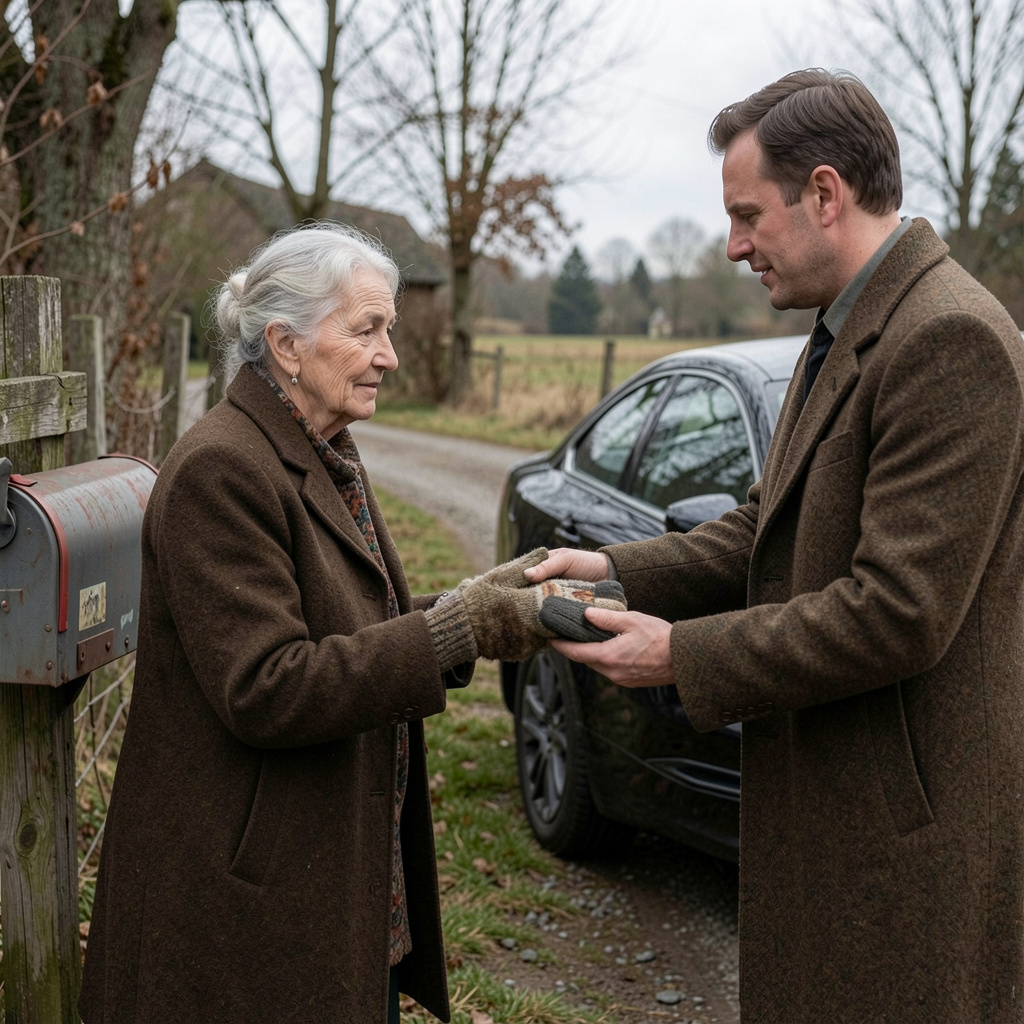
The car stopped beside the mailbox.The driver remained inside.A tall man stepped out.He wore a charcoal wool coat that probably cost more than my monthly Social Security check. His shoes shined like mirrors.
He looked to be in his mid-forties.Successful.Confident.But strangely nervous.
He removed a small package from his coat pocket and walked toward me with slow, careful steps.
“Mrs. Parker?”I nodded.”Yes.”His eyes glistened.”I’ve been looking for you for almost fifteen years.””I’m sorry,” I said politely. “Have we met?”He smiled.”A long time ago.”He reached into the package.
Instead of money or papers, he placed a tiny pair of faded brown children’s gloves into my wrinkled hands.The stitching had begun to unravel.
One thumb had been clumsily repaired with blue thread.
I stared at them.
Then my breath caught.
“My gloves…”
“They were.”
His voice cracked.
“You gave them to a freezing little boy on Bus Route Six during the winter of 1986.”
Suddenly I wasn’t seventy-three anymore.
I was forty-three.
The old diesel engine rattled beneath me as children stomped snow off their boots before climbing aboard.
Except one little boy.
He never had boots.
Or a coat.
Only a paper-thin flannel shirt.
His lips always looked blue.
His fingers shook every morning.
I’d moved him to the first seat beside the heater.
Every day.
I’d handed him my spare gloves.
Every day.
I’d split my peanut butter crackers in half.
Every day.
Until spring arrived.
Then one Monday his seat was empty.
Someone told me his family had moved away over the weekend.
I never even learned where.
Looking back at the man before me, tears blurred my vision.
“Daniel?”
He nodded.
“You remembered.”
“I remembered every child.”
“But you saved one.”
I shook my head.
“I just shared my lunch.”
“No.”
He smiled gently.
“You shared dignity.”
Daniel invited me to sit on the porch.
The driver remained respectfully inside the car.
For nearly an hour we talked.
His story unfolded slowly.
His father had been an alcoholic who drifted from one temporary job to another.
His mother cleaned motel rooms.
Some weeks they had electricity.
Some weeks they didn’t.
The winter of 1986 had been especially brutal.
Their furnace broke.
There wasn’t money to fix it.
His coat had been stolen from school.
His parents couldn’t replace it.
“I thought everyone knew I was poor,” Daniel admitted.
“I was ashamed.”
I squeezed the gloves.
“I never wanted you to feel ashamed.”
“You didn’t.”
He smiled.
“You treated me like every other kid.”
He laughed softly.
“You’d hand me those crackers without saying a word, like it was completely normal.”
“I didn’t want the others noticing.”
“They noticed.”
My heart sank.
“Oh.”
“But do you know what happened?”
I shook my head.
“They started bringing extra snacks too.”
I blinked.
“What?”
“One girl brought an apple every Wednesday.”
“A boy shared cookies.”
“Another kid left hot chocolate beside my seat.”
I covered my mouth.
“I never knew.”
“You started something.”
Daniel leaned back.
“The day we moved, I cried.”
“You did?”
“I wanted to tell you goodbye.”
He reached into his wallet.
Inside was an old school bus photograph.
There we all were.
Twenty-seven children.
One tired bus driver.
He pointed.
“There.”
Second seat.
Tiny.
Skinny.
Half-hidden behind another student.
“I’ve carried this picture for thirty years.”
I laughed through tears.
“My hair was awful.”
He laughed too.
“Yes.”
For a moment, neither of us spoke.
Then he grew serious.
“I’ve wanted to thank you since I was nineteen.”
“What happened?”
“I couldn’t find you.”
“School district lost records.”
“I hired investigators twice.”
I stared.
“You hired investigators?”
“You mattered.”
Daniel eventually graduated first in his high school class.
Scholarships followed.
College.
Law school.
Then business school.
He became an attorney.
Later he started a company helping struggling rural hospitals avoid bankruptcy.
His business expanded nationwide.
Today it employed more than twelve hundred people.
“I’ve done well.”
“I can see that.”
“But none of it started because of me.”
He looked directly into my eyes.
“It started because one woman looked at a freezing child and saw a human being instead of a problem.”
The driver finally stepped out.
Then another woman emerged from the opposite side of the car.
She looked around forty.
Kind eyes.
Dark curls.
She carried a little girl wrapped in a bright red winter coat.
Behind them climbed a teenage boy.
Daniel smiled.
“My family.”
His wife approached first.
“So this is Mrs. Parker.”
She hugged me before I could react.
“I’ve heard about you for twenty-two years.”
“You have?”
“Every Christmas.”
Daniel chuckled.
“My children know the story by heart.”
The little girl stepped forward.
“Are you the glove lady?”
I laughed.
“I suppose I am.”
She hugged my waist.
“Thank you for helping my daddy.”
My heart broke all over again.
The teenage boy held something behind his back.
“Grandma…”
Daniel interrupted gently.
“We call you Grandma Parker.”
The boy handed me a wooden box.
Inside lay hundreds of handwritten letters.
“What are these?”
Daniel smiled.
“People.”
“Who?”
“My employees.”
I looked confused.
“When I started my company, I made one rule.”
“Anyone facing hardship gets help first.”
“No questions.”
“Medical bills.”
“Child care.”
“Housing.”
“Food.”
“If someone needs help, we help.”
I stared.
“Every person who wrote one of these letters wanted you to know that your kindness reached them too.”
I opened one.
Dear Mrs. Parker,
Because one bus driver once shared crackers with a hungry boy, my daughter’s cancer treatments were fully paid when my insurance failed…
Another.
Because Daniel believed someone cared when he was a child, he believed me when I said I needed another chance…
Another.
Thank you for teaching our boss compassion before he even knew what the word meant…
By the tenth letter, I couldn’t see anymore.
Daniel wasn’t finished.
He handed me another envelope.
“No.”
I pushed it back.
“I didn’t help you for money.”
“I know.”
“That’s why this isn’t payment.”
“What is it?”
“A promise fulfilled.”
Inside rested one cashier’s check.
Amount:
$9,000.
Exactly.
Not a penny more.
Not a penny less.
My knees nearly gave way.
“You…how…”
“The bank letters.”
“I noticed them in your mailbox.”
“I made one phone call.”
I shook my head.
“I can’t.”
“You can.”
“No.”
“It isn’t charity.”
“What is it then?”
He smiled.
“A debt.”
“You owe me nothing.”
“I owe you everything.”
The following week, Daniel returned.
This time with contractors.
Electricians.
Roofers.
Plumbers.
Painters.
I protested.
The roof leaked only a little.
The furnace worked most days.
The porch leaned but hadn’t fallen.
They ignored every objection.
By Christmas, the farmhouse looked younger than it had in twenty years.
Harold would’ve laughed himself silly.
The story somehow reached the local newspaper.
Then regional television.
Soon letters poured into my mailbox.
Former students.
Parents.
Teachers.
One letter came from a woman named Rebecca.
You drove Route Six after my mother passed away.
You never knew I cried every morning until you started greeting me with, “There’s my sunshine.”
I’m sixty now.
I still hear those words whenever life gets hard.
Another.
Mrs. Parker,
You waited five extra minutes every day because my little brother tied his shoes slowly.
Dad never knew.
But I did.
Thank you.
The stack grew taller.
Apparently, I’d spent thirty years doing thousands of tiny things I’d completely forgotten.
Yet others never had.
In January, Daniel visited again.
This time carrying blueprints.
“I have an idea.”
“Oh dear.”
He laughed.
“The old bus garage downtown is abandoned.”
“So?”
“I bought it.”
“You bought a bus garage?”
“I’d like your help.”
“With what?”
“We’re turning it into a community center.”
I blinked.
“For seniors.”
“For children.”
“For after-school tutoring.”
“For free meals.”
“For winter clothing.”
He spread the plans across my kitchen table.
“The name is already decided.”
I looked down.
The Route Six Center.
Tears slipped quietly down my cheeks.
“I don’t deserve this.”
He smiled softly.
“Maybe not.”
“But kindness does.”
Spring arrived with birdsong.
The center opened in April.
Old school buses became reading rooms.
One bus held computers.
Another became a tiny library.
The garage transformed into a warm cafeteria where no child ever had to wonder if there would be enough food.
Near the entrance stood a simple glass display.
Inside rested one faded pair of children’s gloves.
A small brass plaque read:
“Kindness is never small to the person receiving it.”
Below that:
“Dedicated to Eleanor Parker, who never realized the distance a simple act of compassion could travel.”
Visitors often stopped there.
Some cried.
Children usually asked why the gloves looked so old.
Their parents would tell them the story.
Every time, it began the same way.
“There was once a school bus driver…”
One snowy afternoon, nearly a year after Daniel found me, I stood outside the center watching children race toward the buses.
A little boy hurried past wearing a coat much too big for him.
He stopped.
Turned around.
“Mrs. Parker?”
“Yes?”
He pulled off one glove.
“My mom says you helped somebody a long time ago.”
“I tried.”
He slipped the glove into my hand.
“I brought an extra pair today.”
“In case another kid forgets.”
For a moment, I couldn’t speak.
Then I looked across the parking lot.
Daniel stood beside his family, smiling.
He understood.
Kindness had finally come full circle.
Not because one woman had changed the world.
But because one warm seat by a bus heater, one pair of worn gloves, and one packet of peanut butter crackers had quietly taught a frightened little boy that compassion is something you carry forward.
Years pass.
People grow old.
Names fade.
But genuine kindness never disappears.
It simply changes hands, traveling from one life to another, until one winter morning, when someone who was once cold opens a warm hand for someone else.
And sometimes, after forty years, it finds its way home.