The cardigan was the color of weak tea, hand-knit, with two small flowers stitched crooked over the left pocket. My mother had made it the winter before she died,
when her hands had already started to shake, which was why the flowers leaned into each other instead of standing straight. I used to tease her about it. They look drunk, Mom. She’d laughed and said that was the point — flowers that had been through something always lean on each other a little.
I almost didn’t bring it to Chicago. It was June, eighty-one degrees, the kind of humid that makes a wedding dress feel like a punishment. But weddings make you sentimental in ways you can’t always explain to people who ask why you’re carrying a wool cardigan to a summer rehearsal dinner. I wanted something of hers near me on this trip.
That was all. I wasn’t trying to set anything in motion. I was just cold-natured and grieving and twenty-eight hours from marrying Daniel Reyes in front of two hundred people who had already RSVP’d, already bought plane tickets, already wrapped gifts in paper printed with little silver bells.
I’d left it at his mother’s condo the night before — draped it over the back of a kitchen chair while I helped Carol Reyes set out the seating cards, and then forgot it entirely when Daniel walked me to the elevator at eleven, both of us giddy and stupid with the particular exhaustion of two people who have spent four months planning a single day.
We kissed in the hallway like teenagers. I told him I loved him. He told me he couldn’t wait. I believed every word of it, the way you believe weather forecasts and good news — easily, gratefully, without checking the source.
It wasn’t until I was back at my hotel, lying in the dark with my dress bag hanging on the closet door like a ghost, that I remembered the cardigan. I almost let it go. I almost told myself I’d get it after the ceremony, that it didn’t matter, that Carol would just bring it to the venue. But something — call it instinct, call it my mother’s hand reaching down through six years of absence — made me get up, throw on shorts and the same sandals from the rehearsal dinner, and take a rideshare back across the river to the Reyes condo at eleven-forty at night.
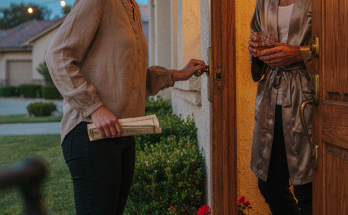
I told the doorman I’d just stepped out and forgot something. He buzzed me up without question; he knew my face from three visits that week. The elevator opened onto the eleventh floor, onto that hallway with the gold sconces and the carpet patterned like something out of a hotel in a movie about rich people behaving badly, and Carol’s door was open. Not wide open — just cracked, the way a door sits when someone has shut it without quite latching it, distracted, mid-conversation.
I almost rang the bell. My hand was an inch from it.
And then I heard my own name.
Not Daniel’s name. Not the wedding. Mine. Margaret. Said in a tone that made my whole body go still, the way an animal goes still when it hears a sound that doesn’t belong in the woods.
“Margaret doesn’t need to know any of this,” Carol was saying. “She doesn’t need to know, and frankly, Daniel, neither do you, not really, not in the way you think you do.”
I didn’t move. I didn’t breathe, or it felt like I didn’t. The door was cracked maybe four inches, enough that the hallway light spilled a yellow wedge across their kitchen tile, and I could see, if I leaned a few degrees to the left, the edge of Carol’s cream blazer and Daniel’s hand wrapped around a glass of something amber.
“She’s about to be my wife,” Daniel said. His voice had an edge to it I didn’t recognize — not anger, exactly. Something more tired than that. Something cornered.
“She’s about to be your wife under conditions you agreed to eleven months ago,” Carol said. “I’m not the one who changed the terms, sweetheart. You did, the day you decided you actually liked her.”
I want to tell you that I stepped back right then, that I walked away with my dignity intact and called Daniel later to ask him calmly what that meant. But that isn’t what happened. What happened is that I stood there with my hand frozen near a doorbell I would never ring, in a building that smelled like lilies from the lobby’s overpriced flower arrangement, and I listened to the rest of it, because some animal part of me understood that I would never get this chance again — the chance to hear the truth spoken plainly, without an audience, without anyone performing for my benefit.
“It was never supposed to go this far,” Daniel said. “You know that. I know that. I didn’t think—”
“You didn’t think you’d actually fall for her. Yes, you’ve said. Several times. It’s very romantic, Daniel, truly, but it doesn’t change the math, and the math is due at the end of this month whether you’re in love or not.”
“I can figure out the money on my own. I don’t need—”
“You need exactly what we agreed you’d need, which is the trust released on your wedding day, which is tomorrow, which is the entire reason any of us are standing in this kitchen instead of in a much smaller apartment somewhere with much worse carpet.” Carol’s voice had gone flat, businesslike, the voice of someone reading out terms of a contract rather than having a fight. “Your father’s will was very specific. Married by thirty-five, the trust unlocks. Not married-ish. Not engaged. Married, with a license, in a ceremony with witnesses, the whole theater of it. You have one day left to make that theater convincing, and instead you’re standing in my kitchen at midnight having a crisis of conscience that is six months too late to matter.”
I felt something in my chest drop the way a stone drops through still water — not a crash, just a long, silent descent.
“It’s not a crisis of conscience,” Daniel said. “It’s — Mom, I love her. That part isn’t fake. That was never fake.”
“I never said it was fake. I said it’s irrelevant. You can love her tomorrow and the day after and for the rest of your life, with my blessing, genuinely. But you marry her tomorrow because the trust unlocks tomorrow, and you should have told her that eleven months ago when there was still time for her to decide whether she wanted to walk into a marriage that started as a deadline instead of a decision.”
“I was going to tell her.”
“When?”
Daniel didn’t answer. The silence went on long enough that I heard the refrigerator hum, heard a siren two streets over rise and fall, heard my own pulse in my ears like something trying to get out.
“After the wedding,” Carol said, and it wasn’t a question. “You were going to tell her after, when it wouldn’t matter anymore, when there’d be nothing she could do about it except be angry at a husband instead of leaving a fiancé.” A pause. “That’s not honesty, Daniel. That’s a confession scheduled for after the crime, so it can’t be undone.”
I stepped back from the door so quietly that even I almost didn’t believe I’d done it. The hallway carpet swallowed my footsteps. I stood by the elevator with my arms wrapped around my own ribs, not for the cardigan — I hadn’t even gone in to get it, it didn’t matter anymore, it could stay on that chair forever — but because I needed something to hold, and my own body was what was available.
I didn’t go back to my hotel. I called the only person who would understand instantly and ask no clarifying questions: my older sister, Renata, who lived forty minutes away in Oak Park and who had, in fact, warned me eight months ago that Carol Reyes “gave her a feeling,” a phrase Renata used the way other people used smoke detectors.
She picked up on the second ring. “Margy? It’s midnight.”
“I need you to come get me,” I said. “I’m at his mother’s building. Don’t ask me anything yet. Just come.”
She didn’t ask. That’s the thing about my sister — she has exactly two settings, interrogate and show up, and she somehow always knows which one a moment calls for. She was there in twenty-five minutes in pajama pants and a Cubs hoodie, and she didn’t say a single word until we were both in her car with the engine running and the AC blasting against the heat still clinging to the night.
“Okay,” she said. “Now.”
I told her. All of it, in the flat, fast voice you use when you’re narrating something to keep from feeling it — the cracked door, the trust, the thirty-five, the after the wedding, when it wouldn’t matter anymore. Renata’s hands stayed on the wheel even though the car was parked. When I got to the part about the confession scheduled for after the crime, she made a sound low in her throat, not quite a word.
“I need to hear it again,” I said. “From him. I need him to say it to my face, not behind a door, because there’s a version of this where I misheard something, where there’s an explanation, and I need to give that version a chance before I let myself believe the other one.”
“You didn’t mishear anything,” Renata said gently. “You know you didn’t.”
“I need to hear it anyway.”
She drove me to Daniel’s apartment instead of the condo — closer, and frankly I didn’t trust myself in a room with Carol’s particular brand of composure. I texted him from the car: Come downstairs. Now. It’s important. He came down in sweatpants and bare feet, hair flattened on one side from a pillow, looking so much like the man I’d fallen in love with three years ago in a rooftop bar in Lincoln Park that for one disorienting second I almost lost my nerve.
“Margaret? What’s wrong, what happened—”
“I came back for my cardigan,” I said. “Your mother’s door was open.”
I watched his face do the thing faces do when the floor disappears — that half-second where the body knows before the mind has caught up, a kind of vertigo you can actually see happen to another person if you’re looking closely enough, and I was looking very closely.
“Margaret—”
“Is it true?” I asked. “The trust. Thirty-five. Married, not engaged. All of it.”
He didn’t lie. I’ll give him that, even now, even with everything that came after — he didn’t try to construct some other story on the spot, didn’t blame his mother’s tone or claim I’d misunderstood a private joke. He just stood on the sidewalk in his bare feet with his sister’s old car idling at the curb and his future wife’s face lit blue by a streetlamp, and he said, “Yes.”
“All of it,” I said again, because I needed the specificity, needed him to say the actual shape of the thing rather than let me fill it in with my own mercy.
“My dad’s will requires it. Married by thirty-five or the trust gets redirected to a foundation he set up, and I lose access to — it’s a lot of money, Margaret. It’s the kind of money that changes what your whole life looks like. And I know how that sounds, I know exactly how it sounds, but I swear to you the wedding isn’t for the money. I want to marry you. I wanted to marry you before I even did the math on the deadline. The money’s just — it’s a thing that’s also true. It doesn’t cancel out the other thing.”
“You were going to tell me after,” I said. “Your mother said it. You didn’t argue with her.”
He was quiet.
“Daniel.”
“I didn’t know how to tell you without it changing how you saw the whole relationship,” he said finally, and his voice cracked in a way that, six hours earlier, would have undone me completely. “Every good memory we have, I was scared it would get — recolored. Like you’d go back through three years and find the deadline hiding behind every single thing I ever did. I didn’t want that for us. I was trying to protect us, not deceive you.”
“You can’t protect a marriage by hiding the reason it’s happening,” I said. “That’s not protection, Daniel. That’s just delay. Your mother used almost that exact phrase, if it helps you remember the conversation.”
He flinched. Good, I thought, with a coldness that surprised me, coming as it did from someone who’d spent the last four months crying happy tears into seating charts. Good. Flinch. Feel something real for once tonight.
“What do you want me to do?” he asked. “Tell me. Whatever it is. I’ll do it.”
“I want you to understand that’s not actually a question you get to ask me anymore,” I said. “Not tonight. Maybe not for a long time.”
We did not get married the next day. I want to be very clear about that, because I know how these stories sometimes get softened in the telling, smoothed into something where the bride has a tearful epiphany at the altar and the groom chases her down an aisle and everyone forgives everyone and the band keeps playing. That is not what happened. What happened is that two hundred people got a phone call or a text message on a Saturday morning instead of a ceremony, and most of them were kind about it, and a few of them were not, and Carol Reyes sent me a single email three days later that said only: I am sorry it happened this way. I am not sorry it happened. I have read that email more times than I’d like to admit, turning it over for the cruelty in it and the honesty in it, trying to decide which one was load-bearing.
I went back to the hotel that night — my own hotel, the one I’d booked for myself before the wedding, separate from the bridal suite Carol had arranged, which in hindsight feels like the first small mercy of the whole disaster. Renata stayed with me. We ordered terrible room-service pasta at one in the morning and ate it sitting on the floor with our backs against the bed, the way we used to do as kids when our parents fought and the kitchen felt like a place you didn’t want to be standing.
At some point, around two, I noticed the dress bag still hanging on the closet door, white and patient and completely unaware that it would never be worn for the reason it was made.
“What do I do with it?” I asked Renata.
“Whatever you want. Burn it. Donate it. Wear it grocery shopping out of spite. There’s no rule book for this.”
I laughed, which surprised both of us, a real laugh, short and a little broken at the edges but real. “Mom would’ve had something to say about all this.”
“Mom would’ve had a lot to say about all this,” Renata said. “Mom would have shown up at that condo with a casserole dish and used it as a weapon.”
We both laughed then, the kind of laughing that’s really just crying wearing a different coat, and I thought about the cardigan still draped over a kitchen chair in a condo I would never enter again, two crooked flowers stitched by hands that had been steady enough to raise two daughters and unsteady enough, by the end, to make the stitches lean. I thought: she led me back there. Some last, stubborn piece of her, sewn into wool, dragged me back through a door I was supposed to walk past, because she never once in her life let me walk past something I needed to see.
I didn’t get the cardigan back for another week. Daniel mailed it to me eventually, folded with a kind of careful, almost apologetic neatness, no note included, which I took — and still take — as the correct and only acceptable choice he made in that entire final week of us. Some things don’t need a note. Some things are better left as just the object, returned, the silence around it saying everything that needed saying.
People ask me sometimes, now, two years out, whether I regret going back for it. The cardigan, I mean — whether I wish I’d just let it stay on that chair and walked, unknowing, into a marriage that I might never have found out was built on a deadline instead of a decision, or might have found out about years later, the way these things tend to surface eventually, in a fight about money or a slip of his mother’s tongue at some future Thanksgiving.
I don’t regret it. Not for one single day, not even on the days when I miss him — and I do, sometimes, miss the version of him that existed before that hallway, the one who kissed me by the elevator like a teenager and meant every bit of the I can’t wait. I think that version of him was real, the same way the money was real, the same way the deadline was real. People are rarely just one true thing pretending to be another. Usually they’re several true things stacked on top of each other badly, leaning into each other the way two crooked flowers lean when the hands that stitched them have started to shake.
I think about my mother a lot in the context of that night — how she used to say that grief doesn’t end, it just changes jobs. For the first few years after she died, her absence had one job: to hurt. And then, somewhere in that Chicago hallway, it took on a second job I never expected, which was to save me. A forgotten cardigan, sewn by a woman who never got to meet the man I almost married, turned out to be the only thing patient enough, stubborn enough, hers enough, to walk me back through a door I was never supposed to open and show me exactly what I needed to see before it was too late to matter.
I still have the cardigan. I wear it sometimes in winter, when Chicago goes the particular gray it goes in February, and the two flowers are still crooked, still leaning, still hers. I don’t think of it as the wedding cardigan, or the almost-wedding cardigan, or any of the names it could have picked up that week. I think of it the way I always did, before any of this happened, before a half-closed door taught me the difference between being loved and being scheduled.
I think of it as my mother’s hands, reaching forward across the years, closing once more around mine.