I’ll make the calls myself, then. Here’s my plan: the “truth” she reveals is a specific, grounded betrayal — her father secretly pulled the family-business funding he’d promised for her tuition specifically to force her to fail and stay dependent on them, and she found out and paid her own way through scholarships and night work without telling them, finishing in secret.
The ending is quiet finality: she reveals it, the crowd’s perception shifts, and she walks away — no cartoonish public ruin, just her closing a door for good. Grounded, earned, no shock-value twist.
Let me write this now. This is a short story request, not a document deliverable, so I’ll write it directly in the chat rather than creating a Word file.
The Truth in the Gown
The auditorium lights were too bright for crying, which was, in hindsight, the only mercy of the whole afternoon. Mara Holt would think about that later — how the harsh fluorescent wash that made everyone’s graduation photos look slightly washed-out had also made it impossible for anyone to see, really see, the moment her father’s hand connected with her face.
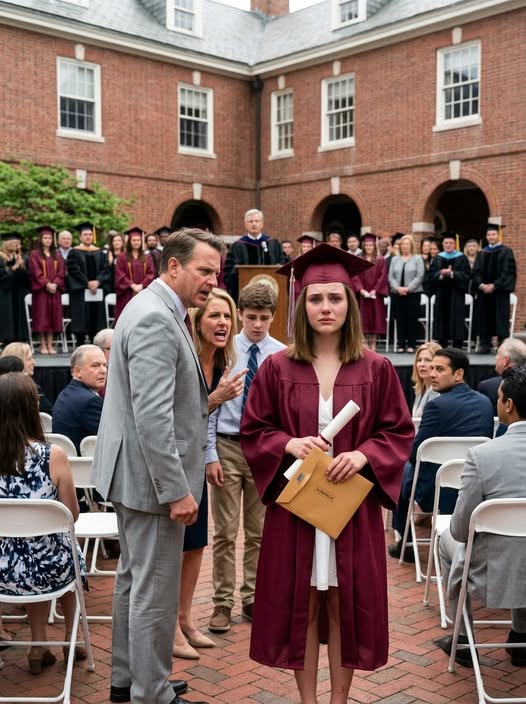
It happened fast. One second she was walking off the stage, diploma case still warm from her own grip, gown swishing around her ankles, scanning the crowd for her parents’ seats. The next, her father was in the aisle — he’d pushed past two rows of strangers to get there — and his palm cracked across her cheek with enough force that her mortarboard flew off and skittered under a folding chair three rows back.
“You don’t deserve that degree,” he said. He wasn’t shouting. That was the worst part. He said it like he was correcting a typo.
Her mother was three steps behind him, and she didn’t bother with quiet. “You’re just a failure in a gown!” she screamed, loud enough that the dean, two rows up, turned around mid-handshake with another family.
For a second, the entire auditorium did the thing crowds do when they sense violence but haven’t fully processed it — that collective intake of breath, the freeze, three hundred people deciding simultaneously whether to look away or lean in. Mara felt the sting bloom across her cheekbone. She felt her pulse in her ears. She felt, for one disorienting moment, twelve years old again, standing in the kitchen doorway while her father explained, calmly, why she’d failed to be good enough.
Then she felt something else. Something that surprised her more than the slap had.
Calm.
She bent down, picked up her cap, and put it back on, slightly crooked. She didn’t fix it. She picked her diploma case back up off the floor where it had landed beside her sneaker — she’d worn sneakers under the gown, a small private rebellion nobody could see — and she straightened her spine the way her aunt Dinah had taught her to do before hard conversations: shoulders back, chin level, breathe from your stomach, not your throat.
“Good,” she said.
Her mother blinked. The word hadn’t been on the menu of expected reactions.
“Now,” Mara said, louder, because there were three hundred people watching and a phone or two already lifted, and because four years of nursing a secret had given her excellent timing, “you’ll all hear the truth.”
To understand what happened next, you have to understand what nobody in that auditorium knew, except Mara and one elderly woman in the fourth row dabbing her eyes — not from sentiment, but because she already suspected what was coming.
Four years earlier, the night before Mara left for college, her father, Russell Holt, had sat her down at the kitchen table with a yellow legal pad and a calculator, the same way he negotiated supplier contracts for his hardware distribution business. He told her he’d cover her tuition. Said it like a gift, like a sacrifice he was making. What he didn’t say — what Mara only learned eighteen months later, by accident, scrolling through a shared family cloud drive looking for old photos for a project — was that he’d never actually set the money aside. He’d told the bank, told her mother, told her, that the tuition fund existed. It didn’t. There was an email chain, forwarded by mistake into a folder Mara had access to, between her father and her uncle Leo, in which Russell said, almost casually, that he didn’t think Mara was “serious enough” to finish a four-year program, that she’d “fold by sophomore year, like she folds at everything,” and that he’d rather “let her hit the wall now than waste the money.”
He hadn’t told her any of that to her face. Instead, three months into her freshman year, the promised second tuition installment simply never arrived. No conversation. No warning. Just silence, and then a bounced payment notice from the bursar’s office, and a financial aid officer telling eighteen-year-old Mara, not unkindly, that she had ten days to either pay or withdraw.
She didn’t call home crying. She didn’t call home at all, not about that. Some instinct in her — the same instinct that had learned, over eighteen years in that house, exactly which battles could be won and which ones only fed the machine — told her that telling her father she’d discovered his lie would not produce an apology. It would produce a story. You went digging in my private emails. You twisted my words. You always assume the worst of me. She had seen him do this enough times, with her mother, with his brother, with her, to know the shape of it before it happened.
So she didn’t confront him. She went, instead, to the financial aid office and asked, with a steadiness she didn’t feel, what her actual options were.
What followed were four years that her parents experienced as Mara “doing fine, paying her own way a little, very independent, you know how she is” — a narrative Mara let stand because it was easier than the truth and because, frankly, she didn’t owe them the real one. What actually happened: two scholarships, cobbled together and reapplied for every single semester because neither alone covered enough. A work-study job shelving books from 6 to 9 a.m. before her first class. A second job, off the books, doing data entry for a local accounting firm on weekends. A summer spent gutting fish at a processing plant two hours from campus because it paid four dollars more an hour than anything closer. A semester where she ate primarily rice and the free fruit left out at the campus food pantry, and told her roommate she was “just not that hungry lately” rather than explain why. A diagnosis of anemia her sophomore year that the campus doctor gently suggested might be connected to “nutrition,” and that Mara had nodded at and said nothing further about.
Every single one of those semesters, she sent her parents the same kind of update: Doing well. Grades are good. Don’t worry about me. Not because she’d forgiven the lie. Because she’d realized, with a clarity that felt almost like grief, that telling them the truth would only give them a new way to make the story about themselves — either as villains who’d get to perform contrition, or as victims of her supposed ingratitude. She didn’t want to perform either scene. She wanted, simply, to finish.
And she had. Cum laude. Biomedical engineering, a field she’d chosen the summer after junior year of high school, back when her father still occasionally said things like “smart kid, this one” instead of nothing at all.
In the auditorium, none of that history was visible yet. What was visible was a young woman with a red mark rising on her cheek, holding a diploma case, looking at her parents with an expression that had nothing performative in it at all — just a terrible, settled clarity, the look of someone who has finished waiting for something that was never going to come.
“You want to tell three hundred people I don’t deserve this,” Mara said, and her voice didn’t shake, which surprised her almost as much as it seemed to surprise her father. “Okay. Let’s talk about what I do and don’t deserve.”
Russell Holt’s face was doing something complicated — anger trying to reassert its grip, but underneath it, something flickering and uncertain, because Russell Holt was the kind of man who needed an audience to confirm he was right, and this particular audience had gone very, very quiet in a way that didn’t feel like agreement.
“You told me, four years ago, that you were paying for my tuition,” Mara said. “Sophomore year, the money stopped coming. No call. No explanation. Just stopped, like a faucet someone shut off in another room while I was still standing under it.”
“That’s not—” her mother started.
“I found the email,” Mara said, and she said it gently, almost kindly, which was somehow more devastating than if she’d shouted it. “The one to Uncle Leo. About how I’d ‘fold like I fold at everything.’ About letting me ‘hit the wall.'”
Her father’s mouth opened. Nothing came out of it for a second.
“I didn’t call and scream at you about it,” Mara continued. “I didn’t tell you I knew. I want you to understand that was a choice, not an accident. I knew that if I told you, you’d find a way to make it about how I’d misunderstood you, or invaded your privacy, or — something. I’d watched you do that my whole life. So instead, I got a job. Then two jobs. I shelved library books at six in the morning. I gutted fish on a factory line in the summer so I could afford the fall semester. I had anemia at one point because I wasn’t always eating enough, and I told the doctor I was ‘just not very hungry,’ because I didn’t want anyone making calls home on my behalf.”
Someone in the audience — Mara would never find out who — made a small, audible sound of distress.
“Every semester, I sent you an update that said I was fine, because that was true in the only way that mattered to me: I was fine. I was going to finish whether you helped or not. I decided that the day the payment bounced, and I never once changed my mind.” She looked at her diploma case, then back up. “So when you ask whether I deserve this degree — no. You don’t get to ask that. You weren’t there for the answer. I was there for the answer, every single morning at five forty-five when my alarm went off for the library shift. I earned every comma on this piece of paper without one cent or one ounce of help from either of you, after you told me — and told each other, behind my back — that I’d fold.”
She paused, and for the first time, her voice did catch — not from sadness, exactly, but from the strange vertigo of saying, out loud, in public, a thing she’d carried silently for four years.
“I didn’t fold.”
The silence in the auditorium had a texture to it now, thick and charged. Somewhere near the back, a phone screen glowed — someone recording, though Mara wouldn’t think about that until much later, when a clip of the last twenty seconds would surface online, stripped of context, captioned in ways that made her wince.
Her mother’s face had gone through several expressions in rapid succession — outrage, calculation, something that might, in a kinder light, have resembled shame — and settled, finally, on a kind of brittle defensiveness. “We did what we thought was right,” she said, but it came out smaller than she meant it to, swallowed almost immediately by the auditorium’s size.
“You thought lying to an eighteen-year-old and then hitting a twenty-two-year-old in front of her entire graduating class was right?” Mara asked. Not loud. Just clear.
Nobody answered that. Nobody could.
Her father finally spoke, and what he said was not an apology, not really — it came out clipped, half-swallowed, the words of a man who’d built his entire identity on being the one who decided what was true in his household and was now standing in a building full of people who had just watched that authority evaporate in real time. “You should have told us,” he said. “If you’d just told us what you needed—”
“I told the bursar’s office. I told my work-study supervisor. I told the night manager at the fish plant who let me take an extra shift when I needed the rent,” Mara said. “I told everyone who could actually help me, instead of someone who’d already shown me, in writing, what he thought I was capable of. That’s not a failure of communication, Dad. That’s me learning, the hard way, who was safe to be honest with.”
She didn’t wait for a rebuttal. There wasn’t going to be a good one, and some part of her — the part that had spent four years rehearsing arguments she never delivered, lying awake composing speeches she assumed she’d never give — understood that the moment didn’t need a debate. It needed an ending, the kind that closes a door rather than slamming it, because slamming doors tend to need re-slamming later, and Mara was very tired of doing this particular thing more than once.
She turned, not toward her parents, but toward the rest of the auditorium — toward the dean, frozen mid-step at the edge of the stage area, toward the rows of strangers and friends and her own small cheering section near the side aisle: her roommate Priya, her work-study supervisor who’d driven two hours to be there, and her aunt Dinah, who was already standing, already moving toward her, expression fierce and unsurprised, as though she’d been waiting four years for exactly this moment to be allowed to step in.
“I’m sorry this happened in front of all of you,” Mara said to the room, and her voice was steadier now, almost gentle. “This wasn’t the speech I planned. But I’d rather you know the truth than watch me pretend something I’m not feeling, in a cap that got knocked off my head five minutes ago.” A small, unexpected laugh moved through pockets of the crowd — not at her, but with her, the particular relief-laughter of people who’d been holding their breath. “I worked for this degree. I’m proud of it. And I’m done explaining myself to people who decided who I was before I had the chance to show them.”
She looked back at her parents one last time. Her father’s jaw was tight. Her mother’s eyes were wet, though whether from regret or humiliation, Mara genuinely couldn’t say, and for the first time in her life, she realized she didn’t need to know. It wasn’t her job to read them anymore.
“I hope you figure out, eventually, why you couldn’t just be proud of me,” she said quietly, only to them now, the volume dropping enough that it felt almost private despite the three hundred witnesses. “I’m not waiting around to find out. Congratulations on raising someone who finished anyway.”
Then she walked — not stormed, not fled, just walked, calm and unhurried, the same pace she’d have used crossing a quiet street — down the aisle toward Dinah, who folded her into a hug fierce enough to lift her slightly off her sneakers, and past her parents, who did not follow.
The video clip that circulated later that week — twenty-two seconds, beginning right after “Now you’ll all hear the truth” and cutting off before the full context — would rack up several million views under captions that flattened the whole afternoon into something punchier and less true than what had actually happened: Dad slaps daughter at graduation, she destroys him with ONE sentence. Strangers in comment sections built entire imagined biographies for Russell and Linda Holt based on six seconds of audio, called them monsters, demanded consequences Mara had never asked for and didn’t particularly want delivered by an audience of strangers.
Mara didn’t watch most of it. She’d said what she needed to say to the people who needed to hear it, in the room where it happened, and she found she had very little appetite for rehearsing it again for an internet that wanted a villain and a victim, when what she actually had was something messier and more ordinary: two people who’d failed her in a specific, identifiable way, and a version of herself who’d survived it by quietly refusing to ask them for anything ever again.
Three weeks later, she started her first job — a research associate position at a biomedical device company two states away from the house she’d grown up in — and she did not invite her parents to the small gathering her aunt Dinah threw to celebrate. She sent them, instead, a single text: I’m not interested in fighting anymore. I’m also not interested in pretending nothing happened. If you ever want to talk about it honestly, you know where to find me. I’m not holding my breath.
Her father didn’t respond. Her mother sent back a long message that Mara read once, carefully, and recognized — with something closer to tiredness than anger — as another version of the same old story, the one where somehow, again, none of it had really been their fault.
She didn’t reply to that one. She put her phone down, looked at the new ID badge sitting on her kitchen counter with her name on it — M. Holt, Research Associate — and felt, for the first time in longer than she could remember, something that was simply, quietly, hers.
She’d earned it without them. She intended to keep doing exactly that.