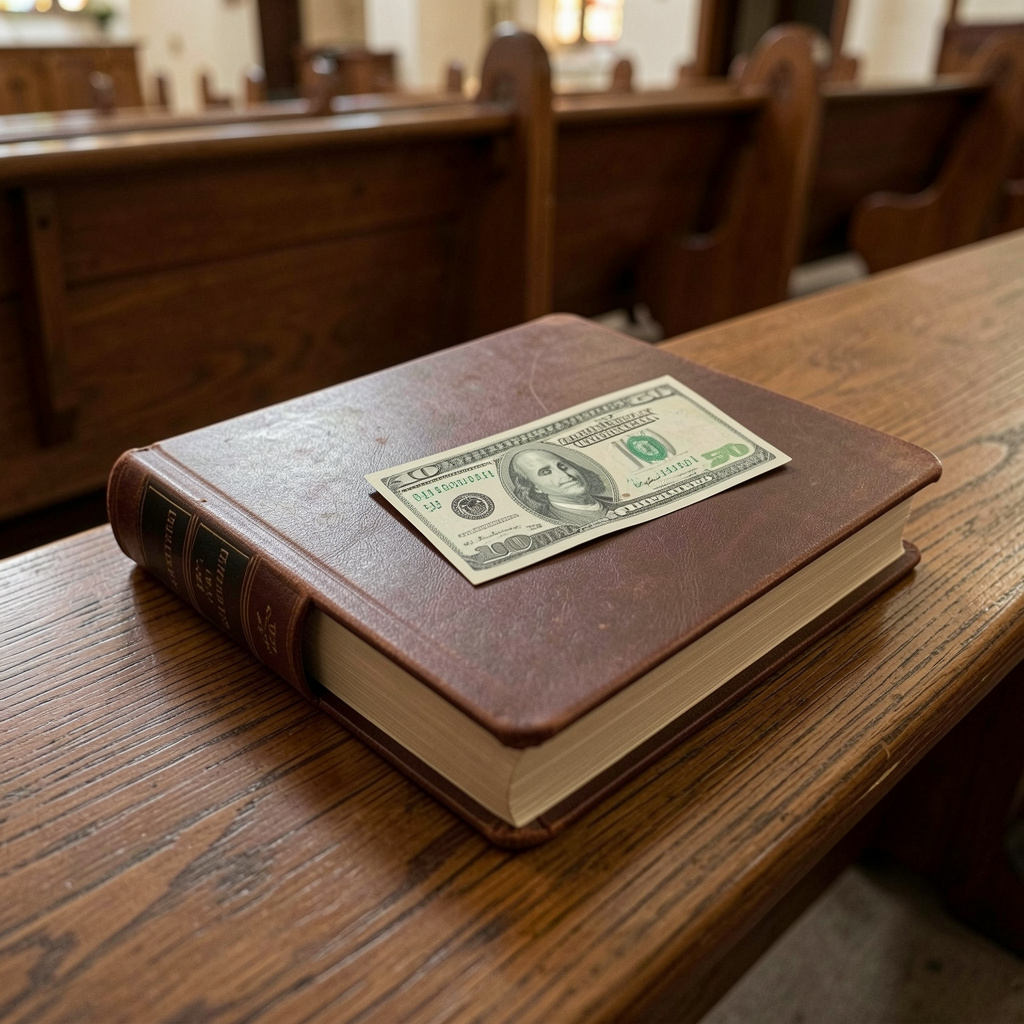
Every first Sunday for nine years, I have found a fifty-dollar bill inside my hymnal. No note, just a clean bill tucked into the pages, always in my pew. The first month I thought someone forgot it. By the third I knew better.
I came early, stayed, watched the ushers. Nothing. In 2022 I switched pews, left side to right, third row to eighth. The next first Sunday the bill was in my new hymnal. Whoever does this knows exactly where I sit.
Last Wednesday our head usher, Leonard, retired after forty-one years. He asked to speak to me in the fellowship hall. He sat with his hands folded the way men do when they’re about to say a true thing, and he told me the fifty dollars was started by my husband.
I said that wasn’t possible. Daniel had been gone eleven years.
Leonard didn’t flinch. He said Daniel set it up in the spring before he died, when the diagnosis had already turned from maybe to soon. He’d come to Leonard — not the pastor, not a deacon, but Leonard, who managed the ushers’ fund and the little metal box in the supply closet where lost-and-found cash sat until somebody claimed it — and asked him to do something for nine years.
Daniel had done the math himself. Fifty dollars, first Sunday of the month, for nine years. He’d paid it all up front, in cash, sealed in an envelope with Leonard’s name on it, and made him promise three things: that he’d never tell me while Daniel was alive, that he’d never tell me unless I asked directly or unless he himself was leaving the position, and that the money would always go in the hymnal in my pew, wherever my pew happened to be.
“He said you’d move pews eventually,” Leonard told me. “He knew you. Said you’d get restless on the left side after a while, that you liked morning light better than I did, accuse me of dimming it on purpose.” Leonard almost laughed at that, the kind of laugh that catches on something wet partway up the throat. “I told him I couldn’t promise to track you for nine years. He said, then make sure whoever’s in this chair after you can. So I wrote it down. Passed it to Carol when I was out for my hip in 2019, she passed it back. It’s in a binder in that closet, if you want to see it. Your name, your pew, the months. All forty rows of paid Sundays, checked off one at a time.”
I want to tell you I cried right there in the fellowship hall, but that’s not what happened. What happened is that I went very still, the way you do when something enormous is moving past you and you’re trying not to spook it. I asked Leonard why fifty dollars. It seemed like an oddly specific number for a man who didn’t think in round figures — Daniel rounded down on tips and up on apologies, but money for its own sake never interested him much.
Leonard said he’d asked the same thing. Daniel told him it was the amount he used to slip me on the first of the month, back when we were newly married and broke in the specific, grinding way only newly married broke people are broke. He’d put it in my coat pocket or my book bag, wherever I’d find it without expecting it, because he liked watching my face when I discovered money I hadn’t been looking for. He said it made me feel lucky instead of looked-after, and he thought those were different feelings, and he liked giving me the first one because the second one, given too often, made people feel small.
That detail undid me more than anything else Leonard said that day, because it was so completely, specifically him. Daniel had opinions like that — small, oddly precise theories about feelings, dignity, the difference between rescuing someone and surprising them — and he never explained them unless you caught him in exactly the right unguarded mood. I hadn’t heard that theory in eleven years. I’d forgotten he had it. And here it was again, secondhand, filtered through a retiring usher in a fellowship hall that smelled like old coffee and floor wax, landing on me like it had been mailed from somewhere very far away and had only just arrived.
I remembered, suddenly and completely, a Tuesday morning early in our marriage when I found two twenties and a ten folded into the toe of my winter boot, of all places, discovered only because I’d been late for work and had to dig the boots out from the back of the closet on the season’s first cold morning. I’d called him at the auto shop where he worked then, half laughing, half irritated, asking what on earth the money was doing in my boot, and he’d said, very seriously, that he liked the idea of money finding me in places I wasn’t looking, because anybody can hand you cash and watch your face fall into the practiced shape of gratitude, but almost nobody gets the chance to watch you discover something. He liked discovery. He’d said it like a man defending a position in a debate nobody else was having, and I’d laughed it off then because we were twenty-four and broke and it seemed like a charming, slightly odd thing young husbands say. I had not thought about that boot in over twenty years. Leonard’s fellowship-hall sentence had reached back through two decades and pulled it out whole, undamaged, like it had been waiting the entire time for permission to resurface.
I asked Leonard whether Daniel had said anything else — anything beyond the mechanics of bills and bank visits and the binder in the closet. Leonard hesitated in the particular way of a man deciding how much of someone else’s heart he’s allowed to hand over secondhand. He said Daniel told him, near the end of that conversation, that he wasn’t doing this because he felt guilty about dying, and he wanted Leonard to understand that distinction clearly, because Leonard had apparently looked at him with exactly the kind of pity Daniel couldn’t stand. He said he was doing it because he’d spent fourteen months watching me become extremely competent at things no one should have to become competent at — injections, insurance appeals, the particular bureaucratic cruelty of being told the same information four times by four different departments — and competence like that hardens a person in ways that are useful and also a little sad. He wanted, he said, for there to be one corner of my life for the next several years that didn’t require any competence from me at all. Just a hymnal. Just a bill. Just luck, undeserved and unexplained, arriving on a schedule he’d already finished worrying about so I never had to.
Leonard said he’d written that part down too, in the margin of the binder, not because the arrangement required it but because he didn’t trust himself to remember it accurately nine years later, and he’d wanted to be able to hand it to me in something close to Daniel’s own words, rather than a paraphrase worn smooth by retelling.
I asked Leonard the obvious question: how. Nine years of fifty-dollar bills is over five thousand dollars. Daniel hadn’t left an estate that could absorb a secret expense like that without my noticing, and I’d gone through every account, every drawer, every shoebox in the back of our closet in the terrible administrative fog of that first year, the year where grief and paperwork braid together so tightly you can’t always tell which one you’re doing.
Leonard said Daniel had given him a single envelope, once, at the very start. Not monthly. Not staggered. The whole amount, counted out in cash, more money than Leonard had ever held that wasn’t already designated for something — a roof, a mission trip, the heating bill for the fellowship hall the winter the furnace finally gave out. Daniel told him exactly what he wanted: small bills converted into clean fifties at the bank, never anything worn or soft at the corners, because he didn’t want me to ever wonder if it was the same bill recycled, sitting in some drawer being handed back to me over and over like a magic trick. He wanted each one to feel new because, he said, that was the whole point — new luck, not old debt.
I asked where a man with a mortgage and a daughter starting community college found over five thousand dollars to hand to an usher in an envelope.
Leonard’s hands tightened on each other, just slightly. He said he didn’t know the whole story, only the part Daniel told him, which was that it came from selling something. Not the truck, not anything obvious like that — I’d have noticed an empty space in the driveway. Something smaller, something Daniel said I wouldn’t miss because I’d never really known he had it.
That sent me down a road I hadn’t expected to walk that week. I went home and did something I hadn’t done in years, which was open the cedar chest at the foot of our bed, the one that still smells faintly like him in a way no candle has ever managed to override. Underneath the folded quilts and the box of photographs I take out maybe once a year, there’s a smaller box, a cigar box really, where Daniel kept what he called his nonsense — concert ticket stubs, a pocketknife with a chipped handle, a brass pocket watch that had belonged to his grandfather and never once told accurate time as long as I knew him.
The watch wasn’t there.
I sat on the floor of our bedroom for a long time with that empty space in the box staring back at me. I remembered, vaguely, asking him once, maybe eight years ago, where the watch had gone, and him saying something about getting it cleaned, and me believing him, because why wouldn’t I, and then never asking again because it’s such a small thing, a broken watch from a man who’s been dead a long time even to the man who kept it.
He’d sold his grandfather’s watch. The one object in that cigar box he actually cared about, the one he used to wind on Sunday mornings out of habit even though it never kept time worth trusting, the one he said he’d give to our daughter’s husband someday, if she ever had one, because that’s what you do with watches that don’t work — you pass them down anyway, for the gesture.
He sold it to buy me nine years of small, undeserved luck.
The next morning, instead of going to the grocery store the way I’d planned, I drove to Whitcomb’s, the jeweler and pawnbroker downtown that’s been in the same storefront since before I was born. I don’t know what I expected to find. Eleven years is a long time for a watch to sit anywhere.
The man behind the counter — not the original Mr. Whitcomb, but his son — listened to my question with the patient, slightly wary look of someone used to widows coming in asking about things that probably don’t exist anymore. But he pulled out an old paper ledger and ran his finger down a column until he found a March, eleven years back. He read the entry without showing it to me. A gentleman’s pocket watch, non-functioning movement, sentimental engraving on the case back. The engraving was the only reason it had stuck in his memory at all — three initials and a date, D.M.H., 1952, which would have been Daniel’s grandfather, a man I never met but knew through Daniel’s stories about him fixing radios in a garage that smelled like solder and burnt coffee.
The watch had sold within the month, he said, to a collector who wanted broken movements to restore as a hobby — either a strange coincidence or the kind of small mercy the universe occasionally allows. He didn’t know where it was now. I didn’t ask for more. It felt like asking too much of the story, like wanting a ribbon tied on something that was never meant to resolve so neatly. Daniel hadn’t kept the watch for me to eventually recover it. He’d traded it for something he thought mattered more, and chasing its current owner would have turned an act of love back into a transaction.
I drove home without the groceries and sat in the driveway for a while before going inside, the engine off, just watching the neighbor’s dog patrol the fence line the way he does every morning regardless of who’s watching.
I want to be careful here, because grief makes people sentimental in ways that flatten the truth, and I don’t want to flatten Daniel into something simpler than he was. He wasn’t a saint. He forgot anniversaries with a consistency that would have been impressive if it weren’t so maddening. He left dishes in the sink with the specific confidence of a man who believed dishes solved themselves overnight. He was, in the ordinary ways husbands are difficult, difficult. But he had this other quality, underneath the dishes and the forgotten anniversaries, which was a kind of long-range tenderness, a willingness to plan kindness the way other men plan retirement accounts. He thought in decades when it came to taking care of me. I just hadn’t known it, because the whole architecture of it was built to be invisible.
I asked Leonard one more thing before he left the fellowship hall that day, which was why he was telling me now, after nine years of keeping a promise that must have weighed on him at odd moments — every first Sunday, watching me find the bill, knowing exactly what I didn’t know.
He said the promise had three conditions, and the third one had finally come. He was leaving the position. There would be no one left in that chair who knew the binder existed unless he handed it to someone, and Daniel’s instructions hadn’t accounted for handing the secret down forever — only for as long as someone in that role remembered to keep it. Leonard said he’d thought about just quietly stopping, letting the fifty-dollar bills end the way most quiet arrangements end, without ceremony, fading into the kind of thing you assume you misremembered. But he said that felt like a smaller betrayal than telling me, and he’d rather give me the truth than let the money simply stop one Sunday with no explanation, leaving me to wonder what I’d done to lose it.
There’s a kind of math grief does on its own, independent of anything you ask it to calculate. Daniel died in March, eleven years ago, on a Tuesday, in a hospital room with a window that looked out over a parking garage instead of anything worth looking at. He’d been sick for fourteen months by then, long enough for both of us to run out of the easy kindnesses and arrive, eventually, at the harder, more honest ones — the kind where you stop pretending the future is coming and start actually saying things to each other instead. I have always believed, in the private accounting I do about my marriage, that those fourteen months were when Daniel and I were most truly known to each other, more than the twenty-two years before them. It is a strange comfort, and not one I’ve explained well to anyone, including myself.
But I had never once suspected he was also, during those fourteen months, quietly building something that would outlast him by nearly a decade. While I was learning to give injections and track medications and negotiate with insurance companies on hold music loud enough to give a person a headache, he was apparently sitting with Leonard in this same fellowship hall, working out the exact denomination of bill, the exact ritual of placement, the precise ethical boundary of when I was and wasn’t allowed to be told. He was dying in increments, and in between those increments, he was planning my Sundays for the next nine years.
I called our daughter, Marianne, that same evening, mostly because I didn’t trust myself to hold the story alone for an entire night without it changing shape in my hands. She’s thirty-one now, married, living three states away in a life that looks, from the outside, very settled and very far from the version of herself who started community college the spring her father got sick. I told her everything Leonard had told me, in roughly the order I’d received it, and I could hear her go quiet on the other end of the line in the particular way she goes quiet when she’s trying not to cry in front of someone, even over the phone, even when the someone is her own mother.
She remembered the watch, too, though differently than I did. She told me her father used to let her wind it when she was small, sitting on his knee at the kitchen table on Sunday mornings before church, the two of them treating the watch’s permanent inaccuracy as a kind of family joke — it’s always almost time, he used to say, as if the watch had its own gentle philosophy about punctuality. She hadn’t known it was gone until I told her. She asked if I was angry that he’d sold something that was, in some sense, also hers, a piece of her own inheritance quietly converted into cash before she ever had the chance to want it.
I told her I’d asked myself the same question, alone in the bedroom with the empty cigar box, and the answer I kept arriving at was no — not because the watch didn’t matter, but because her father had clearly decided, in the brief and terrible window he had to decide anything at all, that nine years of his wife believing the world still loved her mattered more than one more object sitting in a drawer, waiting to be passed down to people who’d mostly remember it as broken anyway. She was quiet again for a while after that, and then she said something I’ve turned over in my mind every day since: that maybe this was its own kind of inheritance, just not the kind you can hold in your hand. Maybe what he’d actually left both of us was evidence — proof, arriving years apart and through different messengers, that he’d loved us with more foresight than either of us had given him credit for while he was alive to take the credit himself.
I went to church the following first Sunday — not because I needed to test whether the money would still be there, since Leonard had already told me the binder showed three more months paid in advance, the last of it, the final installment of a promise that was always going to end whether or not I knew it was running — but because I wanted to sit in the pew and feel what it felt like now that I understood it.
It felt different. Not less, exactly. Different.
For nine years, the fifty dollars had been a small mystery I’d folded into my faith without quite meaning to — proof, however irrational, that the world still occasionally arranged itself in my favor, that grace sometimes showed up in a hymnal instead of a sermon. I’d told myself it was probably some anonymous member of the congregation with a quiet habit of generosity, someone who’d noticed I was a widow on a fixed income and decided, without ever needing credit, to make my months a little easier. I’d built a whole private theology around a stranger’s kindness, and I’d loved that theology, because it asked nothing of me but gratitude.
Now I knew it wasn’t a stranger. It was the single least mysterious explanation possible — my own husband, doing what he always did, which was love me in a way that required nobody’s witness but mine, eventually, on a delay he’d calculated down to the year.
I found the bill in the hymnal that Sunday, same as always, tucked between two pages of a hymn I don’t think I’ve ever actually sung from memory, “Great Is Thy Faithfulness,” which feels now like either an enormous coincidence or the kind of detail Daniel would have arranged on purpose, because he liked that kind of quiet joke, the kind only one person would ever get, and only if they were paying very close attention a decade later.
I held the bill for a long time before I put it in my purse. I thought about the watch, the one that never told accurate time, sold to a man at some pawn shop or jeweler eleven years ago for however much a worn brass pocket watch with sentimental damage is worth, which probably wasn’t five thousand dollars on its own — meaning Daniel had likely added his own money on top of it, scraped together from wherever a dying man scrapes things together when he’s trying to leave one more gift behind a door he won’t be alive to open.
I don’t know if I’ll keep coming to this church for the rest of my life. I think about moving closer to my daughter some years, when the winters here get long enough to make me reconsider everything. But I know that for the rest of however many first Sundays I have left, whether I’m in this building or another one entirely, I will think of Daniel at the bank, converting small bills into fifties, asking for the cleanest ones in the drawer, telling Leonard not the soft ones, the new ones, because he wanted, even from eleven years and counting away, for me to feel lucky.
Not looked-after. Lucky. He’d been very particular about the difference.
I think, now, that the real gift was never the money. It was the nine years of not knowing, which let me believe, every first Sunday, that I was the kind of person the universe occasionally decided to bless without explanation. Daniel gave me that belief on purpose, and then he gave me the truth behind it only when the belief had run its course, when there was no version of “ending” that wouldn’t eventually require an explanation, and he’d rather it be the true one than the one I might invent on my own, alone, wondering what I’d lost.
Leonard asked me, before he left the fellowship hall that day, if I was angry — at the secrecy, at the years of not knowing, at having been managed, in a sense, by a dead man’s careful planning.
I told him no. I told him it was the opposite of anger. It felt like getting a second, much smaller funeral, one without sermons or casseroles or people pressing my hand too hard in the receiving line, just me on the floor of my bedroom with an empty cigar box and eleven years of catching up to do. Daniel had been gone for over a decade, but apparently he wasn’t finished. Apparently there was one more thing he wanted to tell me, and he’d built an entire decade-long apparatus, an usher’s promise and a binder in a supply closet, just to make sure the timing was his and not anyone else’s, not even mine.
Three more Sundays, the binder says. After that, the hymnal in my pew will be just a hymnal, same as anyone else’s, and the bank will go on converting small bills into fifties for whoever asks, with no idea those particular fifties were ever anything more than money.
But I’ll know. I’ll sit in my pew, on whichever side the morning light is better, and I’ll know exactly what an empty hymnal means now, which is not absence, not really. It’s a man who finished what he started, on schedule, the way he never managed to do with the dishes, because some promises he kept and some he just never got around to, and I’ve stopped expecting him to be the same kind of careful about everything. He was careful about this. That has to be enough, and most days, it more than is.