The year had taught me how to breathe through humiliation without letting my face show it. I thought I’d graduated. I thought I’d built enough armor that nothing left over from my marriage could touch me anymore.
Then I saw Diane Castellano’s reflection in the glass door of Lakeview Fertility & Wellness Center, and I understood that some armor only gets tested when you least expect it.
It was a Tuesday morning in March, exactly thirteen months after the divorce was finalized. I’d taken the morning off work — I was a marketing coordinator at a mid-sized architecture firm in Denver, the kind of job that let me disappear for a few hours without anyone asking too many questions — and I’d driven to the clinic with the particular calm of someone who has rehearsed being calm for a long time.
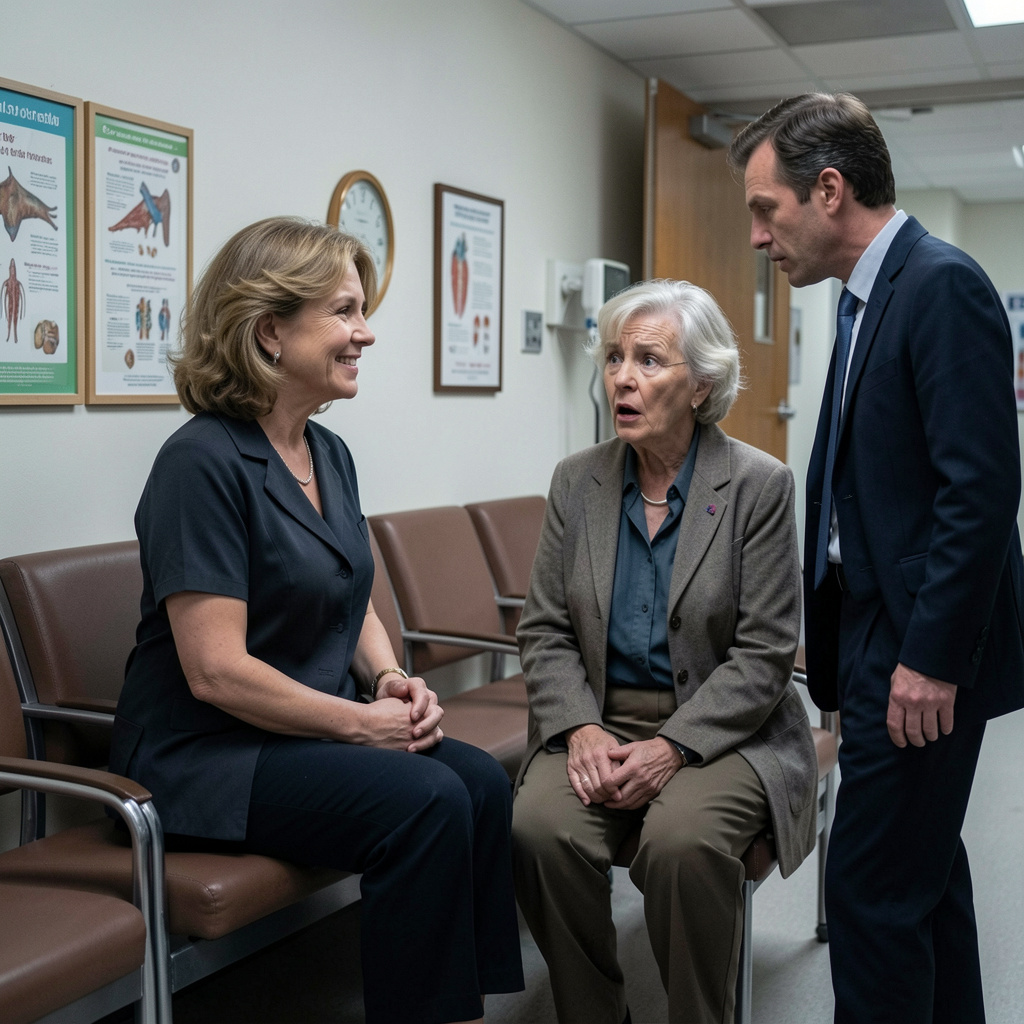
The waiting room smelled like lavender air freshener fighting a losing battle against hand sanitizer. Soft jazz piped through ceiling speakers. I’d checked in, taken a seat near the window, and opened a book I had no intention of reading, because the words on the page were never the point. The point was having something to look at that wasn’t another person’s face.
That was when I heard her voice. The voice that used to make my stomach drop before I even understood why.
“Well. Look who it is.”
I didn’t need to glance up to know it was Diane. Nobody else delivered four words like a verdict.
She was standing a few feet away in a cream-colored coat that probably cost more than my monthly rent, her hair freshly set, her mouth curved into the particular smile she’d perfected over decades of being the kind of woman who enjoyed being right. I had spent four years as her daughter-in-law and most of those years trying to earn an approval that, I eventually realized, had never actually been available to me. Diane didn’t believe in approving of people. She believed in tolerating them until they proved unworthy, and then she believed in never letting them forget it.
“Diane,” I said, closing my book with deliberate slowness. “It’s been a while.”
“Has it?” She tilted her head, studying me the way you’d study a piece of furniture you were trying to decide whether to throw out. “You look tired, Renata. Are you sleeping all right?”
There it was — the opening volley, dressed up as concern. I’d forgotten how good she was at this. Or maybe I’d just forgotten how much it used to cost me to stand there and take it.
“I sleep fine,” I said. “What brings you here?”
I already knew, in a vague sense, what brought most people to a fertility clinic. I just hadn’t expected the specific answer that came next, delivered with the triumphant lift of someone who had been waiting months for the chance to say it out loud to my face.
“I’m here for my granddaughter’s appointment, actually,” Diane said. “Well — granddaughter-to-be. Marisol is seeing Dr. Albrecht about the second round.” She paused to let that land, watching my expression with the patience of a woman who had budgeted extra time for this exact performance. “You remember Marisol. Your old friend.”
I did remember Marisol. Marisol Pena had been my closest friend for nine years before she became something else entirely — the woman my husband Theo had been seeing for the final eight months of our marriage, the woman he’d married eleven weeks after our divorce was finalized, the woman whose name I had trained myself not to flinch at when other people said it in front of me.
“Marisol’s pregnant?” I asked, keeping my voice level.
“Trying to be,” Diane said, and there was no mistaking the relish in it now. “It hasn’t been easy for them, poor things, but they’re determined. Theo says it’s the one thing he really wants — a family of his own, finally, with someone who actually wants the same things he does.” Her eyes flicked over me, head to foot, with the casual cruelty of a woman delivering exactly the blow she’d intended. “He made the right choice leaving you, you know. I never said it before, out of politeness, but I think it’s time you heard it from someone who isn’t afraid to say it. You were never going to give him what he wanted. Marisol will.”
The waiting room kept humming along around us — a man rustling a magazine, a receptionist murmuring into a phone, the soft churn of a white noise machine in the corner — while I sat there absorbing a sentence clearly built to wound. A year ago, that sentence might have. I had spent the better part of three years in that marriage being quietly, methodically convinced that the problem standing between Theo and the life he wanted was me. Diane had been one of the architects of that conviction, dropping comments at holiday dinners about how “some women just aren’t built for motherhood” with her eyes drifting pointedly in my direction, asking me at every family gathering whether we’d “thought more seriously” about treatment, as though my body were a faulty appliance the family had generously agreed to keep around despite the inconvenience.
What Diane didn’t know — what almost nobody in that old life knew — was where the actual fault had lived. Not in me.
I let the silence stretch for exactly as long as it took to decide I wasn’t going to give her the reaction she was hunting for. Then I smiled, the same calm, unhurried smile I’d practiced in my car more times than I’d like to admit, the smile that cost nothing and revealed nothing.
“Is that what you think?” I said.
It wasn’t defiance, exactly. It wasn’t even really a question. It was just enough to make her blink, because Diane Castellano was used to people either crumbling or fighting back, and I was doing neither. I was simply standing in the space between those two reactions, calm as still water, and it visibly unsettled her more than tears ever would have.
“What else would I think?” she said, recovering quickly, jutting her chin up. “It’s not exactly a secret, dear. You couldn’t give him children. He found someone who could. That’s just biology.”
“Mm,” I said, and went back to looking at my book, though I wasn’t reading a word of it.
She was still standing there, clearly waiting for me to dissolve, when the door from the parking lot opened and a man stepped through it, shaking rain off his jacket. He was tall, dark-haired, wearing the kind of soft gray sweater that looked deliberately chosen, carrying two coffees in a cardboard tray. He scanned the room, found me, and smiled — the easy, unguarded smile of someone who’d been looking forward to seeing me all morning.
“Sorry I’m late,” he said, crossing toward me. “Traffic on Speer was a disaster.” He held out one of the coffees. “Oat milk, extra shot, just how you like it.”
“Thank you,” I said, taking it, and let myself smile back at him — a real one this time, not the rehearsed kind.
It was the sight of him, more than anything I’d said, that made Diane’s face change. I watched the recognition land in stages: first confusion, because she clearly didn’t know who this man was; then a flicker of calculation, her eyes darting between us, trying to assemble a story that made sense; then, finally, the moment everything clicked into place and the blood actually drained out of her face.
Because the man standing beside me, setting his hand lightly and naturally on my shoulder, was Dr. Marcus Albrecht.
The same Dr. Albrecht that Marisol was seeing for her second round.
“Diane,” he said pleasantly, with the easy warmth of someone greeting a familiar face in an unfamiliar context. “I didn’t realize you’d be here this morning. Are you here with Marisol?”
Diane opened her mouth. Nothing came out for a long moment. I watched her gaze travel from his hand on my shoulder to my face to the ring on my left hand that she clearly hadn’t noticed until just then — a slim band of rose gold, nothing flashy, exactly the kind of thing you’d miss if you weren’t looking — and something inside her visibly recalibrated.
“You two are—” she started.
“Engaged,” Marcus said easily, before she could finish stitching together whatever sentence she’d been building. “Eight months now. We’re actually here for our own appointment.” He checked his watch. “We should head back, actually — Dr. Albrecht likes punctuality, even when Dr. Albrecht is the one running late.” He grinned at his own joke, the kind of small private humor that belongs to people who’ve been together long enough to have inside jokes about themselves.
I should explain, for context Diane didn’t have and never would have guessed: Marcus wasn’t actually my treating physician. We weren’t here for an embryo transfer or a consultation about my own fertility, although I had, in fact, spent two unsuccessful years in this very building trying every possible explanation for why Theo and I weren’t conceiving — testing my hormone levels, charting cycles, enduring the indignity of being asked, again and again, whether stress might be the culprit, whether I was sleeping enough, eating enough, relaxing enough, as though my body were the only variable in the equation worth investigating.
It was only after the divorce, almost as an afterthought, that Theo had finally agreed to be tested himself — something he’d resisted for years, waving it off with a vague, wounded pride, insisting the problem clearly wasn’t him. The results, when they finally came in, were unambiguous. Severe male factor infertility. Something that had likely been true the entire time we were married, the entire time Diane had been making pointed comments about “biology” at Thanksgiving, the entire time I had quietly absorbed the blame for something that had never been mine to carry.
I hadn’t found out about it through any dramatic confrontation. Marisol had told me, actually — not out of cruelty, but in a strange, halting, almost apologetic phone call eight months after the wedding, when she and Theo had started their own struggles and she’d needed someone to talk to who understood the territory. It hadn’t repaired our friendship. Some things don’t survive betrayal even when an apology eventually limps in behind it. But it had answered a question that had quietly eaten at me for years, and there was a strange, settling relief in finally knowing the truth wasn’t what I’d been told it was.
Marcus knew all of this. He’d been my physician once, briefly, before we became something else to each other — slowly, carefully, over a year of him being the only person in my life who’d looked at my test results and said, plainly, “There’s nothing wrong with you,” and meant it. We’d kept our relationship quiet through most of it, partly out of professionalism while I’d technically still been a patient of the practice, and partly because I simply hadn’t wanted Theo’s family circling it, turning it into another story for them to narrate about me.
But Diane didn’t need to know any of the specifics. All she needed to see was what was right in front of her: the woman she’d just finished telling that nobody wanted, sitting in a waiting room with a doctor’s hand on her shoulder, a ring on her finger, and absolutely none of the desperation Diane had spent years insisting defined me.
“I should— Marisol’s expecting me,” Diane said, her voice noticeably smaller than it had been five minutes earlier. She gathered her purse against her side like a shield. “I’ll just—”
“It was good to see you, Diane,” I said, and I meant it more honestly than she probably realized. It genuinely had been good — not because I’d wanted to humiliate her, though watching her scramble for composure was not without its satisfactions, but because some part of me had needed this exact moment to understand how far I’d actually traveled. A year ago, an encounter like this would have sent me to my car in tears. Today, I felt something closer to mild pity, watching a woman who’d built her sense of superiority on incomplete information realize, in real time, just how incomplete it had been.
She didn’t say anything else. She turned and walked quickly toward the inner hallway, her heels clicking out a rhythm of retreat, and didn’t look back.
Marcus settled into the chair beside me, sipping his coffee, watching her go with an expression that was trying hard to be neutral and not quite managing it.
“You didn’t have to do that,” I said.
“Do what? Get coffee?”
“You know what I mean.”
He shrugged, not quite suppressing a smile. “I didn’t do anything except exist in a waiting room with my fiancée. She did all the rest herself.” He glanced at me sideways. “You okay?”
I thought about it honestly before answering, because the old version of me would have said yes automatically, regardless of the truth, simply to avoid being any kind of inconvenience. “Yeah,” I said, and found that I meant it. “Actually, I think I am.”
I thought, sitting there, about the version of myself who used to dread these family encounters so completely that I’d plan elaborate routes through Denver just to avoid running into the Castellanos at the grocery store. I thought about the Thanksgiving when Diane had loudly wondered, in front of twelve relatives, whether I’d “really tried” the fertility supplements she’d mailed me — supplements I’d taken religiously for eight months, charting every dose in a notebook I still had somewhere, evidence of a desperation I was no longer willing to feel ashamed of. I thought about the Christmas when she’d given Marisol’s children — from Marisol’s first marriage, before any of this — lavish, thoughtful gifts, and handed me a gift card to a chain restaurant with my name spelled wrong on the envelope, as though even her contempt couldn’t be bothered to get the details right.
I thought, too, about Theo, and the strange numbness that had settled over me by the time our marriage actually ended — not heartbreak so much as exhaustion, the particular fatigue of having spent years defending a relationship that had quietly stopped defending me back. He hadn’t been cruel, not exactly. He’d been absent in the specific way some people manage to be absent while still technically present: agreeing with his mother’s comments by saying nothing, letting her version of events stand unchallenged at dinner after dinner, never once turning to her and saying, that’s not fair to my wife. I used to tell myself that silence wasn’t the same as agreement. It took me a long time, and a lot of therapy, to understand that in a marriage, silence usually is.
There’s a particular kind of freedom in finally being believed — not by the people who hurt you, who will likely never fully revise their version of events, but by yourself. For a long time after the divorce, I’d carried Diane’s narrative around like a stone in my coat pocket: that I was the reason the marriage had failed, that my body had been the obstacle, that some fundamental insufficiency in me had cost Theo the family he wanted. It had taken a long time, and a lot of quiet, lonely nights, to set that stone down and recognize it had never belonged to me in the first place.
Watching Diane’s face go pale in that waiting room wasn’t really about winning, even though some small, unkind corner of me had enjoyed it. It was about the relief of no longer needing to win anything from her at all. She could believe whatever she wanted about why my marriage ended. She could keep narrating Marisol’s pregnancy attempts as some kind of cosmic justice for my supposed shortcomings. None of that had any real claim on my life anymore.
We finished our coffee and went in for our own appointment a few minutes later — a routine consultation, nothing dramatic, just the ordinary business of two people building a future together, methodically and without the shadow of anyone else’s expectations hanging over it. Marcus held my hand in the hallway the way he always did, like it was the easiest, most natural thing in the world, and for the first time in longer than I could remember, it actually was.
I never found out whether Marisol’s second round worked. I heard, eventually, through the loose threads that connect even severed social circles, that she and Theo eventually pursued other options — donor sperm, I think, though I never asked for details and nobody offered them unprompted. I hope it worked out for them, honestly. Not out of saintly generosity, but because carrying resentment toward people who are no longer central to your life is its own kind of weight, and I had already set down enough weight for one lifetime.
A few months after the encounter at the clinic, I ran into Marisol herself — not Diane this time, but Marisol, alone, at a farmer’s market near my new apartment in the Highlands. We hadn’t spoken since the divorce, not really, beyond that one strange, halting phone call. I half expected her to turn and walk the other way when she saw me, the way you do when you owe someone an apology you’re not ready to give. Instead she came over, looking tired in a way that had nothing to do with makeup or sleep, and said my name like a question.
We didn’t talk long. There wasn’t much to say that wouldn’t have required either of us to relitigate things neither of us had the stomach for anymore. But she asked how I was doing, and when I told her — genuinely, simply — that I was doing well, that I was engaged, that life had turned out to be wider than the version of it I’d been living with Theo, something in her face shifted. Not envy, exactly. Something closer to recognition. I think she had spent a long time assuming my life had narrowed after the divorce, the way Diane clearly assumed it had, and seeing otherwise seemed to cost her something to absorb.
“I’m glad,” she said finally, and I believed her, even though I knew it was complicated for her to mean it.
I didn’t tell her about Theo’s test results. It wasn’t my secret to spend, and besides, I no longer needed her to know the truth in order to feel at peace with it myself. That was, I think, the real marker of how far I’d come — not the satisfaction of being right, but the fact that being right had quietly stopped mattering as much as simply being okay.
What I kept, instead, was the memory of Diane’s face in that waiting room — not as a trophy, but as a marker. A point on the map showing exactly how far I’d come from the woman who used to shrink in that family’s presence, apologizing for things that were never her fault, absorbing blame that belonged somewhere else entirely.
Marcus and I got married the following spring, in a small ceremony in Cherry Creek with maybe thirty guests, none of whom had the last name Castellano. My mother cried during the vows in the specific, relieved way mothers cry when they’ve spent years quietly worrying about a daughter and finally get to stop. Marcus’s sister gave a toast that referenced, lightly and with great affection, the fact that we’d met in a waiting room — though she left out, mercifully, the part about my ex-mother-in-law’s face going pale across the room from us.
Sometimes the best response to someone’s cruelty isn’t a clever line or a dramatic comeback. Sometimes it’s simply living a life so settled, so quietly whole, that their story about you stops fitting the moment they actually look at you. Diane had walked into that waiting room expecting to find the wreckage she’d helped create. Instead, she found someone who’d built something new entirely out of the pieces, and there was nothing she could say to that — nothing at all — except turn around and walk away.
Is that what you think?
I still smile when I remember saying it. Not because it was clever. Because, by then, it had stopped being a question I needed anyone else to answer.