My mother has never been a complainer. Seventy-five years old, and I can count on one hand the number of times I’ve heard her admit to pain. She raised four kids on a school secretary’s salary after my father left, and somewhere in those years she trained herself to treat her own body like a guest she didn’t want to trouble. So when she called me on a Tuesday morning in March and said, “Lena, honey, my stomach’s been burning something awful,” I dropped the laundry basket I was carrying and sat down on the stairs.
“How long?” I asked.
“Oh, a few weeks. I thought it was the chili I made. Then I thought it was my blood pressure pills. It comes and goes.”
“Mom, weeks?”
“I didn’t want to bother anyone.”
That was the whole tragedy of her, right there, in six words.
I told her I was coming over, and she protested the way she always did — don’t leave work, don’t make a fuss, I’ll take some antacids — and I told her I was coming anyway. I called my husband, Dorian, on my way out the door, mostly out of habit, the way you tell someone in your house where you’re going.
“She’s probably fine,” he said. “You know how your mother is. A little attention, a little sympathy, and she’s a new woman.”
“She doesn’t ask for attention, Dorian. That’s the opposite of who she is.”
“I’m just saying. Old people get aches. It doesn’t mean it’s a tumor every time.” A pause, and then, in a voice that I wish I could say surprised me, but didn’t, not really: “And if it is something, we’re not made of money right now. You know that.”
I didn’t answer him. I hung up and drove to my mother’s apartment with my hands too tight on the wheel, telling myself it was the traffic.
I want to explain something about my marriage before I go further, because otherwise none of what happened next will make sense.
Dorian and I had been married for eleven years. He was charming in the specific way that men are charming when they’ve never had anyone push back on them — quick with a joke, generous in public, the guy who picks up the check at dinner with friends and waves off the thanks. Privately, he counted things. He knew exactly what I’d spent on groceries that week. He knew the balance of every account, mine included, down to the cent, and he had opinions, freely given, about whether my mother’s “little health scares” over the years had been worth the co-pays.
I used to tell myself this was just frugality. Some people grew up with money fear baked into their bones, and Dorian’s father had lost a business once, and surely that explained it. I had built him a whole architecture of excuses, the way you do when you love someone and don’t want to look directly at what’s underneath the love.
What I didn’t know yet — what I wouldn’t know for another nine days — was that Dorian wasn’t being frugal at all. He was being careful. Those are not the same thing, though I’d spent a decade mistaking one for the other.
My mother answered the door pale, one hand pressed flat against her stomach like she was holding something in. She tried to smile at me the way she always did, like an apology for needing anyone at all.
“It’s nothing, really,” she said. “You didn’t need to come.”
I didn’t argue with her. I just got her shoes, got her coat, and got her into the car, and she didn’t fight me on any of it, which told me more than her face did. My mother does not get into a car without a fight unless something in her already knows.
The emergency room at St. Augustine’s was its usual Tuesday-afternoon chaos — a man with a wrapped hand, a toddler shrieking over a fever, the particular fluorescent hum that makes every hospital in America feel like the same hospital. I gave them her insurance card, her list of medications, her age, her symptoms — epigastric burning, three weeks, intermittent, worse at night — and then we waited.
I didn’t tell Dorian I’d actually taken her in. I told myself I’d update him once we knew something, which was a kind of lie I was telling both of us. The truth was simpler and uglier: I didn’t want to hear him say I told you it was nothing before we even had results, and I didn’t want to give him the chance to talk me out of tests “just to be safe with the budget this month.” So I didn’t call. I sat in a blue vinyl chair holding my mother’s hand while a triage nurse took her blood pressure, and for the first time in longer than I want to admit, I felt like I was doing something for my mother instead of doing something for my marriage.
They did blood work first. Her white count was elevated, nothing dramatic, but enough that the ER doctor — a tired, kind man named Dr. Okafor who looked like he’d already worked a double — frowned at the chart longer than I liked.
“We’re going to get a CT of her abdomen,” he said. “Just to rule things out. Could be an ulcer, could be her gallbladder, could be nothing at all. But I’d rather look than guess.”
“Of course,” I said. “Whatever you need to do.”
My mother squeezed my hand. “This is going to cost a fortune,” she whispered, and I almost laughed, because even then, even scared, her first thought was the bill.
“Don’t worry about that,” I told her. “Worry about getting better.”
They took her back for the scan a little after four. I sat in the hallway outside imaging, drinking bad coffee from a vending machine, scrolling through nothing on my phone, doing the thing you do in hospitals where time stops behaving like time. I thought about calling Dorian again. I didn’t.
It was almost six when Dr. Okafor found me. He wasn’t alone — there was a second doctor with him, younger, a woman with her ID badge clipped slightly crooked, and something about the two of them walking together toward me made my stomach drop before either of them said a word.
“Mrs. Calloway’s daughter?” the woman said. “I’m Dr. Reyes, I’m a surgical resident. Can we step into a room for a moment?”
“Is she okay? Where is she?”
“She’s resting comfortably. We just want to talk to you somewhere a little more private.”
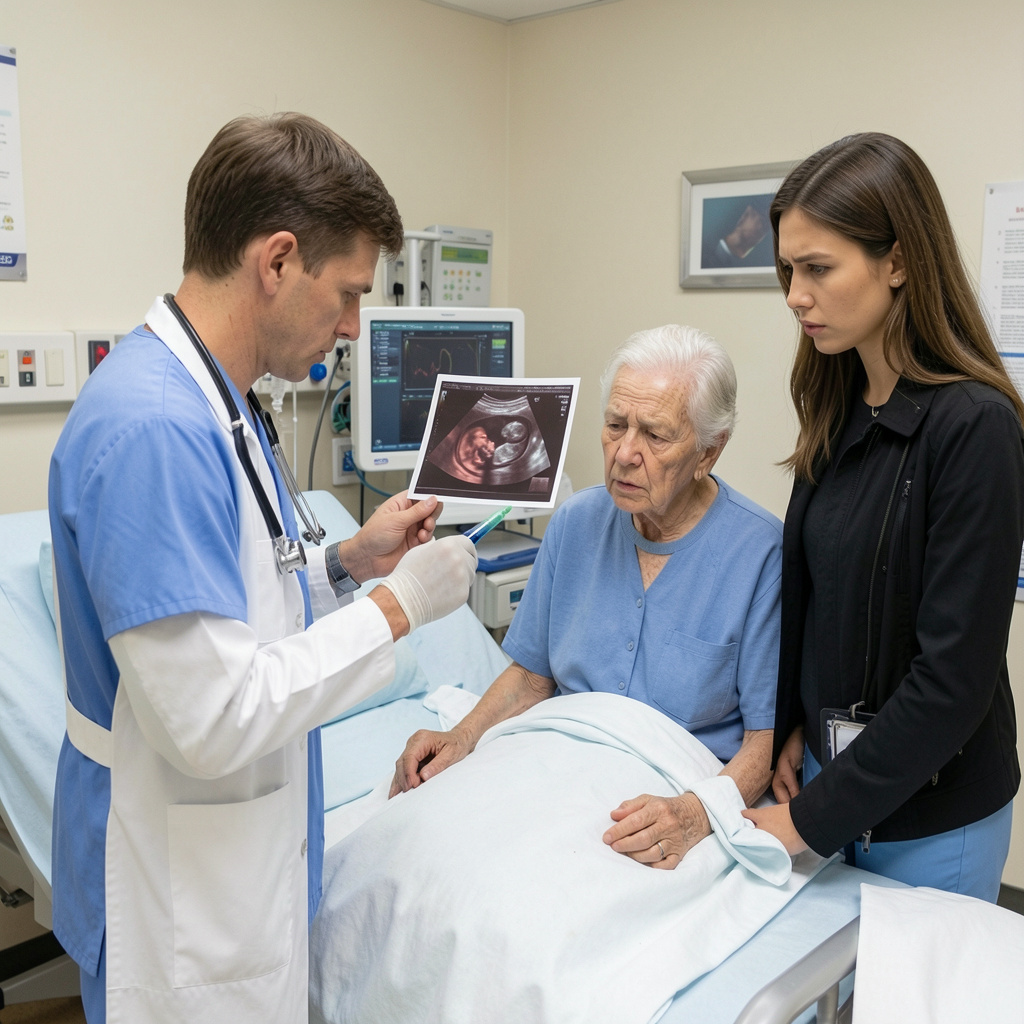
They walked me to a small consultation room near the imaging suite — beige walls, a box of tissues angled too deliberately on the table, the kind of room hospitals build specifically for bad news, though no one ever tells you that’s its purpose until you’re sitting in one. Dr. Reyes closed the door behind us. I remember that detail more clearly than almost anything else that happened that day — the particular, careful way she closed it, like she didn’t want even a draft of hallway noise getting in.
“The CT showed a mass,” Dr. Okafor said. “In her pancreas. There’s also something concerning near the head of the pancreas, close to the bile duct, which is part of why her color’s been a little off — that’s actually a good thing in one sense, because it’s why she noticed symptoms early. A lot of these don’t get caught this soon.”
I heard the words and didn’t, in the way you don’t, at first. Mass. Pancreas. My brain kept trying to slide the words into some less frightening shape and failing.
“Is it — ” I couldn’t make myself finish the sentence.
“We won’t know for certain what we’re dealing with until we biopsy it,” Dr. Reyes said gently. “It could be a number of things, and not all of them are what you’re imagining right now. But given the location and the way it’s behaving, we want to move quickly. We’re going to admit her tonight and get oncology and surgery involved first thing tomorrow.”
“She said it was just burning,” I said, stupidly, like that fact could undo what they’d just told me. “She said it had only been a few weeks.”
“That’s actually fairly typical,” Dr. Okafor said, kindly. “These can be quiet for a long time. The fact that she came in when she did, the fact that you brought her in — that matters. That gives us a real chance to get ahead of it.”
I don’t remember exactly what I said back to them. I remember nodding. I remember Dr. Reyes putting a hand briefly on my shoulder, the practiced, careful touch of someone who does this every day and has never once let it become routine to her, and I remember thinking, with a kind of clarity that arrived like cold water: He told her she was faking it.
That was the moment something in me didn’t break, exactly. It hardened.
I called Dorian from the hallway, my back against the wall, watching nurses move past with a brisk competence I envied.
“Where have you been?” he said, before I could speak. “I’ve called you twice.”
“I’m at the hospital. With Mom.”
A pause. “You took her in? Lena, I told you, I really don’t think—”
“They found a mass on her pancreas, Dorian.” My voice came out flatter than I expected, almost businesslike. “They’re admitting her tonight. They think it might be cancer.”
The silence on the other end went on a beat too long.
“Jesus,” he said finally. “Okay. Okay, that’s — I’m sorry, I didn’t know it was anything like that.”
“You called her a liar this morning.”
“I didn’t call her a liar, I said—”
“You said she was faking it to get money out of me.” I kept my voice low because I was in a hospital hallway, but I made sure every word landed. “She has a mass in her pancreas, Dorian. She wasn’t faking anything. She was scared and she didn’t want to be a burden, and you told her — you told me — that she just wanted attention.”
Another silence, longer this time. And here is the strange thing, the thing I turned over and over in the weeks after, trying to understand what it meant: he didn’t apologize again. He didn’t ask how she was doing, what the doctors said, what came next. What he said was:
“How are they going to pay for all this? Are you putting this on the joint card?”
I stood in that hallway and felt something in my chest go very, very still.
“My mother might have cancer,” I said slowly, “and that’s your first question.”
“I’m just thinking practically, Lena. Someone has to.”
“I have to go,” I said, and hung up before he could answer, and I didn’t cry until I was in my car in the parking garage an hour later, forehead against the steering wheel, the overhead light buzzing on a timer above me.
My mother stayed in the hospital for four days while they ran the biopsy and the additional scans. It turned out to be a neuroendocrine tumor — rare, and frightening in its own right, but caught, the surgeon told us, at a stage where surgery had a real shot at getting all of it. Not a death sentence. A long, hard fight with better odds than either of us had dared hope for in that beige consultation room. I won’t pretend the relief erased the fear. It didn’t. But it gave us something to stand on.
I moved into the spare bedroom of my own house that week — not dramatically, not as a statement, just because I needed somewhere quiet to sleep between hospital visits and I didn’t want to lie next to Dorian and listen to him breathe evenly while I replayed are you putting this on the joint card in my head on a loop. He didn’t ask why. That, too, told me something.
It was on the third night, while I was looking for my mother’s old insurance documents in a drawer in our home office — trying to figure out her secondary coverage so I could get ahead of the bills before they arrived and frightened her — that I found the bank statements.
Not ours. A separate account, in Dorian’s name only, that I had never seen before, tucked inside a folder labeled, with almost insulting plainness, TAXES — MISC. Four years of statements. Money moving in steadily from his paycheck, money moving out in chunks to something called Harlow Capital Partners, which I’d never heard him mention once in eleven years of marriage.
I called the number on one of the statements the next morning, while my mother slept in her hospital bed two floors above oncology, recovering from the biopsy. A bored-sounding woman picked up and confirmed, after I gave her the account number, that Harlow Capital Partners was a private lending fund, and that Dorian Calloway had an outstanding balance of just under sixty thousand dollars, with monthly payments that — when I did the math standing in a hospital cafeteria, my coffee going cold in my hand — matched almost exactly the amount of “extra savings” he was always telling me we didn’t have room for. The money he said didn’t exist for my mother’s medications. The money he said we couldn’t spare for a second medical opinion two years ago when her knee replacement went wrong. It existed. It had simply been going somewhere else.
I didn’t confront him with the statements that day. I held them, and I held my mother’s hand instead, and I let the question sit in me like a stone I was carrying carefully so it wouldn’t drop and shatter on the floor of a place where she needed me steady.
The conversation happened a week later, after my mother’s surgery — which went well, which the surgeon called, with visible relief, “as clean a margin as we could have hoped for” — and after she’d been moved to a step-down unit to recover. I sat Dorian down at our kitchen table with the bank statements between us like evidence in a trial neither of us had asked to attend.
“What is this?” I asked. Not who is Harlow Capital Partners — I’d already learned that. I wanted to hear what he’d call it.
He didn’t reach for the papers. He looked at them the way you look at something you’ve been waiting, with dread, to finally see found.
“It’s a debt,” he said quietly. “From before us. Before the wedding, even. I never told you because—”
“Eleven years, Dorian. You’ve been making payments on a secret debt for eleven years and telling me we couldn’t afford to take my mother to a specialist.”
“It’s not that simple.”
“It’s exactly that simple. You weren’t protecting our money. You were protecting this.” I tapped the statements. “Every time you said we were tight, every time you made me feel guilty for spending on my own mother’s health, you knew this was where the money was actually going. You let me believe she was the expensive one. You let me believe I was being irresponsible, taking her to doctors, when the whole time—”
“I was scared,” he said, and for the first time in longer than I could remember, he didn’t sound smug or certain. He sounded like a much smaller man than the one I’d married. “I took out that loan before I met you, for — it doesn’t even matter now what for. And I kept paying it quietly because I was ashamed, and because once I started lying about it, stopping felt impossible. Every year that went by made it harder to tell you.”
“So instead you made my mother the villain. You told her — no, you told me, to my face — that she was faking being sick to take money from us. While you were secretly bleeding money out of our accounts for years to pay off something you never had the courage to admit to.”
He didn’t answer that. There wasn’t an answer that would have survived contact with the truth sitting on the table between us.
“She has cancer, Dorian,” I said, quieter now, because the anger had burned down into something colder and more permanent. “She has cancer, and the first thing out of your mouth was a question about the credit card. I don’t think I can come back from knowing that about you.”
I won’t pretend the rest unspooled neatly, the way it might in a story written to satisfy. Untangling eleven years of a marriage doesn’t happen over one kitchen table conversation, however clean the moment feels in the retelling. There were more talks after that one — some of them calmer, some of them not, Dorian alternating between genuine remorse and a defensiveness that, even afterward, tried to make the secret debt sound like a private matter he’d simply been entitled to keep. I came to understand that the money wasn’t really the center of it. The center of it was that he had never, not once in our marriage, treated my mother’s pain as real on its own terms. It had only ever been a line item to him, something to be weighed against his own hidden ledger, and weighed and found wanting, every single time.
My mother is home now, six weeks out from surgery, walking a little slower than she used to, but walking. She still apologizes when she needs help carrying groceries up to her apartment. I’ve stopped letting her.
“You didn’t have to fight with him over me,” she told me one evening, when I finally told her the whole of it — the loan, the account, the conversation at the kitchen table. We were sitting on her small balcony, the city going gold and then grey around us. “I don’t want to be the reason your marriage ended.”
“You weren’t the reason,” I told her, and meant it completely. “You were just the moment I finally saw what was already true.”
She reached over and took my hand the way she had in that hospital hallway, the way she’d done a thousand times across my whole life, and for once, she let me hold on just as tightly back.
Dorian and I are separated now, the paperwork moving through the slow machinery these things move through. I don’t know yet what the next chapter looks like — whether it ends in divorce, or something else, though I suspect I already know the answer and am only giving myself time to arrive at it gently. What I do know is this: when my mother said her stomach was burning, it wasn’t a performance, and it wasn’t a grab for sympathy or money. It was her body, after seventy-five years of staying quiet, finally insisting on being heard.
I’m glad, in the end, that I was the one who listened. I only wish it hadn’t taken a closed door and a CT scan to show me that I’d been married to someone who, given the choice between my mother’s life and his own secret, had quietly chosen his secret, again and again, for years, without ever once telling me there was a choice being made at all.
Now there isn’t one left to make. I made mine the day I drove her to that hospital instead of waiting for permission I should never have needed in the first place.