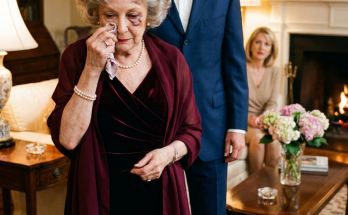
The neighbor’s name was Dolores Marsh, and she had the particular talent of people who have lived alone too long — she noticed everything, and she held it inside until it became something she could no longer carry.
She stood at the door in a cream-colored cardigan at seven in the morning, her silver hair pinned precisely, holding a small glass dish of something covered in foil that I understood immediately was an excuse to knock. She’d made it because she needed a reason to come, and she needed a reason because she was not the kind of woman who accused without evidence. The dish, I would later find, contained a fig-and-walnut loaf she had baked the previous evening while working up the courage.
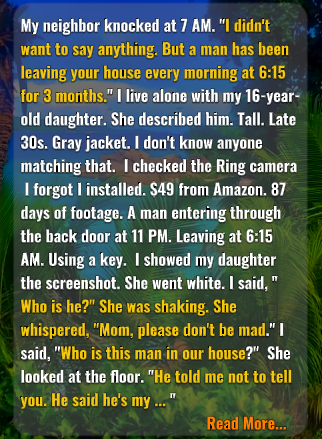
“I didn’t want to say anything,” she began, and those five words settled over me like cold water.
She told me calmly. Methodically. The way a woman describes a thing she has been organizing in her mind for weeks, afraid to get it wrong. Every morning. For three months. At six-fifteen. She described him in the economical way of someone who spent their life watching — not as a hobby but as a coping mechanism for loneliness. Tall. Late thirties. Gray jacket. Dark hair. He walked quickly, always checked the side of the house before moving to the front. He never looked up.
I thanked her. I took the fig loaf. I closed the door.
I stood in the hallway for a moment and heard the ordinary sounds of my house — the refrigerator’s low hum, the shower upstairs where my daughter Iris was getting ready for school, the birds starting up in the oak outside the window. All of it familiar. All of it suddenly opaque, like a painting I had owned for years and only now noticed had something wrong in the background.
I had forgotten about the Ring camera. Genuinely forgotten. I’d bought it forty-nine dollars after a package was stolen from the porch two Novembers ago, installed it myself one Saturday afternoon, and then promptly let the whole project drift from my mind the way practical projects do when you are raising a child alone and working full-time and managing the thousand daily frictions of a life built for two and occupied by one. The app was still on my phone. I hadn’t opened it since February of the previous year, when I’d checked briefly after hearing something outside at night that turned out to be a raccoon.
Eighty-seven days of footage.
I sat at the kitchen table and opened it with the same distant disbelief you feel when you begin doing something your body understands is irreversible. There’s a moment before you press play where everything is still suspended. Where you can still be wrong.
I pressed play.
He entered through the back door at eleven-oh-three PM on the first night of available footage. The timestamp was precise and indifferent. He had a key — this was obvious not from anything dramatic but from the casual way he reached for the lock, the absence of hesitation, the way a person moves in the dark when they know exactly where they are going. He didn’t rush. He didn’t look over his shoulder. He walked into my home at eleven PM with a key and the quiet ease of belonging.
Tall. Late thirties. Gray jacket.
I didn’t know him.
I sat with that for a moment. I scrolled through days. He was there. And there. And there. Eleven PM or slightly after, never wildly different, as though he had a schedule. Six-fifteen in the morning, the same. It had the shape of a secret that had been engineered, maintained, and protected — not a spontaneous thing but a constructed one.
I took a screenshot.
Upstairs, the shower shut off. I heard the pipes settle.
I waited at the kitchen table. I held my phone face-down on my place mat and I tried to find a story that made this innocent. I am not naturally suspicious. I have always considered this a virtue, though I understand now it was also a form of avoidance. There are explanations I reached for: a family friend I’d somehow never met, someone doing maintenance on behalf of a landlord utility I’d forgotten, a confusion of addresses, some elaborate misunderstanding that would resolve into laughter and relief.
But the key. He used a key.
Iris came downstairs at seven-forty in the uniform she has worn to St. Catherine’s since she was twelve — navy skirt, white blouse — with her dark hair still slightly damp and her headphones around her neck and her backpack slung over one shoulder. She was sixteen years old and she was beautiful in the way that people are when they are entirely unaware of it, and she was my daughter, and she moved through the kitchen reaching for an apple the way she always did, and for one final second the morning was ordinary.
“Sit down,” I said.
She looked at me and something shifted in her face. Not guilt, exactly. More like a person who has been dreading a particular door opening and has now heard the handle turn.
She sat.
I slid the phone across the table without a word.
She looked at the screenshot. And she went white — not pale, not ashen, but the particular white of total blood retreat, the color of a person whose body has just been flooded with adrenaline and terror.
“Who is he?” I said.
She didn’t answer immediately. She stared at the photograph. Her jaw tightened. Her hands, flat on the table, pressed down as though she needed something to push against.
“Iris.” My voice was steady. I want to be honest about this: I was not screaming, not crying. I was operating in the clean, cold corridor that opens up in you during a crisis, where everything becomes very simple and very focused. “Who is this man in our house?”
Her lip trembled. She looked at the floor.
“He told me not to tell you.” Her voice was barely audible.
The room contracted.
“He said he’s my—” She stopped. Pressed her mouth together.
“Your what.”
“My father.” She said it so quietly I almost didn’t hear it. Then she looked up at me, and her eyes were full — not of manipulation, but of a complicated grief that had clearly been living in her for some time. “He said he’s my biological father. And that he’s been trying to work up the courage to tell you he was back.”
I need to explain something about Iris’s father, because this story cannot be understood without it.
His name was Daniel Voss. We were together for four years in our late twenties — not a relationship that announced itself as epic, but one that accumulated weight gradually, the way sediment does. He was kind, inconsistent, beautiful to look at, prone to long absences he apologized for without changing. When I found out I was pregnant at thirty-one he was both moved and terrified, and the combination of those two things produced in him a strange paralysis. He stayed for seven months after Iris was born. Then one night I came home to find half the closet empty and a note on the counter that said I’m not able to be who you need me to be. I’m sorry. Tell her I loved her.
I told her nothing for years, and then, when she was old enough to ask, I told her the truth as gently as I could. He left. He was young and frightened and that does not excuse it and it does not diminish her.
I had not heard from Daniel Voss in sixteen years.
“How long,” I said, “have you been talking to him?”
Iris swallowed. “Eight months.”
Eight months.
“He found me on Instagram,” she said. “He sent a message. He said he was my father and that he’d been trying to find me for years and that he knew he had no right to ask for anything but he just wanted to know I was okay.” She was speaking quickly now, the way people do when a held breath finally releases. “I know I should have told you. I know. But I was scared you’d make me stop and I — I wanted to know him, Mom. I wanted to know who he was.”
“So you gave him a key to our house.”
“He asked if he could visit sometimes. At night, when you were asleep. He said he didn’t want to cause any trouble. He said it was just so he could—” She stopped again.
“So he could what?”
“So he could see me.” Her voice broke. “He said he’d missed everything. He said he just wanted to sit and talk. We’d make tea and sit at the table and he’d ask me about school and my friends and what I wanted to be.” She wiped her face with the back of her hand. “He brought me a book once. He said he’d had it since I was born and he always meant to give it to me.”
I stood up from the table. I walked to the window. The oak tree was full and green and entirely indifferent.
I want to tell you what I felt, but it was not a simple feeling. Fury, yes — the cold, foundational fury of a parent who has learned their child was living a secret that involved an unknown man entering their home repeatedly in the night. But also something more complicated. Something that knew this particular man. That had loved this particular man and watched him leave. That recognized, against every reasonable instinct, that the story my daughter was telling me — a man arriving with a book he had kept for sixteen years — sounded exactly like the person Daniel Voss might have become.
Neither of those things negated the other.
“You don’t give strangers a key to your home,” I said, still facing the window. “You don’t give anyone a key to your home without telling me. He is a stranger, Iris. Whatever he is to you genetically, you met him eight months ago and he is a stranger.”
“I know.”
“He is a grown man who asked a fifteen-year-old girl to keep his presence in her home a secret from her mother.”
The silence that followed was different from the ones before it.
“I know,” she said again, and this time there was something new in it. Not argument. Not defense. Just a crack.
I called the school and told them Iris would be absent. Then I made two cups of tea — a reflex, domestic and involuntary — and sat back down across from my daughter and said: Tell me everything, from the beginning, and don’t leave anything out.
She did.
It took nearly an hour. She told me about the Instagram message, the careful, almost formal way he’d introduced himself, the weeks she’d spent deciding whether to respond. She told me about the first reply she sent — three sentences, cold and brief — and the way he’d written back six days later, patiently, without pressure, just saying he understood if she never wanted to speak to him and that he would not contact her again if she said so. She told me about the correspondence that followed, tentative and then gradually less so, the way a person warms to something they have been afraid to want.
She showed me the messages. I read them all.
Daniel Voss had, it appeared, become a quieter man. His messages were careful. Self-aware in a way he had never been at twenty-nine. He apologized repeatedly, not performatively but with a specificity that indicated genuine reflection — he named his failures, he named the ways they must have hurt her, he did not ask for forgiveness so much as offer accounting. He’d spent time, he told her, in therapy. He’d done work, he said, that he should have done twenty years ago.
And yet.
He had, with full knowledge that she was a minor, with full knowledge that I did not know, asked her to let him into our home at night and keep it from me.
The two things lived together uncomfortably, and I had to hold both.
When she finished, I sat quietly for a moment.
“Do you love him?” I asked.
She looked startled by the question. “I don’t — I don’t know. I think I could. I think I want to.” She looked down at her hands. “Is that wrong?”
“No,” I said. “That is not wrong.”
“Are you angry at me?”
I thought about the honest answer. “I’m frightened,” I said. “Frightened is what I am. The rest I’ll sort out.”
I sent him a text from Iris’s phone because I did not have his number. I said: This is her mother. I need you to come to the front door at seven this evening. Knock.
He replied seventeen minutes later. A single word: Okay.
I spent the day in a state of controlled preparation. I am an administrator at a mid-sized accounting firm; I manage twelve people and resolve, on average, three interpersonal crises a week. I know how to walk into a room with an agenda. I spent the day cleaning the house with something close to aggression, and I called my sister Karen in Vancouver and spoke for forty minutes, and she said the things a sister says, and they helped.
Iris stayed in her room. I checked on her twice. Once she was reading. Once she was asleep.
At seven o’clock exactly, someone knocked at the front door.
He was taller than I remembered. Older, of course — we both were — with gray at his temples and a quality of settled stillness that had not been there at twenty-nine. He was wearing a gray jacket. He held nothing in his hands. He looked at me with the expression of a man who has been preparing for this particular conversation for a very long time.
“Sarah,” he said.
“You don’t get to come in,” I said. “We’re going to talk here.”
He nodded. He didn’t argue.
“Tell me,” I said, “why you thought it was appropriate to enter this house without my knowledge. My daughter is sixteen years old. She is a child. And you, a man in your late thirties, thought it was acceptable to ask her to keep secrets from her mother and let you into her home at night.”
He took the words without deflecting. “It wasn’t,” he said. “I know it wasn’t. I want to explain my thinking, but I want you to know first that explaining is not excusing.”
“Then explain.”
“I was afraid of you,” he said. “Not of you specifically. Of what was fair. I left. I had no right to stand at your front door and ask to be let back into her life. I thought if I asked through the proper channels — through you — you would say no, and you would be right to say no, and she would never know I tried.” He looked at the middle distance. “I told myself it was for her. That I was protecting her from another rejection. But that wasn’t entirely true.” He paused. “I was protecting myself. It was easier to be let in the back door than to knock at the front and be turned away.”
“You should have knocked at the front.”
“Yes.”
“Whatever I said, you should have knocked at the front.”
“Yes,” he said again. “I should have.”
We stood in the porch light for a moment. Moths made small erratic orbits around the lamp above us.
“She wants to know you,” I said. It cost me something to say it, but it was true, and I had decided on the drive home from nowhere in particular — I’d driven for an hour in the afternoon just to move — that I would not let what he’d done erase what she needed. “That is real, and I’m not going to punish her for it.”
He nodded. His jaw was tight.
“But it will happen on my terms,” I said. “Daylight. Front door. I know where you are, who you are, and what your intentions are. You don’t ask her to keep secrets. You don’t make her choose between you and me. If I find out you are putting her in the middle, you are gone. Do you understand?”
“I understand.”
“And you go slowly,” I said. “She is not a project. She is not your redemption. She is a sixteen-year-old girl who has been fine without you and who is curious about you, which is different.”
He looked at me then with an expression I remembered — the particular quality he had, in the good moments, of actually hearing what was said to him. Of not deflecting into his own feelings.
“She seems remarkable,” he said quietly.
“She is,” I said. “She didn’t get that from nowhere.”
He almost smiled. So did I. Neither of us did.
“Thursday evening,” I said. “Five o’clock. You come to the front door and you knock.”
I went inside and closed the door.
I went upstairs and stood in the doorway of Iris’s room. She was sitting on her bed with her knees drawn up, waiting. The book he’d brought her — a battered hardcover edition of The Once and Future King — was on the nightstand. I had not noticed it before, and now I did, and I let myself feel the complicated thing that is loving a child who is becoming a person separate from you, with needs and griefs and a history that is partly yours and partly hers alone.
“Thursday,” I said. “Five o’clock. He’s coming to the front door.”
Her whole face changed.
“There are rules,” I said. “I’ll tell you tomorrow. Tonight I just wanted you to know.”
She uncurled from the bed and crossed the room and put her arms around me the way she hadn’t in months, the way teenagers don’t until they suddenly do again, and I held her and smelled her damp hair and felt the specific weight of her that I have known since she was placed in my arms in a bright room sixteen years ago.
“I’m sorry,” she said into my shoulder.
“I know you are.”
“Are you okay?”
I thought about the honest answer. I thought about forty-nine dollar cameras, and fig-and-walnut loaves, and keys, and the back door, and the front door, and the difference between the two.
“I will be,” I said.
The oak tree moved outside her window. The house was quiet. Tomorrow there would be more — more conversation, more rules, more of the difficult ongoing work of this. But for now the house was quiet, and my daughter was in my arms, and that was enough to stand on.
I held her for a long time in the dark.