My parents never expected much from me. To be fair, they weren’t really my parents.
They were my foster parents—the fourth family I had lived with before turning sixteen. They gave me a roof over my head, food on the table, and a place to sleep. For that, I was grateful. But love? Belief?
Those were luxuries I never received. “Some kids are born for college,” my foster father liked to say whenever report cards came home. “Others should learn a trade and be realistic.”
His eyes always landed on me when he said it. I knew exactly what he meant. I was the foster kid. The temporary child. The one nobody planned a future around.
By the time I entered high school, I had already learned an important lesson: Don’t dream too big. Dreams hurt when they don’t come true. So I stopped talking about becoming a doctor.
I stopped telling people how fascinated I was by medicine. I stopped mentioning that I spent nights reading old biology textbooks from the library. Because every time I did, someone laughed. A foster kid becoming a doctor?
Sure. And maybe pigs would fly. Eventually, I started believing them. Then I met Mrs. Carter. She taught sophomore-year biology.
The first day of class, she asked everyone to write down what career they wanted. Most students scribbled answers and moved on. I stared at the blank paper. Finally, I wrote: Doctor.
Then I crossed it out. Mrs. Carter walked by my desk. She stopped. “What did you erase?” “Nothing.”
She tilted her head. “It wasn’t nothing.” I shrugged. “It doesn’t matter.” She looked at me for a moment.
Then she said something nobody had ever said before. “It matters if it matters to you.” I didn’t answer.
But for the first time in years, I thought about the dream again. A week later, she handed back our assignments. Mine had a large red A at the top. Underneath was a note.
You have talent. Don’t waste it.
I stared at the words for several minutes. Nobody had ever called me talented. Not once.
After class, she stopped me. “Have you considered advanced science courses?” I laughed. “Those are for smart kids.” “You are a smart kid.”
“No.”
“Who told you that?”
I looked away. She sighed softly. “Sometimes the biggest obstacle isn’t ability. It’s the people who convince you that you don’t have any.”
Those words followed me home. And stayed with me. Over the next two years, Mrs. Carter became more than a teacher.
She became the first person who truly believed in me. She helped me join academic competitions. She found free tutoring programs. She stayed after school to explain chemistry concepts.
When college application season arrived, I was overwhelmed.
The forms looked impossible. The fees seemed enormous. The essays felt terrifying. I nearly gave up. Mrs. Carter wouldn’t let me.
One afternoon, she walked into the library carrying a giant folder. She dropped it on the table.
“What is that?” “Scholarships.”
My eyes widened.
“There are hundreds.”
“Good.”
“You expect me to apply for all these?”
“I expect you to apply for every single one you’re eligible for.”
I groaned.
She smiled.
“Get started.”
For months, she sat beside me after school.
Essay after essay.
Application after application.
Financial aid forms.
Recommendation requests.
Deadlines.
Corrections.
Revisions.
Whenever I got discouraged, she pushed me forward.
Whenever I doubted myself, she reminded me why I couldn’t quit.
One evening, I finally asked the question I’d been carrying for years.
“Why do you care so much?”
She became very quiet.
Then she answered.
“Because someone once cared about me.”
I waited for more.
She never elaborated.
Senior year ended.
Acceptance letters arrived.
Most were rejections.
A few were waitlists.
Then one afternoon, a thick envelope appeared in the mailbox.
My hands shook.
I opened it.
Read the first line.
Then read it again.
And again.
I had been accepted.
Not only accepted.
I had received a full scholarship.
I couldn’t breathe.
I ran all the way to school.
Burst into Mrs. Carter’s classroom.
She looked up from grading papers.
“Well?”
I handed her the letter.
Her eyes scanned the page.
Then she smiled.
A genuine, radiant smile.
“I knew it.”
I started crying.
She did too.
College was hard.
Medical school was harder.
There were nights I survived on instant noodles.
Weeks when I questioned everything.
Months when exhaustion became normal.
Whenever I felt like quitting, I remembered Mrs. Carter’s note.
You have talent. Don’t waste it.
I kept that note folded inside my wallet.
For twelve years.
Every exam.
Every interview.
Every sleepless night.
It stayed with me.
A reminder that at least one person believed I could do this.
Eventually, impossibly, I reached the finish line.
Medical school graduation.
Doctor.
The word felt unreal.
I stared at my white coat hanging in the closet and laughed.
The foster kid had become a doctor.
Against every prediction.
Against every expectation.
Against every statistic.
The night before graduation, I picked up my phone.
There was one call I had waited twelve years to make.
She answered on the third ring.
“Hello?”
“Mrs. Carter?”
A pause.
Then laughter.
“I know that voice.”
“It’s Ethan.”
“Oh my goodness.”
We talked for nearly an hour.
Finally I said what I had wanted to say for years.
“I owe everything to you.”
“You owe me nothing.”
“That’s not true.”
“Ethan—”
“No. Listen.”
My voice broke.
“If you hadn’t helped me, I’d never have gotten those scholarships.”
Silence.
“If you hadn’t stayed after school… if you hadn’t believed in me…”
I swallowed hard.
“I wouldn’t be here.”
She didn’t respond immediately.
Then she said quietly:
“I’m proud of you.”
“Come to graduation.”
A pause.
Then:
“I wouldn’t miss it.”
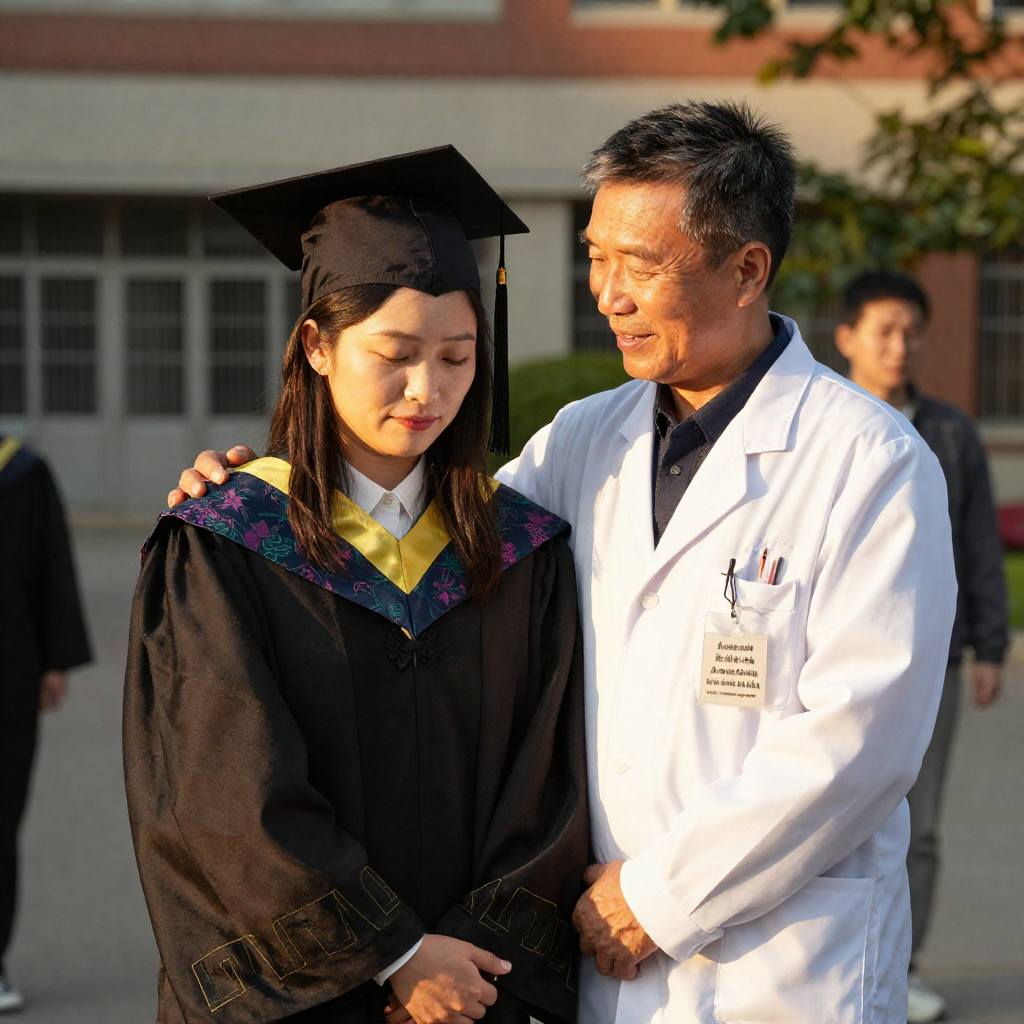
Graduation day arrived.
Thousands of people filled the auditorium.
Families cheered.
Cameras flashed.
Flowers were everywhere.
I searched the crowd until I found her.
Third row.
Simple blue dress.
Same warm eyes.
Same gentle smile.
I waved.
She waved back.
Then sat quietly.
The ceremony lasted hours.
When my name was called, the room erupted.
I walked across the stage.
Received my diploma.
And officially became Dr. Ethan Miller.
For a moment, I wished my biological parents could see it.
Then I realized something.
The person whose opinion mattered most was already there.
Mrs. Carter.
After the ceremony, graduates flooded the hall.
Families hugged.
Photos were taken.
People celebrated.
I spotted Mrs. Carter standing alone near a window.
I hurried over.
She looked emotional.
But strangely quiet.
“You okay?”
She nodded.
“Of course.”
“You haven’t said much.”
She smiled softly.
“I’ve just been thinking.”
About what?
She didn’t answer.
Instead, she reached into her purse.
Pulled out a small envelope.
Yellowed with age.
Edges worn.
She held it carefully.
Like it was fragile.
Then she looked directly at me.
“I kept this for you.”
I frowned.
“What is it?”
“Open it.”
Confused, I took the envelope.
My hands suddenly felt cold.
Inside was a folded piece of paper.
I unfolded it.
The handwriting was familiar.
Mine.
I stared.
It was old.
Very old.
The date at the top nearly stopped my heart.
Sophomore year.
Mrs. Carter’s biology class.
Twelve years earlier.
My eyes moved across the page.
And suddenly I remembered.
It was the career assignment.
The one from the first day of class.
The one where I had written:
Doctor.
Then crossed it out.
Beneath it, in shaky teenage handwriting, I’d written:
Not realistic.
My throat tightened.
I couldn’t speak.
Mrs. Carter pointed to the page.
“Keep reading.”
At the bottom was something else.
Something I had never seen before.
A note written in blue ink.
Her handwriting.
You will be.
The words blurred through tears.
I looked up.
“What is this?”
She smiled.
“The paper you tried to throw away.”
“What?”
“I found it in the recycling bin after class.”
My mouth fell open.
“You kept it?”
“Twelve years.”
“Twelve years?”
She nodded.
“I wanted to give it back when you became a doctor.”
The world seemed to stop.
Twelve years.
She had carried that paper for twelve years.
Believing.
Waiting.
Trusting that one day I would succeed.
Even before I believed it myself.
Tears streamed down my face.
I didn’t even try to hide them.
“You really thought I’d make it?”
She laughed.
“Ethan, I knew.”
“How?”
“Because I recognized something.”
“What?”
She became quiet.
Then finally answered the question I’d asked years ago.
The one she never fully explained.
“Someone once cared about me.”
I waited.
This time she continued.
“When I was sixteen, I was in foster care too.”
I froze.
“What?”
She nodded.
“My father died. My mother disappeared.”
I stared.
“I never knew.”
“Very few people do.”
Suddenly everything made sense.
The understanding.
The patience.
The determination.
The way she always knew exactly what to say.
She had lived it.
Every bit of it.
“I wanted to quit school.”
Her voice trembled.
“I thought my life was over.”
“What happened?”
“A teacher refused to let me quit.”
I smiled through tears.
Of course.
“A teacher believed in me before I believed in myself.”
She looked at me.
“Just like you.”
Neither of us spoke.
The silence said everything.
A few minutes later, she reached into her purse again.
“There is one more thing.”
She handed me a photograph.
Old.
Faded.
Black and white.
A teenage girl stood beside an older woman.
The girl was Mrs. Carter.
The woman beside her smiled proudly.
“That’s your teacher?”
She nodded.
“Mrs. Henderson.”
I turned the picture over.
On the back were handwritten words.
Never underestimate the life you can change by believing in someone.
I swallowed hard.
Mrs. Carter smiled.
“She gave me that photograph when I graduated college.”
My eyes widened.
“And now I’m giving it to you.”
I looked at her.
Confused.
“What do you mean?”
“One day, you’ll meet someone who doesn’t believe in themselves.”
I listened carefully.
“Someone everyone else has given up on.”
Her eyes filled with tears.
“When that happens, don’t forget where you came from.”
I couldn’t speak.
“Pass it on.”
Six years later, I did.
A sixteen-year-old foster kid arrived in my clinic.
He barely spoke.
Avoided eye contact.
Expected disappointment from everyone around him.
I recognized him immediately.
Because once upon a time, he had been me.
After his appointment, I noticed a sketchbook sticking out of his backpack.
I flipped through it.
The drawings were extraordinary.
“Did you make these?”
He shrugged.
“It’s stupid.”
“No.”
I smiled.
“It’s talent.”
The same words Mrs. Carter once told me.
His eyes widened.
And in that moment, I understood.
The greatest gift Mrs. Carter ever gave me wasn’t scholarships.
Or college applications.
Or financial aid.
It was belief.
The kind powerful enough to change the direction of a life.
The kind that echoes across generations.
That night, after work, I opened my desk drawer.
Inside sat the old paper she had saved.
The one that read:
Doctor.
Crossed out.
Followed by:
Not realistic.
And beneath it:
You will be.
I smiled.
Then placed it back beside the photograph of Mrs. Henderson.
Three lives.
Three teachers.
Three acts of belief.
Connected across decades.
Proof that sometimes a single person refusing to give up on you can change everything.
And proof that the most powerful words in the world are often the simplest:
I believe in you.