1. The Sterile Frontline
The rhythmic, synthetic beeping of the fetal heart monitors had finally faded from my memory, replaced by the steady, reassuring hum of the pediatric vital machines. I lay back against the stiff hospital pillows, my body feeling as though it had been dragged behind a Humvee over three miles of shattered asphalt. It was my fifth day postpartum in the maternity ward at Womack Army Medical Center at Fort Bragg. My twins, Leo and Mia, were swaddled tightly in their clear plastic bassinets beside my bed, two tiny, fragile lives that had nearly cost me my own. The delivery had been a grueling, thirty-six-hour marathon of hemorrhaging and high-risk surgical interventions. Yet, as I stared at their rising and falling chests, the dull ache in my sutured abdomen felt like a badge of honor.
I was a U.S. Army frontline combat medic. I had spent the last eight years of my life stabilizing shattered femurs in the dirt of the Korengal Valley and stemming arterial bleeds in the back of violently shaking Blackhawk helicopters. I knew trauma. I knew survival. But nothing could have prepared me for the agonizing, beautiful vulnerability of becoming a mother while my husband, David, was a ghost. He was currently deployed on a Tier One special operations mission somewhere in the Middle East, operating under a strict communications blackout. I hadn’t heard his voice in four months. I didn’t even know if he knew the twins had been born.
To combat the creeping loneliness of his absence, I had focused on a secret project, a massive gesture of goodwill designed to bridge the icy chasm between myself and David’s family. Beneath my pillow, the thick paper of a sealed manila envelope crinkled against my ear every time I shifted. Inside lay a finalized, zero-balance mortgage statement. My mother-in-law, Martha, and my sister-in-law, Jessica, had been drowning in a $120,000 balloon payment on their family home. They had always looked at my military career with a mixture of disdain and opportunistic greed, viewing my deployments not as service, but as an inconvenient obstacle to David’s availability, or worse, a lucrative source of hazard pay. Despite their historical entitlement and passive-aggressive jabs about my “unfeminine” profession, they had promised to help me with the babies while David was gone. To secure that peace, to ensure my children had a village, I had quietly liquidated my combat savings, my deployment bonuses, and my hazard pay. I had bled in foreign dirt to earn that money, but to me, family security was worth every drop. I planned to surprise them with the deed today.
I closed my eyes, letting the sterile scent of iodine and industrial floor wax wash over me. For the first time in nearly a week, my hyper-vigilant nervous system began to power down. I allowed myself to drift, sinking into a heavy, narcotic sleep, entirely oblivious to the predatory footsteps echoing down the linoleum hallway outside my door.
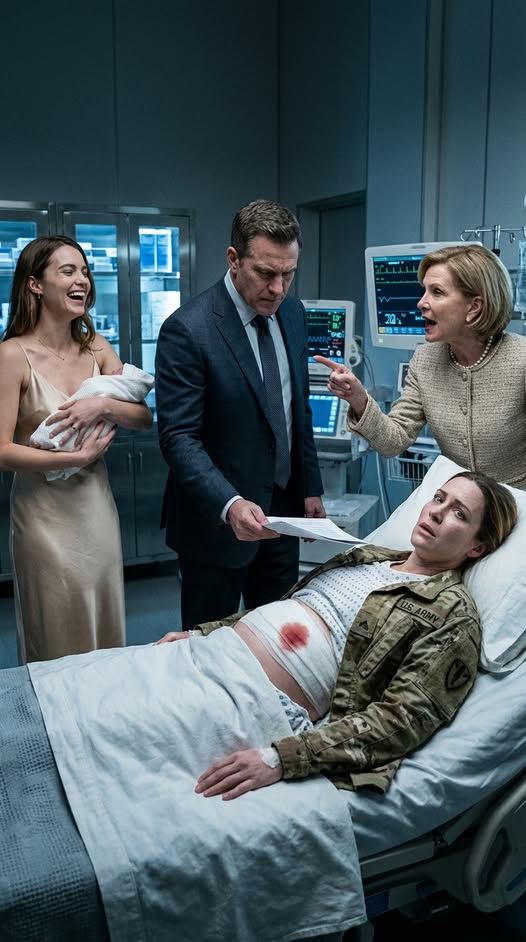
My peaceful rest was violently shattered when the hospital door swung open to reveal Martha and Jessica—not carrying balloons, flowers, or baby gifts, but flanked by a cold-eyed man in a sharp tailored suit clutching a thick stack of legal documents.
2. The Ambush
“Wake up, Sarah,” Martha’s voice sliced through the quiet room, devoid of any grandmotherly warmth. It sounded like a shovel grating against concrete.
I blinked away the haze of exhaustion, instinctively pulling the thin hospital blanket up to my collarbone. Martha stood at the foot of my bed, her posture rigid, her eyes scanning the room like a real estate appraiser evaluating a distressed property. Jessica lingered near the doorway, adjusting the strap of a ridiculously expensive designer handbag, an accessory that probably cost more than my first car. She didn’t even glance at the bassinets where Leo and Mia slept. The man in the suit—whom I would soon learn was Mr. Vance, a high-priced family law attorney—stepped forward, his polished oxfords clicking ominously against the tile.
“What is this?” I rasped, my throat dry from the recycled hospital air. I instinctively reached under my pillow, my fingertips brushing the edge of the manila envelope containing their mortgage payoff.
“Sign the papers, Sarah,” Martha demanded, her voice dripping with venomous pragmatism. She snatched a clipboard from Vance and shoved it onto my legs. “You’re a frontline medic. You have a target on your back every time you clock into work. You’ll probably be blown to pieces on your next tour anyway, just like that poor lieutenant in David’s unit last year. You are an unstable, temporary factor in these children’s lives.”
The sheer audacity of the assault hit me like a physical blow to the chest. My breath hitched. I looked down at the dense legalese on the clipboard: Voluntary Relinquishment of Parental Rights.
Jessica finally stepped forward, her floral perfume temporarily overpowering the smell of antiseptic. “I have the nursery painted in sage green,” she added coldly, examining her immaculate manicure. “I’ve joined the country club’s maternal wellness group. I have the lifestyle for this. I deserve the aesthetic of motherhood without having to ruin my body to get it. Don’t be selfish, Sarah. You’re built for war, not for raising children. You’re practically just an incubator.”
For a fraction of a second, the overwhelming fatigue threatened to drown me. The urge to break down, to scream for the nurses, to cry out for David, clawed at my throat. But then, an ancient, deeply ingrained psychological switch flipped inside my brain. The tremor in my hands ceased. The tears evaporated before they could form. The shock rapidly transmuted into the icy, calculated assessment of a soldier taking incoming fire. I wasn’t a scared postpartum mother anymore; I was a combat tactician analyzing an ambush.
I locked eyes with the lawyer. “Get out of my room,” I commanded, my voice dropping an octave, carrying the unmistakable cadence of an order given on a battlefield. “Now. Before I have the Military Police drag you out by your Italian silk tie.”
Vance hesitated, glancing at Martha, but the murderous intent in my gaze was enough. He practically scurried out the door. Left alone with my in-laws, I knew arguing would only deplete my meager energy reserves. I needed intelligence. I let my head loll back against the pillows, feigning a sudden wave of overwhelming narcotic weakness. I closed my eyes, letting my breathing slow, pretending the confrontation had simply broken me.
Through the narrowest slit of my eyelashes, I watched them. I waited in the deafening silence, my heart hammering a furious rhythm against my ribs, until I heard Martha whisper to Jessica in the shadows near the bathroom door: “The lawyer was just plan A. If she won’t sign them over, we just move to plan B. Her military life insurance is half a million dollars, and I already brought the potassium chloride.”
3. Code Blue-Tango
The words hung in the air, a toxic vapor settling over the sterile room. Potassium chloride. My medic brain cataloged the chemical compound instantly, pulling up textbook pages and trauma protocols with terrifying speed. Administered intravenously, a concentrated dose of KCl disrupts the electrical impulses of the heart muscle. It causes massive, instantaneous cardiac arrest. The most chilling part? To a civilian medical examiner performing a standard postpartum autopsy, it simply looks like a tragic, naturally occurring heart attack—a known, albeit rare, complication of traumatic labor. It was virtually untraceable. They didn’t just want my babies. They wanted my Servicemembers’ Group Life Insurance (SGLI) payout, the $500,000 policy that defaulted to Martha as David’s next of kin if I died while he was unreachable in a combat zone.
A cold dread coiled in my gut, swiftly replaced by a blinding, white-hot fury. I kept my breathing perfectly even, simulating the deep, rhythmic respirations of an exhausted, sedated patient. I could not let my heart monitor spike. I used decades of biofeedback training, forcing my pulse to remain steady on the glowing screen above my bed, even as every instinct screamed at me to leap up and tear their throats out.
Slowly, agonizingly, I slid my right hand under the heavy thermal sheets. I bypassed the manila envelope, my fingers finding the heavy, familiar face of my military-issued, encrypted tactical smartwatch strapped to my wrist. I couldn’t look at the screen. I had to operate by touch alone, relying on muscle memory drilled into me during countless SERE (Survival, Evasion, Resistance, and Escape) training exercises.
Swipe down. Hold the side button. Access emergency comms.
I tapped out a pre-programmed distress sequence on the glass face. Three rapid taps. A two-second pause. Two taps. It was a “Code Blue-Tango”—a direct, encrypted distress signal routed straight to my Battalion Commander and the local detachment of the Army Criminal Investigation Division (CID), indicating a lethal, imminent threat against a service member on a federal installation.
Ten agonizing seconds passed. The silence in the room was absolute, save for Jessica’s soft, bored sigh as she scrolled through her phone. Then, a faint, almost imperceptible vibration buzzed against my wrist. A single, long pulse. Message received. Cavalry is rolling.
But CID was housed in a different building across the massive Fort Bragg complex. They needed time to mobilize, to silently infiltrate the hospital corridors, to breach the observation rooms adjacent to my suite. I had to play a deadly game of cat-and-mouse. I had to keep the prey in the room, maintaining the illusion of a weak, defenseless mother, while an assassin stood feet away.
The digital clock on the wall glowed with a harsh red light, ticking relentlessly toward 3:00 AM. I heard the rustle of a leather purse. Through my eyelashes, I watched Martha extract a small, unmarked syringe, its needle glinting under the ambient light of the fetal monitors. She stepped forward, her face a mask of chilling indifference, and slowly approached my bedside, reaching out with a cruel, tight-lipped smile to inject the lethal dose directly into my primary IV line.
4. The Breach
Time dilated. The room seemed to stretch, the air growing thick as molasses. Martha’s hand hovered over the plastic Y-port of my primary intravenous line, the tubing that ran directly into the vein on the back of my left hand. She moved with a sickeningly steady grace, the confidence of a woman who genuinely believed she was entitled to play God, to play executioner, simply because she desired my assets.
She pushed the tip of the needle into the rubber membrane of the port.
“Sleep well, hero,” she whispered, her voice barely a breath. It was an insult disguised as a lullaby. She pushed the plunger, releasing the clear, lethal liquid into the IV tube.
She was completely oblivious to the fact that two hours ago, long before they arrived, a nurse had changed my fluid bag. I had casually rolled over, and out of sheer, ingrained habit of managing my own medical equipment, I had engaged the plastic roller clamp on the tubing, shutting off the flow of fluids to my arm just below the port she was currently injecting. The potassium chloride wasn’t entering my bloodstream; it was pooling harmlessly in the blocked plastic tube.
Instantly, the facade of the helpless victim shattered. I didn’t just wake up; I erupted. My right hand shot out from beneath the blankets like a striking viper. My fingers locked around Martha’s wrist with bone-bruising, unrelenting force, grinding her radius and ulna together.
Martha gasped, her eyes snapping wide in sudden, absolute terror as she looked down at me. The smug superiority vanished, replaced by the panicked realization of a predator that had just stepped into a steel jaw trap.
“The line is clamped, Martha,” I said, my voice dead, cold, and echoing with the authority of the grave she had just tried to put me in.
Before she could even open her mouth to scream, I shifted my gaze to the large, darkened two-way mirror on the far wall of the hospital suite—a standard feature in military trauma recovery rooms for medical observation.
“Execute,” I barked.
The hospital doors didn’t just open; they exploded inward. Six heavily armed, undercover CID agents, clad in tactical vests and carrying suppressed weapons, flooded the room in a synchronized wave of kinetic violence. “Federal agents! Drop it! Drop it!”
The room erupted into controlled chaos. Two agents tackled a shrieking Jessica, driving her meticulously styled hair into the sterile linoleum, her designer handbag skittering across the floor. Three more converged on Martha, ripping her wrist from my grip and slamming her forcefully against the painted drywall. The syringe clattered harmlessly to the ground, immediately bagged as exhibit A by an evidence technician who swept in right behind the tactical team.
Amidst the screaming and the metallic ratcheting of heavy steel handcuffs, I sat up. The pain in my abdomen flared, but the adrenaline masked it. I reached under my pillow, my fingers wrapping around the thick manila envelope. I pulled it out and tossed it with practiced precision. It landed squarely on Martha’s chest just as an agent pinned her arms behind her back.
“Take a good look, Martha,” I said, my voice cutting through her hysterical sobbing. “That’s the $120,000 deed to your house. I paid off your mortgage yesterday. It was a thank-you gift. But since you’re both going to a federal penitentiary for attempted murder, I guess the bank is just going to foreclose on it anyway.”
As the agents dragged a hyperventilating Jessica and a violently trembling Martha out of the maternity ward, their cries of disbelief echoing down the corridor, the lead CID investigator, a towering man with salt-and-pepper hair, stepped to the foot of my bed. His expression was grim as he reached into his tactical vest, pulling out a heavy, encrypted satellite phone. He handed it to me. The screen was flashing bright green. It was an incoming secure call directly from the Pentagon.
5. Resolution and Growth
The contrast could not have been more absolute. In my mind’s eye, fueled by the later debriefings, I could perfectly picture Federal Holding Cell Block C down in Raleigh. It was a bleak, windowless purgatory of cinderblock and harsh fluorescent lighting. There, stripped of their designer clothes and their delusions of grandeur, Martha and Jessica were violently turning on each other. The audio transcripts would later reveal Jessica screaming obscenities through the bars, cursing Martha for hatching a sloppy plan that had incinerated her pristine country club reputation and guaranteed her a bunk in a federal prison. They were facing catastrophic charges: Attempted murder of a U.S. service member on a federal installation, conspiracy to commit murder, and wire fraud regarding the insurance policy. They wouldn’t see the outside world for decades.
Meanwhile, back at Womack Army Medical Center, the atmosphere in my room had shifted from a battleground to an impenetrable fortress of serenity. A heavily armed Military Police officer, Specialist Miller, stood rigidly at attention outside my closed door, an assault rifle slung across his chest. Nobody was getting within fifty feet of this room without federal clearance.
I sat in the dim, golden light of the bedside lamp, the adrenaline finally, painfully leaching out of my system, leaving behind a profound, bone-deep exhaustion. But beneath the fatigue was a fierce, crystalline clarity. I had taken decisive legal action within hours of the breach. My military lawyers had drafted ironclad restraining orders, permanently severed all familial emergency contacts, and initiated the bureaucratic process to completely excise Martha and Jessica from our legal existence. Furthermore, the secure call from the Pentagon had ensured that David’s chain of command was briefed. They were pulling him out of the blackout zone. He was coming home.
I looked down at the twins in my arms. Leo was asleep, his tiny fingers curled into a fist against my chest. Mia was awake, her dark eyes blinking up at me in the quiet room. The trauma of the night hadn’t hardened my heart; it had only sharpened my protective instincts to a razor’s edge. I had feared that my military conditioning made me a cold mother, just as Jessica had viciously claimed. But holding them now, feeling their fragile warmth, I knew the truth. My capacity for violence was not a detriment to my motherhood; it was its ultimate shield.
On the bedside table, the manila envelope had been returned to me by the evidence techs, deemed irrelevant to the criminal charges. I picked up the canceled $120,000 mortgage check inside. I didn’t feel anger anymore, only a clinical detachment. I tore the thick paper neatly in half, then into quarters, and dropped the pieces into the plastic trash can. I didn’t need to buy a village to raise my children. I was an army of one, and my borders were secure.
Six weeks later, the air in my living room smelled of fresh linen and baby powder. I stood in front of the full-length mirror, adjusting the brass buttons of my perfectly pressed Army dress blue uniform. It was the morning of my promotion ceremony. I was pinning on my new rank, finally stepping into a senior medical officer role. I took a deep breath, smoothing the fabric over my healed abdomen, when I suddenly heard the distinct, heavy crunch of desert combat boots walking up the wooden steps of my front porch.
6. The Ultimate Command
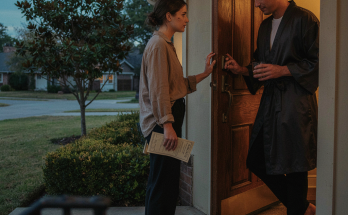
The front door opened, and the morning sunlight spilled into the foyer, framing David. He looked thinner, his face etched with the harsh lines of desert wind and combat stress, but his eyes were bright, frantically scanning the room until they locked onto me. He dropped his heavy canvas duffel bag to the floor with a resounding thud.
He didn’t say a word. He crossed the room in three massive strides and pulled me into a fierce, desperate embrace, burying his face in my neck. He smelled of sweat, aviation fuel, and home. After a long moment, he pulled back, looking over my shoulder to where Leo and Mia were babbling happily in their double playpen.
David had read the encrypted CID reports on his flight out of theater. He knew every detail of the betrayal, every chilling syllable of the transcripts. He had called the federal prosecutor the moment he landed on U.S. soil to offer his full cooperation against his mother and sister. He hadn’t spoken a single word to Martha or Jessica since he read the file, and as he looked at our children, I saw the absolute, unbreakable resolve in his jawline. He never would again. They were dead to him—just inmate numbers erased from the beautiful, protected life we were building.
We stepped out onto the front porch together, David holding a twin in each arm, their tiny hands pulling fascinatedly at his beard. Looking out over our peaceful, sunlit yard, the manicured lawn a stark contrast to the chaotic battlefields we both knew, I adjusted the gleaming silver oak leaf of my new Lieutenant Colonel rank on my collar.
I thought about the blinding nature of greed. Martha and Jessica had looked at me and seen a disposable asset, a stepping stone to a paycheck, a naive girl playing soldier. They had fundamentally misunderstood the nature of the woman they invited into their family. They forgot the most basic, fatal rule of engagement: You never, ever ambush a combat medic. Because the exact same hands that are meticulously trained to stitch arteries, push medications, and pull a shattered soldier back from the absolute brink of death, are the exact same hands that know with terrifying anatomical precision how to push you over it.
As David chuckled, carrying the laughing twins back inside the house to show them his gear, I lingered on the porch for one final moment. I reached into my uniform pocket and pulled out a heavy, cream-colored letter bearing the official seal of the Department of Defense. It wasn’t a deployment order. It was an offer to spearhead a new, elite tactical intelligence and medical integration unit at the Pentagon. I smiled, tracing the embossed seal with my thumb. Martha had tried to end my story in a sterile hospital room, but looking at the letter, I knew the truth. My greatest battles, and my most devastating victories, were just beginning.
If you want more stories like this, or if you’d like to share your thoughts about what you would have done in my situation, I’d love to hear from you. Your perspective helps these stories reach more people, so don’t be shy about commenting or sharing.