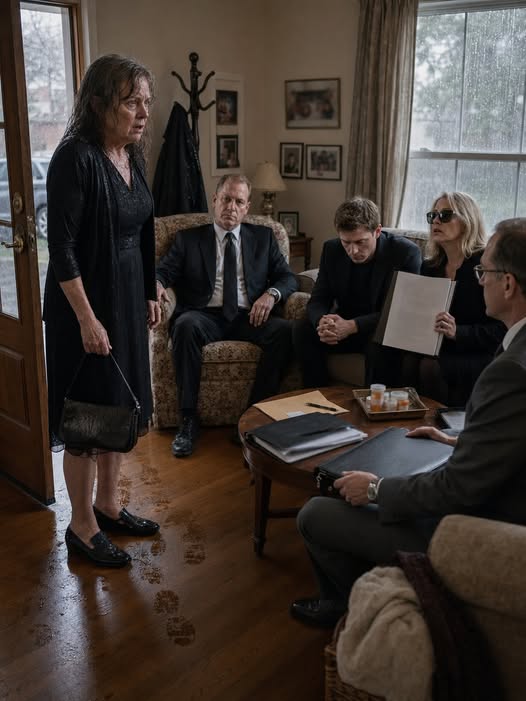
The funeral had been a masterpiece of performance. My husband, Ryan, had wept with operatic intensity, his shoulders shaking as he leaned against his sister, Amanda, who dabbed at her eyes with a lace handkerchief that probably cost more than my first car. I sat in the front row, my hands folded in my lap, feeling nothing but a profound, hollow exhaustion.
For ten years, I had been the ghost in the house. I was the one who changed the bandages on Margaret’s bedsores. I was the one who learned to cook pureed meals that didn’t taste like cardboard. I was the one who sat awake at 3:00 a.m. when her dementia turned the shadows into monsters, whispering to her until she fell back into a fitful sleep. Ryan and Amanda visited once a month. They would bring expensive chocolates Margaret couldn’t chew and talk loudly over her as if she were a piece of furniture. Then they would leave, citing “urgent meetings” or “the kids’ soccer practice,” leaving me with the smell of antiseptic and the weight of a woman who was slowly dissolving into the ether.
When we got back to the house—the sprawling, Victorian estate that had been in the Thorne family for three generations—the air felt different. It was sharp, expectant. I went to the kitchen to make tea, a reflex born of a decade of servitude. I was halfway through reaching for the kettle when Ryan’s voice stopped me.
“Don’t bother, Elena. Sit down. We need to get this over with.”
I walked into the living room. Ryan was there, his tie loosened, looking remarkably recovered from his grief. Amanda sat opposite him, her eyes sharp and predatory. Between them sat a man in a charcoal suit, holding a leather-bound folder.
“This is Mr. Henderson,” Ryan said, not looking at me. “Mom’s attorney. He’s here to read the final will and testament.”
I sat on the edge of a velvet armchair. The house was silent, save for the ticking of the grandfather clock in the hall.
Mr. Henderson cleared his throat. “I’ll skip the preamble. The primary estate, including this property, the upstate acreage, and the liquid investment accounts, is bequeathed in its entirety to Ryan Thorne and Amanda Thorne-Vance, to be divided equally.”
Amanda let out a small, satisfied breath. Ryan nodded.
“And what about Elena?” I asked, my voice sounding thin even to my own ears.
Mr. Henderson looked at me with a flicker of something resembling pity. “To Elena Thorne, for her ten years of… domestic service… Margaret has bequeathed a one-time payment of five thousand dollars.”
The silence that followed was deafening. Ten years. Three thousand, six hundred and fifty days of lifting, cleaning, and losing myself. Five hundred dollars a year. Less than a dollar and a half a day.
“Five thousand?” I whispered.
“Mom felt it was fair,” Ryan said, finally meeting my eyes. His expression was cold, stripped of the “loving husband” mask he wore in public. “You lived here for free, Elena. You had no expenses. This is a bonus, really.”
“And,” Amanda added, standing up to smooth her skirt, “Ryan and I have decided to sell the house. We have a developer interested. We need the premises vacated. You have forty-eight hours to pack your things and leave.”
I looked at Ryan. The man I had married twelve years ago. The man who had promised to stand by me. “You’re kicking me out? Today?”
“The will is the will,” Ryan said, standing up to join his sister. “Take the check, Elena. It’s more than you had when I met you.”
I didn’t argue. I didn’t cry. I stood up, walked to my room, and began to pack. I took only what I had brought with me: a suitcase of clothes, a few books, and the small, sealed manila envelope Margaret had pressed into my hand three days before she took her last breath.
“Don’t open it until I’m in the ground,” she had whispered, her grip surprisingly strong. “Don’t let them see.”
I walked out of the house forty-eight hours later. Ryan didn’t even come to the door to say goodbye. He was too busy in the study with a realtor, discussing the “potential” of the land.
I spent the next three days in a cheap motel on the outskirts of town. The neon sign outside flickered, casting a rhythmic blue light over the stained carpet. I felt like a deep-sea diver who had surfaced too quickly; the world felt bright and distorted.
On the third night, I sat on the edge of the bed and picked up the envelope. It was heavy.
Inside was a letter and a small, antique key with a brass tag that read Vault 412.
My Dearest Elena, Margaret’s handwriting was shaky, a jagged scrawl that broke my heart.
If you are reading this, my children have done exactly what I knew they would. They are my blood, but they are not my heart. They see the world in ledgers and square footage. They think they have won. They think they have inherited the Thorne legacy.
They are wrong.
Ten years ago, before the fog in my brain took hold, I realized that Ryan only married you because he thought your quiet nature made you easy to control. I watched you give up your career to care for a woman who wasn’t even your mother. I watched you wither while they bloomed on your sacrifice.
The Thorne estate they inherited is a hollow shell, Elena. I spent the last decade quietly liquidating the family’s true wealth. The house is mortgaged to the hilt. The investment accounts are nearly drained. By the time the taxes and the debts are settled, Ryan and Amanda will inherit nothing but a pile of beautiful, rotting wood and a mountain of litigation.
But the Thorne family had a secret. My great-grandfather didn’t trust banks. He trusted land, and he trusted ‘the hold.’
Go to the address on the back of this letter. The key in the envelope opens a private vault at the Old Continental Trust. Inside, you will find the deeds to four thousand acres of coastal timberland in Oregon and the original shares of a small tech firm I invested in during the eighties—a firm called Apple. I moved these assets into a private trust in your name five years ago. I was the sole trustee until my death. Now, it is yours.
The check for five thousand dollars in the will was a decoy. It was to ensure they didn’t contest the will until the 48-hour window for the trust’s finalization had passed. By the time they realize the estate is insolvent, the trust will be untouchable.
You gave me ten years of life, Elena. I am giving you the rest of yours. Be free. Don’t look back.
I didn’t go to Oregon immediately. I waited.
Six months later, I sat in a high-end bistro across from the old Thorne estate. I wore a tailored wool coat and watched through the window as a “Foreclosure” sign was hammered into the lawn.
Ryan was there. He looked smaller. His expensive car was gone, replaced by a mid-range sedan. Amanda was shouting at a man in a suit—likely a creditor. They had tried to sell the house, but the liens Margaret had quietly placed on the property made a sale impossible. They were being sued by the very developer they had bragged about.
My phone buzzed. It was a message from my broker. The Apple shares alone were worth north of forty million dollars. The timberland was valued even higher.
I finished my tea, left a hundred-dollar tip for the waitress, and walked toward my car.
I saw Ryan spot me. He froze, his eyes widening as he took in my appearance—the confidence, the lack of exhaustion, the subtle glow of a woman who was no longer a ghost. He started to walk toward me, his hand outstretched, probably preparing a speech about “family” and “mistakes.”
I didn’t wait for him to reach me. I got into my car, adjusted the rearview mirror, and drove toward the airport. Margaret was right. The view was much better when you weren’t carrying someone else’s world on your back.
I was finally out of the shadows, and for the first time in ten years, I wasn’t the one doing the caretaking. I was the one in control.