My Daughter Called Me a LEECH… But the Next Morning, I Walked Into Her Bank Carrying $260 Million
Lucille called me a leech at 8:17 on a Tuesday morning. She didn’t whisper it. She didn’t say it in anger and immediately regret it. She said it while standing in her expensive kitchen, holding a cup of coffee, as if she were commenting on the weather.
“Mom, you’re becoming a leech. You live here for free, eat our food, use our electricity, and somehow you still expect us to give you money.”
I stood beside the kitchen counter, holding a small piece of paper with the name of my prescription written on it.
“I only need a hundred dollars, Lucille,” I said quietly. “My medicine ran out yesterday.”
She rolled her eyes. “Then maybe you should get a job.” I looked at my daughter. My only daughter. The little girl whose scraped knees I had kissed, whose school lunches I had packed, whose college tuition I had helped pay by working double shifts.
For a moment, I couldn’t recognize the woman standing in front of me. “I’m seventy-one years old,” I reminded her.
“And I’m forty-three,” she snapped. “I have my own family to take care of. You can’t expect me to support you forever.”
Her husband, Richard, sat at the breakfast table scrolling through his phone.
He heard everything. He didn’t say a word. I lowered my eyes. “You’re right,” I whispered. Lucille smiled triumphantly. “Good. I’m glad you finally understand.” I folded the prescription paper and slipped it into my cardigan pocket.
Then I returned to the small bedroom they had given me at the back of their house. I closed the door.
And for the first time in three years, I decided I was finished hiding.
Because Lucille didn’t know something.
She didn’t know that I had spent the last three years protecting a secret worth $260 million. She didn’t know that the elderly woman she considered a burden had become the sole beneficiary of one of the largest private fortunes in the country.
And she certainly didn’t know that the money had come from someone she had never expected.
Someone who had been watching our family long before my husband died.
Someone who had left me one final message.
A message that explained why I must never tell my daughter about the inheritance.
The next morning, I walked into the bank where Lucille worked.
I carried a thick leather folder.
And when she opened it, her entire world changed.
But I’m getting ahead of myself.
To understand what happened, you need to know how I became the woman my daughter thought she could throw away.
My name is Margaret Ellis.
For forty-six years, I was married to a wonderful man named Harold.
We weren’t wealthy.
Harold worked as an electrical engineer, and I spent most of my life working as a bookkeeper for a small manufacturing company.
We raised Lucille in a modest three-bedroom house outside Hartford, Connecticut.
We took one vacation every few years.
We drove old cars.
We saved carefully.
But we were happy.
Harold had a habit of bringing me grocery-store flowers every Friday.
Sometimes they were roses.
Sometimes they were carnations.
Once, he brought home a bunch of yellow flowers that looked like they belonged in a roadside ditch.
I laughed so hard that I couldn’t speak.
He simply shrugged.
“Beautiful flowers for a beautiful woman.”
That was Harold.
He never needed expensive things to make me feel loved.
Lucille was our entire world.
She was a bright child, ambitious and determined.
When she announced she wanted to work in banking, Harold was delighted.
“Money is a language,” he told her. “Learn to understand it, and nobody can fool you.”
Lucille took his advice seriously.
She studied finance, graduated near the top of her class, and eventually became a senior relationship manager at a prestigious bank.
Harold and I were proud of her.
We paid what we could toward her education.
When she married Richard, we helped with the wedding.
When they bought their first home, Harold contributed to the down payment.
We never kept a record.
We never asked for anything back.
Parents don’t usually calculate the cost of loving their children.
Then Harold got sick.
It started with a cough that wouldn’t disappear.
At first, we thought it was allergies.
Then came the appointments, the scans, the specialists, and the terrible words that nobody wants to hear.
Cancer.
Within eleven months, my strong, cheerful husband became so weak that he needed help walking to the bathroom.
I slept in a chair beside his hospital bed.
I held his hand during treatments.
I told him everything would be okay, even when I knew it might not be.
Lucille visited when her schedule allowed.
Richard usually stayed home.
The last time Harold was fully awake, he asked me to lean closer.
“Margaret,” he whispered.
“I’m here, darling.”
“Promise me something.”
“Anything.”
“Don’t let yourself become invisible after I’m gone.”
I squeezed his hand.
“Don’t talk like that.”
He smiled faintly.
“And don’t let anyone make you feel like your life is worth less because you need help.”
I started crying.
He wiped a tear from my cheek.
“You’re stronger than you know.”
Those were his last words to me.
He died three days later.
After the funeral, the house felt impossibly empty.
His coffee mug remained beside the sink.
His reading glasses sat on the nightstand.
His old work boots were still by the garage door.
I couldn’t bring myself to move them.
For almost a year, I lived alone.
I managed.
I cooked simple meals, paid my bills, watered Harold’s roses, and visited the cemetery every Sunday.
But my retirement savings were shrinking.
Medical bills had consumed more than I expected, and the property needed repairs.
Eventually, I sold our house.
I didn’t want to.
But I couldn’t afford to maintain it alone.
After paying the mortgage and outstanding expenses, I had enough to live modestly for several years.
Lucille suggested I move in with her.
“Mom, you shouldn’t be alone,” she said over the phone. “We have plenty of room.”
I hesitated.
“Are you sure? I don’t want to interfere with your lives.”
“Of course, Mom. You’re family.”
Those words meant everything to me.
I sold most of my furniture, packed my clothes, Harold’s photographs, and a few treasured belongings.
Then I moved into Lucille’s house.
At first, everything seemed wonderful.
She introduced me to the neighbors.
Richard helped carry my boxes.
They even prepared a welcome dinner.
But slowly, things changed.
My bedroom was moved to a smaller room near the laundry area because Lucille wanted a home office.
My belongings were rearranged.
My television was removed because it didn’t match the room.
Then the comments started.
“Mom, could you stop leaving your knitting in the living room?”
“Mom, please don’t use so much hot water.”
“Mom, we prefer not to have people over without asking.”
I tried to accommodate everything.
I woke early, cooked breakfast, washed dishes, folded laundry, and prepared dinner.
I didn’t want Lucille to think I was taking advantage of her kindness.
Sometimes, I even paid for groceries.
When Richard complained about the rising electric bill, I offered to contribute.
He accepted the money without hesitation.
I never complained.
Then, three years before the morning I walked into the bank, something extraordinary happened.
It began with a letter.
The envelope arrived on a rainy Thursday afternoon.
It had no company logo, only my name written in elegant blue ink.
Inside was a single sentence.
“Mrs. Margaret Ellis, we need to discuss the estate of Mr. Alexander Whitmore.”
I nearly threw it away.
The name meant nothing to me.
But beneath the letter was a business card for an attorney named Thomas Bennett.
I called the number.
A calm male voice answered.
“Mrs. Ellis? Thank you for calling. My name is Thomas Bennett. I’ve been trying to locate you for some time.”
“Why?”
There was a pause.
“Because Mr. Alexander Whitmore named you as the principal beneficiary of his estate.”
I laughed nervously.
“I’m afraid you’ve made a mistake.”
“I assure you, I haven’t.”
“Who is Alexander Whitmore?”
Another pause.
“Would you be available to meet tomorrow? I believe you’ll want to hear the entire story.”
I almost refused.
But something in his voice made me curious.
The following afternoon, I met him in a quiet office downtown.
He was in his early sixties, wore a dark suit, and had a stack of documents arranged neatly on his desk.
He offered me tea.
I accepted.
Then he opened a thick file.
“Mrs. Ellis, do you remember a young man named Alexander who worked at the Whitmore Industrial Company many years ago?”
I thought for a moment.
Then something clicked.
“Alex?”
“Yes.”
I remembered him immediately.
He had been twenty-two when I met him.
It was 1982.
At the time, I was working part-time in the accounting department of a small electrical equipment company.
Alexander was a temporary employee.
He was intelligent but painfully shy.
He came from a poor family and had recently lost his father.
One afternoon, I found him sitting alone in the break room.
He hadn’t eaten.
When I asked why, he admitted he had no money until payday.
I packed half my lunch into a paper bag and gave it to him.
The next day, he tried to repay me.
I refused.
“Just promise you’ll help someone else when you can,” I told him.
He smiled.
“I promise.”
That was all.
He left the company a few months later.
I never saw him again.
Or so I thought.
Thomas adjusted his glasses.
“Alexander Whitmore became one of the most successful industrial investors in the country. He founded several companies, acquired manufacturing facilities, and invested in technology, logistics, and commercial real estate.”
I stared at him.
“That’s wonderful. But what does that have to do with me?”
Thomas opened another folder.
“Everything.”
Alexander had never forgotten the woman who gave him lunch when he had nothing.
Over the years, he had tried to find me.
He eventually discovered that I had married Harold Ellis and that we had a daughter named Lucille.
He learned about Harold’s illness.
He learned about my financial difficulties.
But he hadn’t wanted to interfere with my life.
Then, three years before, Alexander received a terminal diagnosis.
He was dying.
He had no children and had never married.
His closest relatives had spent years arguing with him about his money.
Some wanted him to sell his businesses.
Others wanted control over his investments.
One nephew had even attempted to challenge his financial decisions.
Alexander had become deeply distrustful of anyone who approached him because of his fortune.
But he remembered my words.
“Help someone else when you can.”
He instructed Thomas to locate me.
Then he changed his will.
I became the sole beneficiary of his personal estate.
The total value?
Two hundred and sixty million dollars.
I nearly dropped my teacup.
“That can’t be right.”
Thomas gently turned the document toward me.
There it was.
My full legal name.
My date of birth.
My signature wasn’t required because the document was his last will and testament, properly witnessed and executed.
I stared at the number.
Then I started crying.
Not because of the money.
Because a young man I had once fed had remembered me for more than forty years.
“Why me?” I whispered.
Thomas smiled.
“Because Mr. Whitmore believed you were the only person who had ever helped him without expecting anything in return.”
I asked when I could receive the money.
He explained that the estate required administration, asset transfers, tax planning, and several legal procedures.
It would take time.
He also explained that Alexander had left a sealed letter for me.
I opened it with trembling hands.
The handwriting was unmistakable from the old photographs Thomas showed me.
It read:
Dear Margaret,
You probably don’t remember the day you gave me lunch.
I remember it every day.
I was a frightened young man who believed the world had no place for someone like me. You treated me like I mattered.
You never asked for my name, my background, or what I could do for you.
You simply gave me half your lunch.
That kindness changed the direction of my life.
I have spent decades trying to repay something that cannot truly be repaid.
Please accept this gift without guilt.
But there is one thing I ask.
Do not tell anyone about the inheritance until Thomas confirms that your assets are secure and your legal arrangements are complete.
Money changes how people behave. I learned that the hard way.
I want you to discover who loves you when they believe you have nothing.
And Margaret, remember this: You were valuable before you received a single dollar from me.
With gratitude,
Alexander.
I folded the letter.
For a long time, I sat in silence.
Then I looked at Thomas.
“Do I really have to keep this secret?”
He nodded.
“Mr. Whitmore was very specific. We recommend protecting your privacy until everything is finalized.”
I agreed.
And for three years, I said nothing.
Not to Lucille.
Not to Richard.
Not even to my closest neighbors.
The estate was eventually transferred into a properly structured trust, with independent financial oversight and legal protections.
I received a monthly allowance sufficient to live comfortably.
But I continued living in Lucille’s house.
Why?
Because I wanted to believe that my daughter loved me.
I wanted to know whether she could still see her mother instead of a financial opportunity.
I didn’t need her to give me money.
I didn’t need expensive gifts.
I simply wanted kindness.
And for a while, I convinced myself that she was just stressed.
But then came that Tuesday morning.
The morning she called me a leech because I needed a hundred dollars for medicine.
That night, I sat on my bed holding Alexander’s letter.
I reread his final sentence.
You were valuable before you received a single dollar from me.
I looked at Harold’s photograph on my nightstand.
“Well, darling,” I whispered, “I think it’s time.”
I called Thomas.
“Good evening. It’s Margaret.”
“Mrs. Ellis? Is everything all right?”
“I need to arrange a meeting at the bank where my daughter works.”
He was silent for a moment.
“May I ask why?”
“Because I want to withdraw my money, arrange my own home, and stop depending on people who consider me a burden.”
“Understood. I’ll have everything prepared.”
“One more thing.”
“Yes?”
“I want Lucille to be present when she discovers who left me the inheritance.”
Thomas didn’t argue.
“I’ll arrange it.”
The following morning, I woke before sunrise.
I showered, brushed my silver hair, and put on my best navy-blue dress.
I wore the pearl earrings Harold had given me for our thirtieth anniversary.
Then I packed Alexander’s letter, the trust documents, the inheritance certificate, and the attorney’s authorization papers into my leather folder.
At breakfast, Lucille barely looked at me.
“Where are you going?”
“To the bank.”
She frowned.
“Which bank?”
“Yours.”
She laughed.
“Mom, if you’re going to ask me for money again, don’t bother. I have a busy day.”
I smiled.
“I won’t take much of your time.”
Richard looked up from his coffee.
“What’s that supposed to mean?”
“Nothing,” I replied.
I picked up my purse and walked out.
The bank stood in a glass-and-steel building downtown.
I had been there before to visit Lucille, but never as a customer.
When I entered, a receptionist greeted me.
“Good morning. How may I help you?”
“I’m here to see Lucille Ellis.”
The receptionist recognized the name.
“Of course. Is she expecting you?”
“Not exactly.”
She called upstairs.
A few minutes later, Lucille appeared.
She was wearing a tailored gray suit, her hair perfectly styled.
Her expression changed when she saw me.
“Mom? What are you doing here?”
“I need to speak with you.”
“Can this wait? I’m working.”
“I don’t think it should.”
She sighed and led me toward the private banking area.
A few employees glanced at us.
Lucille looked embarrassed.
“Please don’t make a scene.”
“I haven’t said anything yet.”
She opened the door to a small consultation room.
“All right. What do you need?”
I placed the folder on the desk.
“I’d like to arrange a transfer of my assets and establish an independent banking relationship.”
Lucille looked confused.
“Your assets?”
“Yes.”
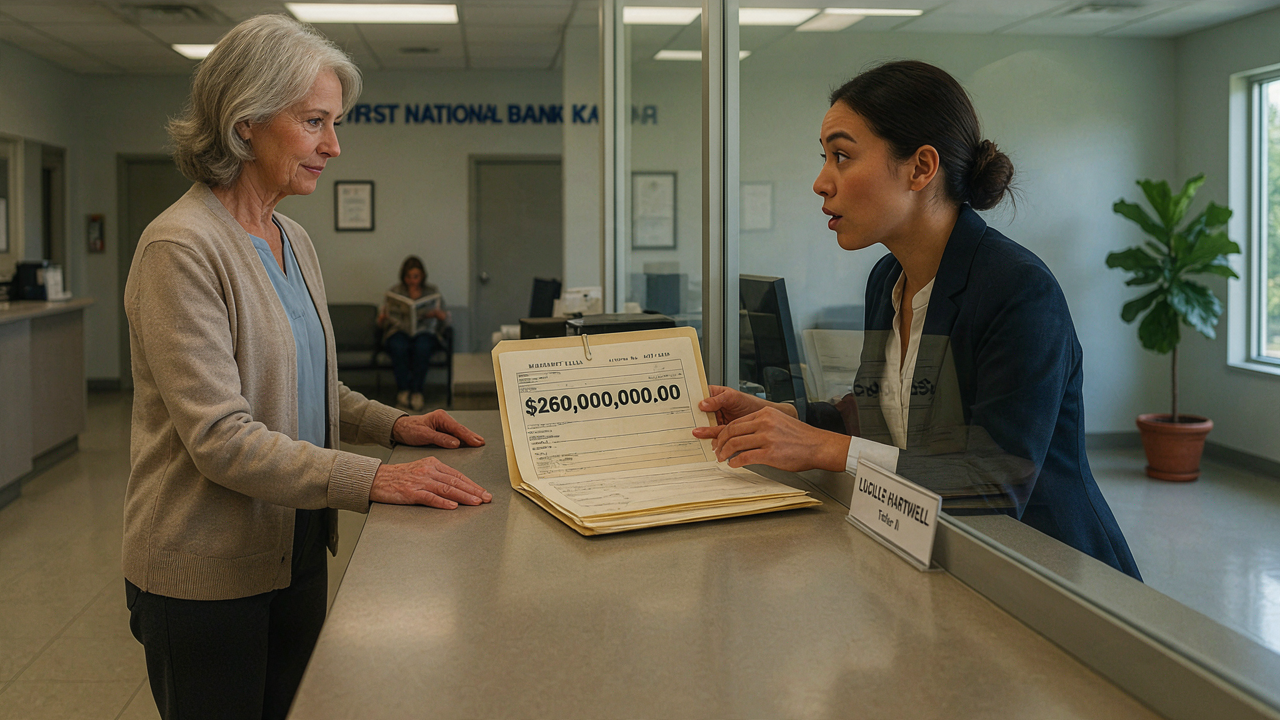
She opened the folder.
The first document was a letter from Thomas Bennett confirming the legal administration of the Whitmore estate.
The second was a certified statement.
She scanned the page.
Then she stopped.
Her eyebrows pulled together.
“What is this?”
“Please keep reading.”
She turned the page.
And there it was.
Lucille’s face lost all its color.
She looked at the number.
Then at me.
Then back at the number.
“Mom…”
Her voice was barely audible.
“What is this?”
“An inheritance.”
She shook her head.
“That’s impossible.”
“It isn’t.”
“Where did you get this?”
“From Alexander Whitmore.”
Her mouth fell open.
“Alexander Whitmore? The industrial billionaire?”
“Yes.”
“How do you know him?”
I pulled out the old letter.
“Because forty-four years ago, I gave him half my lunch.”
Lucille stared at me.
Then she laughed.
A short, nervous laugh.
“You’re joking.”
I shook my head.
She picked up the letter and began reading.
Her expression changed with every paragraph.
When she reached the end, her eyes filled with tears.
“Why didn’t you tell me?”
I looked directly at her.
“That’s an interesting question.”
“Mom, you’re talking about $260 million! You should have told me!”
“Would you have treated me differently?”
She froze.
“Of course.”
“Would you have given me the hundred dollars for my medicine yesterday?”
Her eyes dropped.
“Mom, I was stressed.”
“Would you have called me a leech?”
“Please don’t do this.”
“Would you have reminded me that I lived in your house for free?”
Lucille looked toward the glass wall.
A senior employee had appeared outside the room.
She lowered her voice.
“Can we discuss this privately?”
“We are discussing it privately.”
Then another man entered.
He was in his late fifties, with silver hair and a dark blue suit.
“Mrs. Ellis,” he said warmly. “I’m Thomas Bennett.”
He shook my hand.
Lucille stood abruptly.
“You’re the attorney?”
“Yes.”
“Is this document real?”
Thomas placed his briefcase on the desk.
“Every document in that folder has been independently verified. Mrs. Ellis is the legally recognized beneficiary of Mr. Whitmore’s estate.”
Lucille swallowed.
“And the money is actually available?”
“The estate has completed its administration. The assets are held through properly established structures, and Mrs. Ellis has full authority over the distributions and investments permitted by those arrangements.”
Lucille sat down slowly.
Thomas continued.
“Mrs. Ellis has requested an independent private banking relationship. We have already arranged the necessary compliance review and introductions.”
Lucille looked at him.
Then she looked at me.
“Mom, we need to talk.”
“I agree.”
But before she could say another word, a woman knocked on the door.
She was the bank’s regional director.
“Ms. Ellis,” she said to Lucille, “could you please step outside for a moment?”
Lucille stood.
The director turned toward me.
“Mrs. Ellis, I apologize for the interruption. We would be honored to assist you.”
I nodded.
“Thank you.”
Lucille looked as if she had suddenly realized that the room no longer belonged to her.
She walked outside.
Through the glass, I watched her speak with the regional director.
Her hands were moving rapidly.
She looked shocked, embarrassed, and frightened.
Then she returned.
“Mom, can we go home?”
I closed the folder.
“I think I’ll be staying somewhere else tonight.”
Her face crumpled.
“What?”
“I’ve already arranged an apartment.”
“You can’t just leave.”
“Why not?”
“Because you’re my mother!”
I looked at her for a long moment.
“Yesterday, I was a leech. Today, I’m your mother again?”
She began crying.
“That’s not fair.”
“No, Lucille. It wasn’t fair when I sat in your kitchen asking for medicine.”
Thomas quietly gathered the remaining documents.
I stood.
“There’s one more thing.”
I reached into my purse and placed a small envelope on the table.
It contained a copy of Alexander’s final letter.
“Read it carefully. Especially the last paragraph.”
Then I walked out.
I expected the day to be difficult.
I didn’t expect what happened next.
At 4:30 that afternoon, my phone began ringing.
Lucille called.
I didn’t answer.
Then Richard called.
I didn’t answer.
Then Lucille sent a message.
Mom, please come home. We need to discuss our future.
Our future.
Not my health.
Not my medicine.
Not whether I was okay.
Our future.
I turned off my phone.
That evening, I checked into a beautiful hotel overlooking the river.
For the first time in three years, I slept without worrying about whether I was using too much electricity.
The next morning, Thomas arrived with breakfast and a newspaper.
“There’s something you should know,” he said.
I poured coffee.
“What happened?”
“Your daughter contacted the bank’s regional office yesterday.”
“Why?”
“She asked whether she could become your financial representative.”
I almost laughed.
“Without asking me?”
“She claimed you had been confused about the inheritance and that she needed to protect you.”
I put down my cup.
“Did she say I was incapable of managing my affairs?”
“Yes.”
I stared out the window.
“How convenient.”
Thomas opened his briefcase.
“There’s more.”
He handed me a printed email.
It was from Richard.
He had contacted one of the attorneys associated with the bank, asking how much of my inheritance could legally be transferred into a family trust.
He had even proposed that Lucille and he become co-trustees.
I read the email twice.
Then I looked up.
“How did they know enough to ask these questions?”
“Your daughter has financial training. She understands the basic structures.”
I sighed.
“She knows about money. She has forgotten about people.”
Thomas nodded.
“There’s also a matter involving your former residence.”
I frowned.
“What about it?”
“Your daughter contacted a real estate agent. She was asking whether the house you sold after Harold died could be repurchased using funds from your estate.”
I stared at him.
“Why would she want that?”
“According to the agent, she mentioned that it would be a good investment for the family.”
The family.
I wondered whether she had ever considered that I was part of that family.
Thomas closed the briefcase.
“Mrs. Ellis, I recommend that you establish clear boundaries immediately.”
I nodded.
“That’s exactly what I intend to do.”
Over the next two weeks, I made several decisions.
I purchased a comfortable home in a quiet neighborhood.
It had three bedrooms, a garden, a spacious kitchen, and a little sunroom where I could read.
I hired a financial adviser who had no connection to Lucille’s bank.
I established charitable foundations to support elderly people struggling with medical expenses and young students from disadvantaged backgrounds.
I also arranged for a significant portion of Alexander’s fortune to support medical research.
I didn’t want the money to sit in accounts while people suffered.
I wanted it to do what Alexander had intended.
Help someone.
Meanwhile, Lucille kept calling.
At first, her messages were angry.
You embarrassed me at work.
Then they became emotional.
I can’t believe you kept something this important from your own daughter.
Then came the apologies.
Mom, I’m sorry about what I said.
And finally:
Can we please talk about how we’re going to manage the money?
That last message told me everything.
She still didn’t understand.
I wasn’t hiding the money anymore.
I was protecting it.
And myself.
Three weeks after the bank visit, Lucille appeared at my new home.
I was planting white roses near the front porch.
When I saw her car, I stopped digging.
She got out slowly.
She looked tired.
Her eyes were swollen, and her expensive coat was wrinkled.
“Mom.”
I wiped my hands on a towel.
“Hello, Lucille.”
She looked around.
“This is beautiful.”
“Thank you.”
“How much did it cost?”
I smiled sadly.
“Is that really the first thing you want to ask?”
She looked down.
“I’m sorry.”
I waited.
She stepped closer.
“I’ve been thinking about everything.”
“Have you?”
“Yes. I shouldn’t have called you that.”
“No. You shouldn’t have.”
“I was under pressure. Richard and I have been having financial problems.”
I looked at her.
“What kind of problems?”
She hesitated.
“His business hasn’t been doing well.”
“How badly?”
“He borrowed money to expand a construction company. Several projects failed. We have debts.”
“How much?”
She told me.
It was a substantial amount.
But not enough to justify what she had done.
I listened quietly.
Then she said the words I had been expecting.
“Mom, now that you have all this money, you could help us.”
I folded the towel.
“Lucille, I spent three years living in your home. I cooked your meals, cleaned your kitchen, and helped with your household expenses whenever I could.”
She nodded.
“I know.”
“When I needed a hundred dollars for medicine, you called me a leech.”
Tears appeared in her eyes.
“I know.”
“And now you’re asking me for hundreds of thousands of dollars.”
She covered her face.
“Please don’t make me feel worse.”
I walked toward the porch.
“Then don’t ask me to pretend it never happened.”
She followed.
“Mom, we’re family.”
I stopped.
“Yes. We are.”
“Family helps each other.”
“You’re right.”
She looked hopeful.
Then I continued.
“But family doesn’t have to purchase the right to be treated with dignity.”
Lucille began crying.
For a moment, I saw the little girl who used to run into my arms after school.
I wanted to hug her.
I wanted to tell her everything would be okay.
But I also remembered the woman who had looked at me across her kitchen and called me a leech.
“There’s something else,” I said.
I took Alexander’s letter from a drawer and handed it to her.
“Read it again.”
She opened it.
This time, she read every line slowly.
When she finished, she looked at me.
“Mom, I understand why he left it to you.”
“Do you?”
“He wanted to reward your kindness.”
I shook my head.
“No. He wanted to honor it.”
She looked confused.
“What’s the difference?”
“One is about money. The other is about remembering what kind of person someone was when nobody was watching.”
She lowered her eyes.
I continued.
“Alexander remembered a lunch I gave him forty-four years ago. I never expected anything. I didn’t even remember his last name. But he remembered how I treated him.”
I paused.
“Lucille, I raised you to understand that money is useful. But I hoped I had also taught you that kindness matters when there’s nothing to gain.”
She began sobbing.
“Mom, I was wrong.”
“I know.”
“Can you forgive me?”
I looked at her.
“Forgiveness is possible. Trust takes longer.”
She nodded.
Then she asked quietly:
“Will you help us?”
I took a deep breath.
“I won’t pay Richard’s business debts. I won’t buy you another house. And I won’t put you in control of my inheritance.”
Her expression fell.
“But I am willing to help you find an independent financial counselor. If you genuinely want to rebuild your lives, I’ll support you with advice and limited assistance that doesn’t compromise my security.”
She wiped her cheeks.
“That’s all?”
“That’s more than I received when I needed medicine.”
She didn’t argue.
For the first time, she simply nodded.
Before leaving, she turned toward the garden.
“Can I visit again?”
“Yes.”
“Even if I don’t ask about the money?”
I smiled faintly.
“Especially then.”
She walked to her car.
I watched her drive away.
And I wondered whether she would ever understand what had truly happened.
Not the inheritance.
Not the bank.
Not the $260 million.
The real surprise was that an old man had remembered one small act of kindness for more than four decades.
And my own daughter had forgotten thousands of acts of love in less than three years.
Six months passed.
Lucille began visiting every Sunday.
At first, our conversations were awkward.
She brought groceries.
I thanked her.
She helped me plant flowers.
Sometimes we talked about Harold.
Sometimes we talked about ordinary things.
She never asked about the inheritance again.
Richard, however, did not change as quickly.
He remained angry that I had refused to pay his debts.
Eventually, Lucille told me they were separating.
She said their financial problems had exposed deeper issues in their marriage.
I didn’t celebrate.
I simply listened.
One Sunday, she arrived carrying an old photograph.
It was taken on her eighth birthday.
She was sitting between Harold and me, holding a chocolate cake.
I was laughing.
Harold had frosting on his nose.
Lucille looked at the photograph for a long time.
“I remember this day,” she said.
“Your father baked that cake.”
She smiled.
“He was terrible at baking.”
“He was terrible at many things.”
We both laughed.
Then she became serious.
“Mom, I used to think you were strong because you never needed anything.”
I looked at her.
“But now I realize you were strong because you never made anyone feel small when they needed help.”
I reached across the table and took her hand.
“That’s something your father taught me.”
She squeezed my fingers.
“I wish I had understood it sooner.”
“So do I.”
A year after Alexander’s death, I established a foundation in his name.
Its first project was a program that provided emergency medication assistance to elderly people who couldn’t afford their prescriptions.
I called it the Half a Lunch Foundation.
At the opening ceremony, I told the story of a young man who had once been hungry and a woman who had shared her food.
I didn’t mention the $260 million.
I didn’t need to.
The foundation helped thousands of people.
One afternoon, a little girl approached me after a community event.
She was holding a paper bag.
“My grandmother says you help people,” she said.
I smiled.
“Sometimes I try.”
She handed me the bag.
Inside was a sandwich, an apple, and a small handwritten note.
It read:
Thank you for helping my grandma get her medicine.
I couldn’t speak.
I held the little girl close and closed my eyes.
For a moment, I felt Harold’s hand in mine.
And I imagined Alexander smiling somewhere, knowing that his final gift had become something much bigger than an inheritance.
That evening, I returned home and placed the little girl’s note beside Alexander’s letter.
Two pieces of paper.
One from a billionaire who remembered a sandwich.
One from a child who remembered a medicine bottle.
Both reminded me of the same truth.
Kindness is never wasted.
A few days later, Lucille visited again.
We sat in the sunroom drinking tea.
She noticed the two letters on the table.
“Do you ever regret not telling me about the inheritance sooner?” she asked.
I considered the question.
“Sometimes I regret that we reached a point where I felt I had to hide it.”
She nodded.
“But you wanted to know whether I loved you for yourself.”
“Yes.”
“And now?”
I looked at her.
“Now I want to know whether we can build something better.”
She reached across the table.
“I want that too.”
I squeezed her hand.
I had forgiven her.
But I had also learned something important.
Being a mother doesn’t mean allowing your children to treat you badly.
Being generous doesn’t mean surrendering your dignity.
And being old doesn’t mean becoming invisible.
I was seventy-two years old.
I had lost my husband.
I had lost my home.
I had spent three years trying not to inconvenience the daughter I loved.
But I had not lost myself.
And I would never allow anyone to make me feel worthless again.
Sometimes people think the biggest lesson in my story is that a poor widow suddenly inherited $260 million.
It isn’t.
The biggest lesson is that Alexander Whitmore remembered a simple act of kindness for forty-four years.
He didn’t remember my clothes.
He didn’t remember my salary.
He didn’t remember whether I had a large house or an expensive car.
He remembered that when he was hungry, I shared my lunch.
And when I needed help, my own daughter couldn’t spare a hundred dollars.
So if you ask me what the $260 million taught me, I’ll give you the same answer I gave Lucille.
Money reveals what people want from you. But difficult moments reveal who they really are.
And the greatest inheritance I ever received wasn’t the fortune.
It was the reminder that I had been valuable all along.