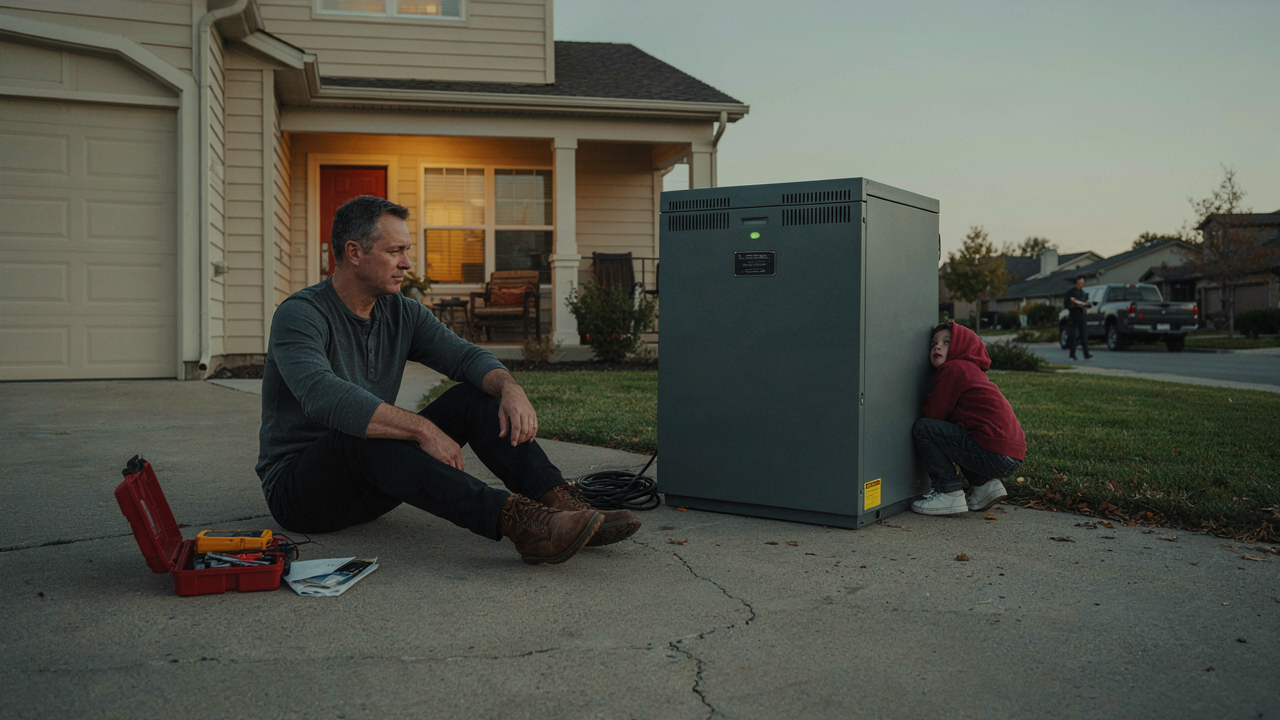
While my daughter and her husband were away in Hawaii, I hired a technician to repair their solar battery system. An hour later, he called and said, “Sir, there’s a little boy hiding behind the backup battery, and he won’t come out.” I drove over immediately, but I did not rush toward him or demand answers. I sat a few feet away, spoke calmly, and waited until he felt safe enough to look at me. My daughter had said the house was empty. What I discovered suggested someone had been there far longer than anyone admitted. By the time I made one quiet call, their vacation was no longer the biggest secret that needed explaining.
He counted them carefully.
Then looked up at me.
“Are you the grandpa who sends money?”
I felt something tighten in my chest.
“What money, Noah?”
“Mama says my grandpa sends money because taking care of me costs too much.”
I sat down across from him.
For years, Diane had told me Daniel’s parents were struggling financially. She said they needed help covering Noah’s school expenses, medical appointments, and clothing.
Every month, I transferred $600 into an account she claimed to manage for his grandparents.
I had never missed a payment.
Not once.
“Did your mama ever buy you birthday presents?” I asked.
Noah shook his head.
“Sometimes Ryan brings me things when I’m good.”
I looked at his coloring book.
“Did he bring you that?”
“No. I found it in the garage.”
Hector stood beside the kitchen counter, his arms folded tightly across his chest.
He looked like a man trying very hard not to lose his temper.
I handed Noah another napkin.
Then I asked Hector to stay with him while I stepped outside.
I took out my phone and made the call I should have made the moment I understood what was happening.
“911. What’s your emergency?”
“My name is Frank Mercer. I’ve discovered a six-year-old child who appears to have been confined inside a locked utility room. His caregivers are out of state. We need police and medical assistance.”
The dispatcher asked whether Noah was currently safe.
“He’s with me now.”
“Is he injured?”
“I don’t know. He’s very thin, and I’m concerned about dehydration and prolonged neglect.”
“Help is on the way, sir. Stay with the child.”
I thanked her and hung up.
Then I made another call.
To Diane.
She answered on the fourth ring.
“Dad? Do you know what time it is here?”
Behind her, I could hear music, laughter, and what sounded like ocean waves.
“Diane, I’m at your house.”
“Oh. Did the technician fix the battery?”
“Not yet.”
“Well, tell him to hurry. Ryan’s worried about the freezer.”
I closed my eyes.
“Diane, where is Noah?”
The background noise continued.
But my daughter said nothing.
“Dad?”
“Where is your son?”
For several seconds, I heard only her breathing.
Then she laughed nervously.
“What are you talking about? He’s in California.”
I looked through the kitchen window.
Noah was carefully folding the empty sandwich wrapper into a little square.
“No,” I said. “He’s sitting at your kitchen table.”
The line went silent.
Then Diane whispered:
“You weren’t supposed to go upstairs.”
Not Is he okay?
Not What happened?
Not Thank God someone found him.
You weren’t supposed to go upstairs.
I had spent sixty-eight years learning to control my anger.
That morning nearly undid all of it.
“Diane, how long has he been living in that room?”
“Dad, you don’t understand.”
“Then explain it.”
“It’s complicated.”
“He’s six years old.”
“I know!”
“There’s a deadbolt on the outside of his door.”
She started crying.
“Ryan said it was safer that way.”
“Safer for whom?”
She didn’t answer.
Then I heard Ryan’s voice in the background.
“Who’s that?”
“My dad.”
“What does he want?”
“He found Noah.”
There was a sudden rustling sound.
Then Ryan came on the phone.
“Frank, listen to me. Before you do anything stupid, let us explain.”
I stared at the house.
“Stupid?”
“Noah has behavioral problems. We had to create a structured environment.”
“He was locked behind a battery.”
“He hides when he’s upset.”
“There’s a lock on the outside of the door.”
Ryan sighed impatiently.
“We were going to deal with everything when we got back.”
I looked toward the kitchen again.
“No,” I said. “You’re going to deal with it now.”
“What does that mean?”
“It means the police are coming.”
Ryan began shouting.
I ended the call.
***
The first police officer arrived twelve minutes later.
Her name was Officer Melanie Torres.
She was followed by another officer, two paramedics, and eventually a child welfare investigator named Rachel Bennett.
I explained everything I knew.
The locked door.
The covered window.
The food schedule.
The notebook.
The birthday cards.
And the conversation with Diane.
Hector gave his own statement.
Then he handed the officers photographs he’d taken of the utility room before opening the door completely.
“I thought something was wrong with the installation,” he explained. “I never expected to find a child.”
Rachel approached Noah slowly.
She introduced herself and asked whether she could sit beside him.
He looked at me.
“She’s here to help,” I said.
Noah nodded.
Rachel spoke gently, asking only a few questions before arranging for a more thorough assessment in a safer setting.
Then one of the paramedics noticed Noah’s feet.
“Does he have shoes?”
I hadn’t seen any.
Rachel asked him.
Noah pointed upstairs.
“I’m not supposed to wear them inside.”
“Do you have shoes for going outside?”
He thought for a moment.
“I used to.”
Rachel exchanged a look with the officer.
I felt sick.
When the paramedics explained that Noah needed to go to the hospital for an examination, he began trembling.
“Did I do something bad?”
“No,” Rachel said. “We’re making sure you’re healthy.”
He grabbed my sleeve.
“Can Frank come?”
I swallowed.
“Of course, buddy. If they’ll let me.”
The paramedic smiled.
“We’ll arrange that.”
Before we left, Hector approached me.
“Frank.”
I turned.
His eyes were red.
“I don’t know what would’ve happened if that battery hadn’t failed.”
Neither did I.
The thought was too terrible to finish.
I shook his hand.
“Thank you for opening that door.”
He nodded.
Then he looked away.
***
At the hospital, doctors examined Noah and began treating his immediate medical needs.
He was underweight.
He had signs of nutritional deficiencies and dental problems.
His muscles lacked the strength expected of a child his age.
But what concerned the medical team most was his fear.
When a nurse brought him a clean hospital gown, he apologized.
When someone offered him apple juice, he apologized again.
When he needed to use the bathroom, he asked permission three times.
Every ordinary need seemed to him like something that might get him punished.
I sat beside his bed.
Rachel brought him a small stuffed dinosaur from the hospital’s children’s department.
He stared at it.
“Can I keep it?”
“Absolutely.”
“Even when I leave?”
“Yes.”
He hugged it against his chest.
Then he whispered:
“I never had one that stayed mine.”
I turned toward the window because I couldn’t let him see what those words had done to me.
My late wife, Margaret, had wanted grandchildren more than anything.
When Noah was born, she bought a blue blanket and spent three afternoons embroidering his name onto it.
She died before his first birthday.
After Diane told me he’d moved to California, I placed that blanket in a cedar chest.
I couldn’t bear to give it away.
Now I wondered how many nights my grandson had slept cold beneath a moving blanket while the one his grandmother made remained untouched in my house.
***
That evening, Rachel asked whether we could speak privately.
She held a folder against her chest.
“Mr. Mercer, we’re working to establish Noah’s formal history.”
I nodded.
“Of course.”
“Do you know the names of his paternal grandparents?”
“Robert and Susan Carter. They lived near Sacramento.”
“Have you spoken with them recently?”
I shook my head.
“Diane said they didn’t want contact.”
Rachel looked at me carefully.
“We contacted Mrs. Carter this afternoon.”
I sat straighter.
“And?”
“She was extremely distressed to learn Noah had been found.”
“Distressed?”
Rachel nodded.
“According to her, she and her husband never had custody of Noah.”
I stared at her.
“What?”
“They asked Diane whether they could visit him after Daniel died. Diane told them she was moving away and intended to raise Noah herself.”
I felt the room tilt.
“They haven’t seen him since he was approximately eighteen months old.”
I struggled to find words.
“But I sent birthday cards.”
Rachel was silent.
“I sent money every month.”
Her expression softened.
“Mr. Mercer, we believe both sides of Noah’s family may have been given false information.”
I leaned back in my chair.
For years, I’d believed another family had taken my grandson away from me.
And for years, that family apparently believed I’d been allowed to watch him grow up.
Diane had kept us apart.
Every grandparent.
Every relative who might have asked questions.
Every person who might have noticed that Noah wasn’t attending school or appearing in family pictures.
I pressed my hands against my face.
“How did I let this happen?”
Rachel gave me a moment.
Then she said, “Right now, Noah needs adults who will follow through on keeping him safe.”
I lowered my hands.
“I want him with me.”
“We can begin evaluating you for an emergency kinship placement.”
“Tell me what you need.”
She explained the process.
Background checks.
A home assessment.
Court authorization.
Coordination with Noah’s other grandparents and medical providers.
I agreed to everything.
Then I returned to his room.
He was asleep, curled around his dinosaur.
I sat beside him until morning.
***
Diane and Ryan cut their vacation short.
They arrived in Portland the following afternoon.
Diane called me from the airport.
“Dad, where’s Noah?”
“He’s safe.”
“Where?”
“The authorities will explain the arrangements.”
“I’m his mother!”
I closed my eyes.
“Yes, Diane. You are.”
“Then tell me where my son is!”
I felt tears rise.
“You had six years to remember he was your son.”
She began crying.
“Dad, please.”
“Noah needs medical attention and protection. I’m cooperating with the people responsible for providing both.”
“You’re making this sound like we’re criminals.”
I looked down at the birthday cards lying on my desk.
“Then you should explain why there was a lock on that door.”
She hung up.
Later that evening, Diane and Ryan went to the police station with an attorney.
Investigators questioned them about the conditions in the house, Noah’s supervision, his schooling, and their decision to travel to Hawaii.
Their explanations differed.
Diane claimed Ryan’s cousin was supposed to check on him.
Ryan said Diane had arranged everything.
The cousin told investigators she had never agreed to supervise a child.
And the evidence inside the house suggested Noah’s isolation stretched far beyond a single vacation.
The refrigerator contained preportioned meals.
The notebook contained months of entries.
Some were written in Diane’s handwriting.
Others appeared to have been copied by Noah himself.
Investigators also found packages of children’s clothing hidden in a storage cabinet.
None of it appeared in the photographs Diane posted online.
As far as her friends and neighbors knew, she and Ryan were a childless married couple.
That was the life they had chosen to show the world.
And Noah had been hidden to preserve it.
***
Three days later, a detective named Owen Mitchell came to my house.
He asked about the money I’d sent Diane.
I retrieved my bank statements.
We sat at my dining table while he reviewed the transfers.
Seventy-two payments.
Six hundred dollars each.
A total of $43,200.
And that didn’t include the birthday money, Christmas gifts, or additional amounts Diane had requested for supposed medical expenses.
Detective Mitchell looked up.
“Did you ever receive receipts?”
I shook my head.
“She was my daughter.”
He nodded without judgment.
“Do you remember what she said the money was for?”
“Everything Noah needed.”
He wrote that down.
Then he opened another folder.
“There’s something else you should know.”
My stomach tightened.
“What?”
“Daniel Carter had a life insurance policy.”
I stared at him.
“I knew that. Diane said the money went toward his funeral and outstanding expenses.”
Detective Mitchell shook his head.
“According to the records we’ve obtained, there was a separate benefit intended for Noah.”
“How much?”
“Approximately $185,000.”
I could barely breathe.
He continued.
“We’re examining how those funds were administered and whether money intended for Noah’s benefit was misused.”
I leaned forward.
“Are you saying my daughter had nearly two hundred thousand dollars to take care of him?”
“The financial investigation is ongoing.”
I looked at the walls of my house.
The modest furniture.
The old carpet Margaret and I had bought together.
Then I pictured Diane’s photographs from Maui.
The resort.
The champagne glasses.
The private sunset cruise.
The neatly arranged sunglasses and designer handbags.
While her child sat behind a battery housing counting the days until she returned.
I lowered my head.
“God help me,” I whispered.
Detective Mitchell closed the folder.
“Mr. Mercer, did you know Ryan before he married your daughter?”
“Not particularly well.”
“Did he know Noah existed?”
“Yes. I asked Diane about introducing them years ago. She said Ryan understood that Noah was living with his grandparents.”
The detective nodded.
“We have information suggesting Ryan knew considerably more than that.”
Then he showed me a photograph recovered during the investigation.
It depicted Noah sitting on the attic floor.
He couldn’t have been more than four.
Behind him stood the same boxes Hector had found.
The date attached to the image was almost two years old.
I stared at it until my vision blurred.
Two years.
At least two years.
I thought about all the holidays I’d celebrated downstairs.
All the dinners.
All the times I’d visited my daughter and complimented her beautiful home.
And somewhere above my head, my grandson might have been listening.
***
Robert and Susan Carter arrived from California the following morning.
Susan was holding a photograph of Daniel when we met.
She looked older than I remembered.
Robert walked with a cane.
Neither of them knew what to say.
Finally, Susan whispered:
“Frank, did you know?”
I shook my head.
“No.”
She began crying.
“Neither did we.”
We stood in my living room, three grandparents who had each spent years believing someone else was raising the same little boy.
Susan explained that they had sent presents.
Diane returned some of them.
Others disappeared.
Eventually, Diane stopped answering their messages altogether.
Robert had considered pursuing visitation through the courts, but his health deteriorated, and they couldn’t afford a prolonged legal dispute.
They never imagined Noah was being mistreated.
“We thought she loved him,” Susan whispered.
I looked at Margaret’s photograph.
“So did I.”
When the child welfare team arranged their first supervised meeting with Noah, Susan brought a small photo album.
She sat beside him and opened it.
“This is your daddy.”
Noah studied Daniel’s face.
“He looks like me.”
Susan smiled through her tears.
“He certainly does.”
“Where is he?”
Robert explained gently that Daniel had died when Noah was very young.
Noah looked at the photograph again.
“Did he know me?”
Susan began crying.
“Oh, sweetheart. He adored you.”
She showed him pictures of Daniel holding him as a baby.
Daniel feeding him.
Daniel asleep on the couch with Noah resting against his chest.
For several minutes, Noah said nothing.
Then he touched one photograph with his fingertip.
“Was I allowed to sit with him?”
Robert turned his face away.
Susan nodded.
“Anytime you wanted.”
Noah smiled.
It was the first real smile I’d seen.
***
A week after his rescue, the court approved Noah’s temporary placement with me under child welfare supervision.
I prepared Margaret’s old sewing room.
A small bed.
Fresh sheets.
A nightlight shaped like a moon.
A bookshelf with children’s books.
And on the bed, the blue blanket Margaret had made before she died.
When Noah entered the room, he stood in the doorway.
“Who sleeps here?”
“You do.”
He looked behind him.
“Just me?”
“Just you.”
He pointed toward the window.
“Can I open that?”
“Of course.”
He walked over and looked outside.
My backyard stretched beneath the afternoon sunlight.
There was a maple tree, a little garden shed, and the old birdbath Margaret used to fill.
Noah stood there for a long time.
Then he asked:
“Can people see me?”
I swallowed.
“Yes.”
“Is that okay?”
I knelt beside him.
“Noah, you don’t have to hide anymore.”
He looked at me uncertainly.
“What if Mama gets mad?”
“The adults are handling that.”
He glanced at the bed.
“Can I sleep with the light on?”
“Absolutely.”
“Can I keep the door open?”
“Yes.”
He thought for a moment.
“Can I close it if I want?”
I smiled.
“Yes, buddy. You get to choose.”
That night, I found him asleep on the floor beside his bed.
He had wrapped himself in Margaret’s blanket.
He was accustomed to sleeping close to the ground.
I covered him gently and left the bedroom door open.
It would take time.
I understood that.
A comfortable bed could be purchased in an afternoon.
Feeling safe enough to sleep in it was something entirely different.
***
Diane requested contact with Noah.
The authorities determined that any contact would need to follow the court’s restrictions and the recommendations of the professionals overseeing his welfare.
She became furious with me.
She sent messages accusing me of stealing her son.
She said Ryan had manipulated her.
She said the utility room was never intended to be permanent.
She said Noah was difficult.
She said she couldn’t cope.
And eventually, she wrote:
“You have no idea what being a mother has cost me.”
I stared at that message for a long time.
Then I replied:
“Noah has spent his childhood paying for decisions he never made. Whatever you were struggling with, he deserved safety and care. I will not help you hide what happened.”
I sent nothing else.
A few days later, she stopped contacting me directly.
***
The criminal investigation lasted several months.
During that time, more evidence emerged.
Ryan had repeatedly pressured Diane to keep Noah out of sight.
He didn’t want children from a previous relationship interfering with the lifestyle he envisioned.
But Diane had participated willingly in the deception.
She had arranged the false stories.
Intercepted correspondence.
Collected money.
Maintained the rules.
And concealed Noah from people who loved him.
Investigators brought charges related to child neglect, confinement, and financial misconduct.
Both Diane and Ryan eventually entered guilty pleas to charges arising from their conduct.
They received prison sentences, and the court imposed restrictions intended to protect Noah from further harm.
Separate proceedings addressed the money intended for his benefit.
Some funds were recovered and placed under independent management.
I attended the sentencing.
Diane sat beside her attorney wearing a plain gray sweater.
Without her expensive clothes and carefully arranged makeup, she looked like the daughter I remembered from years ago.
For a moment, I saw her at six.
Running across our backyard in yellow rain boots.
Laughing when Margaret sprayed her with the garden hose.
I remembered teaching her to ride a bicycle.
Holding her when she lost Daniel.
Promising that whatever happened, she would always have a father.
And I realized that loving my daughter didn’t require pretending she hadn’t harmed her own child.
When the judge asked whether I wanted to speak, I stood.
“I spent six years believing my grandson was being raised by another family,” I began.
My voice shook.
“I sent money, birthday cards, and Christmas gifts. I believed my daughter when she told me he was happy.”
Diane began crying.
I continued.
“But Noah wasn’t happy. He was hidden. He was frightened. He learned to apologize for being hungry.”
I paused.
“He learned that making noise could get him punished and that being seen was something dangerous.”
The courtroom was silent.
“I cannot give him those years back. Nobody can. But I can make sure the rest of his childhood isn’t spent protecting the adults who failed him.”
I looked at Diane.
“You are my daughter. I will always wish you’d made different choices. But your son deserved more than the life you gave him.”
Then I sat down.
I didn’t look at Ryan.
I had nothing to say to him.
***
Noah started school the following spring.
His teachers worked with specialists to help him adapt.
He needed extra support with reading, social interaction, and the ordinary routines other children had been learning for years.
On his first morning, he wore a green backpack with dinosaurs printed across it.
He stood beside my truck holding my hand.
“Grandpa?”
“Yes?”
“What if I ask a question and everybody gets mad?”
I crouched beside him.
“That’s what school is for. Questions.”
“What if I don’t know the answers?”
“Then you’ll learn.”
He considered that.
“Do I have to say sorry first?”
“No.”
He nodded.
Then he walked through the school doors.
I sat in my truck for twenty minutes afterward.
Crying like an old fool.
Margaret would have taken a hundred pictures.
She would have packed his lunch with a note and reminded him not to forget his sweater.
I wished more than anything that she could have seen him.
***
His seventh birthday arrived in June.
Robert and Susan flew up from California.
Hector came with his wife.
Rachel stopped by briefly with permission from the people overseeing Noah’s care.
The backyard was filled with balloons.
A chocolate cake sat on the picnic table.
Noah had chosen it himself.
Seven candles.
Seven years.
For a while, he stood beside the table looking uncertain.
“Is all this for me?”
Susan wrapped an arm around him.
“Yes, sweetheart.”
“Even the cake?”
“Especially the cake.”
We sang.
He smiled nervously.
Then he blew out the candles.
Afterward, I brought out a small wooden box.
Inside were all the birthday cards I had recovered from Diane’s house.
I had opened them carefully and placed them in order.
Noah sat beside me.
“Why didn’t I get these before?”
I took a breath.
“Because some adults made decisions they shouldn’t have made.”
He looked down.
“Were you thinking about me?”
“Every birthday.”
He opened one card.
Then another.
Inside each was a handwritten message from me.
Little stories about his grandmother.
Pictures of our backyard.
Promises that someday we’d go fishing.
He touched the newest card.
“Can we still do those things?”
I smiled.
“Every single one.”
***
By autumn, Noah had learned to ride a bicycle.
He crashed into the grass three times before figuring out how to balance.
Robert cheered from a lawn chair.
Susan brought lemonade.
I ran beside him until my knees reminded me that I was nearly seventy.
Then he took off down the driveway.
“Grandpa! Look!”
I laughed.
“I’m looking!”
He rode another circle.
Then another.
His laughter carried across the yard.
There was no ceiling above him.
No locked door.
No boxes to hide behind.
Just sunlight, open space, and a little boy discovering how wonderful it felt to move freely.
That evening, Hector came over to help repair my garden lights.
Noah ran outside to greet him.
“Mr. Hector!”
Hector grinned.
“Hey, little man.”
Noah threw his arms around him.
Hector looked at me over the child’s shoulder.
His eyes filled.
Neither of us said anything.
We didn’t need to.
***
I’m seventy now.
Noah is eight.
The court eventually approved a permanent guardianship arrangement with me, and his paternal grandparents remain an important part of his life.
He still attends therapy.
Some nights are difficult.
Certain sounds frighten him.
He sometimes saves food in his pockets because part of him still worries there won’t be enough tomorrow.
Healing hasn’t happened all at once.
But he no longer apologizes every time he asks for something.
He complains about vegetables.
Leaves his shoes in the hallway.
Talks during movies.
Laughs too loudly.
Ordinary little things that I once took for granted.
Now they feel like miracles.
Last Christmas, he helped me decorate the tree.
We hung a photograph of Daniel near the mantel.
Beside it was one of Margaret.
Noah looked at both pictures.
“Do you think they would’ve liked me?”
I put down the ornament I was holding.
“Your daddy loved you from the moment he met you. And your grandmother would’ve spoiled you absolutely rotten.”
He smiled.
Then he looked toward the kitchen.
“Can we have cookies?”
“After dinner.”
He groaned dramatically.
I laughed.
For once, he felt safe enough to complain.
And that was something worth celebrating.
***
Sometimes I drive past the house on Harlow Street.
I terminated Diane and Ryan’s occupancy through the appropriate legal process after Noah was removed.
I had the rooms professionally cleaned and the utility-room lock removed.
Eventually, I sold the property.
I couldn’t stand walking through it anymore.
Before the sale was completed, I went upstairs one final time.
The utility room was empty.
The black paper had been removed from the window.
Sunlight fell across the carpet.
I stood where Noah had once hidden and looked around.
Such a small room.
Such a terrible place for a childhood to disappear.
Then I noticed a tiny blue crayon near the baseboard.
I picked it up.
It was broken in half.
I brought it home and placed it inside the wooden box with Noah’s birthday cards.
Not because I wanted him to remember that room forever.
Because I wanted to remember how easily suffering can remain invisible when people accept convenient explanations.
And how important it is to ask questions when something doesn’t feel right.
***
Yesterday morning, Noah and I sat at my kitchen table eating breakfast.
He was drawing a picture for school.
The assignment was simple.
Draw your family.
He drew me first.
Then Robert and Susan.
Then Hector, which made me laugh.
He drew Daniel and Margaret above us, standing together beneath a bright yellow sun.
Finally, he drew himself in the middle.
I leaned closer.
“That’s a pretty crowded picture.”
He smiled.
“That’s everybody.”
I pointed toward the little house he’d drawn.
“Is that our house?”
He nodded.
Then he added two large windows.
A front door.
And a garden full of colorful flowers.
At the bottom, in careful handwriting, he wrote:
MY FAMILY KNOWS WHERE I AM.
I stared at those words.
For a long moment, I couldn’t speak.
Then Noah looked up.
“Grandpa?”
“Yes, buddy?”
“You know that day Mr. Hector found me?”
I nodded.
“Of course.”
He thought for a moment.
“I’m glad the battery broke.”
I looked toward the sunlight coming through the kitchen window.
“So am I.”
He returned to his drawing.
And I quietly wiped my eyes.
That battery failure cost me a service call, exposed my daughter’s lies, and changed the course of our entire family.
But it also brought my grandson home.
I had believed the house was empty.
Instead, I found a child who had spent years being treated as something the world wasn’t supposed to see.
A child who needed more than food, clothes, and a warm bed.
He needed permission to exist without fear.
To be heard.
To be noticed.
To belong.
I cannot recover the birthdays we missed.
I cannot erase the rules he was forced to memorize.
And I cannot undo what my daughter chose to do.
But every morning, when Noah comes running down the hallway in his dinosaur pajamas, I make him breakfast.
Every evening, I read him a story.
Every birthday, I watch him blow out his candles.
And every night, before he falls asleep, I remind him of something he should have known from the beginning.
“You don’t have to hide here, Noah.”
He usually smiles.
“I know, Grandpa.”
Then I tell him I love him.
Not because he’s quiet.
Not because he’s obedient.
Not because he’s done something to deserve a reward.
Simply because he’s my grandson.
And because every child deserves to grow up knowing that being alive is something to celebrate, not something to apologize for.