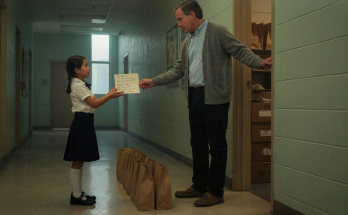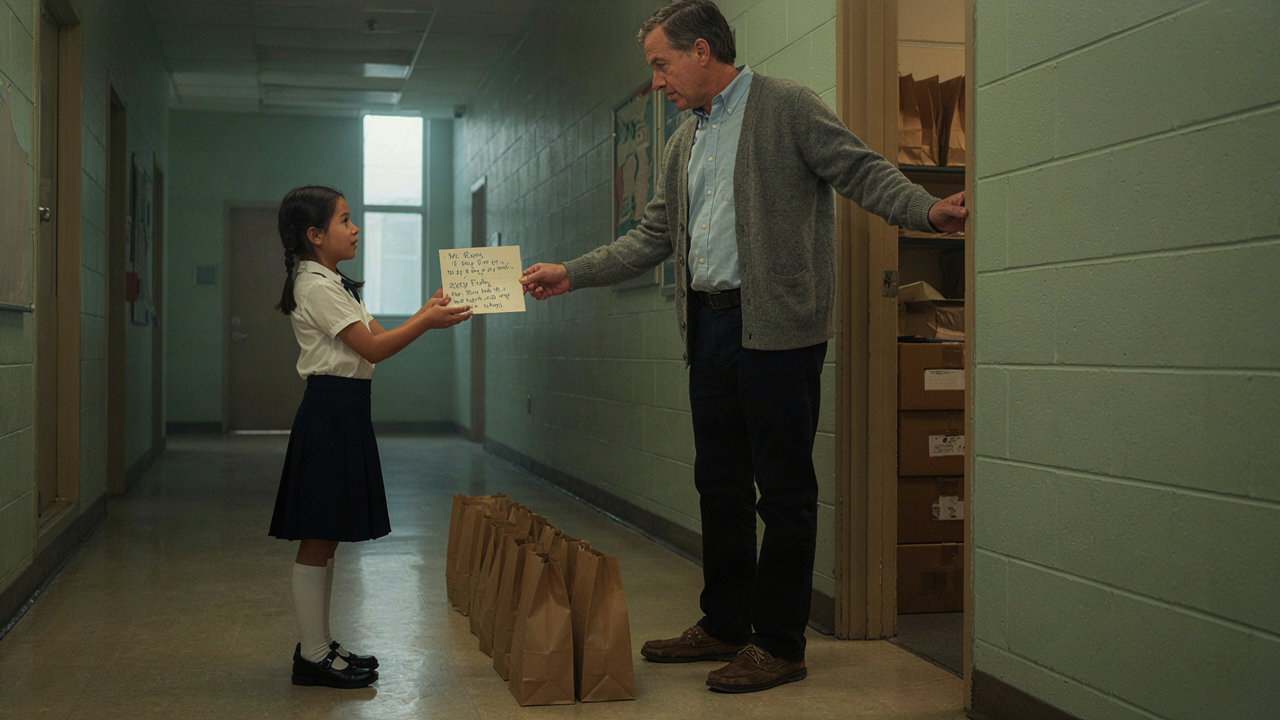
EVERY FRIDAY, I PACKED EIGHT BROWN BAGS FOR HUNGRY CHILDREN. AFTER NINE YEARS, MY SCHOOL TRIED TO FIRE ME FOR IT. THEN ONE LITTLE GIRL HANDED ME A CARD THAT CHANGED EVERYTHING.
For nine years, every Friday at exactly 2:30 p.m., I packed eight brown paper bags. Each bag held a sandwich, one piece of fruit, a granola bar, and a juice box. Nothing fancy.
No expensive snacks. No special treats. Just enough food to keep a child from going hungry over the weekend.
I bought everything with my own money.
Six thousand two hundred dollars.
That’s how much I had spent over nine years.I never asked for reimbursement. I never put my name on the bags. I never told parents what I was doing.
I simply placed them inside the classroom supply closet, and eight children collected them before going home.
They knew the routine.
They knew not to tell anyone.
And I thought that was enough.Until a teacher caught me.Her name was Mrs. Whitmore.She had been working at Jefferson Elementary for eleven years and had a reputation for following every rule, even the ones nobody else remembered.
One Friday afternoon, she saw me placing the final brown bag inside the closet.She stood in the doorway with her arms crossed.
“Mr. Rivera, what exactly are you doing?” I froze. “Just organizing some supplies.”
She glanced at the bags.
“Those aren’t school supplies.” I sighed.”They’re lunches.””For whom?”I didn’t answer immediately.She stepped closer and looked inside one of the bags.
“Are you distributing food to students without authorization?”
“They’re children who need something to eat.”
“That’s not what I asked.”
I looked at her.
“Yes. I give them food on Fridays.”
Her expression changed.
“You understand that’s against district policy, don’t you?”
I almost laughed.
Not because it was funny.
Because I had spent nine years making sure eight children didn’t go hungry, and somehow the most important question in the room was whether I had completed the correct paperwork.
“I submitted a request years ago,” I said quietly. “It was denied.”
“Then you should have followed the decision.”
She walked away.
Three days later, I received an email from the principal.
I was being summoned to a disciplinary hearing for unauthorized food distribution, violation of school procedures, and failure to comply with district safety guidelines.
Possible consequences included a formal reprimand, suspension, or termination.
Termination.
For feeding eight children.
My name is Daniel Rivera.
I’m fifty-four years old.
I’ve been a school custodian and facilities assistant at Jefferson Elementary for twenty-three years.
I know every classroom, every leaking faucet, every broken window, and every squeaky door in that building.
I know which teachers drink coffee before sunrise.
I know which children hide in the library when they’re upset.
And I know what an empty lunchbox looks like.
I also know what it means to go hungry.
When I was nine years old, my mother worked two jobs.
Sometimes there wasn’t enough food for Saturday and Sunday.
I remember sitting at our kitchen table, pretending I wasn’t hungry because I knew my little sister needed the last piece of bread.
My mother always said something that stayed with me.
“Daniel, if you ever have enough to share, don’t make someone beg for it.”
I never forgot.
And that’s why, nine years earlier, I started packing those bags.
It began with a little boy named Marcus.
He was seven.
I found him sitting outside the cafeteria one Friday afternoon, staring at an empty lunch tray.
I asked him if he had eaten.
He shook his head.
“Didn’t you bring lunch?”
He shrugged.
“My mom said we have to wait until Monday.”
I didn’t understand.
“What do you mean?”
He looked at the floor.
“She gets paid Monday.”
I bought him a sandwich from the vending area.
He ate it so quickly that I realized he hadn’t eaten properly all day.
The following Friday, I brought him another sandwich.
Then I noticed two other children watching him.
One girl was named Lily.
Another was named Jamal.
They never asked me for anything.
They just watched.
So I began bringing extra food.
At first, it was three bags.
Then five.
Eventually, eight.
I never made an announcement.
I never asked the children to explain their family situations.
I never wanted them to feel embarrassed.
Every Friday, I simply placed the bags inside the supply closet.
The children knew they could take one.
Sometimes they whispered thank you.
Sometimes they just smiled.
That was enough.
But I wasn’t doing this because I thought I was some kind of hero.
I was doing it because I remembered being hungry.
And I couldn’t walk past a hungry child.
The first year, I spent around $400.
The second year, it was a little more.
By the fifth year, I was buying groceries in bulk.
I learned which bread stayed fresh longest.
I learned which fruit survived the school refrigerator.
I learned that some children preferred peanut butter, while others couldn’t eat it because of allergies.
I kept a handwritten list of dietary restrictions.
I also started including little notes.
“Have a wonderful weekend.”
“Keep smiling.”
“You’re doing better than you think.”
Sometimes the children wrote back.
One note said:
“Thank you, Mr. Rivera. I didn’t have to sleep hungry last night.”
I kept that note in my locker.
Another said:
“My little brother liked the granola bar.”
I kept that one too.
Over the years, the brown bags became part of my Friday routine.
At 2:15, I finished my maintenance checklist.
At 2:20, I washed my hands.
At 2:30, I packed the bags.
At 2:45, I placed them inside the closet.
At 3:00, the children collected them.
Nobody made a big deal about it.
And for nine years, nobody complained.
Until Mrs. Whitmore.
The disciplinary hearing was scheduled for Thursday morning.
I received a formal notice from the district office.
The hearing would include Principal Harris, the assistant superintendent, a human resources representative, and Mrs. Whitmore.
I was allowed to bring documentation.
So I brought everything.
Nine years of grocery receipts.
A copy of my original food assistance request.
The district’s denial letter.
My handwritten records of dietary restrictions.
And the eight children’s thank-you notes.
I arranged everything in a brown folder.
The same color as the bags.
On Wednesday afternoon, I was cleaning the supply closet when someone knocked softly.
I turned around.
A little girl stood outside.
She was about ten years old, wearing a purple sweater and carrying a pink backpack.
Her name was Sofia Bennett.
She had been receiving one of my bags for almost three years.
“Mr. Rivera?”
“Hey, Sofia. What’s wrong?”
She looked behind her.
“Can I talk to you?”
“Of course.”
She stepped inside and pulled a folded card from her backpack.
“I made this for you.”
I smiled.
“You didn’t have to do that.”
“I know.”
She handed it to me.
The front had a drawing of eight brown bags.
Inside, her handwriting was uneven.
It said:
“Mr. Rivera, if they fire you, we just want you to know that every Friday, your brown bag is the only reason my little brother and I have food on Saturday. Sometimes my mom doesn’t get paid until Monday. I used to pretend I wasn’t hungry so he could eat. But because of you, we both eat now. I hope you know you’re more than a janitor to us. You’re the person who remembered.”
I read it once.
Then again.
My throat tightened.
I looked at Sofia.
“Your little brother?”
She nodded.
“His name is Noah. He’s five.”
I swallowed.
“Does your mother know you’ve been taking the bags?”
“Yes. She cried the first time I brought one home.”
“Why?”
Sofia looked down.
“Because she said she felt bad that someone else had to help us.”
I knelt so I was at her eye level.
“Listen to me. You tell your mother she doesn’t owe anybody an apology. Sometimes families have difficult weeks. That doesn’t mean they don’t deserve help.”
Sofia nodded.
Then she said something that broke my heart.
“Mr. Rivera, can I ask you something?”
“Anything.”
“If they stop giving us the bags, will you still be here?”
I didn’t know what to say.
I wanted to promise her that everything would be fine.
But I had a disciplinary hearing in less than twenty-four hours.
So I told her the truth.
“I’m going to do everything I can.”
She hugged me.
Then she left.
I stood in that supply closet for several minutes, holding her card.
And for the first time in nine years, I wondered whether I had made a mistake by keeping everything quiet.
Maybe I should have spoken louder.
Maybe I should have demanded that the district do something.
Maybe I should have told someone what those children were going through.
But I had tried.
And they had denied my request.
The next morning, I arrived at school at 7:10.
The hearing was scheduled for 9:00.
I put on my cleanest shirt, polished my shoes, and carried the brown folder.
Before leaving the maintenance office, I placed Sofia’s card inside.
I didn’t know why.
Maybe I wanted to remember what mattered.
At 8:55, I entered the conference room.
Principal Harris sat at the center of the table.
He was a man in his early sixties who had been principal for six years.
Beside him sat Mrs. Whitmore.
The assistant superintendent, Mr. Collins, sat opposite me.
A human resources representative had a laptop open.
“Mr. Rivera,” Principal Harris began, “thank you for attending.”
I nodded.
“We’re here to discuss allegations concerning unauthorized food distribution.”
Mrs. Whitmore opened a folder.
“On November 14, I observed Mr. Rivera distributing food to students without parental consent forms, medical clearance documentation, or administrative authorization.”
I looked at her.
“That’s not entirely accurate.”
She raised her eyebrows.
“Are you denying that you distributed food?”
“No. I’m saying I didn’t distribute it without considering their safety. I maintained dietary information and avoided foods that could cause known allergic reactions.”
Mr. Collins leaned forward.
“That doesn’t address the authorization issue.”
I opened my folder.
“Actually, it does.”
I removed a document.
“Nine years ago, I submitted a written request to establish a small weekend food program for students experiencing food insecurity.”
I placed the denial letter on the table.
The assistant superintendent picked it up.
He read it.
Then his expression changed.
“Where did you get this?”
“It’s my copy.”
He scanned the document again.
Principal Harris leaned over.
“What does it say?”
Mr. Collins didn’t answer immediately.
I did.
“It says the district could not approve the program because of liability concerns, insufficient oversight, and the absence of a designated funding source.”
Mrs. Whitmore folded her arms.
“That doesn’t authorize you to ignore the decision.”
“No,” I replied. “It doesn’t.”
I paused.
“But it does show that I tried to do this the right way.”
The room became quiet.
I continued.
“I wasn’t trying to undermine the school. I wasn’t trying to embarrass anyone. I just didn’t want eight children going home without food.”
Mr. Collins looked at the receipts.
“How much money have you spent?”
I answered.
“Approximately $6,200.”
“Personally?”
“Yes.”
“Over nine years?”
“Yes.”
He looked at me as if he hadn’t expected that answer.
Then he asked the question that changed the direction of the hearing.
“Why didn’t you tell the administration this was continuing?”
I stared at him.
“I did.”
He frowned.
“When?”
“Three years ago. I emailed the principal at the time. I also spoke to the family support coordinator.”
Principal Harris shifted in his chair.
“I wasn’t principal three years ago.”
“I know.”
I removed another document.
“This is the email.”
The human resources representative took it.
She read the message.
Then she read the reply.
Her eyebrows rose.
“What is it?” Mr. Collins asked.
She turned her laptop slightly.
The email was from the former principal.
It said:
“Mr. Rivera, while we appreciate your concern, please discontinue any independent distribution of food. The district cannot assume responsibility for activities outside approved programming. Further requests should be directed to the family support office.”
There was a second email.
This one was from the family support coordinator.
It said:
“Your request has been noted. At this time, no additional weekend food services are planned.”
I watched them read.
Then I said quietly:
“I stopped asking after that.”
Nobody spoke.
I could hear the air conditioner humming above us.
Finally, Mrs. Whitmore said:
“Regardless, rules exist for a reason.”
I looked at her.
“You’re right.”
She seemed surprised.
I continued.
“Rules matter. Food safety matters. Student privacy matters. But so does making sure children have something to eat.”
Mr. Collins closed the folder.
“We’ll review the documentation and issue a decision.”
I nodded.
“Thank you.”
As I stood, I remembered Sofia’s card.
I took it out.
“Before I leave, I’d like you to read something.”
I placed it on the table.
Nobody moved.
Principal Harris opened it.
He read the first line.
Then the second.
By the time he reached the final sentence, his expression had changed.
He passed it to Mr. Collins.
The assistant superintendent read it silently.
Then he handed it to the human resources representative.
Mrs. Whitmore finally picked it up.
She read the words.
Her face became pale.
But I wasn’t finished.
I opened the brown folder again and removed something else.
A list.
Eight names.
Not their family histories.
Not their financial situations.
Just their first names, ages, and the number of Fridays they had received food.
I placed it in front of them.
“These are the children who have been collecting the bags.”
Mr. Collins looked at the list.
“Are all eight still enrolled here?”
“Seven are. One transferred last year.”
“Do you know their circumstances?”
I hesitated.
“Only what they’ve told me. I never asked for details.”
Then I said something I had never said aloud before.
“Some of them are taking food home for younger brothers and sisters. Some have parents who work overnight shifts. Some have families who receive benefits but still run out of groceries before the next payment. I don’t know every story. I don’t need to.”
Mr. Collins looked down.
“Mr. Rivera, we’re going to need time.”
I nodded.
“Of course.”
I walked out.
I thought that was the end.
I was wrong.
At 11:30 that morning, Principal Harris called me into his office.
He looked exhausted.
“Daniel, close the door.”
I sat down.
He folded his hands.
“I’ve been reviewing the situation.”
“Okay.”
“There’s something you need to understand. The district is under significant pressure regarding liability. If a student has an allergic reaction, the consequences could be serious.”
“I understand.”
“And if food is distributed without proper documentation, we could face legal issues.”
“I understand that too.”
He looked at me.
“Then why keep doing it?”
I took a breath.
“Because I watched a seven-year-old boy stare at an empty lunch tray. Because I knew he would go home and eat nothing until Monday. Because I remembered being that boy.”
Principal Harris looked away.
I continued.
“Every year, I hoped somebody would create an official program. Every year, I was told there wasn’t enough funding. So I kept buying sandwiches.”
He rubbed his forehead.
“Daniel, I’m not saying your intentions were bad.”
“Then what are you saying?”
“I’m saying you may have put your job at risk.”
I nodded slowly.
“I know.”
He sighed.
“Go home for today. We’ll contact you after the district makes its decision.”
I stood.
Then I asked him one question.
“Principal Harris, if you were one of those children, would you want someone to help you?”
He didn’t answer.
I walked out.
That evening, I sat at my kitchen table.
My wife, Elena, was preparing dinner.
She had known about the bags from the beginning.
She had even helped me pack them on holidays when I was short on time.
She placed a plate in front of me.
“How did it go?”
I told her everything.
The hearing.
The questions.
The denial letter.
Sofia’s card.
When I finished, Elena sat across from me.
“What are you going to do?”
“I don’t know.”
She reached across the table and took my hand.
“Daniel, you did nothing wrong by caring.”
“I might lose my job.”
She nodded.
“I know.”
“I’m fifty-four, Elena. Who’s going to hire me if the district fires me for violating policy?”
She looked at me for a long moment.
“Maybe someone who understands what kind of man you are.”
I smiled weakly.
“That’s a nice thought.”
She stood and went to the cabinet.
When she returned, she was holding a small envelope.
“What’s that?”
“Something I found while cleaning.”
She handed it to me.
Inside was an old photograph.
It showed me standing outside Jefferson Elementary with a group of children.
The picture had been taken eight years earlier.
I was holding a cardboard box.
The children were smiling.
On the back, someone had written:
“Thank you for Friday.”
I stared at it.
“Who wrote this?”
Elena smiled.
“One of the children. I think his name was Marcus.”
I remembered him immediately.
The little boy who had started everything.
I hadn’t seen him in years.
He had moved to another school district.
I put the photograph beside Sofia’s card.
For a long time, I said nothing.
Then my phone rang.
It was an unknown number.
“Hello?”
“Is this Mr. Rivera?”
“Yes.”
A young man’s voice answered.
“My name is Marcus Bennett. I don’t know if you remember me.”
I sat upright.
“Marcus?”
There was a pause.
Then he laughed.
“You do remember.”
“Of course I remember you.”
“Someone told me you might be in trouble at school.”
I glanced at Elena.
“Who told you?”
“My little cousin. She goes to Jefferson. Sofia.”
I smiled.
“She’s a wonderful girl.”
Marcus became quiet.
Then he said:
“Mr. Rivera, I wanted to tell you something. I graduated from community college last spring. I’m working at a grocery distribution center now. I’m saving money to go back to school.”
“That’s wonderful, Marcus.”
“I wouldn’t have made it through elementary school without those bags.”
I looked down.
He continued.
“I used to take half my sandwich home for my little sister. Sometimes I pretended I wasn’t hungry. You figured it out.”
My eyes began to sting.
“I remember.”
“Do you remember what you told me?”
I shook my head, although he couldn’t see me.
“You said, ‘You don’t have to earn the right to eat.'”
I closed my eyes.
I had forgotten saying that.
Marcus hadn’t.
“Mr. Rivera, I want to help.”
I smiled.
“You don’t need to.”
“Yes, I do.”
“Marcus—”
“Let me finish. I have a job now. I can buy groceries. I can help with the program.”
I swallowed.
“What program?”
“The one we’re going to start.”
I laughed softly.
“You make it sound easy.”
“It isn’t. But you taught me something.”
“What?”
“That if somebody helps you when you’re struggling, you don’t forget it when things get better.”
We spoke for another fifteen minutes.
Before hanging up, Marcus said:
“Please don’t quit, Mr. Rivera.”
I looked at the photograph.
“I’ll try not to.”
The following Monday, something unexpected happened.
At 7:45 a.m., I arrived at school and found a crowd near the front entrance.
Parents.
Teachers.
Several students.
And a woman holding a clipboard.
I recognized her immediately.
Her name was Angela Brooks.
She was the district’s family services director.
She approached me.
“Mr. Rivera?”
“Yes?”
“Could you come with me?”
I looked around.
“Am I in trouble?”
She smiled slightly.
“Not exactly.”
She led me into the principal’s conference room.
Inside were Principal Harris, Mr. Collins, and three people I had never met.
One was a woman from a local food bank.
Another was a representative from a grocery store.
The third was Marcus.
I stared.
“Marcus?”
He stood up.
“Good morning, Mr. Rivera.”
I shook my head in disbelief.
“What are you doing here?”
He smiled.
“Trying to return the favor.”
Angela Brooks gestured toward a chair.
“Please sit down.”
I did.
She opened a folder.
“Over the weekend, the district received several calls and emails concerning the Friday food bags.”
I frowned.
“From whom?”
“Parents, former students, and community members.”
She continued.
“Some of them described receiving assistance from you when they were children. Others said they had heard about your situation and wanted to help.”
I looked at Marcus.
He nodded.
Angela continued.
“Mr. Bennett contacted our office with a proposal.”
She handed me a document.
It was titled:
THE FRIDAY TABLE PROJECT.
I read the first paragraph.
It proposed an officially approved weekend food program for students experiencing food insecurity.
It included a partnership with the local food bank.
A volunteer screening process.
Allergy documentation.
Parental consent.
A designated storage area.
And a transparent funding system.
I looked up.
“Who organized this?”
Marcus raised his hand.
“I did some of it.”
The grocery representative smiled.
“And our company has agreed to donate the basic food supplies for the first six months.”
The food bank representative added:
“We can provide additional weekend food packages and help coordinate deliveries.”
I stared at the document.
For nine years, I had tried to get something like this approved.
Now, in one weekend, it was happening.
But there was something else.
Angela turned to Principal Harris.
“Before we proceed, we need to address the disciplinary matter.”
The room became quiet.
Mr. Collins opened his folder.
“After reviewing the original denial, subsequent correspondence, and the circumstances surrounding Mr. Rivera’s actions, the district has decided not to pursue termination.”
I exhaled.
“Thank you.”
He continued.
“The formal allegations will be withdrawn, subject to completion of the district’s standard food safety training.”
I nodded.
“That’s fair.”
Then he said:
“However, there is another matter.”
My stomach tightened.
“What matter?”
He looked at me.
“The district would like to appoint you as the program’s coordinator.”
I stared at him.
“Me?”
“Yes.”
“But I’m a maintenance assistant.”
Angela smiled.
“That doesn’t change the fact that you understand these children’s needs better than anyone in this room.”
I didn’t know what to say.
Marcus leaned forward.
“Take it, Mr. Rivera.”
I looked at him.
He grinned.
“You’re the reason we’re here.”
I felt tears building.
For the first time in nine years, I wasn’t going to have to hide the brown bags.
I was going to be allowed to put them on the table.
The first official Friday Table distribution took place three weeks later.
The school cafeteria had been transformed.
Long tables stood near the windows.
Cardboard boxes contained fruit, sandwiches, cereal, milk, and other food items.
Every package had been prepared according to the new safety procedures.
Parents had signed consent forms.
The food bank had delivered supplies.
And volunteers had arrived before sunrise.
I stood near the entrance, holding a clipboard.
I felt nervous.
It was strange.
For nine years, I had quietly placed bags inside a closet.
Now there were banners.
Photographs.
A local newspaper reporter.
And nearly thirty volunteers.
Principal Harris approached me.
“Ready?”
I looked at the tables.
“Not sure.”
He smiled.
“You’ve done this before.”
“Not like this.”
He nodded.
“Maybe that’s a good thing.”
At 2:30 p.m., the first children arrived.
Sofia was at the front.
She wore the same purple sweater.
Behind her was Noah, holding her hand.
When she saw me, she ran forward.
“Mr. Rivera!”
I smiled.
“Hey, Sofia.”
She looked at the tables.
“Are these all for us?”
I nodded.
“Every child who needs something can take a package.”
She looked at the food.
Then at me.
“Does this mean you aren’t getting fired?”
I laughed.
“No, sweetheart. It means we’re doing this the right way now.”
She threw her arms around me.
Noah hugged my leg.
Then Sofia pulled something from her backpack.
Another card.
“I made you something.”
I opened it.
It showed eight brown bags.
But this time, there were hundreds of little stars drawn around them.
Inside, she had written:
“Dear Mr. Rivera, I used to think people only helped when they wanted something back. You showed me that wasn’t true. Now I want to grow up and help people too. Thank you for remembering us.”
I couldn’t speak.
I just hugged her.
The newspaper article appeared the following Monday.
The headline read:
SCHOOL WORKER WHO QUIETLY FED CHILDREN FOR NINE YEARS HELPS LAUNCH OFFICIAL WEEKEND FOOD PROGRAM.
The article mentioned the $6,200 I had spent.
It mentioned the district’s original denial.
It mentioned Marcus, who had returned as a volunteer.
And it included a photograph of Sofia and Noah standing beside the food tables.
I didn’t ask for the article.
I didn’t want attention.
But something happened after it was published.
The phone started ringing.
A retired teacher offered to volunteer.
A local bakery donated bread.
A restaurant offered to provide fresh fruit every Friday.
A construction company donated refrigerators.
And a woman from a nearby church called to say she wanted to fund food packages for families during school holidays.
Within two months, the Friday Table Project had expanded from eight children to forty-three.
By the end of the school year, it was serving sixty-seven students.
The district even established a small emergency grocery fund.
I was asked to speak at a school board meeting.
I almost refused.
I didn’t like standing in front of people.
But Marcus called me that evening.
“Mr. Rivera, you have to go.”
“Why?”
“Because somebody needs to hear what happened.”
So I went.
The school board meeting was held on a Tuesday evening.
The room was full.
Parents sat in the front rows.
Teachers filled the back.
Several former students stood near the wall.
I wore my best shirt.
When my name was called, I walked to the microphone.
I placed my notes on the table.
For a few seconds, I couldn’t speak.
Then I looked toward the audience.
I saw Sofia.
I saw Marcus.
I saw Principal Harris.
And I saw Mrs. Whitmore.
She was sitting near the back.
I took a breath.
“My name is Daniel Rivera. I’ve worked at Jefferson Elementary for twenty-three years.”
I paused.
“Nine years ago, I noticed a child who hadn’t eaten. I bought him a sandwich. The next Friday, I brought another one.”
A few people smiled.
“Eventually, I was bringing eight bags every Friday. I paid for them myself. I never expected recognition. I didn’t even expect anyone to know.”
I looked down at my notes.
“Years ago, I asked the district to approve a weekend food program. My request was denied because of liability concerns.”
The room became silent.
“I understand why rules exist. I understand why food safety matters. But I also believe that when a child is hungry, we have a responsibility to find a safe way to help.”
I looked toward the board members.
“Those eight children weren’t statistics. They were children who wanted to play outside on Saturday, finish their homework, and wake up on Sunday without worrying about whether there would be breakfast.”
My voice cracked.
“They didn’t need anyone to feel sorry for them. They needed someone to make sure they had food.”
I stopped.
Then I said:
“I spent $6,200 over nine years. I don’t regret one dollar.”
The room erupted in applause.
I stepped away from the microphone.
But before I could return to my seat, someone stood up.
It was Mrs. Whitmore.
She walked toward the microphone.
I watched her carefully.
She looked uncomfortable.
“Mr. Rivera?”
I nodded.
She turned toward the audience.
“I was the teacher who reported him.”
The room became completely silent.
She continued.
“I believed I was protecting the school. I believed he had ignored district procedures, and I was concerned about liability.”
She looked at me.
“But I didn’t ask why he was doing it. I didn’t ask what the children needed. I saw brown bags and a policy violation.”
Her voice trembled.
“I read the card Sofia gave him. I read the district’s original denial. And I realized that I had been so focused on the rules that I hadn’t noticed the problem happening in front of me.”
She swallowed.
“Mr. Rivera, I’m sorry.”
I stared at her.
For a moment, I didn’t know what to say.
Then I stood.
“Thank you, Mrs. Whitmore.”
She nodded.
I continued.
“I don’t want anyone punished for asking questions about safety. I just want us to ask the right questions.”
She wiped her eyes.
And for the first time, I saw something in her expression that hadn’t been there before.
Understanding.
By the end of that school year, something remarkable had happened.
The Friday Table Project was no longer just a school program.
It had become a community effort.
Parents who once received food were now volunteering.
Former students were returning to help.
Local businesses were donating supplies.
And Marcus had enrolled in a social work program at the community college.
He told me he wanted to work with families experiencing food insecurity.
I couldn’t have been prouder.
One Friday afternoon, almost a year after the disciplinary hearing, I was finishing the final food packages.
The room was busy.
Children were laughing.
Volunteers were organizing boxes.
I looked at the clock.
2:30 p.m.
The exact time I had been packing those eight bags for nine years.
Except now there were sixty-seven.
I smiled.
Then I heard someone behind me.
“Mr. Rivera?”
I turned.
Sofia stood in the doorway.
She was holding a small paper bag.
“What have you got there?”
She smiled.
“It’s for you.”
I laughed.
“You don’t need to bring me anything.”
“I know.”
She placed it on the table.
Inside was a sandwich, an apple, a granola bar, and a juice box.
Exactly what I used to pack.
I looked at her.
“Why did you make this?”
She shrugged.
“Because you always made sure we had something.”
I picked up the bag.
There was a folded note inside.
I opened it.
It said:
“Mr. Rivera, I’m ten now. When I grow up, I want to be a teacher. I want to make sure nobody at my school is hungry. I want to remember what you taught me. Helping people isn’t embarrassing. Being hungry isn’t something to be ashamed of. And nobody should have to pretend they’re not hungry so someone else can eat.”
I read the note twice.
Then I looked at her.
“That’s a wonderful dream, Sofia.”
She smiled.
“Do you think I can do it?”
I knelt beside her.
“I think you’re already doing it.”
She hugged me.
And I held that little brown bag as if it were the most valuable thing in the world.
A few months later, I received an invitation to a district appreciation ceremony.
I nearly threw it away.
I wasn’t interested in awards.
But the invitation said the students had requested my presence.
So I went.
The auditorium was packed.
There were teachers, parents, administrators, and representatives from the food bank.
I sat near the back.
Then the lights dimmed.
Principal Harris stepped onto the stage.
“Tonight, we want to recognize someone who taught us that compassion is not an extra responsibility. It is part of our responsibility.”
He paused.
“For twenty-three years, Daniel Rivera has cared for this school. He has repaired our classrooms, cleaned our hallways, and helped keep our building safe.”
A photograph appeared on the screen.
It showed me standing beside eight brown paper bags.
The audience applauded.
Principal Harris continued.
“But for nine years, every Friday at 2:30 p.m., he did something else. He made sure eight children had food for the weekend.”
Another photograph appeared.
This one showed the new food program.
“Today, that small act has grown into a community program serving dozens of families.”
He looked toward me.
“Daniel, would you please join us?”
I stood.
As I walked toward the stage, I noticed something.
The front row was filled with former students.
Marcus was there.
Sofia was there.
And beside her sat Noah.
He was holding a little sign.
It read:
THANK YOU FOR THE SANDWICHES.
I laughed through my tears.
When I reached the stage, Principal Harris handed me a plaque.
It read:
“THE JEFFERSON COMMUNITY HEART AWARD — DANIEL RIVERA.”
I held it for a moment.
Then I looked at the audience.
“I don’t know what to say.”
Everyone laughed.
I continued.
“I’ve spent most of my life believing that helping someone doesn’t need an audience. You see a need, and you do what you can.”
I looked toward the children.
“Sometimes, the smallest thing can make the biggest difference. A sandwich. An apple. A juice box. A brown paper bag.”
I paused.
“But I want to say something to the adults in this room.”
The auditorium became quiet.
“Please don’t wait for a child to ask for help before you notice they’re struggling. Some children are very good at pretending they’re okay.”
I thought of Marcus.
I thought of Sofia.
I thought of myself at nine years old.
“They learn to say they’re not hungry. They learn to share one meal with a younger brother. They learn to smile when their stomach hurts.”
My voice cracked.
“And sometimes, all they need is one person to notice.”
I looked down at the plaque.
“Nine years ago, I thought I was packing eight lunches. I didn’t understand that I was giving eight children something else.”
I looked up.
“One less thing to worry about.”
The audience stood.
The applause seemed to go on forever.
But the moment I remember most happened afterward.
Sofia walked up to me.
She was holding a small envelope.
“Mr. Rivera, this is from all of us.”
I opened it.
Inside were dozens of handwritten notes.
One said:
“Because of you, I didn’t go to bed hungry.”
Another said:
“My little brother doesn’t cry on Fridays anymore.”
Another said:
“I used to think asking for help meant we were poor. Now I know people help because they care.”
And the final note was from Marcus.
It read:
“Mr. Rivera, I used to think those brown bags were just food. Now I understand they were proof that somebody saw us. You didn’t just feed us. You made us believe we mattered.”
I couldn’t hold back my tears.
I folded the letters carefully and placed them inside my jacket.
I’m still working at Jefferson Elementary.
I’m still the maintenance assistant.
I still fix broken doors, replace light bulbs, and clean up after school events.
But every Friday at 2:30, I walk into the cafeteria.
And there are brown bags waiting.
Not eight anymore.
Sixty-seven.
Sometimes more.
The children know where to find them.
The parents know they can ask for help without embarrassment.
And the teachers know that if they notice a child struggling, they can quietly connect the family with the program.
We also have a new rule.
Nobody is allowed to use the word “charity” when talking about the children who receive food.
We call it community support.
Because that’s what it is.
Last Friday, I was closing the storage room when Principal Harris came in.
He stood beside me and watched the volunteers prepare the final bags.
“You know,” he said, “I’ve been thinking about something.”
“What’s that?”
“We almost lost you over this.”
I smiled sadly.
“Yes, we almost did.”
He looked at the bags.
“I wish we had listened nine years ago.”
I nodded.
“Me too.”
He was quiet for a moment.
Then he asked:
“Do you think those nine years could have been different?”
I looked around the room.
At the volunteers.
At the food.
At the children laughing in the hallway.
Then I said:
“Maybe. But I think what matters now is that we don’t waste another nine years.”
He smiled.
We finished the final bags.
At 3:00 p.m., Sofia came running through the cafeteria with Noah beside her.
She picked up two bags.
One for herself.
One for her brother.
Then she turned around.
“Mr. Rivera!”
“Yes?”
She smiled.
“Next Friday, can I help pack them?”
I nodded.
“Absolutely.”
She looked at the tables.
“I want to make sure everybody gets one.”
I watched her walk away.
And I realized something.
Nine years ago, I had started with one sandwich because I couldn’t forget what hunger felt like.
Now a little girl who once depended on those sandwiches wanted to make sure other children never felt alone.
That was the real reward.
Not the plaque.
Not the newspaper article.
Not the applause.
It was knowing that kindness had traveled further than I ever imagined.
And sometimes, when I’m alone in the cafeteria after everyone has gone home, I still remember that first Friday.
Eight brown bags.
Eight hungry children.
One old custodian who had no idea what he was starting.
People sometimes ask me whether I regret spending $6,200 of my own money.
I always give them the same answer.
I regret that I couldn’t feed more children sooner.
Because no child should have to wait until Monday to eat.
No child should have to pretend they’re not hungry.
And no person should ever have to choose between following a rule and remembering that a child is human.
The district once told me I should have gone through the proper channels.
Now there’s a sign hanging above the cafeteria entrance.
It reads:
“NO CHILD SHOULD HAVE TO ASK TWICE FOR A MEAL. IF YOU NEED HELP, WE ARE HERE.”
And underneath it, in smaller letters, are eight words Sofia insisted we include:
“Someone remembered us. Now we remember others.”
Every Friday at 2:30, I still look at the clock.
But I no longer pack eight bags in secret.
I pack sixty-seven in the open.
And every single one reminds me why I started.