FIFTEEN YEARS: My Wife Left Seven Boxes After I Spent a Week in Rome With My Mistress—What I Discovered Destroyed My Billion-Dollar Empire
My name is Gabriel Laurent. I’m forty-three years old, and according to every financial magazine that has ever written about me, I’m worth approximately $5.9 billion.
I own luxury hotels in twelve countries, a private aviation company, commercial properties across Europe, and a technology investment firm headquartered in New York.
I’ve appeared on magazine covers. I’ve shaken hands with presidents. I’ve bought buildings simply because I liked the view from the penthouse.
For fifteen years, I had one woman beside me.
My wife, Isabelle.
She was thirty-nine, beautiful in a quiet way, intelligent, compassionate, and far more patient than I deserved.
But somewhere along the way, I began confusing her patience with weakness.
I thought she would always forgive me.
I thought she would always wait.
And most importantly, I thought my money made me untouchable.
I was wrong.
It started on a Monday morning.
I was standing in my office when Isabelle called.
“Gabriel, can you come home tonight?”
I glanced at my calendar.
“I’m flying to Rome.”
“I know. But I really need you here.”
“Isabelle, we discussed this. The investors are expecting me.”
There was silence.
Then she said something I barely heard.
“Please. Just give me one week.”
I sighed.
“One week for what?”
“I need to tell you something important.”
I looked at the photograph on my desk. It showed Isabelle and me on our wedding day, fifteen years earlier.
She was smiling so brightly that I almost didn’t recognize the woman in the picture.
“Can’t it wait until I return?”
“No, Gabriel. It can’t.”
I checked my watch.
My private jet was scheduled to depart in two hours.
“Listen, sweetheart. I’ll be back next Monday. We’ll talk then. I promise.”
She didn’t answer immediately.
Then she whispered, “All right.”
I hung up.
I didn’t know that would be the last conversation we would have as husband and wife.
Because I wasn’t going to Rome alone.
I was taking Victoria, my thirty-one-year-old mistress.
Victoria was a former model I’d met at a charity gala six months earlier. She was glamorous, ambitious, and fascinated by my wealth.
She liked expensive restaurants, designer handbags, and photographs of herself in front of beautiful places.
Unlike Isabelle, Victoria never asked me to slow down.
She never questioned my business trips.
She never asked why I came home at midnight.
She made me feel important.
And I mistook that feeling for love.
For seven days, we lived like royalty in Rome.
We stayed in a private penthouse overlooking the city. We ate at restaurants where reservations were almost impossible to obtain. We visited museums after closing hours and drank champagne on a terrace overlooking ancient rooftops.
Victoria posted photographs of our trip, carefully avoiding my face.
“You’re sure your wife won’t find out?” she asked one evening.
I laughed.
“Isabelle doesn’t concern herself with my business.”
“That isn’t what I asked.”
I poured another glass of wine.
“Victoria, my wife knows how this world works. She’s comfortable. She has everything she could possibly want.”
Victoria smiled.
“Then why does she keep calling?”
I looked at my phone.
There were four missed calls from Isabelle.
I turned it face down.
“Because she gets lonely.”
Victoria leaned closer.
“Then perhaps you should divorce her.”
I laughed again.
“Isabelle would never leave me.”
Those words would haunt me for the rest of my life.
On Sunday evening, I received another message.
It was from Isabelle.
Just six words.
Please remember the seven boxes.
I stared at the screen.
“What boxes?” Victoria asked.
“Nothing.”
I put the phone away.
I had no idea what she meant.
By Monday afternoon, I was back in Paris.
Victoria wanted me to stay with her for another night, but I told her I had to return home.
I hadn’t seen Isabelle in a week.
Despite everything, I expected her to greet me at the door.
Perhaps she’d be upset.
Perhaps she’d cry.
But I knew how to handle that.
I’d buy her something expensive. A necklace, perhaps. Maybe a trip to the Maldives.
Money had always solved our arguments.
Or at least, I’d convinced myself it had.
My driver brought me to our mansion shortly after six.
The house was unusually quiet.
There were no lights in the kitchen.
No music playing in the living room.
And Isabelle’s car wasn’t in the driveway.
I walked inside.
“Isabelle?”
No answer.
I placed my suitcase near the staircase and headed upstairs.
When I opened our bedroom door, I stopped breathing.
Her closet was empty.
Every dress, every handbag, every pair of shoes was gone.
The jewelry boxes she kept on the dressing table had disappeared.
Even the little photograph of us beside the mirror was missing.
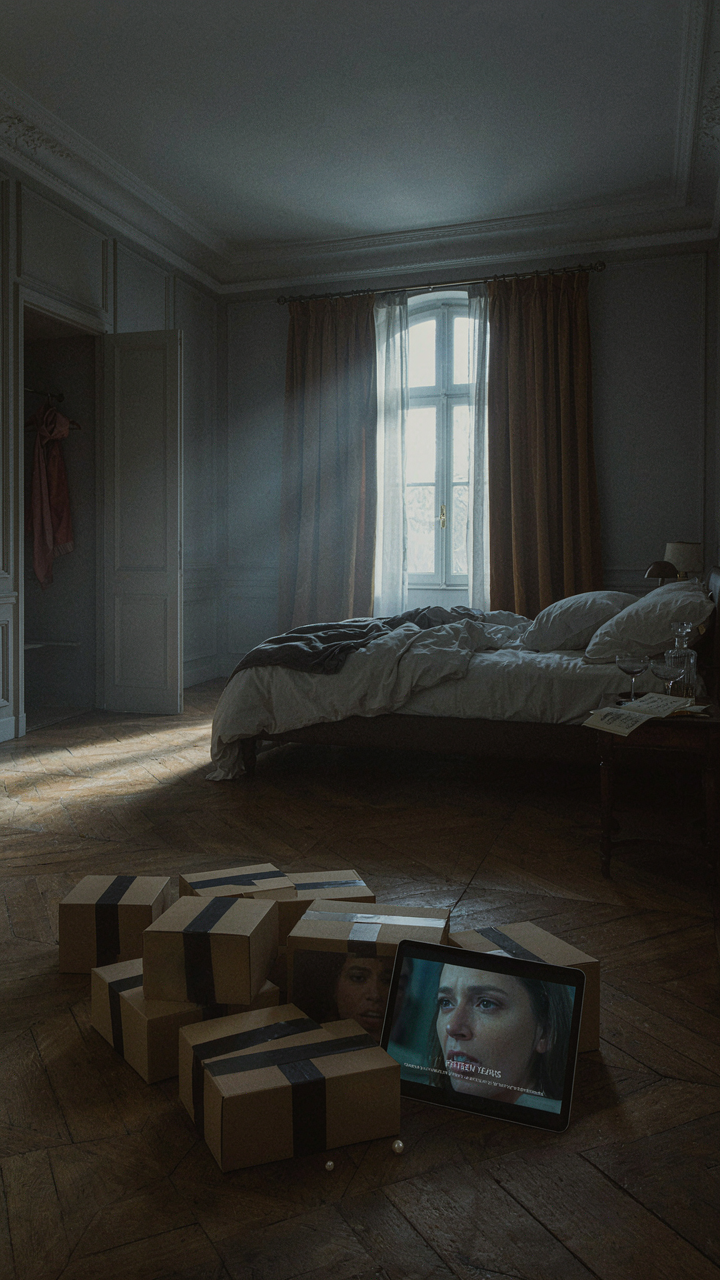
The only things remaining were seven large wooden boxes arranged in a perfect row on the floor.
Each box had a number painted on its lid.
ONE.
TWO.
THREE.
FOUR.
FIVE.
SIX.
SEVEN.
Beside them sat an iPad.
Its screen displayed a single video file.
The title read:
FIFTEEN YEARS.
I felt a strange chill.
I picked up the tablet and pressed play.
The screen flickered.
Then Isabelle appeared.
She was sitting in the living room, wearing a simple blue sweater.
Her eyes were red.
Her hair was tied back.
She looked exhausted.
“Gabriel,” she began softly. “If you’re watching this, you’ve finally come home.”
I swallowed.
“I begged you to stay with me for one week. You chose Rome instead.”
My stomach tightened.
She looked directly into the camera.
“I know about Victoria. I know about the hotel, the private dinners, and the photographs you thought nobody would see.”
I froze.
She knew.
Of course she knew.
But then she said something that made my blood run cold.
“Before you open those seven boxes, you deserve to know what happened to me while you were gone.”
She paused.
Then she took a deep breath.
“Gabriel, fifteen years ago, when we got married, I was already pregnant.”
I blinked.
“What?”
The recording continued.
“I never told you because you were terrified of becoming a father. You had just started your first company, and you told me children would destroy your ambitions.”
I remembered that conversation.
I had been twenty-eight.
I had told her I wanted to build something extraordinary before having a family.
She nodded sadly.
“I respected your wishes. But I lost the baby eleven weeks into the pregnancy.”
My throat tightened.
“Nobody knows about that. Not even your mother. I went to the hospital alone because you were in London negotiating your first major investment.”
I lowered the tablet.
I remembered that trip.
I’d been celebrating a multimillion-dollar deal.
I hadn’t known.
“I buried that pain quietly,” she continued. “I thought we would have another chance.”
She wiped her cheek.
“But two years later, the doctors told me I would never carry a child again.”
I sat on the edge of the bed.
For fifteen years, I’d believed we simply hadn’t wanted children.
I’d never asked her why.
I’d never taken the time.
“Gabriel, I wanted to tell you. But every time I tried, you were busy. There was always another deal, another meeting, another flight.”
She looked down.
“And then I discovered something about you that changed everything.”
The video paused.
A new clip appeared.
It showed me in a hospital corridor.
I recognized the date.
Four years earlier.
I was wearing a gray suit, speaking on my phone.
Behind me, a young nurse was pushing a wheelchair.
In that wheelchair sat a little girl.
She looked about nine years old.
She had dark brown hair.
And she had my eyes.
I stood up so quickly that the tablet nearly slipped from my hands.
The recording resumed.
“Her name is Sophie,” Isabelle said. “She’s ten years old now.”
I stared at the screen.
“Her mother was a woman named Elena. You met her fifteen years ago, before our wedding.”
My mind raced.
Elena.
The name sounded familiar.
Then I remembered.
Elena Moreau.
A young woman who had worked as an assistant at one of my earliest investment companies.
We’d had a brief relationship before I married Isabelle.
I’d ended it when my business began taking off.
I hadn’t seen her again.
Or so I thought.
“Elena gave birth to your daughter three months before we got married,” Isabelle continued. “She tried to contact you several times, but your lawyers handled everything.”
I felt sick.
“My lawyers?”
“Yes. Your former personal attorney, Richard Hale, arranged a financial settlement. Elena was told to leave you alone. In exchange, she received money and signed a confidentiality agreement.”
I remembered Richard.
He had handled almost everything during those years.
I had trusted him completely.
“Elena died four years ago from an aggressive illness. Before she died, she asked me to look after Sophie.”
I couldn’t move.
“Why you?” I whispered.
Isabelle answered through the screen.
“Because she knew I was the only person who could give Sophie the stable home she deserved.”
I felt the room spinning.
“Where is she?”
Isabelle’s face changed.
“She’s safe, Gabriel. But she’s not here.”
I looked around the bedroom.
“Where is my daughter?”
Isabelle leaned closer to the camera.
“That’s what the seven boxes will explain.”
The screen went black.
For several seconds, I couldn’t breathe.
Then I noticed a small envelope taped to the first box.
My name was written on it.
I tore it open.
Inside was a photograph.
A little girl stood beside Isabelle in front of a Christmas tree.
She was smiling.
Isabelle had one arm around her.
On the back, in handwriting I recognized, were the words:
The daughter you never knew you had.
I sank to my knees.
For the first time in my adult life, I cried.
But I still hadn’t opened the boxes.
And I was about to discover that Sophie wasn’t the only secret Isabelle had kept.
BOX ONE: THE GIRL I ABANDONED
The first box contained photographs.
Hundreds of them.
Sophie at three years old.
Sophie at five.
Sophie on her first day of school.
Sophie holding a birthday cake.
Sophie sleeping on a hospital bed.
In almost every photograph, Isabelle was beside her.
Some pictures showed them baking together. Others showed them visiting parks, museums, and beaches.
There were drawings, school certificates, birthday cards, and handwritten notes.
One drawing showed three people holding hands.
A little girl had written beneath it:
My family.
Isabelle.
Sophie.
And a man with no face.
I stared at that drawing for a long time.
Then I found a letter.
It was written by Sophie.
Dear Dad,
I don’t know if you know I exist. Mama says you are a very busy man. Aunt Isabelle says you work hard because you want to make the world better.
I hope one day you have time to meet me.
I am good at mathematics. I like drawing. I don’t like broccoli.
Love, Sophie.
The letter was dated six months earlier.
I pressed it against my chest.
I had spent billions building hotels, companies, and properties.
Yet I had missed every birthday of my own daughter.
Every school performance.
Every scraped knee.
Every bedtime story.
And the woman I’d neglected had been there for all of it.
BOX TWO: THE WOMAN WHO KNEW
The second box contained medical records.
There were hospital reports, prescriptions, and letters from doctors.
I found a document dated four years earlier.
It described Sophie’s condition following her mother’s death.
She had been diagnosed with a rare blood disorder.
The doctors recommended long-term specialist care and regular monitoring.
My hands began shaking.
Another document showed the cost of her treatment.
Isabelle had paid every bill.
There were bank statements showing regular transfers to the hospital.
Then I found something that made me stop.
The total was nearly $2.8 million.
I stared at the number.
Why had Isabelle paid for everything?
I had more money than I could spend in a hundred lifetimes.
She could have asked me.
She could have demanded that I help.
Instead, she had used her own inheritance.
At the bottom of the box was a handwritten note.
I didn’t want Sophie to grow up believing her father was a bank account. I wanted her to know that someone could love her without expecting anything in return.
I covered my face.
I had thought Isabelle was weak because she never fought with me.
Now I understood.
She hadn’t been fighting for my attention.
She had been fighting to protect a little girl from the consequences of my selfishness.
BOX THREE: THE MAN WHO STOLE MY DAUGHTER
The third box contained legal documents.
I recognized Richard Hale’s signature.
My former attorney.
The documents revealed that Elena had attempted to establish paternity shortly before Sophie was born.
Richard had arranged a settlement that included a substantial payment.
But the most disturbing document was a private memorandum.
It contained instructions.
Client requests that all future correspondence from Elena Moreau be redirected through legal counsel. No direct contact is to be permitted.
There was another page.
A handwritten note from Richard.
Mr. Laurent wishes to avoid personal complications that could affect the company’s upcoming public offering.
I read it twice.
I remembered the public offering.
I’d been so obsessed with protecting my reputation that I’d allowed someone else to make decisions about my own child.
I called my current legal director.
“Find Richard Hale.”
“Mr. Laurent, it’s nearly seven.”
“I don’t care what time it is. I want his current address, every file connected to Elena Moreau, and every communication he ever had with my office.”
“Is this urgent?”
I looked at the photographs.
“More urgent than anything I’ve ever done.”
BOX FOUR: THE MONEY ISN’T YOURS
The fourth box was heavier.
Inside were property deeds, company documents, bank statements, and trust agreements.
At first, I assumed Isabelle had taken something from our shared accounts.
But then I noticed the names.
Several of my companies.
My holding company.
Three major investment properties.
A charitable foundation.
I read the documents carefully.
They showed that fifteen years earlier, before our wedding, Isabelle had inherited a substantial portfolio from her grandfather.
She had quietly invested it.
Over time, those investments had become a significant part of my business empire.
I remembered her grandfather.
He had been a wealthy industrialist who never liked me.
He had once told me:
“Money makes a man louder, Gabriel. It doesn’t make him greater.”
I’d laughed at him.
Now I wished I could hear those words again.
The documents showed that Isabelle had used her inheritance to provide the initial capital for several of my most successful ventures.
She had never demanded recognition.
She had never asked for her name on the buildings.
She had simply trusted me.
But there was more.
A letter from a financial institution explained that Isabelle’s investment shares had been held through a private trust.
The trust had voting rights.
Significant voting rights.
I called my chief financial officer.
“How much of Laurent Global is controlled by the Isabelle Laurent Trust?”
He was silent.
“Sir, why are you asking?”
“Answer me.”
“Approximately thirty-one percent of the voting shares.”
I gripped the phone.
“Thirty-one?”
“Yes, sir.”
“And who controls the trust?”
Another silence.
“Your wife.”
I looked at the documents again.
For fifteen years, I’d told the world I had built an empire alone.
But the woman I’d treated as an ornament had helped finance its foundation.
And she had never needed to tell me.
BOX FIVE: THE LAST PROMISE
The fifth box contained a small velvet pouch.
Inside was a wedding ring.
Not mine.
Isabelle’s original wedding ring.
Beside it was a letter.
Gabriel,
I loved you before you were rich.
I loved you when you were sleeping on a borrowed sofa in a tiny apartment, trying to convince investors that your company would change the world.
I loved you when we had no money for expensive restaurants.
I loved you when you were afraid.
But somewhere along the way, you became a man who believed that everyone around him existed to serve his ambitions.
I stayed because I remembered the man you used to be.
I stayed because Sophie needed stability.
And I stayed because I kept hoping you would eventually come home.
But I cannot keep waiting.
I promised Elena I would protect her daughter. I promised myself I would not allow Sophie to grow up feeling unwanted.
I have kept both promises.
Now I must keep one more.
I must choose myself.
I stopped reading.
There was a second page.
The divorce papers are with my attorney. You will receive them tomorrow.
I dropped the letter.
For the first time, the possibility of losing Isabelle felt real.
Not losing her jewelry.
Not losing her photographs.
Losing her.
BOX SIX: THE PRICE OF YOUR SILENCE
The sixth box contained a laptop.
It was already open.
On the screen was a folder titled:
THE LAST FIFTEEN YEARS.
Inside were recordings, emails, photographs, and financial records.
I clicked the first video.
It showed Isabelle sitting in a hospital waiting room.
She looked younger.
Her hands were clasped tightly.
A doctor entered and sat beside her.
I could hear him speaking.
“Mrs. Laurent, I’m sorry. The treatment has not produced the results we hoped for.”
Isabelle nodded.
“How much time does she have?”
The doctor hesitated.
“We cannot give you an exact answer. But the next few months will be important.”
The video ended.
I searched through the documents.
A medical report showed that Sophie had experienced complications.
But the latest records showed improvement.
She was stable.
Then I found an email dated three weeks earlier.
It was from Isabelle to me.
Gabriel, I need you to come home. Sophie wants to meet you. She has been asking about you.
I searched my inbox.
I found the message.
I had received it.
I’d marked it as read.
And I’d never replied.
Another email appeared.
She has an important appointment next week. Please come. She wants to see you.
My response was one sentence.
I’m traveling. Handle whatever is needed.
I closed my eyes.
I remembered sending it.
I had been boarding a helicopter after a meeting.
I’d barely read the message.
Then I found a final recording.
Isabelle was sitting beside Sophie in a hospital room.
Sophie looked pale but smiled at the camera.
“Hello, Dad,” she said.
Her voice was small.
“I’m going to get better. Aunt Isabelle says you’re very busy, but I hope one day we can have breakfast together.”
She paused.
“Maybe you can teach me how to run a company.”
Then she laughed.
“Actually, maybe not. Aunt Isabelle says business people don’t sleep enough.”
I couldn’t hold the tablet anymore.
I put it down and covered my mouth.
I had missed the chance to be there when my daughter needed me.
And I might have missed the chance to know her at all.
But the final box contained the truth that would destroy everything I thought I owned.
BOX SEVEN: WHAT MONEY CANNOT BUY
The seventh box was smaller than the others.
It contained a sealed envelope, a USB drive, and a photograph.
The photograph showed Isabelle standing outside a small school.
Beside her was Sophie.
They were holding hands.
On the back was written:
The day she asked me to be her mother.
I opened the envelope.
Inside was a letter from Isabelle.
Gabriel,
There is something else you need to know.
When Elena died, she left a letter for Sophie. I found it while organizing her belongings.
In that letter, Elena explained that she had not wanted money from you. She had wanted you to know you had a daughter.
She had tried to reach you for years.
She never stopped hoping.
But Richard Hale told her that you wanted nothing to do with the child.
I felt my knees weaken.
He lied.
I read the sentence again.
He lied.
I discovered the truth three months ago. I hired independent investigators and found the original correspondence. Richard had intercepted letters, withheld medical information, and misrepresented your wishes.
I looked at the USB drive.
My hands were trembling.
I inserted it into the laptop.
A video opened.
A man appeared.
Richard Hale.
He was older, sitting in an office.
His voice was clear.
“Mr. Laurent, if you’re watching this, I assume Mrs. Laurent has finally shown you the documents.”
I leaned closer.
“I handled the Elena Moreau matter at your request. You told me you wanted no distractions before the public offering. You instructed me to keep your personal life separate from the company.”
I shook my head.
“No. No, I didn’t.”
Richard continued.
“But I made decisions beyond those instructions. I believed the child would create a reputational risk. I negotiated the settlement and told Elena that you had no intention of acknowledging Sophie.”
He paused.
“Mrs. Laurent discovered the correspondence. She confronted me. I advised her that the matter should remain private.”
Then he looked directly into the camera.
“She refused.”
The screen changed.
It showed a document.
An affidavit.
Richard admitted to withholding correspondence and falsifying statements.
I sat motionless.
Then the video returned.
“There is one more thing,” Richard said.
“Mrs. Laurent discovered that your company had been using funds from the Isabelle Laurent Trust without proper authorization. She has spent the last several months investigating the transactions.”
My blood ran cold.
“What transactions?”
Richard continued.
“Your chief financial officer approved several transfers from the trust into subsidiaries controlled by your private investment group. Some of those transfers were made without the required trustee authorization.”
I stared at the screen.
The money wasn’t simply an investment.
It was legally protected trust property.
And I had been treating it like my own.
Richard took a breath.
“Mrs. Laurent has already notified the relevant institutions. The trust’s voting rights have been exercised. Your wife has removed you from certain positions pending an independent review.”
I felt as though someone had punched me in the chest.
“She can’t do that,” I whispered.
But the next document answered me.
A board resolution.
My removal as chairman of three subsidiaries.
A temporary suspension of certain executive powers.
And a formal notice of investigation.
The final screen displayed a message from Isabelle.
Gabriel, you always said money could solve anything.
But it cannot buy back fifteen years.
It cannot erase a child’s loneliness.
It cannot turn a stranger into a father.
And it cannot make a woman stay when she has finally learned her worth.
I stared at those words.
Then the video ended.
I dropped the tablet.
It hit the wooden floor and cracked.
For several minutes, I didn’t move.
I had spent seven days in Rome believing I was enjoying the best week of my life.
Meanwhile, my wife had been preparing to leave me.
My daughter was somewhere in the world.
And the empire I thought belonged entirely to me was beginning to collapse.
THE CALL I NEVER EXPECTED
At 8:15 the next morning, my phone rang.
It was my chief financial officer.
“Sir, we have a serious situation.”
“What now?”
“The board has called an emergency meeting. The independent trustees have frozen several disputed transfers. The auditors want access to your private investment records.”
“Tell them I’ll handle it.”
“There’s something else.”
“What?”
“Mrs. Laurent’s legal team has requested that all communication go through her attorney.”
I rubbed my forehead.
“Where is Isabelle?”
“We don’t know.”
“Find her.”
“Sir, with respect, she has asked not to be contacted directly.”
I slammed my hand on the desk.
“She’s my wife!”
My CFO went quiet.
Then he said something I wasn’t prepared for.
“Not according to the divorce petition, sir.”
I hung up.
I immediately called Isabelle.
Her number was disconnected.
I called her friends.
Nobody answered.
I drove to her favorite café.
The manager told me she hadn’t been there in weeks.
I went to the charity foundation she had supported.
Her office was empty.
Finally, I contacted her attorney.
A woman named Margaret Collins answered.
“Mr. Laurent.”
“Where is my wife?”
“Your wife is safe.”
“Tell me where she is.”
“She has instructed me not to disclose her location.”
“Margaret, I’ve been married to Isabelle for fifteen years.”
“Then perhaps you should have listened when she asked you to come home.”
I closed my eyes.
“Please. I need to see her.”
There was a pause.
“Do you understand why she left?”
I looked at the floor.
“Yes.”
“No, Mr. Laurent. You understand the financial consequences. You understand the legal consequences. But I don’t think you understand what happened to her.”
I said nothing.
“She spent years trying to build a family with you. When she couldn’t have children, she suffered alone. Then she discovered your daughter and chose to love her. She gave Sophie the childhood you never knew existed.”
I swallowed.
“And when she finally asked you for one week, you went to Rome.”
Her voice softened.
“She isn’t punishing you, Gabriel. She’s protecting herself.”
The call ended.
I sat in my car for almost an hour.
Then I did something I hadn’t done in fifteen years.
I went to a hospital.
Not because I had an appointment.
Not because someone had called me.
I went because I wanted to know whether my daughter was there.
THE FIRST MEETING
Two days later, Margaret contacted me.
“Mr. Laurent, Sophie has agreed to meet you.”
I nearly dropped the phone.
“Where?”
“At the children’s garden near Saint Anne’s Hospital. Tomorrow at ten.”
“Will Isabelle be there?”
“Yes.”
I arrived forty minutes early.
I wore no expensive suit.
No watch.
No security detail.
For once, I didn’t want anyone to recognize me.
At ten o’clock, a black car pulled up.
Isabelle stepped out.
She looked thinner.
Her hair was shorter.
She wore a simple beige coat.
And beside her stood a little girl.
Sophie.
My daughter.
She looked exactly like the child in the hospital photograph.
Dark hair.
Brown eyes.
A small nose.
She held Isabelle’s hand tightly.
I approached slowly.
“Hello, Sophie.”
She looked at me.
“Hello.”
I knelt so we were at the same height.
“I’m Gabriel.”
She tilted her head.
“I know.”
I tried to smile.
“Your mother told you about me?”
She nodded.
“Aunt Isabelle showed me pictures.”
I glanced at Isabelle.
She looked away.
I turned back to Sophie.
“I’ve wanted to meet you for a long time.”
Sophie studied my face.
“Why didn’t you come before?”
The question was simple.
It was also the hardest thing anyone had ever asked me.
I could have blamed Richard.
I could have blamed my business.
I could have blamed the past.
But I had spent years making excuses.
So I told her the truth.
“Because I made selfish choices. I thought work was more important than people. And I was wrong.”
She looked down at her shoes.
“Are you going to leave again?”
My throat tightened.
“Not if you want me to stay.”
She didn’t answer.
Instead, she reached into her little backpack and pulled out a folded piece of paper.
It was a drawing.
Three people holding hands.
This time, the man had a face.
She handed it to me.
“I drew this last week,” she said.
I stared at it.
“Thank you.”
Then she asked, “Can we get ice cream?”
I laughed through my tears.
“Yes. Absolutely.”
We walked toward the café.
Isabelle stayed behind.
I looked back.
“Isabelle?”
She stopped.
“Will you join us?”
She studied me for a moment.
Then she shook her head.
“Today is about Sophie meeting her father.”
And she walked in the opposite direction.
I wanted to follow her.
But I didn’t.
For once, I understood that wanting something didn’t mean I was entitled to it.
THE BILLION-DOLLAR MEETING
Three weeks later, the emergency board meeting took place.
The room was filled with executives, lawyers, investors, and independent trustees.
I sat at the head of the table.
But for the first time, nobody was waiting for my permission to speak.
The chairman of the audit committee presented the findings.
Several transfers had been made from the Isabelle Laurent Trust without the necessary authorization.
Some were legitimate business investments.
Others were improperly documented.
The auditors recommended a complete restructuring.
My lawyers argued that I had acted in good faith.
But the trust’s representatives had their own documents.
They showed that Isabelle had repeatedly requested financial transparency.
Those requests had been ignored.
Then the meeting room doors opened.
Isabelle entered.
She was accompanied by Margaret Collins and two independent trustees.
She wore a dark navy suit.
Her expression was calm.
She didn’t look angry.
That somehow hurt more.
The chairman stood.
“Mrs. Laurent, thank you for joining us.”
She nodded.
I stared at her.
“Isabelle.”
She looked at me.
“Gabriel.”
That was all.
The meeting continued.
The trustees confirmed that Isabelle’s voting rights gave her significant influence over the holding company.
They also announced that the board would appoint an independent executive committee while the financial review continued.
My position was not immediately terminated.
But my authority was restricted.
For the first time in twenty years, I wasn’t the person making the final decision.
When the meeting ended, I approached Isabelle.
“Can we talk?”
She glanced at Margaret.
“Five minutes.”
We entered a private conference room.
I closed the door.
“I never knew about Sophie.”
“I know.”
“Richard lied to me.”
“Yes.”
“I should have investigated.”
She looked at me.
“Yes, you should have.”
I lowered my eyes.
“I’ve been seeing Sophie.”
“I know.”
“She’s wonderful.”
A small smile appeared on Isabelle’s face.
“She is.”
I took a breath.
“Isabelle, I want to fix our marriage.”
Her expression didn’t change.
“Why?”
“Because I love you.”
She looked at me for a long time.
Then she said something I will never forget.
“Gabriel, you love the idea of having me back. You love the idea of returning to your comfortable life. You miss the person who made your world feel safe.”
She stepped closer.
“But where were you when I was afraid? Where were you when I sat beside Sophie in a hospital room? Where were you when I begged you for one week?”
I couldn’t answer.
“I didn’t leave because you went to Rome with Victoria,” she continued. “I left because Rome was simply the latest example of a life you had been living for years.”
Tears filled my eyes.
“I can change.”
“I hope you do.”
“Then give me another chance.”
She shook her head.
“I gave you fifteen years of chances.”
She opened the door.
“Now I’m giving myself a chance.”
And she left.
THE WOMAN I SHOULD HAVE SEEN
Six months passed.
My divorce was finalized.
The financial investigation resulted in a major restructuring of several companies. I repaid the disputed trust transfers and accepted an independent oversight arrangement.
I remained wealthy.
But I was no longer untouchable.
Victoria called once.
She said she missed me.
I asked whether she missed me or the private jet.
She didn’t answer.
We never spoke again.
I also dismissed several executives who had helped conceal the old legal correspondence.
Richard Hale eventually faced professional disciplinary proceedings and a civil lawsuit.
But none of those things mattered as much as what happened on a rainy Thursday afternoon.
I was sitting in a small café with Sophie.
We had started seeing each other every weekend.
I helped her with mathematics.
She taught me how to draw animals.
I was terrible at it.
She laughed every time I attempted to draw a cat.
That afternoon, she was working on a school project.
She looked up.
“Dad?”
“Yes?”
“Do you still love Aunt Isabelle?”
I nearly dropped my coffee.
“Why do you ask?”
“Because she gets sad sometimes when people mention you.”
I looked out the window.
“Yes, Sophie. I do.”
“Then why don’t you live together?”
I took a breath.
“Because loving someone doesn’t mean you always know how to treat them properly.”
She thought about that.
Then she asked, “Are you going to marry someone else?”
I smiled sadly.
“I don’t know.”
She returned to her drawing.
A few minutes later, she pushed a piece of paper toward me.
It showed three people.
Me.
Sophie.
And Isabelle.
All holding hands.
At the top, she’d written:
MY FAMILY.
I stared at the picture.
“That’s beautiful.”
Sophie smiled.
“Maybe one day we can all have dinner together.”
I didn’t promise her anything.
I had learned that promises meant nothing without actions.
Instead, I said, “I would like that.”
That evening, I drove Sophie home.
Isabelle opened the door.
She looked at the drawing in my hand.
“She made that for you?” she asked.
“For all of us.”
Isabelle smiled.
It was the first genuine smile I’d seen from her in months.
I handed her the picture.
“She hopes we can have dinner together sometime.”
Isabelle studied it.
Then she looked at me.
“Perhaps.”
It wasn’t forgiveness.
It wasn’t reconciliation.
But it was something.
And I had learned not to demand more.
THE FINAL BOX
A year after returning from Rome, I received a package.
There was no return address.
Inside was a small wooden box.
I recognized it immediately.
It was the kind Isabelle’s grandfather used to keep in his study.
Inside was a final letter.
I hadn’t seen it among the original seven boxes.
Perhaps she had kept it until she was ready.
The letter read:
Gabriel,
When I married you, I believed we would grow old together.
I imagined a house full of children, Sunday breakfasts, ordinary arguments, and quiet evenings.
Instead, we built an empire.
And somewhere inside that empire, we lost the people we were supposed to be.
I don’t regret loving you. I don’t regret helping you build your company. And I don’t regret taking care of Sophie.
But I regret the years I spent believing that if I loved you enough, you would eventually notice me.
I have learned that being needed is not the same as being loved.
I have learned that money can buy beautiful things, but it cannot create a home.
And I have learned that sometimes leaving is the only way to save yourself.
I hope you become the man Sophie deserves.
I hope you become the man you once promised me you would be.
And I hope one day you understand that the greatest thing you ever owned was never your company.
It was the family you had.
Isabelle.
I folded the letter carefully.
Then I looked at the photograph attached to it.
It showed Isabelle and Sophie on a beach.
They were laughing.
The sun was setting behind them.
For the first time, I didn’t feel angry that they were happy without me.
I felt grateful.
Because Isabelle had given my daughter something I had never given either of them.
A home.
That evening, I went to the office and removed the enormous photograph of myself standing in front of my corporate headquarters.
I replaced it with Sophie’s drawing.
Three people holding hands.
A father.
A daughter.
And a woman who had taught them both what love really meant.
People still call me a billionaire.
Financial magazines still write about my fortune.
My company still owns buildings across the world.
But whenever someone asks what my greatest achievement is, I no longer mention the empire.
I tell them about a little girl who once asked whether I would leave again.
And about the woman who waited fifteen years for me to come home.
I spent seven days in Rome thinking I had everything.
When I returned, I discovered that the two people who mattered most had learned to live without me.
And the cruelest part?
Isabelle hadn’t taken my fortune.
She hadn’t destroyed my company.
She hadn’t even tried to ruin my reputation.
She had simply taken away the illusion that money could replace love.
I thought those seven boxes contained the end of my marriage.
But they actually contained the story of the fifteen years I had failed to notice.