The hospital gave me my husband’s wedding ring in a clear plastic bag. That was how seventeen years of marriage ended: with a nurse placing a bag in my palm and asking whether someone could drive me home.
I called my mother.Then my father.Then my mother again.
Across the corridor, a vending machine hummed. Somewhere behind a curtain, someone laughed at something on television.
Daniel had been alive when the ambulance left our driveway. Frightened, sweating, apologizing because he thought he was ruining our evening.
“Tell Sophie I’ll fix her bicycle tomorrow,” he’d whispered.By eleven forty-three, there would be no tomorrow for him.I called my parents fourteen times.At twelve sixteen, my mother finally sent a text.
At Vanessa’s birthday dinner. Music’s too loud. Call you tomorrow.
I stared at it until the letters blurred.
Then I typed:
Daniel died. Please come.
The message changed to “Read.”
Nobody came.
Our daughter was asleep at our neighbor Ruth’s house when I returned.
I stood in Ruth’s kitchen holding Daniel’s shoes. I couldn’t remember why I had brought them home instead of leaving them in the bag with his clothes.
Ruth looked at my face and turned off the kettle.
“Oh, sweetheart.”
She held me while I made a sound I had never heard come out of myself before.
At dawn, I sat beside Sophie on Ruth’s guest bed.
She opened her eyes and immediately looked behind me.
“Where’s Daddy?”
There are sentences that split a life in two.
I had to say one to my eight-year-old daughter.
She didn’t scream. She pulled the blanket up to her chin and asked whether we had told the doctors about his medicine.
“Yes, baby.”
“All of it?”
“Yes.”
She studied my face.
Then she whispered, “But he promised.”
I lay down beside her.
“I know.”
For a long time, neither of us moved.
My parents arrived at ten the next morning.
Mother carried supermarket flowers with the price sticker still attached. Father stood behind her, looking uncomfortable.
“We didn’t realize it was that serious,” she said.
I looked at her.
“I told you he died.”
Her eyes shifted toward Father.
“Well, by then, we’d both had wine. Your sister was upset. We couldn’t simply leave everyone.”
I could still have forgiven the missed calls.
What I couldn’t understand was the hours after they read my message. Surely there had been a taxi. A quiet room where they could call me. Some moment between the cake and going to bed when my grief might have mattered.
Mother reached for my hand.
“You know how Vanessa gets about birthdays.”
I withdrew it.
They stayed twenty minutes.
Ruth stayed three days.
She washed Daniel’s coffee cup, then apologized because she thought I might have wanted it left untouched. She answered the door when casseroles arrived. She sat with Sophie while I met the funeral director.
My parents asked what time they should come to the service.
Daniel’s funeral was on a Thursday.
My sister arrived wearing sunglasses and carrying a handbag I recognized from a photograph she had posted the night he died.
In that photograph, she stood between our parents beneath gold balloons.
The caption read: Everything I need, right here.
I had seen it while looking for a picture of Daniel to send to the funeral home.
At the cemetery, Vanessa hugged me stiffly.
“You look exhausted.”
I almost laughed.
She glanced at Sophie, who was holding Ruth’s hand beside the hearse.
“Children bounce back,” she said.
I walked away before I answered.
Afterward, my parents came to the house with everyone else. Mother rearranged the food on my kitchen counter. Father asked Daniel’s business partner whether the company would continue operating.
I thought he was making conversation.
Later, I would remember how carefully he had listened.
Nine days after the funeral, Daniel’s attorney came to see me.
Her name was Miriam Cole. She wore practical shoes and carried a battered leather briefcase.
Daniel had trusted her for years.
“I wish we were meeting under different circumstances,” she said.
“So do I.”
She explained the estate slowly, stopping whenever I lost track.
Daniel’s share of his engineering company. Our savings. Life insurance. The house. A trust he had established for Sophie.
I knew we were secure. We had worked toward that together.
Still, hearing the figures without him beside me felt obscene.
Then Miriam placed a cream envelope on the table.
My name was written across the front in Daniel’s handwriting.
Beneath it were two smaller envelopes.
One said: For Sophie, whenever she wants it.
The other said: For Helen and Robert, if they ask.
My parents.
I looked up.
“Ask what?”
Miriam folded her hands.
“Daniel thought this might happen. He hoped he was wrong.”
I read my letter after Sophie went to bed.
Emma,
If Miriam is giving you this, I’ve done the one thing I promised I would try very hard not to do: leave you carrying too much.
I pressed the page against my mouth.
He had written it six months earlier, after his cardiologist changed his medication and advised him to put his affairs in order.
We had done most of that together.
Most.
There is something I should have told you. I kept waiting for a better time, which usually means I was avoiding a difficult conversation.
I could hear him saying it.
Your parents came to my office last October. They asked for money for Vanessa’s shop. They said you had agreed to help, but you were embarrassed to ask me.
I lowered the letter.
Vanessa had opened a boutique the previous spring. My parents spoke about it as though she had invented commerce.
I had never agreed to finance it.
I told them I needed to speak to you. They became upset. Your father said marriage had made you forget your obligations.
There was more.
A second visit.
A request for eighty thousand dollars.
A printed loan agreement with my name on it.
The signature wasn’t yours, Em.
I read that line three times.
Daniel had recognized it immediately.
He knew how I wrote my capital E. He knew I always included my middle initial on financial documents.
My father had called it a misunderstanding.
My mother had cried.
They had begged Daniel not to tell me.
I agreed to give them time to tell you themselves. That was a mistake. Then you were planning Sophie’s birthday, and your mother was being kinder than usual, and I let myself hope they would leave you alone.
Attached was a copy of the proposed agreement, marked in Daniel’s handwriting: Rejected. No funds advanced.
My name sat at the bottom in someone else’s hand.
I called Miriam the next morning.
“Why didn’t he report it?”
“He wanted you to decide how to handle your family,” she said. “He preserved everything. He also made it clear to them that there would be no money.”
“Did they know he kept copies?”
“Yes.”
I stared through the kitchen window.
Sophie was in the garden with Ruth, trying to repair a bird feeder Daniel had built.
“What’s in their envelope?”
“A letter and a summary of the relevant estate documents. No account numbers or confidential financial details.”
“Can they take anything?”
“They have no entitlement under Daniel’s estate plan. If anyone contacts you claiming otherwise, send them to me.”
I thanked her.
Before we ended the call, she said, gently, “Emma, you don’t have to make every decision this week.”
It was the first time anyone had told me I could wait.
My parents came back that Sunday.
Mother brought a lemon cake.
Daniel hated lemon cake.
She placed it on the counter and looked around our kitchen.
“You need to open the curtains,” she said. “This house feels so sad.”
Father sat in Daniel’s chair.
I waited until he noticed me looking at him. He moved to the sofa.
They asked about Sophie. They told me I needed to eat. Mother hugged me and held on after I tried to step back.
Then she folded her hands in her lap.
“We should discuss the practical side.”
I felt something inside me become very still.
“What practical side?”
“Your future,” Father said.
“And Vanessa’s,” Mother added.
I looked from one to the other.
Father cleared his throat.
“We understand Daniel left a considerable amount.”
“Who told you that?”
“No one had to tell us. He owned a successful business.”
Mother leaned forward.
“We’re not asking for anything unreasonable. You have the house. You’ll have his insurance. Half the inheritance would still leave you comfortable.”
For a moment, I thought I had misunderstood.
“Half?”
“Within the family,” she said quickly. “Your sister is struggling. We’ve used most of our retirement helping her.”
Daniel’s absence seemed to fill the room.
His jacket still hung by the back door. His reading glasses were on the shelf beside the television.
Father glanced toward the hallway.
“You don’t need to decide how to transfer it today.”
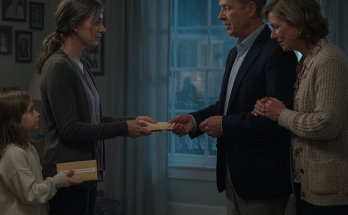
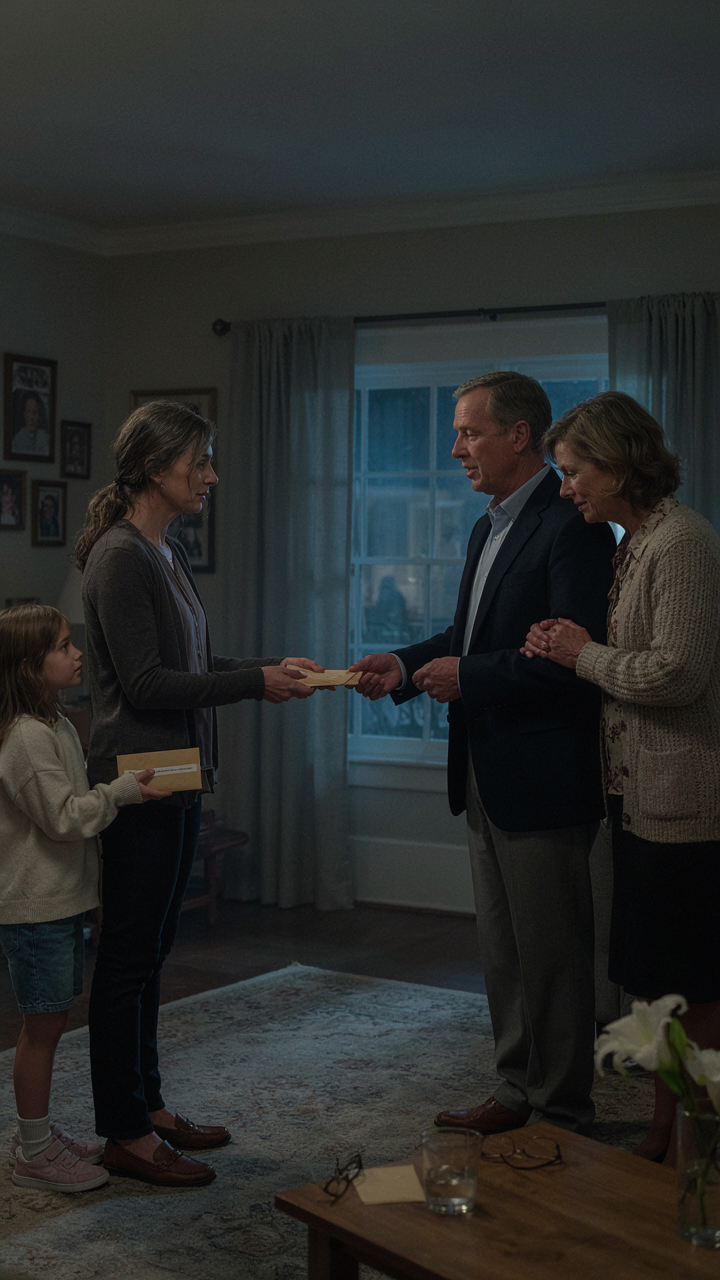
That was when Sophie appeared.
She wore her father’s old college sweatshirt. The sleeves covered her hands.
In them, she held a cream envelope.
She had found me crying over Daniel’s letter the evening before.
I had told her only what she needed to know.
“Daddy left some instructions to help me with grown-up things.”
“Like his bicycle instructions?”
“Something like that.”
She had noticed the envelope addressed to her grandparents.
“Is that theirs?”
“If they ask me for something that belongs to us.”
Now she stood beside my chair.
“Grandma,” she said quietly. “Daddy left this for you.”
Mother’s expression softened into relief.
“Oh, darling.”
She accepted the envelope with both hands.
Father leaned closer.
They thought Daniel had arranged a gift.
I knew it from the quick glance they exchanged.
Mother opened the flap and unfolded the first page.
Her smile disappeared.
Father took the letter from her.
He read halfway down, stopped, and looked at me.
“Where did you get this?”
“From Daniel’s attorney.”
“This is private.”
“It’s addressed to you.”
Sophie slipped her hand into mine.
I kissed the top of her head.
“Go see whether Ruth needs help with the bird feeder, sweetheart.”
She looked at my parents once before leaving.
Neither of them said goodbye.
I had not yet read their letter.
Father dropped it on the coffee table, and I picked it up.
Helen and Robert,
If Emma has given you this, then you have asked her for money after my death.
I hope she is reading it years from now because you need help with something none of us could have anticipated. But I suspect you have come soon enough that my daughter is still asking where I am.
Mother began crying.
I kept reading.
I know about the loan agreement bearing Emma’s forged signature. I know about the requests you made afterward. Miriam has copies of the documents and our correspondence.
You told me helping Vanessa was Emma’s duty because she was the stronger daughter.
Emma was twenty-three when she paid to repair your roof. She was twenty-seven when she covered Vanessa’s first unpaid rent. She gave up a holiday we had saved for because you said the family needed her.
I watched her spend years trying to earn approval you kept promising was just one more favor away.
My hands shook.
I remembered the roof.
The holiday.
Daniel sitting across from me at our little kitchen table, saying we could visit the coast another year.
The enclosed summary explains the provisions I have made for Emma and Sophie. You are not beneficiaries. Vanessa is not a beneficiary. Emma owes you no payment for being her parents.
Do not bring a financial demand into my daughter’s home and call it love.
At the bottom, beneath his signature, he had added one final sentence.
If you want to help them, ask what they need and listen to the answer.
“He was turning you against us,” Father said.
I looked at him.
There it was.
No denial about the signature.
No question about what Daniel had known.
“You let me think you came here because you missed him.”
“We did,” Mother whispered.
“You just asked me for half of everything he left.”
“We’ve made sacrifices too.”
“What sacrifices?”
“Raising you.”
The refrigerator motor clicked on.
Outside, I heard Ruth laugh gently at something Sophie said.
I set the letter down.
“Did you sign my name?”
Mother wiped her face.
“Your sister was about to lose the shop.”
“Did you sign my name?”
“We thought once everything was arranged, you would understand.”
Father reached for the papers.
I moved them out of his reach.
He stood.
“Your husband enjoyed making us feel small.”
“No,” I said. “He kept paying for dinner while you congratulated yourselves on Vanessa’s ambition. He listened when you interrupted him. He fixed things in your house every time we visited.”
My voice broke.
“The night he died, I needed you.”
Mother stared at her hands.
“I needed someone to sit beside me while they explained what had happened. I needed someone to help me tell Sophie.”
“We couldn’t have changed anything,” Father said.
I looked toward the garden.
“No. You couldn’t have.”
Then I opened the front door.
Mother stopped beside me.
“You’ll regret shutting out your family.”
I was too tired for an argument.
“Please leave.”
Father walked past without looking at me.
Mother waited another moment, perhaps expecting me to apologize.
I had done that so often that I almost felt the words rise automatically.
Instead, I held the door.
When they were gone, I sat on the floor.
Sophie came inside a few minutes later.
She studied my face, then sat beside me.
“Was it the right envelope?”
“Yes.”
“Did I do something bad?”
I pulled her into my lap.
“No, baby. None of this is your fault.”
She leaned against me.
“Are Grandma and Grandpa mad?”
“They’re upset with me.”
“Because you said no?”
“Yes.”
She thought about that.
“Daddy said I could say no to hugs.”
“You can.”
“Can you say no to things too?”
I held her tighter.
“I’m learning.”
Vanessa called that night.
Mother had told her I was threatening the family over an inheritance.
“You have enough,” she said. “Why are you being cruel?”
I asked whether she knew about the false loan agreement.
Silence.
Then, “They were only trying to help.”
“With my name.”
“I was going to pay it back.”
I closed my eyes.
Daniel had known.
All those months, he had known my family was willing to put my future at risk and then sit at our table, letting him serve them dinner.
“You should have told me,” I said.
“I didn’t want a fight.”
“You wanted the money.”
She hung up.
For once, I didn’t call back.
The months afterward were not the triumphant freedom people imagine when they tell stories about cutting off relatives.
I missed my mother.
That embarrassed me at first.
I wanted to call her when Sophie lost a tooth. I wanted to tell her how hard Daniel’s birthday had been. Sometimes, while shopping, I reached for something she liked before remembering.
Grief didn’t make me stop wanting parents.
It made their absence hurt in a different way.
Miriam handled the financial questions. I stopped answering messages that began with apologies and ended with requests.
Ruth came for dinner every Tuesday.
Sophie started seeing a counselor. Eventually, I did too.
We learned that a good morning could turn bad because someone in the grocery store wore Daniel’s cologne. We learned to leave parties early. We learned that laughter didn’t mean we had forgotten him.
In April, I fixed Sophie’s bicycle.
Badly.
The brake rubbed, and the handlebars were crooked.
Our neighbor helped me finish it.
When Sophie rode down the pavement, she shouted, “Daddy would say the helmet strap’s too loose!”
I laughed so hard I cried.
She stopped, tightened it, and waited for me.
Nearly a year after Daniel died, my father came alone.
I spoke to him on the porch.
He looked older. He held a folded piece of paper.
“I’ve written down what happened with the agreement,” he said. “Who did what. I signed it.”
I didn’t take it immediately.
“Why now?”
He stared at the porch boards.
“Because I keep hearing what you said about the hospital.”
I waited.
“I could have come,” he said. “I didn’t want to deal with it. Your mother was upset, and Vanessa wanted us to stay, and I chose the easier thing.”
For the first time, he gave me no excuse.
I took the paper.
“This doesn’t fix it.”
“I know.”
I wasn’t ready to invite him inside.
He didn’t ask.
After he left, I put his statement in the folder Miriam had given me. Then I went to help Sophie with her homework.
Nothing was repaired that afternoon.
But something had finally been named honestly.
On the first anniversary of Daniel’s death, Sophie and I went to the coast.
We stayed in a small hotel with uneven floors and ate chips wrapped in paper.
That evening, she brought her letter down to the beach.
We had read it many times.
This time, she read it aloud herself.
You never have to win anything for me to be proud of you. You are already my favorite Sophie.
Her voice trembled.
She folded the page carefully.
“Do you think he knew we’d be okay?”
I watched the water darken.
“I think he hoped we would have help.”
She leaned against my arm.
“We do.”
Ruth had packed sandwiches for the drive. Miriam had called that morning. There were people at home who knew this date and would remember it next year too.
“Yes,” I said. “We do.”
Sophie slipped her letter back into its envelope.
Then she took my hand, and we walked up the beach before the tide could reach our shoes.