My Father Left My Sister His Entire House… and Left Me Only an Old Chessboard. When I Broke One of the Pieces, I Discovered the Secret He Had Hidden for 30 Years.
The day my father’s will was read, my sister inherited a house worth nearly a million dollars.
I inherited a chessboard.
And not even a beautiful one.
It was an old wooden chessboard with scratched corners, faded squares, and pieces that looked as if they had survived a hundred years of neglect. Some of the pieces were chipped. One pawn had a crack down its middle, and the black king leaned slightly to one side.
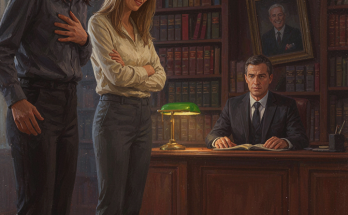
My sister, Lara, laughed so hard that she nearly fell out of her chair.
“Are you serious?” she asked the lawyer. “That’s what Kate gets?”
The lawyer, Mr. Bennett, adjusted his glasses.
“That is exactly what your father specified.”
Lara covered her mouth, pretending to feel sorry for me.
“Oh, Kate. After everything you did for Dad, he leaves you a board game?”
I sat frozen in my chair.
For three years, I had bathed our father, prepared his meals, washed his clothes, managed his medications, and sat beside him through countless sleepless nights.
While Lara was busy with her career, vacations, expensive restaurants, and social life, I was the one holding Dad’s hand when he woke up frightened from a nightmare.
I was the one who rushed him to the hospital when his breathing became difficult.
I was the one who heard him whisper, “Please don’t leave me alone, sweetheart,” whenever I tried to go home for a few hours.
And now, after his death, Lara was getting everything.
The house.
The furniture.
The jewelry our mother had left behind.
The antique dining table.
The paintings.
Even the silverware Dad had inherited from our grandparents.
Everything.
I was getting a chessboard.
I looked at Mr. Bennett, hoping he would explain that there had been some mistake.
“Did Dad leave any other instructions for me?”
The lawyer hesitated.
“Your father was very specific about the chessboard. He asked that it be given to you personally, without allowing anyone else to claim it.”
Lara burst into another round of laughter.
“Of course he did! Maybe he thought Kate needed something to occupy her time. She never had much of a life outside this house anyway.”
Her words hurt more than I wanted to admit.
I had given up a promising job as a hotel manager to care for Dad after his stroke. I had postponed relationships, abandoned plans to move to another city, and spent my savings renovating the downstairs bathroom so he could bathe safely.
Lara had called those sacrifices my choice.
She had told everyone that I was unemployed because I lacked ambition.
Now she sat in Dad’s lawyer’s office wearing a designer dress, checking the price of the house on her phone as though she had already started spending the money.
I reached for the chessboard.
It was heavier than I expected.
The wooden frame was dark and smooth in places where Dad’s hands had polished it over decades. I remembered seeing it on his study desk when I was a child.
He had taught me to play chess on that very board.
“Never assume the most valuable thing in a room is the thing that shines,” he used to tell me.
Back then, I thought he was simply teaching me not to be materialistic.
Now, as Lara laughed at my inheritance, those words felt like a cruel joke.
I stood up.
“Congratulations, Lara.”
She smiled.
“Thank you, darling. And don’t worry. If you ever need a place to stay, I might let you visit.”
I didn’t answer.
I carried the chessboard out of the office, walked through the cold afternoon, and drove home to the small apartment I had rented after Dad’s funeral.
I was furious.
Not because I had expected a fortune.
I had never asked Dad for money.
I was furious because, for one terrible moment, I believed that all those years of love and sacrifice had meant nothing to him.
When I got home, I placed the chessboard on my kitchen table.
I stared at it.
Then I started crying.
I cried for my father, for the years I had spent caring for him, and for the little girl inside me who still wanted to believe that her father had understood how much she loved him.
I wiped my face.
“Fine,” I whispered. “You wanted me to have it? I’ll keep it.”
I picked up the board to put it away.
Then I stopped.
Something rattled inside it.
I shook it gently.
A strange, hollow sound came from one of the pieces.
I frowned.
The black king.
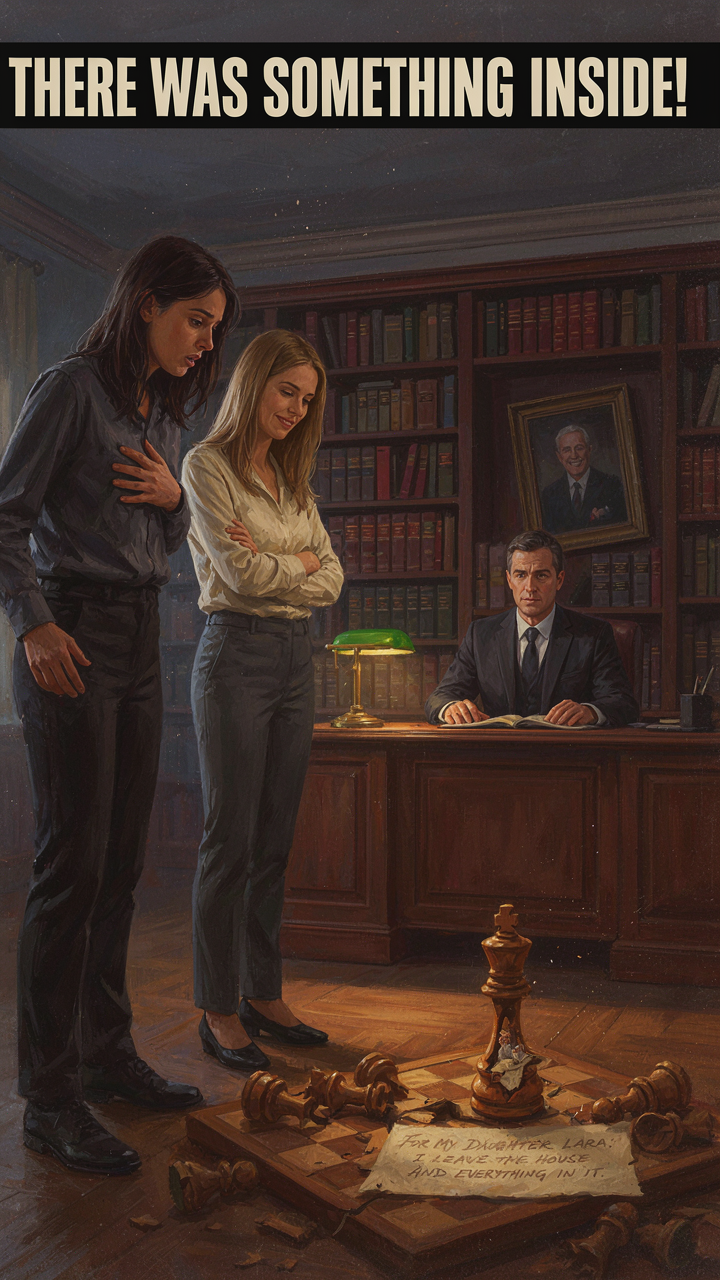
I picked it up and turned it over. Its felt-covered base had begun to peel away. Beneath the fabric, I could see a thin seam around the wooden bottom.
I pressed it with my thumb.
Nothing happened.
I pressed harder.
The bottom shifted slightly.
My heart began to beat faster.
I grabbed a small kitchen knife and carefully worked the blade beneath the loose edge.
The base popped open.
Something small and metallic slipped out and landed on the table.
It was a key.
Not an ordinary house key.
It was a tiny brass key with a number stamped into its handle.
317.
Beneath it lay a tightly folded piece of paper.
My hands trembled as I unfolded it.
There were only six words written in my father’s familiar handwriting.
Kate, if you found this, begin.
I read the sentence again.
Then again.
Begin what?
I turned the paper over.
On the back was another message.
The first move was never about winning.
I sat down slowly.
For several minutes, I did nothing but stare at the key.
Then I remembered something Dad had told me during the final month of his life.
He had been weak, confused at times, and often unable to finish his sentences. One evening, while I was helping him into bed, he had taken my wrist and looked at me with unusual urgency.
“Kate, promise me something.”
“Anything, Dad.”
“If Lara ever tells you that everything is settled, don’t believe her.”
I had assumed he was talking about his medical arrangements or the house.
“What do you mean?”
He had closed his eyes.
“Follow the game.”
I had thought the medication was making him confused.
Now I wasn’t so sure.
I turned the brass key over in my palm.
Number 317.
A storage locker? A safety deposit box? A hotel room?
I needed answers.
And I had a feeling that my father had left me a great many more questions than I had ever imagined.
That night, I barely slept.
At six in the morning, I went to the bank where Dad had kept his accounts.
I had helped him organize his financial paperwork for years, so I knew the names of most of his banks. I also knew he had once rented a safety deposit box, although he had told me he closed it after our mother died.
I asked a teller whether the number on my key matched anything in their system.
She checked.
Then she frowned.
“I’m sorry, ma’am. We can’t provide information about another person’s account without the appropriate documentation.”
I showed her the death certificate and a copy of the will.
She called her supervisor.
Ten minutes later, a bank manager invited me into a private office.
“Your father did have a safety deposit box here,” he explained. “However, the account was closed almost twenty years ago.”
My stomach sank.
“Was anything left inside?”
“The records indicate that the box was emptied.”
He handed the key back to me.
“But there’s something unusual.”
I leaned forward.
“What?”
“The box number was 317. We don’t use that numbering system anymore. The key you have appears to be an older key from our former vault.”
“Can you tell me where the old vault was?”
He shook his head.
“I’m afraid not. The vault was decommissioned before I joined the bank.”
I left disappointed.
For the next two days, I searched through Dad’s papers, hoping to find an old receipt or a letter mentioning the box.
I found nothing.
Then, on the third afternoon, I remembered his old friend.
Arthur Collins had worked with Dad for nearly thirty years. They had been accountants together before Dad opened his own financial consulting business.
Arthur had attended the funeral, but he had left before I could speak with him.
I found his number in Dad’s address book.
He answered on the second ring.
“Kate? I’m glad you called.”
“Arthur, I need to ask you something about Dad.”
There was a pause.
“Has Lara contacted you?”
The question startled me.
“No. Why?”
“Because your father made me promise not to discuss certain matters unless you came to me first.”
My fingers tightened around the phone.
“What matters?”
“Not over the phone. Can you meet me tomorrow morning?”
We arranged to meet at a small café near the park.
Arthur arrived carrying a worn leather briefcase.
He looked older than I remembered, his gray hair thinner and his shoulders slightly hunched. But his eyes were sharp.
After ordering coffee, he placed the briefcase on the table.
“Your father knew this day would come,” he said.
“What day?”
“The day his daughters discovered that he had left them different things.”
I swallowed.
“Why did he leave Lara the house and give me a chessboard?”
Arthur looked at me for a long moment.
“Because he wanted to know whether you would stop at the inheritance.”
I stared at him.
“That doesn’t make any sense.”
“Your father believed people reveal themselves when they think they have won. He also believed that the person who loses everything has the clearest opportunity to see what was hidden.”
He opened his briefcase.
Inside was an old photograph of Dad standing beside a younger Arthur in front of a brick building.
I recognized the building immediately.
It was the first office where Dad had worked.
On the back of the photograph, Dad had written a date and a sentence.
The second move belongs to the one who remembers.
Arthur tapped the photograph.
“Do you remember your father’s first business?”
“Of course. He started with almost nothing. He used to tell us how he built it from a single office and two desks.”
“That was the story he told most people.”
Arthur slid another photograph toward me.
It showed Dad beside a woman I had never seen before.
She wore a dark coat and stood in front of the same building. In her arms was a little boy, perhaps five years old.
“Who is she?”
Arthur sighed.
“Her name was Evelyn Shaw. She was your father’s business partner long before I joined them.”
“My father never mentioned her.”
“He couldn’t. Not without putting several people in danger.”
I stared at him.
“What are you talking about?”
Arthur lowered his voice.
“Your father discovered that someone he trusted had been using the company to hide stolen money. Evelyn helped him uncover it. Before they could bring the evidence to the authorities, she disappeared.”
“Disappeared?”
“Her home burned down. The official report called it an electrical accident. She and her son survived, but they were forced to leave town. Your father spent years trying to find them.”
I looked at the photograph again.
“Why didn’t he tell us?”
“Because the person responsible was still connected to his business.”
A chill passed through me.
“Who was it?”
Arthur didn’t answer immediately.
Instead, he reached into his briefcase and removed a small envelope.
“Your father told me to give you this only after you showed me the key.”
I placed the brass key on the table.
Arthur nodded.
Inside the envelope was a handwritten note.
The third move is made by the person who knows what the pieces are worth.
Below the sentence was an address.
It belonged to a storage facility on the outskirts of town.
Unit 317.
My heart pounded.
The key hadn’t belonged to the bank after all.
It belonged to a storage locker.
Arthur stood.
“I’ve done what your father asked. The rest is yours to discover.”
“Wait. Arthur, what did Dad leave inside?”
He looked at me sadly.
“Something he spent thirty years protecting.”
Then he walked away.
I drove to the storage facility immediately.
The place was surrounded by a chain-link fence, and the office smelled of dust and old paper. An employee examined my key, checked a ledger, and led me down a narrow corridor.
Unit 317 was at the very end.
The key turned.
The door rolled upward.
Inside stood a single metal cabinet, a wooden chair, and several cardboard boxes.
Nothing else.
I felt a wave of disappointment.
Then I noticed a small chess symbol painted on the cabinet.
I opened it.
There were seven folders inside, each marked with a number.
One.
Two.
Three.
Four.
Five.
Six.
Seven.
On top lay another envelope.
Kate, if you have reached this room, you have already done what your sister never thought necessary.
I sat on the wooden chair and began reading.
The first folder contained financial records from Dad’s original business.
The second held copies of contracts and property deeds.
The third contained letters between Dad and Evelyn Shaw.
The fourth held photographs, handwritten notes, and newspaper clippings.
The fifth contained bank statements spanning more than twenty years.
The sixth held a sealed envelope marked FOR THE ATTORNEY ONLY.
The seventh folder was empty.
I opened the first folder.
At first, the numbers meant very little to me. But I recognized my father’s handwriting in the margins.
He had marked certain transactions with a small black chess piece.
Others were marked with a white one.
As I studied the papers, a pattern emerged.
For years, Dad’s company had invested in commercial properties. Some were sold, some were rented, and others were transferred to holding companies.
But the records showed something unusual.
Several properties had been purchased through a private trust that was never listed among Dad’s personal assets.
The trust owned a warehouse, two office buildings, a small shopping center, and a large piece of undeveloped land near the highway.
The estimated combined value was enormous.
I turned to the next document.
A statement from an independent accounting firm showed that the trust had assets worth more than $8.6 million.
I read the figure several times.
Eight million six hundred thousand dollars.
My father had never lived extravagantly. He drove the same old sedan for fifteen years, repaired his own furniture, and complained whenever I spent too much money on groceries.
I had assumed he was comfortable but not wealthy.
Yet here was evidence that he had built a fortune far beyond anything I had imagined.
Why had he hidden it?
I opened the third folder and found a letter from Evelyn.
Daniel, if anything happens to me, protect the children. They must never become bargaining chips in someone else’s greed.
The letter was dated thirty years earlier.
My father had written a reply beneath it.
I promise. The money will never be allowed to control their lives.
I stared at the page.
The children.
Plural.
But Dad had only two daughters.
Lara and me.
Or so I had always believed.
I searched through the remaining letters until I found a birth certificate.
The name of the child was Michael Shaw.
His mother was Evelyn Shaw.
His father was listed as Daniel Whitmore.
My father’s full name.
I felt the room tilt around me.
My father had another son.
A son who had been hidden from us for thirty years.
I pressed my hands against my face.
For years, I had believed that our family had been broken only by our mother’s death and the rivalry between my sister and me.
Now I was discovering an entire history that had existed outside our lives.
I wanted to be angry with Dad.
I wanted to demand why he had kept this from us.
But another thought interrupted me.
If Michael was his son, why had he left him nothing in the will?
I returned to the folders.
Behind the birth certificate was a document explaining the trust.
The trust had been created to protect assets connected to the original business and to preserve money for several people who had been affected by the fraud Dad and Evelyn uncovered.
Michael was one beneficiary.
I was another.
Lara was not listed.
But neither of us had unrestricted access to the trust.
The final authority belonged to an independent trustee.
The document contained a handwritten note.
My daughters must be given a choice. One may take the visible inheritance. The other must decide whether she wants the truth.
I closed my eyes.
Suddenly, the will made a terrible kind of sense.
Dad had left Lara the house because it was the thing she had always wanted.
And he had left me the chessboard because it was the key to everything he had hidden.
But why?
Was this a test?
A punishment?
Or had he been trying to protect us from something?
I read through the documents until evening, taking photographs of every page and carefully replacing everything in its folder.
Before leaving, I opened the envelope marked for the attorney.
Inside was a letter addressed to Mr. Bennett.
It contained instructions for what should happen if I discovered the storage unit.
The last paragraph made my blood run cold.
If Lara attempts to sell the family house within thirty days of my death, notify the trustee immediately. She does not know what was used as collateral for the final loan.
I read it twice.
The house.
The house Lara had just inherited.
What had Dad done?
I drove home with more questions than answers.
At eight that evening, my phone rang.
It was Lara.
“Well,” she said brightly, “I hope you’re enjoying your little chessboard.”
I remained silent.
“Listen, I wanted to tell you something. I’ve decided to sell the house. It’s too big for me, and I could use the money.”
“How soon?”
“I’m meeting a real estate agent tomorrow. Why?”
“No reason.”
She laughed.
“You sound jealous.”
“I’m not jealous, Lara.”
“Good. Because Dad knew who deserved what. You always wanted to be the good daughter. I suppose he finally realized that doesn’t make you the successful one.”
I gripped the phone.
“Did Dad ever tell you anything about his business records?”
There was a pause.
“What kind of question is that?”
“I’m just asking.”
“No. And I don’t care. His business was his business. The house is mine.”
She hung up.
I stared at my phone.
Then I remembered the final sentence in the letter.
If Lara attempts to sell the family house within thirty days of my death, notify the trustee immediately.
I called Mr. Bennett.
He listened without interrupting as I explained what I had found.
When I finished, he was quiet for several seconds.
“Kate, I need you to bring those documents to my office tomorrow morning.”
“Why?”
“Because your father anticipated this possibility. And if what you found is genuine, your sister may be about to make a very expensive mistake.”
The next morning, I arrived at his office carrying copies of the records.
Mr. Bennett examined the trust documents, checked the signatures, and called an attorney who specialized in property law.
After an hour, he looked up.
“The house was used as collateral for a business loan five years ago.”
My stomach tightened.
“How much?”
“Approximately $420,000.”
“Was Dad still paying it off?”
“He was. But the loan was secured by a private agreement that requires the lender to approve any sale or transfer of ownership.”
“Does Lara know?”
“Apparently not.”
He turned another page.
“There’s more. Your father arranged for the debt to be settled through the trust upon his death, provided that neither beneficiary attempted to transfer the property before the trustee completed a final review.”
I blinked.
“So the house isn’t actually hers?”
“It was left to her, yes. But the transfer is subject to the existing loan agreement and the terms of the estate.”
“Can she sell it?”
“Not without resolving those obligations.”
I felt a strange mixture of relief and dread.
Dad hadn’t left Lara an effortless fortune.
He had left her a responsibility she didn’t understand.
But that still didn’t explain the trust.
Mr. Bennett folded his hands.
“Your father asked me to contact the trustee if you came forward with the chessboard.”
“Who is the trustee?”
“Arthur Collins.”
I stared at him.
“Arthur?”
“He has managed the trust for years. Your father trusted him completely.”
“And what happens now?”
Mr. Bennett opened the sixth folder.
“Now, we verify the records, locate the other beneficiary, and establish whether the conditions of the trust have been satisfied.”
“Michael Shaw?”
The lawyer looked up sharply.
“You found his birth certificate.”
“Yes.”
He nodded slowly.
“Then your father has finally given you the opportunity to meet your brother.”
I left his office feeling as though the ground beneath my life had shifted.
I had spent thirty years believing that I knew my family.
Now I was discovering that my father had built an entirely separate world, one that revolved around secrets, loyalty, and a chess game whose rules I was only beginning to understand.
Three days later, Arthur called me.
“I found Michael,” he said.
“Where is he?”
“Portland. He owns a small architectural firm.”
“Does he know about Dad?”
“He knows who his father was. But he doesn’t know the full story.”
“Why not?”
“Because your father believed that revealing the truth too early would expose Michael to the same people who had threatened his mother.”
I sat down.
“Is he safe?”
“As far as I can determine, yes.”
“Does he want to meet me?”
Arthur hesitated.
“He agreed to speak with you.”
We arranged to meet at a quiet restaurant the following weekend.
I arrived early.
I couldn’t stop thinking about what I would say to a brother I had never known existed.
Would he hate our father?
Would he resent us?
Would he believe I had known about him all along?
When a tall man with dark hair entered the restaurant, I recognized him from the photographs in the storage unit.
He looked around until his eyes met mine.
Then he walked toward the table.
“Kate?”
I stood.
“Michael?”
He nodded.
We sat down awkwardly.
For several minutes, neither of us spoke.
Finally, he said, “I didn’t know what to expect.”
“Neither did I.”
He smiled faintly.
“Arthur told me you found the chessboard.”
I nodded.
“Did Dad ever tell you about me?”
“Not directly. I found your birth certificate.”
Michael looked down at his hands.
“He sent me a letter once. I was twenty-two. He said he was sorry that he couldn’t be the father I deserved.”
My throat tightened.
“Did you ever meet him?”
“Once.”
I stared at him.
“When?”
“About ten years ago. He came to Portland and waited outside my office. He didn’t tell me who he was at first. He just asked whether I was happy.”
“What did you say?”
“I told him I was trying.”
Michael looked toward the window.
“He cried. I had never seen a grown man cry like that.”
I swallowed.
“Why didn’t he tell you the truth?”
“Because he believed that the people who had threatened my mother were still watching him. He said he would explain everything when it was safe.”
“Did he?”
Michael shook his head.
“No. He died before he could.”
For the first time, I felt the full weight of my father’s secret.
He had spent decades protecting people from a past that had never completely disappeared.
And now, by leaving me the chessboard, he had placed the next move in my hands.
I told Michael about the trust, the financial records, and the property documents.
He listened carefully.
When I finished, he looked troubled.
“Kate, there’s something you should know.”
“What?”
“Last year, a man contacted me claiming to represent an investment group. He wanted to buy my firm and asked questions about my family.”
“Did you tell him about Dad?”
“No. I thought it was strange, so I declined the offer.”
He took a folded paper from his wallet.
“I kept his business card.”
The name printed on it was Gregory Vance.
I recognized it immediately.
Gregory Vance had been Dad’s former business associate.
The man whose name appeared repeatedly in the old accounting records.
The man Arthur had refused to identify at the café.
I felt cold.
“Did you ever meet him?”
“No. But I searched his name after he contacted me. He’s still involved in commercial property investments.”
I leaned forward.
“Michael, I think he was the person Dad was trying to protect us from.”
Michael’s expression hardened.
“Then we need to find out why he’s interested in our family now.”
We returned to the documents with Arthur and Mr. Bennett.
Over the following week, they pieced together the history.
Thirty years earlier, Gregory Vance had secretly diverted money from the original business into accounts controlled by shell companies.
Dad and Evelyn discovered the scheme.
Before they could report it, Evelyn’s home burned down. She survived with Michael, but she disappeared to protect her son.
Dad stayed behind, gathering evidence while pretending he knew nothing.
He eventually recovered a portion of the missing funds and used them to establish the private trust.
The trust purchased properties that generated rental income, creating a source of financial security for the people affected by the fraud.
But Gregory had never been prosecuted.
The evidence was incomplete, and several key records had disappeared.
Dad spent the rest of his life quietly preserving what remained.
The seventh folder, which I had assumed was empty, turned out to have a hidden compartment in its back cover.
Inside was a small memory card and a note.
The final move belongs to the one who can choose not to become the enemy.
Arthur examined the memory card using a secure computer.
It contained scanned documents, recorded conversations, and a video file dated five years earlier.
We watched it in Mr. Bennett’s conference room.
Dad appeared on the screen, sitting at his study desk.
He looked older than I remembered, but his voice was clear.
“If you’re watching this, then I am no longer able to explain things myself.”
He paused and took a breath.
“I owe both my daughters an apology. I allowed my fear to shape their lives without giving them the truth.”
My eyes filled with tears.
“I made mistakes. I believed I could protect everyone by keeping secrets. I told myself that silence was love. Sometimes, it was cowardice.”
Dad looked directly into the camera.
“Lara, if you see this, I hope you understand that I never wanted to punish you. You were always drawn to the things people could see: a beautiful house, a respected name, a comfortable life. I thought giving you the house would finally make you happy. Perhaps I was wrong.”
He looked down.
“Kate, you have always searched for the person behind the problem. You notice when someone is afraid. You listen when other people stop listening. But you must understand something: caring for others does not mean sacrificing your entire life.”
I covered my mouth.
“I watched you give up more than you should have given. I was grateful, but I was also ashamed. I allowed you to believe that love required you to disappear into someone else’s needs.”
Tears rolled down my face.
“I cannot give you back those years. I cannot tell you that the decisions I made were all correct. But I can leave you the chance to decide what happens next.”
Dad reached toward something outside the camera’s view.
Then he held up a black chess king.
“The board is not a prize. It is a map. The pieces represent the people whose lives became entangled in my mistakes. Some are innocent. Some are guilty. And some have simply been afraid for too long.”
He leaned closer.
“Do not seek revenge for me. Seek the truth. Then decide whether the truth is worth more when it destroys someone or when it finally sets people free.”
The video ended.
Nobody spoke.
I sat with my hands clasped together, crying quietly.
For the first time since the will was read, I understood why Dad had left me the chessboard.
He hadn’t been telling me that I was worth less than my sister.
He had been asking me to finish something he could not.
But there was one final problem.
Gregory Vance was trying to buy the commercial properties held by the trust.
If he acquired them, he could gain access to records that might expose the original fraud.
And if he discovered that Michael was alive and connected to the trust, he might try to silence him.
We needed to act carefully.
Arthur contacted the trust’s independent auditors. Mr. Bennett arranged for the evidence to be reviewed by investigators. Michael provided the correspondence he had received from Gregory’s investment group.
Then Lara called me.
She sounded furious.
“What have you done?”
I stood in my kitchen, the chessboard in front of me.
“What are you talking about?”
“The real estate agent says I can’t sell the house without approval from the lender. Mr. Bennett won’t explain anything. He keeps talking about Dad’s trust.”
“Because there’s an outstanding loan and conditions attached to the estate.”
“You knew about this?”
“I found out after I read the documents Dad left.”
There was a long silence.
Then Lara said, “You found other money, didn’t you?”
I closed my eyes.
“Lara, this isn’t about money.”
“Don’t lie to me! You always wanted to be Dad’s favorite. You spent years acting like the perfect daughter, and now you’ve found some secret fortune that you think belongs to you.”
“I never said that.”
“Then tell me how much.”
I looked at the chessboard.
“Eight million six hundred thousand dollars was the approximate value of the trust when the records were prepared. But it isn’t a personal inheritance waiting for me to spend. It has obligations and other beneficiaries.”
“Other beneficiaries?”
I hesitated.
“Dad had a son.”
Silence.
Then Lara laughed once, sharply.
“No.”
“His name is Michael.”
“No. You’re making this up.”
“I met him. He’s real.”
She began breathing heavily.
“So Dad had another family, and he gave you the secret that goes with it?”
“He didn’t give me a secret family. He left me the means to discover the truth.”
“And what about me?”
“Lara, I don’t know how to explain everything yet.”
“You don’t have to explain anything. I understand perfectly.”
Her voice turned bitter.
“He gave you the interesting part of his life and gave me a house.”
I wanted to tell her that I had spent years wishing she would help me care for Dad, that I had wanted her presence far more than her money.
Instead, I said, “He gave each of us something different. We still have to decide what we do with it.”
She hung up.
For the next several days, Lara refused to speak to me.
Then Gregory Vance made his move.
He contacted her directly.
He offered to purchase the house immediately and promised to handle the outstanding loan. He told her that the family property was worth more than she realized and that a quick sale would spare her months of legal complications.
Lara was tempted.
She wanted the money, and she was angry enough with Dad to ignore anything that might delay it.
But before she signed the papers, she called me.
“Kate, I need you to tell me something.”
“What?”
“Did Dad ever mention Gregory Vance?”
I felt my stomach tighten.
“Yes.”
“Was he dangerous?”
I took a breath.
“I can’t tell you what he might do. But the records suggest he was involved in serious financial misconduct. You shouldn’t sign anything until Mr. Bennett reviews it.”
She was quiet.
“He told me Dad had borrowed money from him.”
“That isn’t what the documents show.”
“He said the house was basically his collateral.”
“That’s partly true, but there’s more to it.”
Another silence.
Then Lara whispered, “He said if I didn’t sell immediately, I could lose everything.”
“Don’t sign anything until you get independent legal advice.”
For the first time in years, my sister sounded frightened rather than angry.
“Will you help me?”
The question surprised me.
I had spent so long hoping Lara would acknowledge what I had done for Dad that I had never imagined she would ask me for help.
“Yes,” I said. “I’ll help you.”
We met at Mr. Bennett’s office the following morning.
Lara arrived without her usual designer handbag or carefully arranged smile. She looked tired.
Mr. Bennett explained the loan agreement and the trust’s rights. He also explained that Gregory’s offer contained clauses that could have transferred certain liabilities to Lara while allowing his investment group to gain control over the property.
Had she signed, she might have received far less than she expected and become entangled in a legal dispute she did not understand.
Lara stared at the documents.
“He told me he was helping me.”
“He was offering you a deal that favored him,” Mr. Bennett replied.
She looked at me.
“Why didn’t Dad just tell us all this?”
I thought about the video.
“Because he thought keeping the truth hidden would protect us.”
“Did it?”
“No.”
Lara lowered her head.
For the first time since the will reading, she had nothing cruel to say.
Investigators eventually confirmed that the records in the storage unit were authentic. The evidence was sufficient to reopen the investigation into Gregory’s old business dealings.
He denied wrongdoing, but several transactions were frozen while the authorities reviewed the evidence.
The trust’s assets were protected.
Michael was formally recognized as a beneficiary, and the trust continued supporting the people it had been established to protect.
As for the house, Lara decided not to sell it immediately. She arranged for an independent appraisal and worked with the trustee to resolve the outstanding obligations.
She also discovered that Dad had left her a separate letter.
Mr. Bennett had been instructed to give it to her only after the estate’s initial review.
She read it alone.
Later that evening, she came to my apartment.
She carried the letter in one hand and looked as though she had aged several years.
“Can I come in?”
I stepped aside.
She sat at my kitchen table.
For a while, she stared at the chessboard.
Then she spoke.
“Dad wrote that he knew I would be angry.”
I waited.
“He said I had spent my whole life trying to prove that I was successful because I was terrified of being ordinary.”
Her voice trembled.
“He said that when Mom died, I decided that money and status were the only things nobody could take away from me.”
I sat across from her.
“I didn’t know you felt that way.”
“Neither did I, until I read it.”
She unfolded the letter again.
“He said he loved me. But he also said he had watched me become someone who measured love by what people gave me.”
Tears gathered in her eyes.
“He said he was sorry that he had allowed me to believe the house was proof that I mattered more.”
I looked down.
Lara wiped her cheek.
“Kate, I laughed at you in that office. I made fun of the only thing Dad left you because I thought it meant he loved me more.”
She swallowed.
“But you were the one who took care of him. You were there every day.”
I didn’t answer.
“I knew you were exhausted. I knew you were giving up your life. And instead of helping, I told myself you were choosing to be miserable.”
Her voice broke.
“I’m sorry.”
For years, I had imagined this moment.
I had pictured myself telling Lara exactly how much she had hurt me. I had imagined listing every missed visit, every unanswered call, every time she had criticized me while I was barely holding myself together.
But when she finally apologized, I felt no desire to punish her.
I felt tired.
“I needed you,” I said quietly.
She nodded, crying.
“I know.”
“No, Lara. I don’t think you do. There were nights when Dad couldn’t breathe properly, and I was so frightened that I wanted to call someone just to hear another person’s voice. There were mornings when I couldn’t remember the last time I’d slept for more than three hours.”
She covered her face.
“And when you did visit, you criticized the way I cared for him. You told me I was letting myself go. You asked why I hadn’t found a better job.”
“I was wrong.”
“Yes,” I said. “You were.”
We sat in silence.
Then I reached across the table and took her hand.
“I don’t want revenge. But I can’t pretend none of it happened.”
“You shouldn’t.”
“If we’re going to be sisters again, it has to be different.”
She squeezed my fingers.
“I want that.”
It wasn’t a magical reconciliation.
There were still years of resentment between us, and an apology couldn’t erase them overnight.
But it was a beginning.
Over the following months, Michael became part of our lives.
At first, our conversations were awkward. We had different childhood memories, different habits, and different ideas about the father we had known.
But we also shared small things.
Michael had inherited Dad’s habit of tapping his fingers against the table when he was thinking. Lara had inherited his stubbornness. And I discovered that Michael laughed at exactly the same terrible jokes Dad used to tell.
One afternoon, he came to my apartment carrying a small wooden box.
“I found this among my mother’s things,” he said.
Inside was a photograph of Dad teaching a young boy to play chess.
The boy was Michael.
On the back, Dad had written:
Every game begins with a choice. Every family deserves the chance to make another one.
Michael stared at the words.
“He must have wanted us to know each other.”
“I think he did.”
“Do you forgive him?”
The question caught me off guard.
I thought about the years of silence, the secrets, and the way Dad had tried to protect everyone by keeping us separated.
“I love him,” I said. “But I’m still angry with him.”
Michael nodded.
“That’s how I feel too.”
We placed the photograph beside the chessboard.
A few months later, the legal investigation reached an important milestone. Gregory Vance’s investment group withdrew its offer for the properties, and the authorities announced further proceedings related to the financial records.
The trust remained intact.
Its assets continued to generate income, and the beneficiaries received independent advice about their rights and responsibilities.
I didn’t suddenly become rich.
I didn’t buy a mansion or quit my job.
Instead, I returned to work part-time at a small hotel, something I had once loved before caregiving consumed my life.
I began taking long walks again.
I met friends for coffee.
I learned to sleep through the night without waking at every imagined sound.
For the first time in years, I started making plans that belonged to me.
Lara changed too.
She kept the house for a while, then decided to sell it after resolving the legal complications. She used part of the proceeds to buy a smaller home and invested the rest carefully.
She began visiting Michael regularly.
Sometimes, the three of us gathered around my kitchen table and played chess.
Lara was terrible at it.
She liked to move quickly, attacking whatever piece looked most valuable.
Michael was patient and strategic.
I had learned something different from Dad.
I watched the whole board.
One evening, nearly a year after the will reading, Lara sat across from me and examined the old wooden pieces.
“Do you ever think about that day?” she asked.
“The day you laughed at me?”
She winced.
“Yes.”
“Sometimes.”
“I wish I could take it back.”
I moved my knight.
“You can’t.”
“I know.”
She studied the board.
“But I think I understand something now.”
“What?”
She picked up the black king and turned it over in her hands.
“I thought the most valuable thing Dad could leave me was something I could sell.”
She set the piece down.
“But the house didn’t tell me who I was. And the chessboard didn’t tell you that you were worth less.”
I looked at her.
She continued.
“Dad left me the thing I wanted. He left you the thing you needed to understand him. Neither of us knew what to do with our inheritance until we stopped comparing them.”
I felt tears sting my eyes.
For the first time, I believed that my sister truly understood.
I reached across the board.
She took my hand.
And together, we finished the game.
That night, after Lara and Michael had gone home, I sat alone with the chessboard.
I lifted the black king and examined the little compartment where the brass key had been hidden.
It was empty now.
But I remembered the first note Dad had left inside.
Kate, if you found this, begin.
I had once believed those words meant I needed to uncover a fortune.
Instead, they had led me through old lies, a hidden brother, a financial scandal, and the painful truth about my family.
They had also led me back to myself.
I placed the king on its square.
Then I noticed something I had never seen before.
The underside of the white queen had a tiny inscription carved into the wood.
I turned it toward the light.
The words were almost too small to read.
For Kate, who stayed when staying was hard.
My breath caught.
I had examined that piece dozens of times. How had I missed it?
I ran my thumb over the inscription.
Then I remembered Dad’s final lesson.
The board is not a prize. It is a map.
I turned the piece over again.
There was another line, carved beneath the first.
And for Lara, who must learn that love cannot be inherited.
I sat completely still.
Dad had known we would compare our gifts.
He had known Lara might laugh.
He had known I might feel betrayed.
He had even known that we might one day discover what he had hidden and still fail to understand why he had hidden it.
He hadn’t created a perfect plan.
He had created an opportunity.
An opportunity for us to make a different choice.
I began to cry, but this time the tears weren’t bitter.
I wasn’t crying because my father had left me a chessboard instead of a house.
I was crying because, in the end, he had left me something far more complicated than money.
He had left me the truth.
And the truth had forced me to face the one question I had avoided for years:
Could I love my family without allowing their mistakes to define my life?
I didn’t have a perfect answer.
But I knew where to begin.
The next morning, I placed the chessboard on a shelf in my living room, where the sunlight could reach its worn wooden squares.
Not as a reminder of what I had lost.
Not as proof that my father had loved me more than my sister.
But as a reminder that the most important moves in life are rarely the ones that make us look powerful.
They are the ones that help us become honest.
And sometimes, the person who appears to have inherited nothing is the only person who has been given the chance to understand everything.
Because my father didn’t leave me a chessboard because I was the daughter he loved least.
He left it to me because I was the daughter he trusted to uncover the truth.
And the greatest secret hidden inside that broken chess piece wasn’t the money, the properties, or the brother I never knew existed.
It was this:
My father had spent thirty years trying to protect our family from the consequences of his silence.
But he had finally understood that the only way to save us was to let us choose what happened next.
And for the first time in our lives, my sister and I were finally ready to make that choice together.