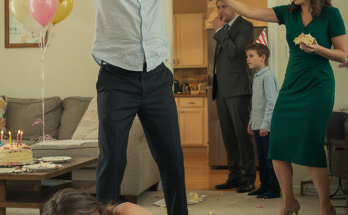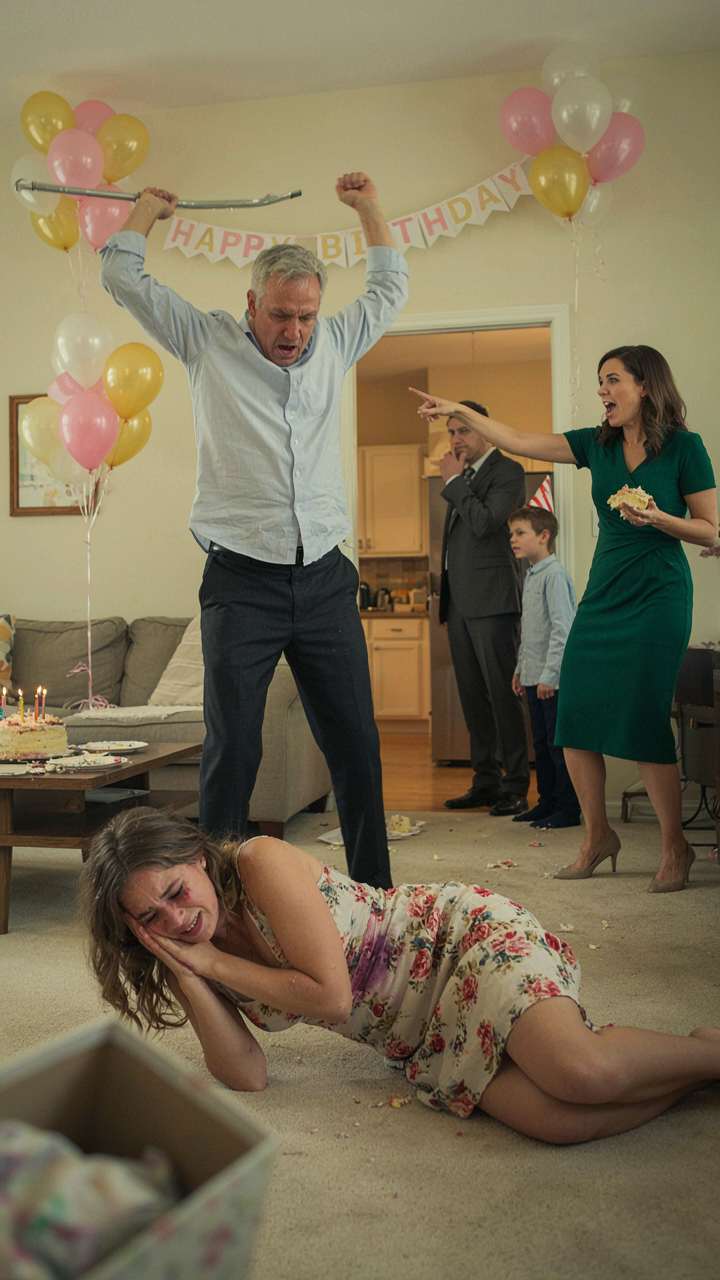
“Give her the crutch.”
Dad finally held it out.
Daniel took it from him instead of making me reach.
He crouched beside me and placed one hand beneath my elbow.
“Can you get up?”
I nodded, though I wasn’t sure.
With the crutch under my arm and Daniel steadying me from the other side, I managed to stand. My injured leg trembled with the effort, but the deeper ache was somewhere behind my ribs.
Rachel stared at Noah’s tablet.
“Noah,” she said carefully, “you misunderstood what you heard.”
Noah looked toward his father.
Daniel glanced down at him.
“Buddy, why don’t you go sit with Aunt Lisa in the backyard for a few minutes?”
My cousin Lisa stepped forward immediately.
“I’ve got him.”
Noah hesitated.
He was still wearing the crooked paper crown.
“Is Aunt Emma okay?”
I forced a smile.
“I’m okay.”
It wasn’t entirely true.
But it was the only answer a seven-year-old needed.
“You didn’t ruin my birthday,” he said.
Something inside me almost broke all over again.
“I know.”
He nodded solemnly, then took Lisa’s hand.
As they walked toward the patio door, he glanced back at the fallen cake.
“We still have cupcakes.”
Daniel let out the faintest breath of laughter.
“So we do.”
That tiny moment changed the room.
It reminded everyone that Noah’s birthday was supposed to belong to Noah, not to whatever old resentment had spilled across the hardwood floor with the frosting.
Daniel looked around at our relatives.
“I think we’re done with the family audience.”
Aunt Marianne picked up her purse first.
She touched my shoulder gently on her way past.
“I’m sorry I didn’t say something sooner.”
I looked at her.
She seemed ashamed.
That surprised me.
Not enough to make the hurt disappear, but enough to make me realize the silence in that room had not meant the same thing to everyone. Some had believed Rachel. Some had been confused. Some had simply frozen.
One by one, people moved outside or toward the front hall.
Nobody argued.
Nobody defended Dad.
Within five minutes, the living room contained only Daniel, Rachel, Dad, and me.
Daniel bent and picked up Noah’s tablet from the coffee table.
“Start the video.”
Rachel folded her arms.
“You’re seriously going to interrogate me at our son’s birthday?”
“No.”
Daniel met her eyes.
“I’m going to ask what happened before I walked through that door.”
“That’s exactly what I told you. Emma got upset.”
“Then the recording should clear everything up.”
Rachel’s expression hardened.
Dad stepped between them.
“This has gotten ridiculous. Daniel, your wife has spent three days preparing this party. Emma comes in already in a mood—”
“I brought Noah a telescope.”
I didn’t know why I said it.
Everyone looked at me.
I swallowed.
“I spent two weeks comparing them because he keeps talking about Saturn. I wrapped it in the blue paper because he told me blue was his favorite color now.”
My voice shook despite my effort to steady it.
“I didn’t come here looking for a fight.”
Daniel’s face softened.
“I know.”
Dad turned toward me.
“You’ve been sensitive lately.”
There it was again.
Not angry.
Not loud.
Almost reasonable.
That made it worse.
“Sensitive.”
“You’ve been through a lot.”
“So that means I imagined Rachel pushing me?”
“No one said that.”
“You did. Five minutes ago.”
Dad looked away.
Daniel tapped the tablet screen.
A video began.
At first there was only Noah’s face filling the frame.
He was whispering dramatically.
“This is the official birthday documentary.”
Despite everything, Daniel smiled.
The camera moved wildly past balloons, paper plates, and a tray of sandwiches. Noah narrated each item as though filming a nature special.
Then the video shifted.
The tablet had apparently been left propped against a stack of board games on a shelf near the dining room.
The picture showed only part of the room.
But the audio was clear.
Rachel’s voice came first.
“She’s going to ask eventually.”
Dad answered.
“I know.”
“You said the statement was enough.”
“It should be.”
“And if Daniel sees the account?”
“He won’t.”
Daniel paused the video.
“What account?”
Dad sat down heavily.
Rachel stared at the floor.
I felt suddenly cold.
“What statement?” I asked.
Nobody answered.
Daniel pressed play again.
Rachel’s recorded voice filled the room.
“I’m telling you, if Emma finds out about the money before we fix this, she’ll think we stole from her.”
My stomach tightened.
Dad’s voice followed.
“We didn’t steal anything.”
“That isn’t how she’ll see it.”
“We borrowed it.”
“Without asking her.”
A pause.
Then Dad said something that made my hands go numb around the crutch.
“She wasn’t using it.”
Daniel stopped the recording.
The screen went black.
“What money?”
Dad rubbed both hands across his face.
Rachel walked to the window.
For the first time since I had known her, she looked as though she had no prepared answer.
Dad finally said, “Your mother’s emergency account.”
My mother had been dead eleven years.
I stared at him.
“What emergency account?”
His eyes met mine.
And in that moment, I knew.
Not what he had done.
Not yet.
But I knew whatever came next had existed long before my accident.
“Dad.”
He sighed.
“Your mother set some money aside.”
“How much?”
“That’s not the point.”
“How much?”
Daniel’s voice came quietly from beside me.
“Dad, answer her.”
“Forty-two thousand originally.”
I blinked.
The number didn’t make sense.
Mom had been a school librarian. Dad had managed a regional hardware store. We had never been poor, but there had never been forty-two-thousand-dollar secrets in our family.
“At the end,” Dad continued, “your mother had a life insurance policy through work. Most of it went toward medical bills and the mortgage. She asked me to put the rest aside.”
“For what?”
“For you and Daniel.”
The room blurred slightly.
I gripped the crutch harder.
Mom had known she was dying for nearly a year.
She had spent those months labeling old photographs, writing birthday cards years in advance for grandchildren she would never meet, making casseroles for Dad because she worried he wouldn’t cook after she was gone.
Of course she would have made a plan.
And of course she would have told Dad.
“What happened to it?”
Dad didn’t answer immediately.
Rachel did.
“We used part of it for the house.”
Daniel turned toward her.
“What?”
“Our down payment.”
His face went still.
Rachel rushed on.
“We were short after the appraisal changed. You remember. We were going to lose the house.”
“You told me your parents helped us.”
“They couldn’t.”
“So you lied to me.”
“I was going to tell you when we paid it back.”
Daniel stared at his wife as though he were trying to recognize her.
“How much?”
“Twenty-eight thousand.”
I felt the number like a weight.
Not because I had been counting on money I never knew existed.
Because four months ago, while I lay in a hospital bed wondering how I would pay rent if I lost my job, Dad had sat beside me and said, “We’ll figure something out.”
He had known.
I looked at him.
“You had money Mom left for me.”
“It wasn’t specifically yours.”
“You said it was for both of us.”
“It was a family emergency fund.”
“I was hit by a drunk driver.”
Dad flinched.
“That was an emergency.”
“I know.”
“Then why didn’t you tell me?”
His shoulders sagged.
“Because most of it wasn’t there anymore.”
Silence settled over us.
Daniel walked to the dining table and pulled out a chair.
He sat as though his knees had stopped working.
“How much is left?”
Dad stared at his hands.
“About sixty-four hundred.”
“What happened to the rest?”
“Property taxes one year. Your grandmother’s care for a while. A roof repair. Things came up.”
“And you decided all of that by yourself?”
“It was in my name.”
“That isn’t what I asked.”
Dad looked at him.
“No.”
It was the first honest answer he had given us.
“No, I didn’t ask.”
I thought of every conversation from the last four months.
Every time I had worried aloud about physical therapy costs.
Every time Dad told me not to panic.
Every time Rachel had said I needed to “think realistically” about downsizing my apartment.
They had both known there had once been enough money to buy me months of recovery time.
Maybe years ago, using it had seemed harmless.
Maybe Dad had sincerely intended to replace it.
But at some point, keeping the secret had become more important than keeping faith with us.
I looked toward the tablet.
“What was the statement?”
Dad said nothing.
Rachel turned from the window.
“It wasn’t what you think.”
“I don’t know what to think.”
She pressed her lips together.
“When you were in the hospital, the insurance company called your emergency contact.”
“Dad.”
“Yes.”
“They asked questions about whether you were able to manage paperwork yourself. You were taking pain medication. You were exhausted.”
“And?”
Rachel looked at Dad.
He answered this time.
“I said you were emotionally overwhelmed and that important correspondence should come through me for a while.”
My stomach dropped.
“You told them I couldn’t handle my own affairs?”
“Temporarily.”
“I never asked you to do that.”
“You couldn’t even get out of bed.”
“That doesn’t mean I stopped being an adult.”
Daniel stood.
“Did Emma authorize this?”
Dad’s silence was answer enough.
I closed my eyes.
Suddenly the missing letters made sense.
I had thought insurers were simply slow. Dad had often arrived at my apartment carrying envelopes, telling me he had “sorted the important stuff.”
At the time, it had felt like care.
Now I wasn’t sure what it had been.
“What correspondence?” I asked.
“Mostly routine.”
“Mostly?”
Dad looked toward Rachel.
“There was a rehabilitation benefit.”
I stared at him.
“What rehabilitation benefit?”
Rachel’s voice was barely above a whisper.
“A temporary living and vocational support benefit. Through the driver’s insurer.”
“How much?”
“It varied.”
“Rachel.”
“Up to twelve hundred a month for several months, plus retraining assistance.”
The room became very quiet again.
My job had disappeared six weeks after the accident.
My manager had called, voice full of rehearsed sympathy, and told me they couldn’t keep my position open indefinitely.
I had cried afterward until my throat hurt.
I had applied for three remote jobs and been rejected from all three.
I had stopped physical therapy twice a week because the copay was adding up.
And somewhere there had been a letter telling me help existed.
“What happened to it?”
Dad stood.
“Nothing happened to it. You can still apply.”
“That isn’t an answer.”
He looked older than he had an hour earlier.
“I put it aside.”
“Why?”
“Because I thought the settlement would come through quickly.”
“And because if I started looking closely at finances, I might ask about Mom’s money.”
He didn’t deny it.
That hurt more than denial would have.
Daniel walked away from the table.
He stood facing the kitchen, both hands on his hips.
Rachel spoke first.
“We were trying to replace the money.”
He turned.
“We?”
She swallowed.
“I’ve been putting money back every month.”
“From our account?”
“From freelance bookkeeping.”
“How long?”
“Almost two years.”
Daniel shook his head slowly.
“You should have told me.”
“I was ashamed.”
“And today?”
Her eyes filled, though she didn’t cry.
“Today was stupid.”
I looked at her.
“That’s one word.”
“I heard your father tell Aunt Marianne you were planning to ask him about Mom’s estate paperwork next week. I panicked.”
“So you pushed me into a cake?”
Rachel shut her eyes.
“I was moving past you. I put my hands out. I pushed harder than I meant to.”
It wasn’t an apology.
But it was the first time she had admitted touching me.
“And afterward?”
“I thought everyone would blame me.”
“So you blamed me first.”
“Yes.”
The word landed quietly.
No excuses.
No elaborate defense.
Just yes.
Daniel looked down at the tablet.
“What did Noah hear about making people think Emma was crazy?”
Rachel’s face twisted with regret.
Dad answered.
“We were talking before the party. I said if Emma started accusing me of hiding money, everyone would think grief and the accident had made her suspicious.”
My throat tightened.
“And Rachel?”
“She said we needed people to believe nothing was wrong until we had everything fixed.”
Rachel shook her head.
“That isn’t exactly—”
Daniel lifted the tablet slightly.
“We have the recording.”
She stopped.
I lowered myself into a chair.
My leg throbbed.
The room smelled overwhelmingly of sugar.
I suddenly wanted to leave more than I had ever wanted anything.
Daniel came beside me.
“I’m taking you home.”
“No.”
“Emma—”
“It’s Noah’s birthday.”
He looked toward the backyard.
Through the glass doors I could see Noah sitting with Lisa and two cousins at the patio table. Someone had put a candle into a cupcake. The children were laughing about something.
“He should have his dad,” I said.
Daniel hesitated.
Then he nodded.
“I’ll have Lisa drive you.”
“I can call a car.”
“You’re not leaving alone.”
There was nothing controlling in his voice.
Only brotherly concern.
For once, I let someone help.
Before I left, Dad came into the hallway.
“Emma.”
I stopped.
He looked at the frosting dried along the hem of my dress.
“I never meant for things to become this.”
I waited.
He seemed to expect me to answer.
When I didn’t, he continued.
“I was going to replace the money.”
“That’s not what hurts most.”
His face changed.
“I know.”
“No. I don’t think you do.”
I looked at the man who had taught me to ride a bicycle, who had sat through every school concert, who had slept in a hospital chair the first three nights after my accident.
That was the hardest part.
He wasn’t a stranger.
He was my father.
Good memories did not erase what he had done.
What he had done did not erase every good memory.
I wished one of those things could have been simple.
“You knew I was scared,” I said. “You watched me wonder how I was going to survive financially. And instead of telling me the truth, you decided what I could handle.”
Dad’s eyes dropped.
“I thought I was protecting you.”
“From what?”
He had no answer.
Lisa drove me home.
Neither of us spoke for the first ten minutes.
Then she said, “I should have stood up when you said Rachel pushed you.”
I watched houses pass beyond the window.
“You didn’t know what happened.”
“I saw enough.”
I looked at her.
She kept her eyes on the road.
“I think our family got used to letting your dad decide what the truth was,” she said. “He says something confidently, and everyone else relaxes because we assume he knows what he’s doing.”
That sounded painfully familiar.
“Mom used to challenge him.”
Lisa nodded.
“Yes.”
I smiled faintly.
Mom had challenged everyone.
Politely.
Relentlessly.
She once returned a toaster three times because the company kept sending the wrong model.
Lisa pulled into my apartment complex.
Before I opened the door, she touched my arm.
“There’s something else.”
I waited.
“Aunt Marianne called me while we were driving.”
My stomach tightened.
“What?”
“She said she has a box that belonged to your mother.”
I stared at her.
“What kind of box?”
“Papers. Letters. Some old bank statements.”
“Why does Marianne have it?”
“She doesn’t know. Your mom gave it to her near the end and asked her to keep it somewhere safe.”
I felt suddenly alert.
“Has she opened it?”
“Not until today.”
“What did she find?”
Lisa hesitated.
“An envelope with your name on it.”
My heart started beating faster.
“From Mom?”
“Yes.”
“When was it written?”
“About two weeks before she died.”
I looked down at my hands.
Eleven years.
For eleven years, a letter from my mother had been sitting in a box I didn’t know existed.
“Why didn’t Marianne give it to me?”
“She thought your dad had copies of everything. She forgot about the box after she moved. She only remembered it today when he mentioned the emergency account.”
I leaned back against the seat.
The afternoon had already changed too much.
But one question rose above all the others.
“What does the letter say?”
Lisa shook her head.
“She didn’t read it.”
My eyes burned again.
Not from humiliation this time.
Not even from anger.
From the strange, impossible feeling that my mother—gone for more than a decade—had just reached into the worst day of my year and placed a sealed envelope in my path.
Lisa squeezed my hand.
“She’s bringing the box tomorrow.”
That night, long after I had washed the pink frosting from my hair and hung my dress over the shower rail, I sat at my kitchen table staring at my phone.
There were twelve missed calls.
Three from Dad.
Four from Daniel.
One from Rachel.
The rest from relatives.
I answered none of them.
At 10:17, Daniel sent a message.
Noah had opened the telescope.
He had insisted on pointing it toward Saturn even though clouds covered half the sky.
Then another message appeared.
I stayed.
I looked at the words for a long time.
Stayed where?
Before I could reply, another came.
At the house. Rachel and I talked. Noah’s asleep. I’m not leaving tonight. We’re going to work through what happened like adults, but there will be no more secrets.
A minute later:
And Emma? I’m sorry. I should have known more about Mom’s account too.
I typed back slowly.
You didn’t know.
His answer arrived almost immediately.
Maybe. But I also didn’t ask enough questions.
I set the phone down.
For the first time that day, I understood that whatever came next would not simply be about discovering who had done something wrong.
It would be about discovering how many of us had learned to look away.
The following afternoon, Aunt Marianne arrived carrying a faded blue document box.
She placed it gently on my kitchen table.
“I should have brought this years ago.”
Her voice trembled.
I touched the lid.
A white label had been taped across the top.
In my mother’s handwriting were four words.
FOR EMMA AND DANIEL.
Marianne sat across from me.
“There’s something you should know before you open it.”
I looked up.
“What?”
“I found the account papers.”
My pulse quickened.
“And?”
She folded her hands.
“The money wasn’t the only thing your mother left you.”
She slid one document across the table.
At first, I didn’t understand what I was reading.
Then I saw an address.
A familiar one.
A little cedar cottage beside Lake Vernon, where Daniel and I had spent summers as children.
I looked at Marianne.
“That place was sold after Mom died.”
She shook her head slowly.
“No, Emma.”
My fingers tightened around the paper.
“Then who owns it?”
Marianne’s eyes softened.
“You and Daniel do.”
And suddenly the secret inside our family became much bigger than forty-two thousand dollars.