Chapter 1: The Dead Weight in the Stern
“You can just walk. You’re both as fat as cows anyway.”
The words hung in the freezing air, delivered with the breezy, detached cheerfulness of a sportscaster announcing a trivial halftime score. An automated radio voice—chipper and oblivious—spilled from the speakers: Hello. You are tuned into the Tempted Hearts channel. Enjoy the broadcast.
Then came the sharp, metallic clack of the electronic door locks engaging. The black SUV lurched violently forward, its heavy tires spitting a vicious spray of wet gravel against my shins.
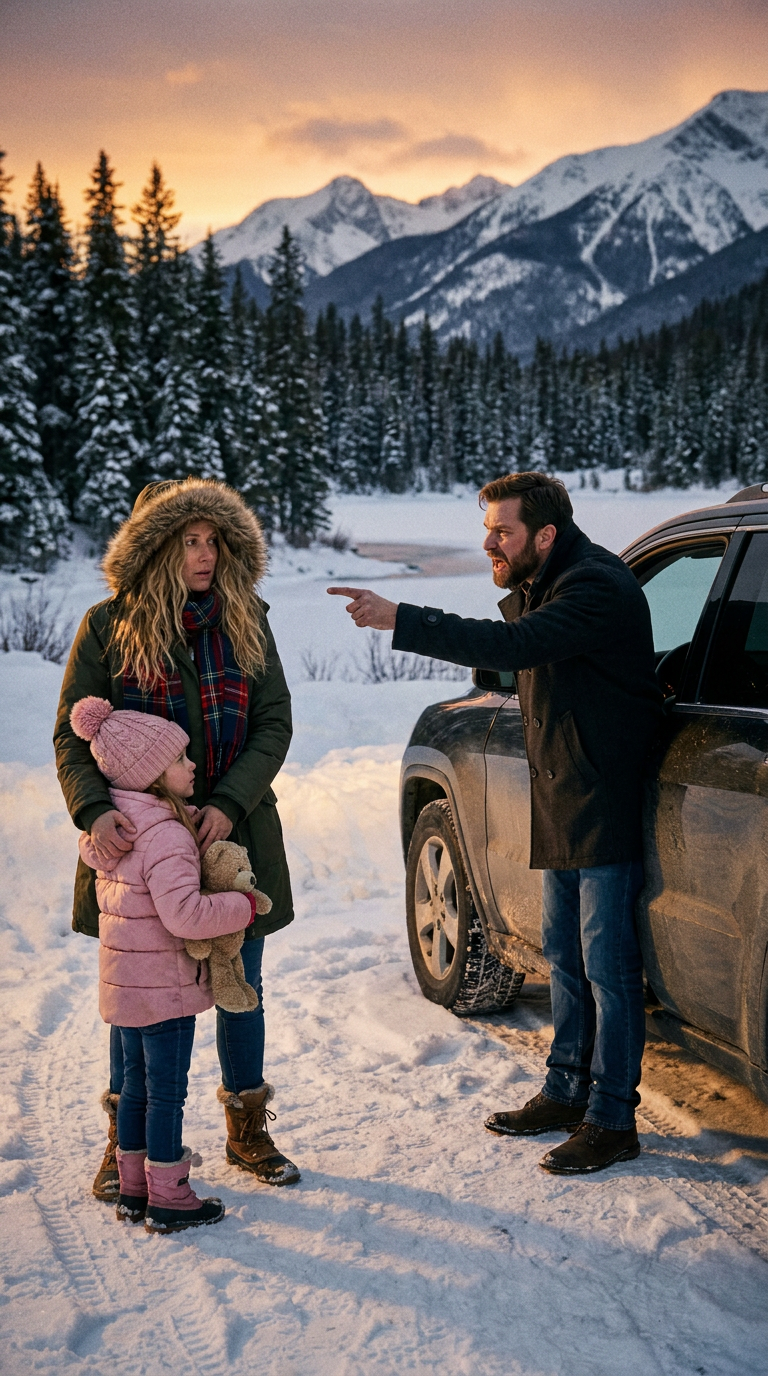
A minute later, the suffocating darkness of the old county logging road reclaimed the space. Only two shapes remained on the shoulder: my fifteen-year-old daughter, Valerie, shivering in her thin varsity track jacket, and myself. We stood paralyzed, watching the glowing red dots of the tail lights shrink into the distance. The dots grew smaller and smaller until the sharp curve of the treeline swallowed them entirely.
Beside me, Val hugged her torso, her white running shoes—the same ones she had laced up with such desperate hope at the starting line that morning—now completely soaked through with icy mud. There was no bronze medal swinging from her neck. That hardware had gone to the girl who crossed the finish line a fraction of a second faster.
“Mom,” Val whispered, the word fracturing in the frigid night air. “He’ll come back, right?”
I didn’t answer her. I kept my eyes locked on the absolute blackness where the lights had vanished. Strangely, the frantic, hyperventilating panic that should have seized a mother stranded in the woods didn’t materialize. Instead, an incredibly lucid, glacial clarity crystallized in my mind. For seventeen agonizing years, I had held my breath, waiting for my husband to cross the unforgivable line. Tonight, he had sprinted past it entirely on his own.
The day had masqueraded as a celebration. The state crew championships were hosted at a sprawling regatta course in a neighboring county. Val had sacrificed her entire year to the water—rowing at 6:00 A.M. while her classmates slept, and rowing again until the sun dipped below the tree line. Coach Rachel, a sinewy woman with a voice capable of shattering glass, rarely wasted words. “She pulls hard. She’s got grit,” was her highest praise for Val.
My husband, Leo, had never attended a single competition. His excuses rotated like tires in his auto shops: a supplier screwed up an invoice, a mechanic walked out, or he simply couldn’t fathom the appeal of watching narrow boats crawl across a lake. But that morning, he had abruptly decided to play the family man. He strutted out to the driveway in a crisp new jacket, clean-shaven and jingling his keys. “Might as well see what my money is going toward,” he had chuckled.
I had foolishly assumed it was a clumsy joke. It was merely the overture.
Val’s quad finished fourth, missing the podium by half a boat length. In rowing, half a boat length is a ghost; it’s less than a second, the brutal consequence of a single uncoordinated stroke in the final two hundred meters. On the muddy shore, Coach Rachel patted Val’s trembling shoulder. “It’s fine. We’ll take it next year.”
But Leo hadn’t offered comfort. As Val trudged up to us—soaking wet, her chest heaving, eyes burning with the raw exhaustion of leaving her soul on the water—Leo looked her up and down with clinical disdain. “Well, did your heavy stern weigh you down? I told you a boat can’t move with a rear end like that.”
Val had laughed. It was a hollow, desperate sound. I knew that laugh intimately. It was the biological defense mechanism of a girl terrified of shattering in public. She had been laughing at her father’s “jokes” since she was nine. Endless quips about donuts, about needing reinforced chairs, about her thighs. She would force out a laugh, then vanish into the bathroom, running the faucet at full blast so no one could hear the muffled sobs.
The cruelty escalated at the boathouse cafe. When Val pulled out her iPhone, likely to text a teammate, Leo snatched it from her grip with viper-like speed. “No phones at the table. You can sit in silence until tomorrow and think about your pathetic results.” He tossed the device into the SUV’s glove box.
I had remained silent. That cowardice would lodge in my throat like a shard of glass for hours. I stayed quiet because the cafe was crowded, and because Val shot me a pleading, wide-eyed look. Please, Mom. Not a scene. She had learned to navigate his minefields by surrendering.
By the time we hit the interstate, the November night had dropped over the Northeast like a heavy velvet curtain. Twenty-five miles from home, a blinding yellow sign ambushed us: ROAD CLOSED. BRIDGE REPAIR. DETOUR.
Leo cursed, slamming the steering wheel so hard Val flinched in the back seat. He violently yanked the wheel, forcing the SUV onto a narrow, dilapidated county road winding deep into the pines.
“Just what I needed,” he seethed. “I don’t drive this road.”
“Relax, Leo,” I had murmured, trying to defuse the cabin pressure. “What difference does it make?”
“The difference is it ruins the suspension!” he snapped. It was a bizarre phobia. In seventeen years of marriage, we had never taken this specific bypass. Even in deadlocked summer traffic, Leo would happily drive thirty miles out of his way to avoid it.
The darkness outside fueled his venom. He locked eyes with Val in the rearview mirror. “Do you realize how much cash I dumped into you this year, Valerie? Training camps, gear, club fees. And the result? Fourth place. Fourth is a zero. You look like a barge out there. Drop twenty pounds and maybe you’d actually win.”
In the reflection of the window, I saw my daughter’s chin quiver. And in that precise second, the dormant, beaten-down dog that had lived curled up in my chest for seventeen years bared its teeth and stood up.
“Stop,” I commanded.
Leo blinked, genuinely failing to process the defiance. “What?”
“Stop it. You have bullied her all day. She rowed two thousand meters against a brutal headwind. You couldn’t run fifty feet. Shut your mouth.”
His face contorted into a mask of pure, ugly disbelief. “You’re giving me orders? You’ve been leeching off me for almost two decades. You haven’t worked a day. You eat my food, wear my clothes, and let your kid play in puddles on my dime.”
Normally, I would count to one hundred in my head, staring out the window until the storm passed. But tonight, the ledger in my mind finally balanced.
“Leeching off you?” My voice dropped to a dead, terrifying level. “Who balances your books, Leo? Who prepares your federal tax returns? Who reviews every single vendor contract? Who knows exactly how much cash you skim off the top to hide from the IRS? I do it. For free. I write it all down. So tell me, who is the real leech?”
He slammed the brakes. The heavy SUV swerved violently, tires screaming against the asphalt before skidding into the dirt shoulder. Val shrieked against her seatbelt. Leo twisted his entire torso toward me. All the color had drained from his face, leaving him looking like a bloated corpse.
“Keep your mouth shut about those notebooks,” he hissed, his voice a razor blade in the dark. “Never to anyone. You’re nobody. A couch potato cow.”
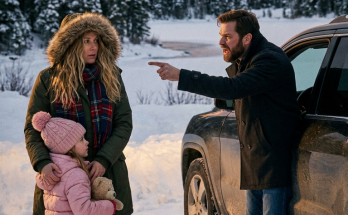
He reached across the console, yanked my door handle, and shoved it open. The freezing scent of rotting pine needles flooded the heated cabin. “Get out.”
When I unbuckled my belt and ordered Val to follow me, I reached into the back seat for my leather purse. It held my phone, my ID, my debit cards. But Leo was faster. He lunged, snatching the strap and slamming the heavy door inches from my face. He rolled the window down a crack.
“I bought that purse. Nothing in there belongs to you. Enjoy the jog.”
And now, the tail lights were gone. We were entirely alone in the abyss.