The Secret Hidden Inside the Blanket: My Daughter-in-Law Threw Away My Gift, but My Son Discovered What She Never Expected
The moment my daughter-in-law tossed my hand-knitted baby blanket into the trash, I heard a few guests laugh.
“We only use designer things here,” Vanessa announced, brushing invisible dust from her expensive dress. “No offense, Eleanor, but this isn’t the kind of thing we want our baby surrounded by.”
The blanket landed on top of a crumpled paper plate smeared with buttercream frosting.
For a moment, I couldn’t breathe.
I had spent eleven months knitting that blanket. I had worked on it through sleepless nights, during winter storms, and on evenings when the only company I had was the ticking clock above my kitchen sink.
Every stitch carried a memory.
But Vanessa saw only cheap yarn.
I could have argued. I could have reminded her that I had raised her husband, that I had worked double shifts to give him a future, and that I had spent the last three months preparing for the arrival of my first grandchild.
Instead, I smiled.
“Of course, dear.”
Then I bent down, retrieved the blanket from the trash, folded it carefully, and put it inside my handbag.
Nobody stopped me.
Nobody apologized.
And when I walked out of that baby shower, I thought the worst part of the afternoon was behind me.
I was wrong.
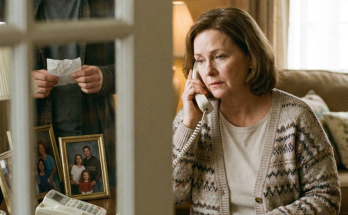
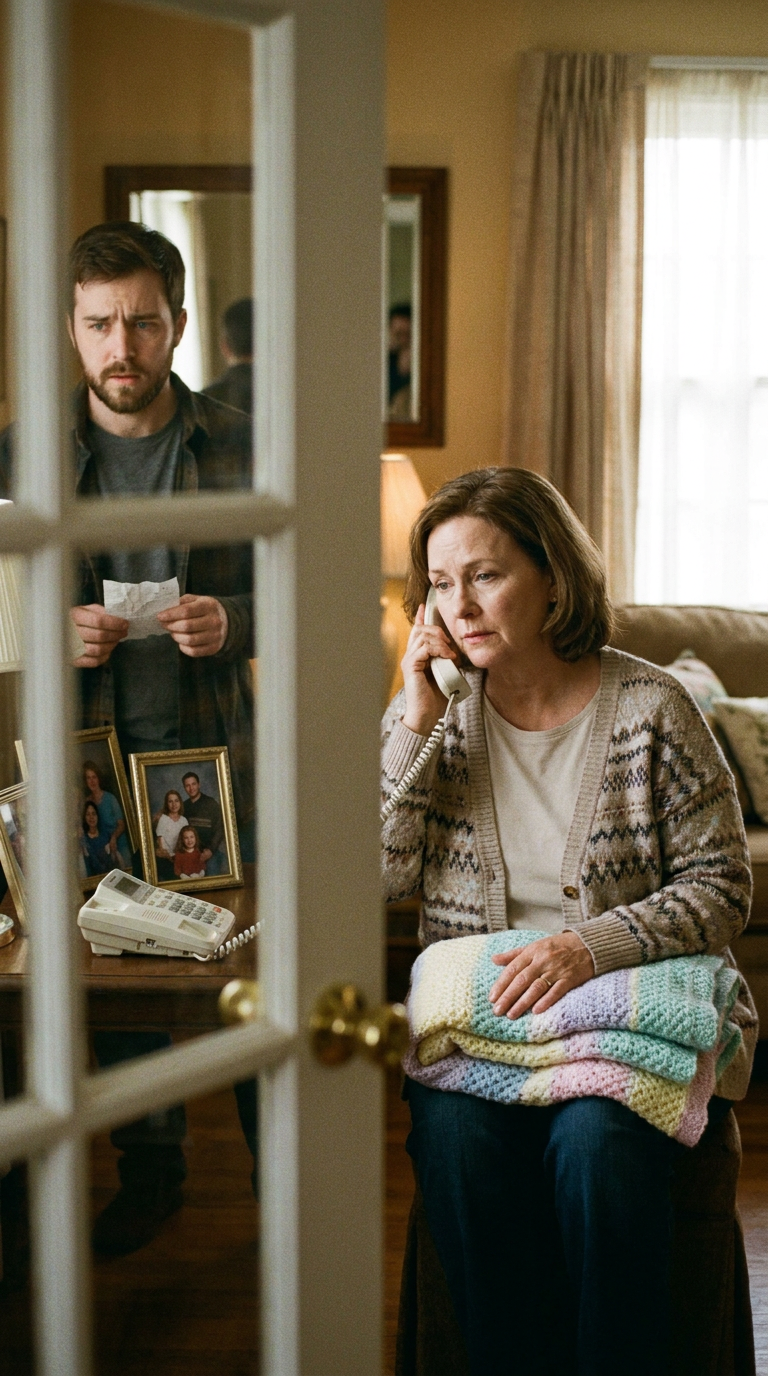
At 9:17 that night, my phone rang.
It was my son, Daniel.
His voice sounded strange, as though he had been crying.
“Mom,” he whispered. “I need you to tell me something.”
“What is it, sweetheart?”
He took a shaky breath.
“What’s folded inside that blanket?”
I sat down so quickly that my kitchen chair scraped against the floor.
For eleven months, I had kept a promise to a dying woman.
And now, somehow, that promise was about to change everything.
But to understand why my son was crying, you need to know what happened before the blanket ever reached Vanessa’s trash can.
You need to know about the little boy I raised, the woman he married, and the secret I had carried for thirty-two years.
Because that blanket wasn’t merely a gift.
It was the last thing I had left of the woman who saved my son’s life.
And I had no idea that someone else had finally discovered the truth.
Chapter One: The Woman Who Never Seemed Good Enough
My name is Eleanor Whitmore. I was sixty-eight years old when my grandson’s baby shower took place.
I lived alone in a modest two-bedroom house in a quiet neighborhood outside Columbus, Ohio.
My husband, Thomas, had died seven years earlier after a sudden heart attack. We had been married for forty-one years, and his absence still followed me through the house like a shadow.
I kept his favorite coffee mug in the cabinet. I watered the roses he had planted beside the porch. Every Sunday, I cooked enough food for two before remembering that there was only one person left to eat it.
Our only child, Daniel, was thirty-six.
He had always been a gentle boy. As a child, he collected fallen birds from the garden and carried them into the house in shoeboxes. When he was ten, he cried because another boy had broken his favorite pencil.
When he was twenty, he worked three jobs while attending college because he didn’t want me to take out another loan.
I was proud of the man he became.
He was a successful architect, patient with people, generous with his time, and still the kind of person who called me every Sunday evening just to ask whether I had eaten.
Then he met Vanessa.
She was beautiful in a way that made people turn their heads. She had glossy brown hair, designer handbags, and a smile that could make a stranger feel like the most important person in the room.
She also had a talent for making me feel as though I had wandered into the wrong house.
The first time Daniel brought her to dinner, I prepared roast chicken, mashed potatoes, and apple pie.
Vanessa inspected the dining room.
“Oh,” she said, “you still use these old-fashioned dishes?”
“They were my mother’s,” I replied.
“How charming.”
She said it the way someone might describe an antique lamp that didn’t match the furniture.
During dinner, she talked about luxury vacations, exclusive restaurants, and the expensive apartment she had lived in before moving in with Daniel.
When I asked about her family, her smile faded slightly.
“My mother died when I was young,” she said. “I never really had the kind of family other people take for granted.”
Daniel reached for her hand.
I felt sorry for her then.
I didn’t know that, over the following years, I would spend countless nights wondering whether compassion had made me blind.
They married two years later in an elegant hotel ballroom.
I paid for the rehearsal dinner because Daniel had been saving for a house. I also gave them $8,000 toward their honeymoon.
Vanessa thanked me with a kiss on the cheek.
“You’re so generous, Eleanor. Daniel is lucky to have you.”
For a few months, I believed we might become close.
Then the little comments began.
When I brought homemade cookies to their apartment, Vanessa said their kitchen wasn’t designed for storing unnecessary food.
When I offered to help decorate their new house, she explained that they had hired a professional.
When I asked whether they wanted me to make curtains for the nursery, she laughed.
“Handmade things are sweet, but we’re going for a more sophisticated look.”
I learned to swallow my disappointment.
Daniel was happy, I told myself.
That was what mattered.
Then, eleven months before the baby shower, I received a telephone call that changed the way I understood everything.
It came from a woman I hadn’t spoken to in more than thirty years.
Her name was Margaret Ellis.
And she was dying.
Chapter Two: The Promise
Margaret had been my closest friend when I was young.
We met when I was twenty-two and working at a small medical clinic. She was a nurse with a loud laugh, quick hands, and a habit of bringing homemade biscuits to work.
She was also the first person who held my hand when my husband and I learned that our newborn son had a serious heart defect.
Daniel had been only three days old.
The doctors explained that he needed specialized treatment immediately. The procedure was risky, and the costs terrified us.
Thomas and I had savings, but nowhere near enough.
I remember sitting in the hospital corridor at two in the morning, staring at the floor while my whole world seemed to collapse.
Margaret found me there.
She sat beside me without asking questions.
Then she said, “We’re going to get that little boy through this.”
And somehow, she made me believe her.
Margaret contacted a specialist she knew. She helped us navigate the hospital system. She organized a small fundraiser among friends and coworkers and contributed money of her own.
When Daniel underwent surgery, Margaret stayed beside me until dawn.
She wasn’t his mother.
She wasn’t his relative.
But she loved him as if he belonged to her.
The surgery succeeded.
Daniel recovered slowly, and eventually the doctors told us he could expect a normal life with routine follow-up care.
Thomas and I never forgot what Margaret had done.
Neither did I.
Over the next several years, our lives moved in different directions. Margaret left the clinic, moved to another state, and eventually married a man named Robert Ellis.
We exchanged Christmas cards for a while.
Then our correspondence became less frequent.
Life happened. Jobs changed. Parents died. Children grew up.
But every few years, Margaret would call, and we’d talk as though no time had passed.
Then, thirty-two years after Daniel’s birth, her name appeared on my phone.
“Eleanor,” she said weakly, “I need to ask you for something.”
She was living in a hospice facility in Pennsylvania. Her husband had died years earlier, and she had no children of her own.
Cancer had spread through her body.
I drove six hours to see her the following week.
She was smaller than I remembered, her silver hair thin against the pillow. But when she saw me, her eyes brightened.
“You came,” she whispered.
“Of course I came.”
I sat beside her and held her hand.
We talked about the old clinic, about Thomas, about Daniel’s childhood. She smiled when I told her my son had become an architect.
Then she grew serious.
“Does he remember the little blue rabbit?” she asked.
I frowned.
“What rabbit?”
“The one I gave him when he was in the hospital. Blue ears, yellow button eyes. He used to hold it during his recovery.”
I remembered it then.
Daniel had carried that rabbit everywhere until one ear came loose. Thomas had repaired it with crooked stitches, and Daniel refused to let us replace it.
“He remembers,” I said.
Margaret closed her eyes.
“Good.”
For a moment, I thought she had fallen asleep.
Then she squeezed my hand.
“Eleanor, there’s something I never told you.”
Her voice trembled.
I leaned closer.
“After Daniel’s surgery, I learned something about the hospital records. Something about his birth. I wanted to tell you, but the timing was wrong, and then the years passed. I kept thinking I would find the right moment.”
My stomach tightened.
“What are you talking about?”
She looked at me for a long time.
“Not yet. I need to explain it properly.”
She asked me to bring a small box from her bedside cabinet.
Inside lay a yellowed photograph, several folded documents, and a skein of pale blue yarn.
I recognized the photograph immediately.
It showed Margaret holding a newborn baby wrapped in a blue blanket.
The baby was not Daniel.
At least, not the Daniel I knew.
“Who is that?” I whispered.
Margaret’s eyes filled with tears.
“My son.”
I stared at her.
“Margaret, you never told me you had a child.”
“I didn’t raise him.”
She looked away.
“I gave birth when I was very young. My family said I had brought shame upon them. They arranged an adoption before I had a chance to hold him properly.”
Her voice cracked.
“I was told he would have a good home. I was told I should forget him.”
She touched the photograph.
“But a mother doesn’t forget.”
I felt tears gathering in my own eyes.
“Did you ever find him?”
“Eventually, I learned where he was born and where he went. I spent years searching. By the time I found enough information, I was afraid I would destroy the life he’d built.”
She turned toward me.
“Then I learned something else. Something connected to your family.”
My heart pounded.
“What?”
But she shook her head.
“I need you to promise me something first.”
I took her hand.
“Anything.”
“When your grandchild is born, knit a blanket. Use this blue yarn. Fold the photograph and the letter I give you into the lining. Don’t open the sealed envelope unless you absolutely have to.”
I stared at her.
“Why would I do that?”
“Because one day, the truth may need to find its way home.”
She pressed a small sealed envelope into my hand.
“Promise me, Eleanor.”
I looked at the frail woman who had once helped save my son.
Then I nodded.
“I promise.”
Margaret died three days later.
I returned home with the photograph, the letter, and the blue yarn.
And I kept my promise.
Chapter Three: Eleven Months of Stitches
After Margaret’s funeral, I couldn’t bring myself to open the sealed envelope.
I placed it in my bedroom drawer, beneath Thomas’s old watch and the wedding photograph we had taken forty-one years earlier.
For weeks, I thought about Margaret’s final words.
The truth may need to find its way home.
I wondered whether she had been confused by the medication. Whether the documents were connected to her adoption. Whether the secret involved someone I knew.
But I also remembered the way she had looked at me.
She had been afraid.
Not afraid of dying.
Afraid of leaving something unfinished.
Six months later, Daniel called with wonderful news.
“Mom, you’re going to be a grandmother.”
I cried so hard that he had to wait several seconds before I could answer.
Vanessa was expecting a boy.
I immediately went to my sewing room, pulled out the blue yarn Margaret had given me, and started knitting.
I worked on the blanket every evening.
The pattern was simple: rows of soft blue squares bordered by a delicate cream edge.
But I made one special addition.
Inside the border, I stitched a tiny blue rabbit.
It was the same rabbit Margaret had given Daniel all those years ago.
I couldn’t explain why I chose it. I simply knew it belonged there.
The blanket took eleven months because my hands were no longer as steady as they used to be. Some nights, my fingers ached so badly that I had to stop.
Still, I continued.
I knitted through thunderstorms and power outages. I knitted while listening to the radio. I knitted on the anniversary of Thomas’s death.
Sometimes I spoke to Margaret as I worked.
“I’m keeping my promise,” I whispered.
When the blanket was finished, I laid it across my bed.
It was soft, warm, and imperfect.
One corner was slightly wider than the other. A few stitches were tighter than they should have been.
But I loved it.
Before finishing the border, I carefully placed the photograph and the letter inside a small protective fabric pocket sewn beneath the edge.
I did not open the sealed envelope.
I tucked it into the pocket with the other documents, following Margaret’s instructions.
Then I wrapped the blanket in tissue paper and placed it in a gift box.
I imagined my grandson sleeping beneath it.
I imagined Daniel sending me a photograph of the baby wrapped in blue yarn.
I imagined Vanessa thanking me.
Perhaps, I thought, a baby could soften the edges between us.
Perhaps becoming a grandmother would finally give me a place in their new little family.
I was sixty-eight years old, and I still wanted my son to need me.
That was my mistake.
I confused being needed with being loved.
Chapter Four: The Baby Shower
The baby shower took place on a Saturday afternoon in a private room at an upscale restaurant.
Vanessa had chosen everything herself.
White roses covered the tables. Gold balloons floated near the ceiling. A towering cake stood beneath a decorative arch, its frosting arranged in pale blue clouds.
There were designer baby clothes displayed on velvet hangers, expensive gift baskets, and a photographer who had been hired to capture every detail.
I arrived wearing my best navy cardigan and the pearl earrings Thomas had given me for our twentieth anniversary.
I carried the blanket in a white box tied with a blue ribbon.
At the entrance, Vanessa’s friend Jessica looked inside.
“Oh, how sweet,” she said.
Her smile suggested that she was being polite.
Vanessa approached a few minutes later.
“Eleanor! You made it.”
She kissed the air beside my cheek.
“Just put your gift over there with the others. We’re taking pictures first.”
I placed the box on the gift table.
For the next hour, I watched guests arrive with luxury strollers, designer diaper bags, and enormous packages wrapped in expensive paper.
Every gift received an announcement.
“Oh my goodness, the limited-edition collection!”
“Is that the European stroller?”
“Look at this beautiful cashmere set!”
Vanessa squealed over each item.
When someone presented a $900 baby carrier, she hugged the woman and announced that it was exactly what she had wanted.
I sat quietly near the end of a table.
I had brought a small tin of homemade butter cookies, but Vanessa had told me beforehand that the caterer would provide all the food.
So I left them in my handbag.
At around three o’clock, Vanessa finally approached the gift table.
“Time to open presents!” she announced.
Everyone gathered around.
I watched as she opened a designer changing bag, a silver rattle, and a hand-embroidered name blanket from one of her friends.
Then she picked up my box.
Her eyebrows lifted when she saw the blue ribbon.
“What’s this?”
“Something I made for the baby,” I said.
She untied the ribbon and removed the tissue paper.
The blanket unfolded across her lap.
For several seconds, she said nothing.
Then she held it up between two fingers.
“Oh.”
The room became strangely quiet.
“It’s hand-knitted,” I explained. “I used soft baby yarn. I thought he might like something warm for his crib.”
Vanessa turned the blanket over.
Her lips pressed together.
“Eleanor, I thought we discussed this.”
I blinked.
“Discussed what, dear?”
“The aesthetic. We’ve been very careful about what we buy for the nursery. Everything matches.”
She held the blanket up again.
“This doesn’t match anything.”
I looked at the delicate cream border and the little blue rabbit.
“I thought the baby could use it when he’s being held. It doesn’t have to go in the nursery.”
Jessica shifted uncomfortably.
Another guest suddenly became fascinated by her phone.
Vanessa laughed lightly.
“We only use designer things here.”
Then, as though she were removing an unwanted advertisement from her table, she walked to the trash bin beside the catering station.
And dropped my blanket inside.
The fabric landed on top of a paper plate covered in buttercream frosting.
Someone gasped.
Another guest murmured, “Oh, that’s awkward.”
Vanessa returned to her chair and smoothed her dress.
“Now, where were we?”
My face burned.
I could feel every eye in the room.
I wanted to shout.
I wanted to tell her that I had spent eleven months making that blanket. I wanted to explain that the yarn had belonged to a dying woman who had once helped save my son’s life.
I wanted to ask her how a person could look at something made with love and see only its price.
Instead, I stood up.
“I’m sorry it wasn’t what you wanted.”
Vanessa waved her hand.
“Don’t be so sensitive. It’s just a blanket.”
I nodded.
Then I walked to the bin.
I lifted the blanket out, carefully brushed away the frosting, and folded it over my arm.
Nobody offered to help.
Nobody apologized.
As I passed Vanessa, she said, “You really don’t have to make everything about yourself.”
I stopped.
For the first time in years, I looked directly into her eyes without trying to make her comfortable.
“You’re right,” I said quietly. “I don’t.”
Then I left.
Outside, the autumn air felt cold against my face.
I sat in my car for several minutes before starting the engine.
The smell of buttercream had settled into the sleeves of my cardigan.
I could still hear the laughter inside the restaurant.
But something else had happened in that room.
Something I hadn’t expected.
For the first time since Daniel’s wedding, I no longer felt the need to prove that I deserved a place in my son’s life.
I simply wanted to go home.
And keep the promise I had made to Margaret.
Chapter Five: The Phone Call at 9:17
By the time I arrived home, the sun had disappeared behind the houses.
I placed the blanket on my kitchen table and examined it carefully.
A small patch near the border was stained with frosting. I dampened a cloth and cleaned it.
Then I sat down.
I thought about Margaret.
I thought about the photograph and the sealed envelope hidden beneath the blanket’s border.
I wondered whether I should finally open it.
Before I could decide, my phone rang.
Daniel.
I answered immediately.
“Hello, sweetheart.”
There was no response at first.
I heard a door close on his end of the line.
Then he whispered, “Mom, are you home?”
“Yes. I just got back.”
“Did you bring the blanket with you?”
I looked toward the table.
“Yes. Why?”
His breathing became uneven.
“Mom, I need you to tell me something.”
“What is it?”
“What’s folded inside that blanket?”
I gripped the phone.
For a moment, I couldn’t speak.
“Daniel, what are you talking about?”
“I found a photograph.”
My heart seemed to stop.
He continued, his voice breaking.
“Vanessa was complaining about the blanket after you left. She said it was ridiculous that you had taken it back out of the trash. She wanted me to throw it away.”
I closed my eyes.
“I see.”
“I didn’t know what had happened until I found it in the car. You must have left a small piece of yarn on the passenger seat when you got in earlier. Vanessa said you were being dramatic, and she started laughing about the whole thing.”
He paused.
“Then she said something that made me angry. She said you probably didn’t even know what was inside the blanket.”
My fingers tightened around the phone.
“What happened next?”
“I told her to stop talking about you like that. We argued. She said I was always choosing you over her.”
I could hear him trying to steady himself.
“Then I went into the garage to get some air. I saw the blanket on the back seat, and a little piece of the lining had come loose.”
My mouth went dry.
“Daniel…”
“I found the photograph. A woman holding a newborn baby. There was a letter folded behind it.”
He stopped.
When he spoke again, his voice was barely audible.
“Mom, the letter has my name on it.”
I stood so quickly that the chair tipped backward.
“What?”
“It says, ‘To Daniel, when the time is right.’”
The kitchen seemed to tilt around me.
For thirty-two years, I had believed I understood the story of my son’s birth.
Now I was beginning to realize that the truth had been waiting in my own house all along.
“Daniel,” I said carefully, “I need you to bring the photograph and letter here tomorrow morning.”
“Mom, please tell me what’s happening.”
“I can’t explain it properly over the phone.”
“Is that woman my mother?”
The question cut through me.
I wanted to say no.
I wanted to protect him from the uncertainty I had carried since Margaret’s death.
But I had promised a dying woman that the truth would find its way home.
So I whispered, “I think we need to read the letter together.”
He began to cry.
And for the first time in thirty-six years, I realized that my son was about to ask me a question I could not answer with a simple reassurance.
“Did you know?” he asked.
I looked at the blanket on my kitchen table.
“Yes,” I whispered. “But I don’t know everything.”
Then the line went silent.
Chapter Six: The Letter Margaret Left Behind
Daniel arrived the next morning at 8:30.
He looked exhausted.
His eyes were red, and he had the photograph and letter tucked inside a manila envelope.
I made coffee, but neither of us drank it.
He placed the photograph on the table.
It showed Margaret holding a newborn boy in a hospital bed.
On the back, someone had written a date.
The date was the same day Daniel had been born.
He stared at it for a long time.
“Who was she, Mom?”
I sat across from him.
“Margaret was my closest friend when you were born. She helped us when you needed surgery.”
He nodded slowly.
“I remember you talking about her.”
“She was there for us when we had almost nobody else.”
I explained what Margaret had told me in hospice, including the promise about the blanket.
Daniel listened without interrupting.
When I finished, he picked up the letter.
His hands shook as he unfolded it.
The paper was old, but Margaret’s handwriting remained clear.
He began reading aloud.
Dear Daniel,
If you are reading this, then the time has finally come for you to know the truth about your birth.
I am the woman in the photograph. I gave birth to a baby boy many years ago, but I was not allowed to raise him. My family arranged an adoption, and I spent years believing I would never know what happened to him.
I learned later that the baby had been adopted by a loving couple named Eleanor and Thomas Whitmore.
Daniel stopped reading.
He looked at me.
“Whitmore?”
I nodded, tears sliding down my cheeks.
He continued.
When I discovered who had adopted my son, I was afraid to approach the family. I did not want to disturb the life he had built. But when I met Eleanor at the clinic, I realized that she was the kind of mother every child deserves.
I watched from a distance for a time. When Daniel became seriously ill, I helped Eleanor and Thomas find the care he needed. I never told them who I was because I feared they would think I had come to claim him.
I did not want to take him away. I only wanted to know he was loved.
Daniel covered his mouth.
He looked as though the room had disappeared around him.
I reached for his hand.
He didn’t pull away.
The letter continued.
I need you to understand something, Daniel. I did not abandon you because I did not love you. I let you go because I was young, frightened, and surrounded by people who told me I had no choice.
For years, I imagined what your life might have been. I hoped you were healthy. I hoped someone held you when you cried. I hoped you would grow up knowing that your life mattered.
When I learned that you had become an architect, I cried with happiness. I never contacted you because I believed that love sometimes means standing back and allowing someone else to be the parent.
Eleanor was your mother in every way that mattered. She gave you a home, a name, and a future.
Please do not let this letter make you question the love you received.
I only ask that you remember me as someone who loved you before you could ever know my name.
With all the love I was never able to give you in person,
Margaret.
Daniel reached the last line and lowered the paper.
For several minutes, neither of us spoke.
Then he asked, “Is it true?”
I swallowed.
“I believe it is.”
“You knew she was my biological mother?”
“I learned that she believed she was your birth mother shortly before she died. She gave me the letter and asked me to keep it with the blanket until the right time.”
He looked at me with an expression I had never seen before.
“Why didn’t you tell me?”
The question was quiet, but it hurt more than if he had shouted.
“Because I promised her I would let the truth come to you when the time was right. And because I was afraid.”
“Afraid of what?”
I looked down at my hands.
“Afraid you might think I had kept something from you that should never have been mine to keep. Afraid you might wonder whether I loved you less if you had another mother.”
His face crumpled.
“Mom…”
“I should have told you sooner that Margaret had left me a letter. I know that now. But I never wanted to take anything from you. I thought I was protecting you.”
He stood and walked to the window.
For a moment, I thought he might leave.
Then he turned around.
“Do you know what Vanessa said last night?”
I shook my head.
“She said the blanket was worthless. She said you were trying to manipulate us with some sentimental story.”
His jaw tightened.
“She didn’t even know what it was. She just wanted to throw it away.”
I felt an unexpected calm settle over me.
“Daniel, what happened at the shower was cruel. But the blanket doesn’t need Vanessa’s approval to matter.”
He looked at the photograph again.
“No,” he whispered. “It doesn’t.”
Then he asked the question that changed everything.
“Mom, can we find out whether this is legally and biologically true?”
I nodded.
“Yes, sweetheart. We can.”
And for the first time since the baby shower, I felt that something good might come from the hurt.
The truth had finally begun its journey home.
Chapter Seven: The Woman in the Photograph
Over the following weeks, Daniel and I worked together to verify Margaret’s story.
We contacted the hospice facility and asked whether they still had copies of the documents she had left with me.
A social worker helped us locate the attorney who had handled Margaret’s estate.
The attorney confirmed that Margaret had spent years trying to obtain information about her biological son. He had copies of letters she had written to adoption agencies and records showing that she had eventually identified the Whitmore family.
There were also medical documents, including a record of Margaret’s presence at the clinic where Daniel had received treatment as a newborn.
The evidence was compelling, but we wanted certainty.
Daniel contacted an accredited genetic testing service and arranged a comparison using a preserved biological sample from Margaret’s medical records, where legally available and properly authorized.
The process took several weeks.
During that time, Daniel asked me dozens of questions about his childhood.
Did I ever suspect?
Did Margaret visit us after he came home from the hospital?
Did Thomas know?
I answered as honestly as I could.
Thomas had never known that Margaret believed she was Daniel’s biological mother. As far as he was concerned, she was our dear friend who had helped us through a medical crisis.
I had only learned the truth near the end of Margaret’s life.
Daniel seemed relieved by that answer, though the sadness remained.
He also began talking about his own childhood in a way he hadn’t done for years.
He remembered the blue rabbit.
He remembered the smell of my kitchen on Sunday mornings.
He remembered Thomas teaching him to ride a bicycle and holding the back of the seat long after Daniel was able to balance on his own.
“Dad was the one who cried when I went to college,” he said one evening.
I smiled through my tears.
“He hid in the garage afterward because he didn’t want you to see.”
Daniel laughed.
It was the first time I had heard that sound since the baby shower.
Then his face grew serious.
“Mom, I need you to know something.”
I waited.
“Nothing about this changes who raised me.”
My eyes filled.
“You don’t have to say that to make me feel better.”
“I’m not saying it for you. I’m saying it because it’s true.”
He took my hand.
“Margaret gave me life. You and Dad gave me my life.”
For a long time, I couldn’t answer.
Then he hugged me.
It was the same kind of hug he had given me as a little boy after scraping his knee.
And for one precious moment, I was no longer afraid of losing my place in his heart.
But while Daniel and I were finding peace, his marriage was beginning to unravel.
Because Vanessa had discovered that the blanket contained a secret.
And she wasn’t interested in understanding it.
She was interested in what it might cost her.
Chapter Eight: The Designer Wife
Daniel returned home after our first conversation and tried to explain the situation to Vanessa.
He told her about Margaret, the photograph, and the letter.
He explained that the blanket had been made as part of a promise to a dying woman.
Vanessa’s first reaction was disbelief.
Then she laughed.
“Are you seriously telling me that your mother hid a family secret inside a homemade blanket?”
“I’m telling you what the letter says.”
“And you believe it?”
“We’re verifying it.”
Vanessa crossed her arms.
“This is exactly what I mean. Your mother always has to be involved in everything. First she makes a blanket we never asked for, then she turns it into some emotional drama.”
Daniel stared at her.
“She didn’t turn it into anything. You threw it in the trash.”
“Oh, please. I was trying to keep the shower elegant.”
“It was a baby shower, Vanessa. Not a museum exhibition.”
She recoiled as though he had slapped her.
“How dare you speak to me like that?”
He walked away rather than continue the argument.
But the next morning, Vanessa demanded to see the letter.
Daniel refused.
“It’s private.”
“I’m your wife.”
“And it’s a letter about my birth.”
Her expression hardened.
“So now you have secrets from me?”
“No. I have something personal that I need time to understand.”
Vanessa began crying.
She said he had changed. She said his mother had always come first. She said the baby would grow up surrounded by old-fashioned people who didn’t understand the world they were entering.
Daniel tried to reassure her.
He reminded her that their son was due in a few weeks and that they needed to focus on preparing for his arrival.
But Vanessa had become fixated on the letter.
She wanted to know whether Margaret had left money.
She wanted to know whether the adoption records mentioned an inheritance.
She wanted to know whether Daniel had a right to any property.
Daniel told her that Margaret’s attorney had made no such promises.
Still, she continued asking.
One evening, Daniel found her searching online for Margaret’s name and the names of relatives mentioned in the estate documents.
When he asked what she was doing, she said she was merely curious.
He didn’t believe her.
For the first time, he began to recognize a pattern he had ignored for years.
Whenever something mattered deeply to him, Vanessa wanted to know how it could benefit her.
When he was promoted, she immediately researched larger houses.
When he received a bonus, she chose a more expensive vacation.
When I offered to babysit, she asked whether I would also contribute toward a professional nanny.
He had always explained those moments away.
She was ambitious, he told himself.
She liked nice things.
She wanted the best for their family.
But now, with his son’s birth approaching, he began to wonder whether he had confused ambition with entitlement.
And whether his mother’s quiet patience had allowed him to overlook something that should have been obvious.
Chapter Nine: The Results
The genetic results arrived on a Thursday afternoon.
Daniel called me immediately.
“Mom, the attorney is here. Can you come over?”
I drove to his house with the blue blanket folded carefully on the passenger seat.
When I arrived, Daniel was sitting at the dining table with a woman named Ms. Carter, the attorney who had helped verify Margaret’s records.
An envelope lay between them.
Daniel opened it.
His eyes moved across the page.
Then he covered his face.
“It’s confirmed,” he whispered.
The genetic comparison supported the conclusion that Margaret was his biological mother.
I sat down slowly.
Even though I had expected the result, seeing it in writing made the truth feel real in a way the letter hadn’t.
Margaret had carried Daniel in her body.
She had given birth to him.
And then she had watched from a distance while I raised him.
I thought about the years she had spent wondering whether he was safe, whether he was happy, whether someone kissed his forehead when he was sick.
I thought about the courage it must have taken to stay away.
Daniel reached across the table and held my hand.
“I wish I could have met her properly.”
“So do I,” I said.
He looked at the photograph.
“I’m angry that she had to go through all of that.”
“I know.”
“And I’m sad that she died before I could tell her that she didn’t need to be afraid of me.”
I squeezed his fingers.
“Maybe she knew, sweetheart. Maybe that’s why she trusted us with the truth.”
Ms. Carter cleared her throat gently.
“There is one additional matter.”
Daniel looked up.
“Margaret left a personal letter with instructions that it be delivered to you after her identity was confirmed. It was not included in the documents Eleanor received.”
She handed him another envelope.
His name was written on the front.
Daniel opened it carefully.
Inside was a short letter.
My dear Daniel,
If you have received this, then you know who I was.
I have spent much of my life wondering whether I made the right decision. I have prayed that the people who raised you gave you more love than I could have offered at that time.
I hope they did.
I have no wish to disturb your family or ask anything from you. I only wanted you to know that you were wanted, even when I was too frightened to fight for you.
Please live a good life. Be kind to your children. Tell them they are loved, even when they make mistakes.
And if you ever hold a blue blanket in your hands, remember that somewhere, a frightened young woman once dreamed of wrapping her baby in one.
With love, always,
Margaret.
Daniel read it twice.
Then he folded the letter and placed it inside his jacket.
He looked at me.
“Mom, I want to keep the blanket.”
I smiled.
“It’s yours.”
“No,” he said softly. “It’s ours.”
He lifted it from the table.
His fingers traced the little blue rabbit stitched into the border.
“I want my son to know this story.”
And that was when I finally understood why Margaret had asked me to knit the blanket.
It wasn’t meant to hide the truth forever.
It was meant to carry it until someone was ready to receive it.
Chapter Ten: The Night Everything Changed
Vanessa learned the results that evening.
Daniel told her as soon as he got home.
He expected questions. Perhaps tears. Maybe even a quiet moment of reflection.
Instead, she asked, “Did Margaret leave you anything?”
He stared at her.
“What?”
“Money. Property. Investments. Anything like that.”
“Vanessa, she was dying. This was about her life and mine.”
“I’m asking a simple question.”
“No, you’re asking about money.”
Her face flushed.
“We have a baby coming. I have a right to know if your family situation has changed.”
“Nothing has changed about our finances.”
“Then why are you being so secretive?”
Daniel looked at her for a long moment.
“I don’t think you’re hearing me.”
She threw her hands up.
“Because all you talk about is your mother and that blanket! Do you realize how ridiculous this sounds?”
He went very still.
“You’re still talking about the blanket?”
“Because it’s become an obsession.”
“No,” Daniel said quietly. “It’s become important to me.”
He told her that the genetic evidence had confirmed Margaret’s identity. He explained that he wanted to preserve the letters and the blanket for their son.
Vanessa laughed bitterly.
“So our child is going to inherit a box of old papers and a cheap blanket?”
Daniel looked at her as though he were seeing her clearly for the first time.
“Our child is going to inherit a story about love, sacrifice, and the importance of treating people with dignity.”
She scoffed.
“That’s not going to pay for his education.”
“No. But it might teach him not to become the kind of person who measures everyone by the price of their belongings.”
Vanessa went silent.
Then she said something Daniel would remember for the rest of his life.
“If you keep choosing your mother over me, don’t expect me to pretend this marriage is working.”
He took a long breath.
“I’m not choosing my mother over you. I’m asking you to respect her.”
“She’s manipulating you.”
“She retrieved her own gift from a trash can.”
“She embarrassed me at my own baby shower!”
Daniel shook his head.
“You embarrassed yourself.”
Vanessa stared at him.
For several seconds, neither moved.
Then she walked upstairs and slammed the bedroom door.
Daniel stayed downstairs until midnight.
He called me at 12:08 a.m.
“Mom, I don’t know what to do.”
I wanted to tell him to leave her.
I wanted to say that he deserved someone who understood the meaning of kindness.
But I had spent years learning that a mother cannot make every decision for her child.
So I said, “You don’t have to decide everything tonight.”
He sighed.
“I’m afraid of what happens when the baby comes.”
“Then start with what you know. You love your son. You want him to be safe. You want him to grow up in a home where people treat one another well.”
“What if Vanessa doesn’t want that?”
“Then you’ll have to face that truth when you’re ready.”
He was silent.
Finally, he said, “I’m sorry she treated you that way.”
I looked at the blanket folded on my table.
“You don’t need to apologize for someone else’s actions, Daniel.”
“I know. But I should have stood up for you sooner.”
I swallowed the lump in my throat.
“I’m glad you’re standing up now.”
For the first time in many years, I didn’t feel like the mother waiting outside the door for permission to enter her son’s life.
I felt like his mother again.
Not because he needed me to solve a problem.
But because he was finally willing to see me.
Chapter Eleven: The Birth
Three weeks later, Vanessa went into labor.
Daniel called me from the hospital at 4:12 in the morning.
“Mom, he’s here.”
I sat straight up in bed.
“Is everyone all right?”
“Both of them are fine. He’s perfect.”
His voice broke on the last word.
I cried into the telephone.
“What did you name him?”
“Thomas. We named him after Dad.”
For a moment, I couldn’t speak.
My husband had been gone for seven years, but hearing his name attached to this tiny new life made him feel close again.
“Thomas,” I whispered.
“Would you like to come see him?”
I arrived at the hospital two hours later carrying a small bag with fresh clothes and the blue blanket.
Daniel met me outside the room.
He looked exhausted, but happier than I had seen him in years.
“Vanessa’s resting,” he said. “The baby is asleep.”
He led me inside.
My grandson lay in a clear hospital bassinet, wrapped in a plain white receiving blanket.
He was tiny.
His cheeks were pink, his hair dark, and his fingers curled into little fists.
I stood beside him, afraid to breathe too loudly.
“Hello, Thomas,” I whispered.
Daniel placed a hand on my shoulder.
“He has your hands.”
I laughed softly.
“Let’s hope he has his grandfather’s patience.”
Daniel lifted his son carefully and settled him in my arms.
I had held babies before.
I had held Daniel.
But holding Thomas felt like touching the future.
I brushed my finger across his cheek.
“Your great-grandmother Margaret would have loved you,” I whispered.
Daniel’s eyes filled with tears.
Then he reached into the bag I had brought and removed the blue blanket.
“Can we wrap him in it?”
I nodded.
Together, we unfolded it.
The little blue rabbit appeared near the corner.
Daniel smiled through his tears.
“It’s beautiful, Mom.”
We wrapped Thomas in the blanket.
It fit him perfectly.
His tiny hand emerged from the cream border, then slipped back inside as he settled against my chest.
I could smell the clean cotton and the faint scent of the yarn.
For a moment, I imagined Margaret standing beside us.
Not as a ghost.
Not as a tragedy.
But as a woman who had finally found a way to be part of the family she had loved from afar.
I looked down at my grandson.
“You were loved before you were born,” I whispered. “And you’ll never have to wonder about that.”
Daniel bent and kissed my forehead.
Then he said something I will never forget.
“Mom, when Thomas is old enough, I want you to tell him the whole story.”
I nodded.
“I will.”
“Tell him about Margaret. Tell him about Dad. Tell him about the blanket.”
I smiled.
“And tell him about the baby shower?”
Daniel gave a small, embarrassed laugh.
“Maybe when he’s older.”
We both laughed.
It wasn’t a perfect family.
It wasn’t a perfect story.
But for the first time, I felt that the truth had brought us closer instead of tearing us apart.
Then the hospital room door opened.
Vanessa stood in the doorway.
She looked at the baby in my arms.
Her expression changed.
“Why is he wrapped in that blanket?”
Daniel turned toward her.
“Because it’s his grandmother’s gift.”
Vanessa’s jaw tightened.
“I told you I didn’t want that thing near the baby.”
Daniel looked at his son.
Then he looked at his wife.
And for the first time in their marriage, he didn’t try to smooth over the moment.
“It’s staying,” he said.
The room fell silent.
Vanessa stared at him.
“You’re embarrassing me.”
“No,” Daniel replied. “I’m protecting my son from learning that kindness is something to be ashamed of.”
She looked from Daniel to me, then back at the baby.
For a moment, I thought she might apologize.
Instead, she turned and walked out.
Daniel closed his eyes.
I held Thomas a little closer.
And I knew that the hardest part of this story was not over.
But neither was the best part.
Chapter Twelve: The Truth in the Nursery
The weeks after Thomas’s birth were difficult.
Daniel and Vanessa argued more frequently. He wanted their son to grow up knowing both sides of his family history. Vanessa wanted the subject buried.
She refused to put the blanket in the nursery.
Daniel kept it in a small basket beside his side of the bed and used it when he held Thomas in the evenings.
When I visited, I brought food, washed bottles, and folded laundry.
I never criticized Vanessa.
I never mentioned the baby shower unless Daniel asked.
I simply loved my grandson.
And slowly, Daniel began to make changes.
He started attending counseling alone, then invited Vanessa to join him. He learned to say no when conversations became cruel. He stopped pretending that every argument could be solved by buying something expensive or taking a weekend trip.
Vanessa resisted.
She said he had become distant.
He replied that he was trying to become honest.
Eventually, they agreed to attend counseling together.
I didn’t know whether their marriage would survive.
That was their decision.
But I knew Daniel had begun to understand something important: love was not measured by how much disrespect a person could tolerate.
One afternoon, when Thomas was nearly three months old, Daniel brought him to my house.
He placed the baby in my arms and sat beside me on the couch.
“Mom, I’ve been thinking about what Margaret wrote.”
I looked down at my grandson.
“What part?”
“The part about telling your children they are loved, even when they make mistakes.”
He rubbed his hands together.
“I think I spent years trying to keep everyone happy because I thought that was what a good husband did. I thought if I kept Vanessa happy, there would never be a reason for her to leave.”
I said nothing.
“But I wasn’t making anyone happy. I was just teaching myself to be quiet.”
I looked at him.
“You don’t have to make yourself smaller to keep someone beside you.”
He nodded.
“I know that now.”
Then he looked at Thomas.
“I want him to grow up knowing that love doesn’t mean getting everything you want. It means caring about what something means to someone else.”
I smiled.
“Then you’re already teaching him.”
Daniel picked up the blue blanket.
He ran his fingers over the tiny rabbit.
“There’s one thing I still don’t understand.”
“What is that?”
“Why did Margaret ask you to hide the letter inside the blanket instead of giving it to me directly?”
I considered the question.
“Perhaps she was afraid. Perhaps she wanted to make sure the truth wouldn’t be forced on you before you were ready.”
“Or perhaps she knew that one day, someone would reveal what they really thought of something made with love.”
I looked at him.
He was right.
Margaret hadn’t known what would happen at the baby shower. She hadn’t known Vanessa would throw the blanket into a trash can.
But she had trusted that the blanket would eventually reach the person who needed to understand its meaning.
And somehow, it had.
I leaned down and kissed Thomas’s forehead.
“Your great-grandmother was a brave woman,” I whispered.
Daniel smiled.
“And so are you, Mom.”
I shook my head.
“No, sweetheart. I was just a woman who kept knitting.”
He looked at the blanket.
“Sometimes that’s how brave people begin.”
Chapter Thirteen: The Last Stitch
Six months after the baby shower, I sat at my kitchen table repairing a loose stitch on the blue blanket.
Thomas was sleeping in the basket beside me.
The house smelled of coffee and the apple pie I had baked that morning.
For the first time in years, I wasn’t cooking for an empty chair.
Daniel visited every Sunday now, sometimes with Vanessa, sometimes alone with the baby.
Their marriage remained uncertain, but Daniel no longer pretended everything was fine.
He was learning to make decisions based on what was right rather than what would avoid an argument.
And I was learning to let him.
That afternoon, he arrived with a small wooden box.
“I found something,” he said.
Inside was the little blue rabbit Thomas had loved as a child, the one I had kept for decades.
Its yellow button eyes were worn, and one ear still carried the crooked stitches Thomas had made when he tried to repair it himself.
Daniel placed it beside the blanket.
“I want Thomas to have both.”
I smiled.
“Then he’ll have a rabbit and a blanket.”
“No,” Daniel said. “He’ll have proof that people can love you long before they understand your story.”
I felt tears gathering in my eyes.
He sat across from me.
“Mom, I need to ask you something.”
“Of course.”
“Do you regret keeping Margaret’s secret?”
I looked toward the window.
Outside, the roses Thomas had planted were beginning to bloom again.
“I regret that she spent so many years afraid,” I said. “I regret that you couldn’t meet her properly. And I regret that I didn’t understand sooner why she needed that promise.”
I paused.
“But I don’t regret loving you. Not for one second.”
Daniel reached across the table and held my hand.
“Neither do I.”
We sat together in silence.
Then Thomas stirred in his basket, making a tiny sound.
Daniel lifted him carefully.
The baby opened his eyes, looked at his father, and then reached toward the blue blanket.
His fingers caught the little rabbit stitched into the border.
I watched him clutch it.
And suddenly, I understood the simplest truth of all.
The blanket had survived the trash can.
It had survived frosting, careless words, and the pride of someone who believed expensive things were the only things worth keeping.
It had survived the secret hidden inside its lining.
But its real purpose had never been to prove Vanessa wrong.
It had been to remind us that the things we value most are not always the things other people recognize.
A blanket can be made from inexpensive yarn and still carry a lifetime of love.
A mother can give birth to a child and never raise him.
Another mother can raise that child without knowing the full story.
A dying woman can leave behind a letter that changes a family decades later.
And sometimes, the person who throws away a gift reveals far more about herself than she ever intended.
Daniel looked at me.
“Mom, do you think Thomas will understand all of this one day?”
I smiled.
“When he’s old enough, we’ll tell him.”
“What will you say?”
I looked at my grandson, wrapped in the blanket I had spent eleven months knitting.
“I’ll tell him that his life began with a great deal of love. I’ll tell him about a frightened young woman who wanted him to have a good home. I’ll tell him about his grandfather, who taught his father to ride a bicycle. And I’ll tell him about the grandmother who knitted until her fingers hurt because she wanted him to have something made just for him.”
Daniel laughed softly.
“And the baby shower?”
I raised an eyebrow.
“Absolutely. But I’ll wait until he can appreciate a good family story.”
He laughed again.
Then his face became serious.
“Mom, I’m sorry I let you feel like you had to earn your place in our family.”
I squeezed his hand.
“You never have to apologize for growing up, sweetheart. You only have to decide what kind of man you want to be.”
He nodded.
“I know what kind I want to be.”
He looked at Thomas.
“The kind who never throws away something just because he doesn’t understand its value.”
I reached across the table and touched the blanket.
“Then Margaret’s story will live on.”
That evening, after Daniel and Thomas had gone home, I sat alone for a while.
I folded the blanket carefully and placed it in the little basket beside my favorite chair.
The room was quiet, but it no longer felt empty.
I thought of Margaret in the hospice room, her hand trembling around mine.
I thought of Thomas, standing in our garden with his crooked smile.
I thought of Daniel, the little boy I had once feared I might lose.
And I thought of the woman who had laughed when my gift landed in the trash.
I no longer hated her.
I pitied her.
Because she had mistaken the price of a thing for its worth.
She had believed that a designer label could make something valuable, while handmade love was disposable.
But she had been wrong.
The blanket was still here.
The truth was still here.
And the family that mattered most was learning how to tell the difference between what looked impressive and what was truly precious.
I picked up my knitting needles and began working on a new blanket.
This one would be for the child who might come after Thomas.
I chose soft cream yarn and pale green thread.
I would stitch a small tree into the corner, its branches reaching upward.
And when the time came, I would give it freely.
No promise hidden inside.
No secret folded beneath the border.
Just a grandmother’s love, made visible one stitch at a time.
Because that was the final lesson Margaret had left me.
Love does not become worthless because someone refuses to recognize it.
And a gift does not lose its meaning when it is thrown away.
Sometimes, the person who throws it away is the one who needs to learn its value most.
As for my grandson, he would grow up knowing the truth.
He would know that his great-grandmother had loved his father before she ever knew his name.
He would know that his grandfather had taught his father how to be gentle.
He would know that the woman who raised his father had spent eleven months making him a blanket.
And he would know that the blanket had once been thrown into a trash can by someone who thought it wasn’t good enough.
But it had found its way home.
Just like Margaret’s letter.
Just like the truth.
And just like a family that was finally learning that love was never supposed to be measured by a designer label.
It was measured by the hands that held you when you were small, the people who stayed when life became difficult, and the promises kept long after the person who asked for them was gone.
That night, before turning off the kitchen light, I ran my fingers over the little blue rabbit one last time.
Then I whispered the words Margaret had never lived long enough to hear from her son.
“You were loved, Margaret. He knows now.”
And for the first time since the baby shower, I could finally put the blanket away without feeling the sting of what had happened.
Because it had never really been about the trash can.
It had been about everything that came after.
And the little boy I had once wrapped in a hospital blanket had grown into a man who finally understood the value of the love that had carried him home.