I Came Home Two Days Early and Found 20 Guests Eating in My House While My Wife and Five-Year-Old Daughter Washed Dishes With Burned Hands—Then My Mother Threatened to Starve Them
PART 1: THE CONFERENCE THAT ENDED EARLY
“If your daughter doesn’t finish washing those dishes, neither of you is having dinner tonight.”
My mother’s voice traveled through the kitchen like a knife.
I stopped walking.
I was standing less than thirty feet away, holding my suitcase in one hand and my car keys in the other. For several seconds, I couldn’t make sense of what I’d just heard.
Then I looked through the open doorway.
And my entire world seemed to stop.
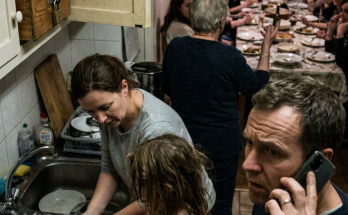
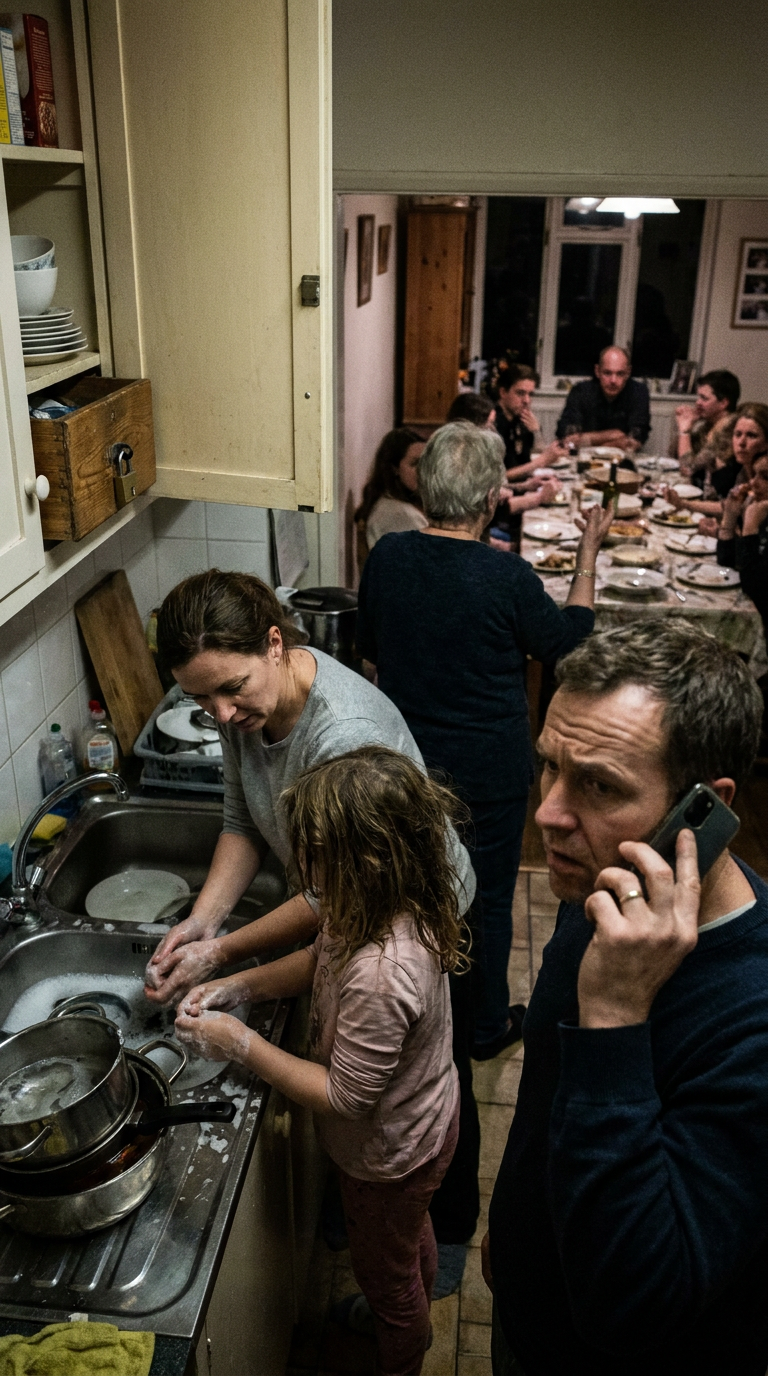
My wife, Emily, was standing at the kitchen sink, her shoulders slumped, her hair pulled into a messy bun. Her hands were red and swollen, and she kept wincing whenever she reached into the hot, soapy water.
Beside her stood our five-year-old daughter, Lily.
My little girl was wearing the pink dress I’d bought her for her birthday. The dress was now soaked at the bottom, stained with grease, and covered in little white streaks of dish soap.
Her tiny hands were submerged in the sink.
She was crying silently.
Not the loud, dramatic crying children sometimes do when they’re upset.
This was different.
She was trying desperately not to make a sound.
And standing behind them was my mother, Patricia.
She wore her favorite pearl necklace and a perfectly pressed blue blouse. In one hand, she held a glass of iced tea. In the other, she held a kitchen towel she’d apparently been using to point at the dishes.
“Faster, Lily!” she snapped. “You have two hands. There’s no reason you should be taking this long.”
My daughter sniffled.
“But Grandma, my fingers hurt.”
“Then stop complaining and finish.”
My mother turned toward Emily.
“And you need to teach your daughter some discipline. She’s becoming spoiled because you let her get away with everything.”
Emily lowered her head.
“I’m sorry, Patricia. I’ll finish the rest. Just please let Lily go sit down.”
My mother laughed.
“Absolutely not. If she wants to eat tonight, she needs to earn it.”
Behind them, through the dining room doorway, I could see twenty people sitting around my dining table.
My mother’s friends.
Her cousins.
Two women I’d never met.
A man laughing loudly while helping himself to another piece of roast chicken.
There were expensive bottles of wine on my table, flowers in my wife’s favorite vase, and enough food to feed an entire neighborhood.
And my wife and daughter were being threatened with no dinner.
In my own house.
I felt something inside me go cold.
I didn’t yell.
I didn’t storm into the kitchen.
I didn’t even announce that I was home.
Instead, I quietly set my suitcase beside the hallway wall, pulled out my phone, and dialed 911.
Because what I was witnessing wasn’t simply an argument between my wife and my mother.
It was something much worse.
And I had a terrible feeling that this wasn’t the first time it had happened.
Two days earlier, I’d been in Salt Lake City for a technology conference.
I work as a software systems architect, and the conference was supposed to last until Thursday evening. I’d planned to fly home Friday morning, surprising Emily and Lily with an extra day together.
But Wednesday afternoon, the conference organizers canceled the remaining sessions because of an unexpected venue problem.
My colleagues scrambled to rebook their flights.
I decided to rent a car and drive back to Phoenix.
It would take approximately ten hours, but I didn’t mind.
I wanted to see my family.
I’d been traveling frequently for work, and Emily had been handling almost everything at home while also working part-time as a graphic designer.
My mother had been staying with us for three weeks.
That arrangement was supposed to be temporary.
Patricia had recently sold her condominium and was waiting for renovations to finish on her new townhouse. I offered to let her stay in our guest room.
At first, everything seemed fine.
She helped Emily prepare dinner. She played with Lily. She even offered to watch our daughter when Emily needed to finish freelance projects.
But after the first week, the atmosphere began changing.
My mother started criticizing the way Emily cooked.
Then she criticized how Emily dressed Lily.
Then she complained that our daughter was too loud, too emotional, and too attached to her mother.
Whenever I called, Emily insisted everything was okay.
“Your mom is just adjusting,” she’d say.
“She’s been living alone for years. It’s difficult for her to share a house.”
I’d believed her.
Or perhaps I’d simply wanted to believe her.
Now, standing in my hallway, listening to my mother threaten my wife and daughter, I realized how badly I’d misunderstood the situation.
The dispatcher answered.
“911. What’s your emergency?”
I kept my voice low.
“I’m at my residence in Phoenix. I’m witnessing an adult threatening my wife and five-year-old daughter. My daughter is being forced to wash dishes in extremely hot water, and my wife’s hands appear injured. There are approximately twenty other adults in the house.”
“Are you in immediate danger?”
“I’m outside the kitchen. The person threatening them is my mother. I don’t want to escalate the situation before officers arrive.”
The dispatcher asked for my address.
I gave it to her.
Then she asked whether there were weapons.
“Not that I’m aware of.”
“Are you able to safely separate your daughter from the situation?”
I looked toward the kitchen.
My mother was now grabbing another plate from the counter.
“Not without confronting her.”
“Stay somewhere safe. Officers are being dispatched.”
I ended the call.
And then Lily said something that made my blood run colder than anything I’d heard so far.
“Daddy said Grandma wasn’t supposed to open the little drawer.”
I froze.
My daughter had never mentioned a drawer before.
My mother immediately turned around.
“Lily! Stop talking!”
But Lily had already looked toward the hallway.
And she saw me.
Her face changed.
“DADDY!”
She tried to run toward me, but my mother grabbed her wrist.
“Get back to the sink!”
That’s when I stepped into the kitchen.
“Take your hand off my daughter.”
My mother’s face went completely white.
PART 2: THE WOMAN I THOUGHT I KNEW
For a moment, nobody moved.
My mother stared at me as if I’d suddenly appeared out of thin air.
Then she recovered.
“Oh! Daniel! You’re home early!”
Her voice became cheerful.
Almost unnaturally cheerful.
She released Lily’s wrist and smiled.
“Sweetheart, your father is home. Why don’t you say hello?”
Lily didn’t move.
She stood beside the sink, her little shoulders shaking.
Emily turned around.
When she saw me, her expression crumpled.
Not because she was relieved.
Not immediately.
She looked terrified.
That frightened me more than my mother’s behavior.
“Daniel,” she whispered.
I crossed the kitchen.
“Are you okay?”
She tried to nod.
Then she looked down at her hands.
I saw the blisters.
Some were small.
Others were large enough that the skin around them had begun swelling.
I felt sick.
“What happened to your hands?”
Before Emily could answer, my mother interrupted.
“Oh, don’t exaggerate. She burned herself while cooking. She’s always been careless around hot water.”
I looked at the sink.
The water was still running.
Steam rose from the basin.
There were at least thirty dirty plates stacked beside it.
“Why is Lily washing dishes?”
My mother gave me an offended look.
“Because she made a mess earlier, and I believe children should learn responsibility.”
“She’s five.”
“Exactly. If you don’t teach them discipline when they’re young, they’ll become impossible later.”
I looked toward the dining room.
One of my mother’s friends had appeared in the doorway.
She was holding a wineglass.
“Patricia, is everything all right?”
My mother immediately smiled.
“Of course, Margaret! Daniel just surprised us.”
Margaret looked at me, then at Emily’s hands.
Her smile disappeared.
I turned toward my mother.
“Everyone needs to leave.”
Her expression hardened.
“Excuse me?”
“You heard me. The dinner is over. Everyone needs to leave my house.”
My mother laughed nervously.
“Daniel, don’t be ridiculous. These are my guests.”
“This is my house.”
“And I’m your mother!”
“That doesn’t make this your house.”
Her cheeks flushed.
“You are embarrassing me in front of my friends.”
I looked at the dining room.
Twenty people were now watching us.
Some appeared confused.
Others looked uncomfortable.
A few seemed annoyed that their dinner had been interrupted.
I wondered how many of them knew what had been happening in my kitchen.
Then my mother leaned closer and lowered her voice.
“You have no idea what your wife has been doing while you’ve been away.”
I stared at her.
“What?”
“She’s been disrespectful. She refuses to help me. She lets Lily run wild. I’ve had to manage this entire household because your wife is too lazy to do anything properly.”
Emily’s eyes filled with tears.
“Patricia, please.”
My mother turned toward her.
“Don’t interrupt me.”
That was enough.
I stepped between them.
“You’re not speaking to my wife like that anymore.”
My mother looked at me as if I’d slapped her.
Then she began crying.
Not quietly.
Loudly.
Dramatically.
“Oh, Daniel! After everything I’ve done for you! This is how you treat your own mother?”
Several guests began murmuring.
One woman shook her head.
My mother pointed toward Emily.
“She’s turned you against me!”
I didn’t answer.
I was watching Lily.
She had moved behind Emily and was clutching the back of her mother’s shirt.
Her eyes kept drifting toward a small wooden cabinet beneath the kitchen counter.
The cabinet had a tiny brass lock.
I recognized it immediately.
It was the drawer where Emily kept important household documents.
And where we’d placed something else months earlier.
Something my mother had never been allowed to touch.
“Mom,” I said quietly, “what did Lily mean about the little drawer?”
My mother’s crying stopped.
Just like that.
She stared at me.
Then she looked at the cabinet.
For the first time since I’d arrived, she appeared genuinely frightened.
And I knew that whatever was inside that drawer mattered far more than a stack of dirty dishes.
PART 3: THE LOCKED DRAWER
“There’s nothing in that drawer,” my mother said quickly.
I didn’t take my eyes off her.
“Then why are you afraid of it?”
“I’m not afraid!”
“Then you won’t mind if I open it.”
She stepped toward the cabinet.
“Daniel, don’t you dare!”
I moved between her and the drawer.
“Emily, do you have the key?”
My wife hesitated.
Then she nodded toward the small pocket of her apron.
My mother lunged.
“Give me that key!”
I caught her arm before she could reach Emily.
“Don’t.”
For a few seconds, we stood facing each other.
Then my mother pulled away.
“You ungrateful boy. I sacrificed everything for you!”
I had heard that sentence my entire adult life.
Whenever I disagreed with her, she reminded me of the sacrifices she’d made.
Whenever I set a boundary, she accused me of abandoning her.
Whenever I defended Emily, she claimed I’d forgotten who raised me.
But this time, something was different.
My daughter was watching me.
And I realized that if I allowed my mother to control this situation, Lily would remember it for the rest of her life.
I turned toward my wife.
“Open it.”
Emily’s hands trembled as she retrieved the key.
The little brass lock clicked.
Inside the drawer were several folders, a small digital recorder, and a thick envelope.
My mother stared at them.
Then she began shouting.
“Those are private documents! You have no right to look through them!”
I opened the envelope.
The first document was a printed email.
The second was a photograph.
The third was a handwritten list.
And suddenly, the pieces began falling into place.
The photograph showed my mother standing in our kitchen, holding Lily’s arm while Emily sat on the floor beside a fallen bowl.
The date on the photograph was three days earlier.
The email was from my mother to a woman named Margaret.
It read:
Emily is becoming a problem. She thinks she can make the rules in my son’s house. I’m going to show her that she needs to earn her place here.
I read it twice.
Then I looked at Emily.
“How long has this been happening?”
She started crying.
“Since you left.”
“Every day?”
She nodded.
My mother interrupted.
“That’s completely out of context!”
I pulled out the handwritten list.
It contained a schedule.
Breakfast preparation.
Laundry.
Bathroom cleaning.
Kitchen cleaning.
Cooking.
Dishwashing.
And at the bottom, in my mother’s handwriting, were two sentences.
No dinner until all chores are finished.
Lily must participate. She needs to learn that her mother isn’t a servant.
My stomach twisted.
I looked at the digital recorder.
“What is this?”
Emily wiped her face.
“I started recording after your mother threatened to throw Lily’s toys away. I wanted you to understand what was happening, but I was afraid you’d think I was exaggerating.”
I picked up the recorder.
My mother stepped backward.
“Don’t listen to that!”
I pressed play.
At first, there was the sound of running water.
Then my mother’s voice.
“Your husband isn’t here to protect you. So you should be grateful I’m allowing you to stay in this house.”
Emily’s voice followed.
“Patricia, this is Daniel’s house. He invited you to stay here.”
My mother laughed.
“Daniel is my son. Anything he owns is because I raised him. Don’t forget that.”
Then came Lily’s small voice.
“Grandma, can I have my dinner?”
My mother’s response was unmistakable.
“Not until your mother finishes cleaning.”
The recording continued.
Emily asked my mother to stop making Lily work.
My mother replied that if Emily couldn’t control her child, both of them would go hungry.
I stopped the recording.
The kitchen was silent.
Even the guests in the dining room had stopped talking.
My mother looked around desperately.
“She edited it! She made me sound horrible!”
But Margaret was staring at her.
So was everyone else.
Then a man near the dining room entrance spoke.
“Patricia, is that why you told us Emily was sick and couldn’t join dinner?”
My mother said nothing.
He continued.
“You said she was resting because she had a fever.”
Another guest added, “You told us your granddaughter was playing upstairs.”
My mother looked toward the dining room.
“Everyone, please. This is a family matter.”
I turned toward them.
“It stopped being a family matter when a five-year-old child was forced to work with burned hands while twenty adults ate dinner.”
Nobody answered.
Then the doorbell rang.
The police had arrived.
PART 4: TWENTY WITNESSES
Two officers entered through the front door.
One was a middle-aged woman with short dark hair. The other was a younger officer carrying a notepad.
“Who called 911?”
“I did,” I answered.
The female officer looked around.
“Can someone explain what’s happening?”
Before I could respond, my mother rushed forward.
“Officer, thank goodness you’re here! My son has come home and started threatening me. He’s having some kind of emotional episode.”
I stared at her.
She was still trying to control the story.
The female officer didn’t immediately react.
Instead, she looked at Emily.
“Ma’am, are you injured?”
Emily glanced at my mother.
That single glance told the officer more than any explanation could have.
“Let’s step over here,” she said gently.
Emily followed her.
The younger officer approached me.
“Sir, can you tell me what you witnessed?”
I explained everything.
The early return.
The threats.
The hot water.
The injuries.
The dishes.
The twenty guests.
Then I showed him the photographs, the handwritten chore schedule, and the recording.
My mother began protesting.
“Those are private conversations! You can’t use those against me!”
The officer calmly asked her to stop interrupting.
Meanwhile, the female officer examined Emily’s hands.
“These need medical attention.”
Then she crouched to Lily’s eye level.
“Sweetheart, can you tell me what happened?”
Lily looked at me.
I knelt beside her.
“It’s okay, baby. You can tell her the truth.”
My daughter swallowed.
“Grandma said Mommy was bad.”
The officer nodded.
“And what did Grandma say to you?”
“She said I had to wash all the plates.”
“Did you want to wash them?”
Lily shook her head.
“My fingers hurt.”
“Did you tell Grandma?”
“Yes.”
“What did she say?”
Lily’s chin trembled.
“She said if I stopped, Mommy and me couldn’t eat.”
The officer’s expression became serious.
She asked Lily whether she’d been hurt before.
My daughter hesitated.
Then she whispered something that made Emily cover her mouth.
“Grandma pinched me when I spilled milk.”
My mother immediately shouted.
“That’s a lie!”
The officer stood.
“Ma’am, I need you to remain quiet while I speak with the child.”
My mother looked at me.
“You see what she’s doing? She’s teaching Lily to hate me!”
I didn’t answer.
Because I was looking at the guests.
One by one, they began speaking.
Margaret admitted she’d heard my mother insulting Emily earlier that evening.
A man named Robert said he’d seen Lily carrying a stack of plates that afternoon.
Another woman admitted that my mother had joked about making Emily “work off her stay.”
Then someone said something unexpected.
“I saw Patricia take a key from the kitchen drawer yesterday.”
Everyone turned toward him.
It was a man I’d met only once.
My mother’s cousin, Thomas.
He looked uncomfortable.
“I didn’t know what it was for. But she was searching through paperwork and said she needed to find something before Daniel came home.”
I turned toward the cabinet.
The folders.
The recorder.
The envelope.
Suddenly, the locked drawer made sense.
My mother hadn’t simply wanted to hide evidence of her behavior.
She’d been searching for something.
Something she believed could give her control over my household.
The female officer asked me whether I knew what Thomas was talking about.
I looked at the open drawer.
Then at Emily.
She nodded slowly.
“It’s the house documents,” she whispered.
And my blood ran cold again.
PART 5: WHAT MY MOTHER REALLY WANTED
Six months earlier, Emily and I had updated our estate plan.
We’d purchased our Phoenix home seven years before, and we’d recently refinanced it.
During the process, our attorney recommended that we organize our important documents and update our emergency instructions.
We placed copies of the deed, insurance information, medical directives, and our wills in the locked kitchen drawer.
We also included a document that mattered enormously to us.
A signed statement naming Emily as the primary guardian of Lily if something happened to me.
My mother had never accepted that decision.
She believed that because she was Lily’s grandmother, she should automatically have authority over her.
She’d even joked that she’d raise Lily “properly” if Emily ever became unable to do so.
I’d dismissed those comments as ordinary family disagreements.
Now I wondered how much of her behavior had been building toward this moment.
The female officer asked whether my mother had access to the house.
“She has a guest-room key,” I answered. “But she doesn’t have permission to enter our office or access our documents.”
“Has she threatened your wife before?”
I looked at Emily.
She nodded.
“Several times.”
The officer asked her to explain.
Emily described the insults, the threats, the punishment, and the restrictions my mother had imposed while I was away.
She told the officer that my mother had taken her phone twice, claiming Emily needed to stop contacting me because she was “disturbing my work.”
She described how my mother had refused to let her leave the house with Lily unless the chores were completed.
She also explained that my mother had threatened to tell me Emily was an unfit parent.
My mother began crying again.
“This is absurd! I was helping them!”
But the officer didn’t look convinced.
“Ma’am, we are documenting these statements. A child has reported being physically hurt, and we’re concerned about the injuries we’re seeing.”
My mother turned toward the guests.
“Surely someone here understands that I was only trying to help!”
Nobody spoke.
Then Margaret slowly removed her coat from the back of a chair.
“Patricia, I think you should leave.”
My mother stared at her.
“You’re taking their side?”
Margaret looked at Lily.
“I’m taking the side of a five-year-old who shouldn’t have been washing dishes tonight.”
Thomas nodded.
“So am I.”
Another guest stood.
Then another.
Within minutes, the dining room began emptying.
Some guests apologized to Emily.
One woman even offered to drive her to the hospital.
My mother stood in the middle of the kitchen, watching the people she’d invited abandon her.
For the first time, she seemed to understand that she was losing control.
But she wasn’t finished.
She turned toward me.
“Daniel, if you let these people humiliate me, you’ll regret it.”
I looked at her.
“No, Mom. What I’ll regret is not listening when Emily tried to tell me something was wrong.”
Her expression hardened.
“You’re choosing her over me?”
“I’m choosing my wife and daughter.”
She stared at me for several seconds.
Then she whispered:
“After everything I did for you?”
I answered quietly.
“You don’t get to hurt my family and call it love.”
The officer asked my mother to step into the living room while they continued their investigation.
She refused at first.
Then the younger officer repeated the instruction.
Eventually, she walked away.
But as she passed Lily, she stopped.
“Remember who loved you first, sweetheart.”
Lily buried her face in Emily’s shoulder.
And that was when I realized something.
My daughter wasn’t simply afraid of my mother.
She believed she had done something wrong.
She believed she had to earn love by obeying.
And that was the most heartbreaking part of the entire evening.
PART 6: THE FIRST NIGHT OF FREEDOM
The officers stayed for nearly an hour.
They photographed Emily’s injuries, documented Lily’s statements, and collected the information about the recordings and photographs.
They advised us to seek medical care and explained the next steps for reporting the suspected mistreatment.
My mother was not arrested that night. The officers explained that the investigation would need to establish what had happened and determine what further action was appropriate.
But they made one thing clear.
She could no longer remain in our home that evening.
I watched her pack a small suitcase from the guest room.
She moved slowly, angrily, occasionally muttering about how everyone had betrayed her.
When she came downstairs, she stopped in front of me.
“You’ll call me tomorrow.”
I didn’t answer.
“You hear me, Daniel? You’ll call your mother.”
I looked at the woman who had raised me.
I remembered her making pancakes on Saturday mornings when I was little.
I remembered her sitting beside my bed when I had the flu.
I remembered the years I’d believed that everything she did was motivated by love.
But I also remembered the look on Lily’s face when she’d seen me standing in the hallway.
The fear.
The tears.
The desperate relief.
“Not tomorrow,” I said.
My mother stared at me.
“Then when?”
“When I’m ready to speak with someone who understands that loving a child doesn’t mean controlling everyone around them.”
Her mouth fell open.
Then she walked out.
The front door closed.
And for the first time in three weeks, our house was quiet.
Not the frightening silence that comes after an argument.
A peaceful silence.
Emily sat on the couch, holding Lily tightly.
I knelt in front of them.
“I’m sorry.”
Emily began crying.
“I tried to tell you.”
“I know.”
“I didn’t want to make you choose between us.”
I shook my head.
“You shouldn’t have had to.”
Then I took Lily’s little hands in mine.
Her fingers were red and swollen.
“Baby, I need you to listen to me.”
She looked at me.
“You never have to earn dinner in this house. You never have to work to deserve love. And nobody gets to hurt you because they think you’re not being obedient enough.”
Her lower lip trembled.
“Even Grandma?”
I swallowed.
“Even Grandma.”
She climbed into my arms.
Then she whispered the question that broke my heart.
“Daddy, am I still a good girl?”
I held her tighter.
“You’re my wonderful girl. You were wonderful before tonight, and you’ll be wonderful tomorrow.”
She began sobbing.
Not the silent crying I’d witnessed in the kitchen.
This time, she cried loudly, freely, and without trying to hide it.
And I held her until she finally fell asleep.
PART 7: THE LAST SECRET
The following morning, Emily and Lily went to the hospital.
Emily needed treatment for her burns.
Lily was examined by a pediatrician, who documented her condition and recommended follow-up support.
Later that afternoon, we met with our attorney.
I brought the photographs, recordings, and documents from the drawer.
Our attorney listened carefully.
Then she asked a question that neither of us had expected.
“Has your mother ever threatened to report your wife to child protective services?”
Emily looked at me.
I looked at her.
Then she nodded.
“She said it twice.”
The attorney asked us to explain.
Emily described how my mother had threatened to tell authorities that she neglected Lily and refused to provide proper meals.
She’d apparently believed that if she frightened Emily enough, she’d be able to force her out of the house.
Our attorney explained that we should preserve every piece of evidence and communicate with the appropriate authorities rather than trying to resolve the situation through confrontation.
Then she examined the documents from the locked drawer.
One item caught her attention.
A handwritten note tucked inside the envelope.
It wasn’t in my mother’s handwriting.
It was written by Emily.
The note was dated two weeks earlier.
It read:
Daniel, if you’re reading this, I couldn’t find the courage to tell you what has been happening.
Your mother keeps saying that I’m not good enough for you. She says Lily would be better off without me.
I know you love your mother, and I don’t want to destroy your relationship with her.
But I’m scared that one day Lily will believe everything she’s saying.
Please don’t let our daughter grow up thinking love is something she has to earn.
I couldn’t finish reading.
I lowered the paper.
Emily began crying.
“Why didn’t you show me this?”
“Because I was afraid.”
“Afraid of what?”
She looked at me.
“That you wouldn’t believe me.”
Those words hurt more than anything my mother had said.
Because Emily wasn’t afraid of a stranger.
She was afraid that her own husband might dismiss her suffering to protect his mother.
I reached for her hand.
“I’m sorry I made you feel alone.”
She nodded.
“I need you to understand something, Daniel. I don’t need you to hate your mother. I need you to protect our family when someone hurts us.”
“I understand.”
But she shook her head.
“No. I need you to show me.”
And she was right.
An apology wouldn’t erase what had happened.
I would have to prove that I understood by what I did next.
PART 8: THE HOUSE BELONGED TO US AGAIN
Three weeks later, my mother sent me a letter.
It was four pages long.
The first page described how humiliated she’d felt when the police arrived.
The second explained how much she’d sacrificed raising me.
The third accused Emily of manipulating me.
And the fourth ended with a sentence I’d heard throughout my childhood.
One day, when you have children of your own, you’ll understand what a mother deserves.
I read it once.
Then I put it away.
I didn’t respond.
Our attorney helped us formalize the boundaries we needed. We changed the locks, reviewed our security arrangements, and made sure my mother had no access to our home or private documents.
We also began family counseling.
Not because Emily had done anything wrong.
Because what happened had frightened all three of us, and we needed help rebuilding the sense of safety we’d lost.
Lily started sleeping through the night again.
At first, she refused to enter the kitchen.
She would stand in the doorway and ask whether Grandma was coming back.
I told her the truth.
“Grandma won’t be coming back to live here.”
“Ever?”
“Not unless Mommy and Daddy decide it’s safe, and we haven’t decided that.”
She thought about it.
Then she asked:
“Can I have pancakes?”
I smiled.
“Absolutely.”
That Saturday, we made pancakes together.
Lily stood on a small step stool, wearing her favorite yellow pajamas.
She poured the flour.
She cracked an egg.
She spilled some milk.
And when the batter splashed onto the counter, she froze.
Her eyes widened.
“Sorry, Daddy!”
I looked at the mess.
Then I looked at her.
“Do you know what we do when we make a mess?”
She shook her head.
“We clean it up together.”
I handed her a little cloth.
She smiled.
And for the first time in weeks, she laughed in our kitchen.
It was a small sound.
But to me, it was the most beautiful sound I’d ever heard.
EPILOGUE: THE PHONE CALL
Six months later, my mother called.
I almost ignored it.
But something made me answer.
“Daniel?”
“Yes.”
Her voice sounded tired.
“I want to see Lily.”
I didn’t answer immediately.
“Have you spoken to your counselor?”
“Yes.”
“Have you taken responsibility for what happened?”
Silence.
Then she said, “I made mistakes.”
I closed my eyes.
“Mom, you threatened a five-year-old with hunger. You hurt her mother. You tried to control our household and frighten Emily into leaving.”
“I know.”
“Do you understand why that was wrong?”
Another silence.
Then she whispered, “I thought I was helping.”
I took a breath.
“That’s not the same as understanding.”
She began crying.
“I miss my granddaughter.”
I believed her.
But missing Lily didn’t automatically make it safe for her to return.
I told my mother that any future contact would depend on accountability, professional guidance, and Emily’s agreement.
There would be no surprise visits.
No private access to Lily.
No threats.
No punishment disguised as discipline.
And no more pretending that being family made harmful behavior acceptable.
My mother didn’t agree with every condition.
But she listened.
We ended the call without making promises.
That evening, I sat beside Lily on the couch.
She was drawing a picture of our family.
Three people.
Me.
Emily.
And Lily.
Above our heads, she’d drawn a bright yellow sun.
I pointed to the picture.
“Who’s this?”
“That’s Mommy.”
“And this?”
“Daddy.”
“And who’s the little one?”
She giggled.
“That’s me!”
Then she added a fourth figure.
I looked at it carefully.
“Who’s that?”
She thought for a moment.
“That’s Grandma.”
My heart tightened.
“Do you miss Grandma?”
Lily nodded.
“Sometimes.”
“That’s okay, sweetheart.”
She looked up at me.
“Daddy?”
“Yes?”
“Will Grandma make Mommy wash dishes again?”
I took her little hand.
“No. Nobody will ever make Mommy or you do something that hurts you in this house.”
She smiled.
Then she returned to her drawing.
And I sat there thinking about the night I’d come home two days early.
The night twenty adults sat around my dining table while my wife and daughter suffered in the kitchen.
The night I discovered that silence can be mistaken for peace, and obedience can be mistaken for love.
I couldn’t change what had happened.
But I could change what happened next.
And I made myself one promise.
My daughter would never have to wonder whether she deserved kindness.
She would never have to earn her place at our table.
And she would never have to stay silent just to keep the family together.
Because the most important thing I’d learned that night wasn’t how to confront my mother.
It was that protecting your family sometimes means refusing to protect someone from the consequences of hurting them.