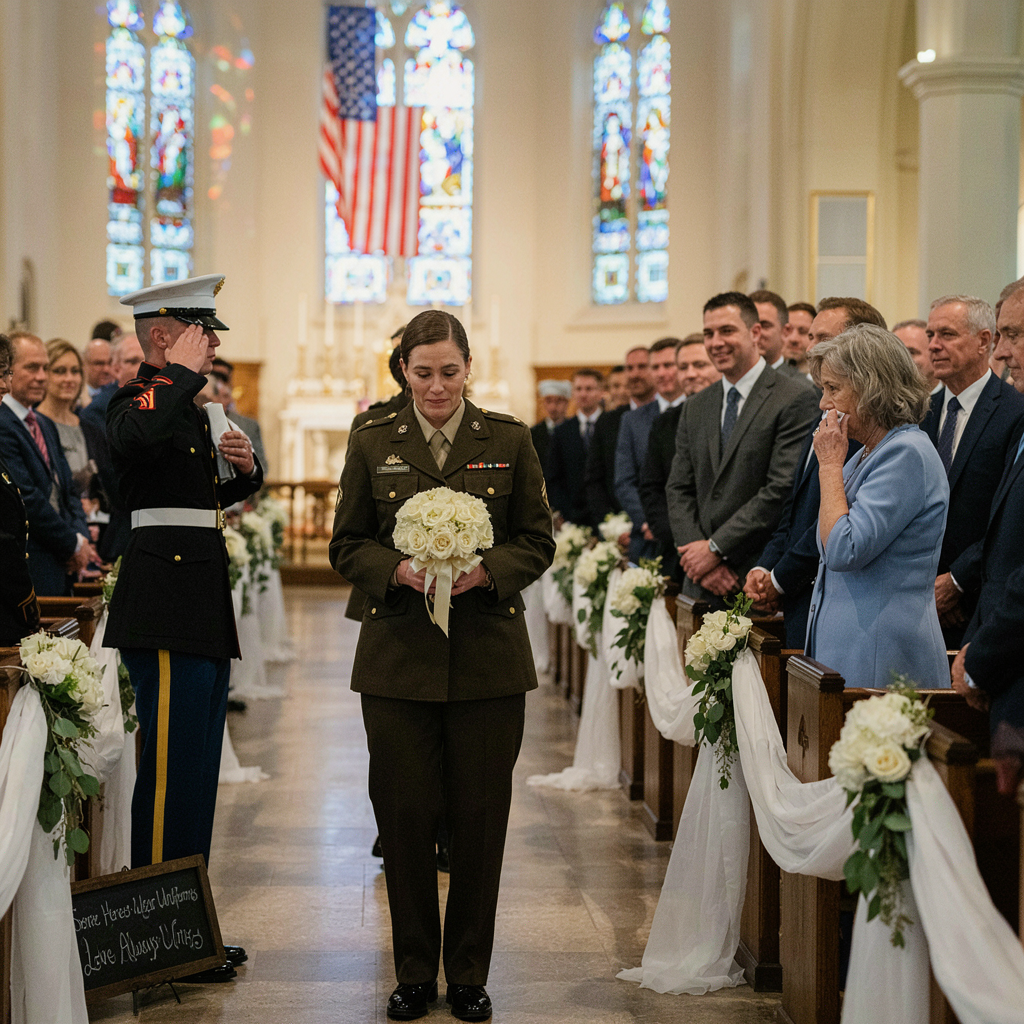
Four hundred and sixty-three of them.
Some were young enough that I could still see the uncertainty of their first deployment hiding behind their formal posture.
Others had gray in their hair.
A few stood with canes.
Several carried scars that no uniform could hide.
And every one of them was standing for me.
“GENERAL ON DECK!”
The words struck the chapel ceiling and rolled through the building like thunder.
Every Marine snapped to attention.
Every Marine except one.
Not exactly.
The man standing near the second pew was only half a second late.
Most people would never have noticed.
Sergeant Major Marcus Tanaka noticed.
So did I.
The man’s eyes had gone past me.
Straight toward my father.
Colonel Gabriel Mercer had served under me nearly fifteen years earlier.
I remembered him as a major with a broken nose, a dark sense of humor, and a stubborn refusal to leave a wounded Marine behind during a firefight that had lasted nearly seven hours.
Now silver touched his temples.
He wore his dress uniform, decorations aligned perfectly across his chest.
But when everyone else came to attention, Gabriel stared at my father as though he had just seen something he had hoped never to encounter outside an investigation.
Then his eyes met mine.
He saluted.
I returned it.
Beside me, Tanaka barely moved his lips.
“Ma’am, there’s something you need to know before the reception.”
My father heard him.
I knew he had because his hand tightened at his side.
He took one step toward us.
“Marcus.”
Tanaka turned his head.
My father had never served a day in uniform, yet he said Tanaka’s first name with the familiar authority of a man accustomed to believing that everyone could be bought, managed, impressed, or intimidated.
“This is Amelia’s wedding,” Dad said quietly. “Whatever business you think needs discussing can wait.”
Tanaka’s expression didn’t change.
“That depends on what you call business, sir.”
Dad’s face hardened.
Celeste appeared behind him.
She had followed us from the bridal room, apparently unable to accept that I had actually walked away from the wedding gown she and my father had tried to force onto me.
“What is going on?” she whispered.
Nobody answered her.
From the altar, Noah was watching me.
And suddenly the rest of the room disappeared.
My father disappeared.
Celeste disappeared.
The whispers vanished.
The years vanished.
There was only Noah.
He stood beneath the stained glass in a dark formal suit, his silver hair neatly combed, his hands clasped in front of him.
He wasn’t smiling broadly.
That wasn’t Noah.
His emotions had always lived in the smaller things.
The slight tightening around his eyes.
The way his shoulders lowered when he saw me.
The quiet breath he released as though he had been holding it since morning.
And the instant he saw my uniform, something warm moved across his face.
Pride.
Not pride in the stars.
Not pride in the medals.
Pride in me.
Exactly as I had arrived.
I looked at Tanaka.
“Later?”
He hesitated.
Then nodded.
“Later, ma’am.”
My father opened his mouth.
I didn’t let him speak.
“You made your choice in the hallway.”
His jaw tightened.
“Amelia—”
“You said you wouldn’t walk me down the aisle.”
I looked at the hundreds of Marines standing inside and outside the chapel.
“I think I’ll manage.”
For the first time that day, my father had no answer.
I linked my arm through Tanaka’s.
“Ready, Sergeant Major?”
His eyes glistened.
The man had survived explosions, firefights, emergency surgeries, and thirty-two years in the Marine Corps without letting me see him cry.
Now he blinked twice.
“Yes, ma’am.”
Then he glanced toward the altar.
“Though I should warn you, the groom looks terrified.”
Noah heard him.
“I’m standing right here, Marcus.”
Laughter rippled through the chapel.
The tension cracked.
I smiled.
And then we walked.
I had imagined that walk many times during the months before the wedding.
Sometimes I pictured Dad beside me.
Sometimes I pictured walking alone.
Never once had I imagined this.
As Tanaka and I moved down the aisle, faces emerged from my past.
Captain Lena Ortiz.
She had been a nineteen-year-old lance corporal when I first met her.
Now she commanded Marines of her own.
Master Sergeant Paul Dwyer stood three rows back. His left leg had been replaced by a prosthetic after an explosion outside Sangin. He grinned when I recognized him.
Colonel Samuel Greene.
Major Priya Desai.
Gunnery Sergeant Lopez.
Families.
Widows.
Husbands.
Children.
People whose names I knew.
People whose names I didn’t.
Halfway down the aisle, I saw a woman pressing a handkerchief against her mouth.
Evelyn Briggs.
Owen’s mother.
My feet nearly stopped.
Owen Briggs had been one of mine.
Not by blood.
But that distinction had never mattered much to Marines.
He had survived two deployments.
He had survived an explosion that killed the man beside him.
He had survived months of rehabilitation.
Then he came home and discovered that survival did not automatically mean peace.
He called me once at two in the morning.
I talked to him until sunrise.
Three weeks later, he died by suicide.
For years afterward, I wondered which sentence I had failed to say.
Which silence I had misunderstood.
Which question I should have asked.
Havenline had begun because I could not bring Owen back.
So I tried to build something that might help bring someone else home.
When Evelyn saw me looking at her, she touched two fingers to her heart.
I returned the gesture.
Then I kept walking.
At the altar, Tanaka placed my hand in Noah’s.
He leaned closer.
“I was supposed to say something intimidating.”
Noah nodded solemnly.
“I assumed.”
Tanaka looked at him.
“If you break her heart, approximately four hundred Marines know where you live.”
More laughter spread through the chapel.
Noah glanced at the crowd.
“Only four hundred?”
“Some are still parking.”
That finally made me laugh.
Tanaka stepped away.
Noah squeezed my hand.
“You came in uniform.”
“I told you I would.”
“I know.”
His thumb moved gently across my knuckles.
“You look beautiful.”
Behind me, somewhere in the first few rows, I heard Celeste shift in her seat.
I didn’t look back.
The chaplain began.
I heard perhaps half of the opening words.
The other half dissolved beneath the realization of what was happening.
At fifty-two years old, after three decades of being told that sacrifice had made me hard, leadership had made me intimidating, ambition had made me unfeminine, and authority had made me difficult to love, I was standing beside a man who had never once asked me to shrink.
Noah had never asked me to speak more softly so another man could feel taller.
He had never asked me to hide my scars.
He had never made jokes about my rank.
He had never acted threatened when a room changed because I entered it.
He had simply learned me.
The real me.
The woman who woke from certain dreams and sat quietly at the edge of the bed until sunrise.
The woman who kept every letter from a Marine’s mother.
The woman who sometimes stood in grocery-store aisles staring at cereal because after making decisions involving thousands of lives, choosing breakfast felt strangely exhausting.
The woman who loved terrible old detective movies.
The woman who cried every year on Owen Briggs’s birthday.
The woman underneath the uniform.
And the woman inside it.
When it came time for our vows, Noah unfolded a small sheet of paper.
His hands were trembling.
That surprised me.
Noah had briefed rooms full of senior officials without raising his pulse.
But now his voice caught on the first sentence.
“I had something polished written.”
I smiled.
“That sounds dangerous.”
A few people chuckled.
He looked down at the page.
Then he folded it again.
“I don’t want polished.”
He placed the paper in his pocket.
“I want true.”
The chapel became completely silent.
“Amelia, most people know what you’ve done. They know your rank. They know your career. They know the citations, headlines, speeches and photographs. They know General Hart.”
His fingers tightened around mine.
“But I know the woman who keeps dog treats in her car even though we don’t own a dog.”
I heard Tanaka cough suspiciously to hide a laugh.
“I know the woman who pretends not to like romantic comedies and then gets angry when the ending isn’t happy enough. I know the woman who once drove forty miles because one of her former Marines had called and sounded lonely.”
My eyes burned.
“And I know what it costs you to be strong all the time.”
That sentence found the part of me I had spent thirty-one years protecting.
Noah’s voice softened.
“So I will never ask you to be less strong.”
He paused.
“But when you’re tired, I promise you won’t have to be strong alone.”
I blinked quickly.
Behind Noah, Colonel Mercer looked down.
Evelyn Briggs was openly crying.
Noah continued.
“I will never ask you to make yourself smaller so I can feel bigger.”
His eyes flicked, just briefly, toward my family.
Then back to me.
“I will never confuse loving you with owning you. I will stand beside you when the world is watching and when nobody is. I will tell you the truth when it’s difficult. I will listen when you need silence. And whatever comes through that door tomorrow, or ten years from now, I choose you.”
His voice broke.
“All of you.”
I had spent my life giving orders.
For several seconds, I couldn’t find words.
Then I laughed quietly through tears.
“That was extremely unfair.”
He smiled.
“You outrank me. Recover.”
The room laughed again.
I took a breath.
I hadn’t written my vows down.
I knew what I needed to say.
“Noah, when I was younger, I believed love was something you earned by becoming impressive enough.”
My voice sounded steadier than I felt.
“I thought if I worked harder, served better, accomplished more, eventually the people I loved would decide I was worthy of being proud of.”
The room behind me became very still.
I didn’t turn around.
“It took me a long time to understand that love requiring you to erase yourself is not love.”
Noah’s eyes filled.
“You were the first person in my life who never asked me to choose between being loved and being myself.”
I reached for his other hand.
“So I promise to give you the same freedom.”
I smiled through tears.
“I promise to love the brilliant, infuriating man who leaves coffee mugs everywhere except the dishwasher.”
“That seems exaggerated.”
“It is not.”
More laughter.
“I promise to argue fairly. To forgive honestly. To tell you when I’m afraid instead of disguising fear as irritation.”
Noah raised one eyebrow.
“That one is going to take practice.”
“Do you want to get married today or not?”
The chaplain laughed.
Noah nodded.
“Continue, General.”
I looked at him.
“And I promise that whatever title either of us carries outside our home, inside it we will be equals.”
His smile disappeared.
Something deeper replaced it.
“I choose you, Noah.”
I swallowed.
“All of you.”
When we exchanged rings, my hands stopped trembling.
When the chaplain pronounced us married, Noah kissed me.
And somewhere behind us, one Marine started applauding before the chaplain had technically finished speaking.
Then four hundred and sixty-two others joined him.
The chapel erupted.
Not dignified applause.
Not restrained ceremony.
Marines shouted.
Someone whistled.
Tanaka yelled something that I would not repeat in a chapel.
Noah pulled away from me laughing.
I laughed too.
And for several seconds, I forgot there was anything waiting beyond those doors except our future.
Then I saw Colonel Mercer.
He was not smiling.
Neither was Tanaka.
My father had already left his seat.
The reception was being held in a historic officers’ club less than ten minutes away.
Guests moved between the chapel and reception grounds while Noah and I remained behind for photographs.
I wanted one photograph with every Marine who had come.
The photographer nearly fainted when I told him.
“That’s four hundred and sixty-three people, General.”
“I can count.”
“We’ll lose the light.”
Tanaka stepped beside him.
“Son, she has coordinated aircraft, artillery, infantry and logistics simultaneously. I suggest you find a wider lens.”
The photographer found a wider lens.
We took the photograph on the chapel steps.
I stood in the center with Noah.
Hundreds of Marines spread behind us.
Some were active duty.
Some retired.
Some were veterans who had put their uniforms back on for the first time in years.
Several families stood among them.
Evelyn Briggs was beside Tanaka.
Afterward, she hugged me.
Not the polite kind of hug people give at formal events.
She wrapped both arms around me and held on.
“You built something beautiful because you couldn’t save my boy,” she whispered.
I closed my eyes.
“I’m sorry.”
“Stop apologizing for Owen.”
Her voice sharpened.
I opened my eyes.
She was crying.
“So many people tried to save him.”
She touched my cheek.
“You were one of them.”
I couldn’t speak.
Evelyn continued.
“My younger son called Havenline two years ago.”
That stunned me.
“What?”
“He was in a bad place. Worse than I realized.”
She smiled through her tears.
“The person who answered stayed with him until we got there.”
My throat tightened.
“He’s alive, Amelia.”
I covered my mouth.
Evelyn squeezed my shoulders.
“You couldn’t save both of my sons.”
Her eyes held mine.
“But what you built helped save one.”
For the first time in years, hearing Owen’s name did not feel only like failure.
It still hurt.
Perhaps it always would.
But grief shifted slightly inside me.
Not gone.
Never gone.
Just no longer carrying the entire weight of the story.
Evelyn kissed my cheek.
“That’s what those stars mean to me.”
She glanced toward Celeste, who stood several yards away watching.
“Not that they make you important.”
Evelyn looked back at me.
“That you used what you became to make somebody else feel less alone.”
Then she walked away.
I stood frozen.
Noah slipped his hand into mine.
For a moment neither of us said anything.
Finally he whispered, “You okay?”
“No.”
He nodded.
“That was my guess.”
I leaned against him.
“But I think I might be.”
He kissed my temple.
Then I remembered Tanaka’s warning.
I looked across the lawn.
Colonel Mercer was speaking quietly with him.
My father stood twenty feet away pretending not to watch.
Celeste was beside him.
She looked furious.
Dad looked afraid.
That frightened me more.
My father, Richard Hart, did not frighten easily.
He had built Hartwell Defense from a small manufacturing company into a massive federal contractor.
He had stared down boards, competitors, lawsuits and market collapses.
I had watched senators, executives and generals treat him with the careful politeness powerful people receive.
Growing up, I thought confidence was something he had in unlimited supply.
Later I learned that some men only appear fearless while they control the room.
Take away control and you discover what was underneath.
Dad was watching Colonel Mercer like a man standing beside a door he desperately needed to keep closed.
I turned to Noah.
“I need five minutes.”
“I’m coming.”
“Noah—”
“We’ve been married twenty-two minutes.”
He glanced at his watch.
“Too early for separate finances and secret meetings.”
Despite everything, I smiled.
“Fine.”
We approached Tanaka and Mercer.
Mercer came to attention.
“At ease, Gabe.”
He relaxed.
“Congratulations, ma’am.”
“Thank you.”
I looked between them.
“What’s going on?”
Mercer glanced toward my father.
“Not here.”
“That’s exactly what Dad said.”
Mercer’s mouth tightened.
“Yes, ma’am.”
“Which is why we’re discussing it here.”
Tanaka almost smiled.
Mercer lowered his voice.
“I’m assigned to an acquisition integrity review involving Hartwell Defense.”
For several seconds, the words seemed ordinary.
Then their meaning arrived.
I looked toward my father.
He was still watching.
“What kind of review?”
Mercer hesitated.
“One involving Havenline.”
Noah became completely still.
My pulse changed.
“What does my organization have to do with Hartwell Defense?”
“That’s what we’ve been trying to establish.”
I stared at him.
Mercer continued.
“Eight months ago, Hartwell submitted material supporting a proposed behavioral-readiness and crisis-response technology contract.”
I said nothing.
“The proposal repeatedly references Havenline.”
My stomach tightened.
“How?”
“As a strategic clinical partner.”
I stared at him.
“We aren’t.”
“I know.”
“No. I mean we have never discussed becoming one.”
“I know that too.”
A cold sensation moved through my chest.
Mercer opened a slim leather portfolio.
Inside was a photocopied document.
He held it out.
I recognized the Havenline logo instantly.
Below it was a letter.
To whom it may concern…
I read three sentences.
Then stopped.
The letter stated that Havenline had agreed to participate in a Hartwell Defense pilot program that would integrate crisis-support data with a military-readiness platform.
It described access to anonymized historical information.
It described a future data-sharing framework.
It described my personal support.
At the bottom was my name.
General Amelia Hart.
Founder, Havenline.
And beneath it—
My signature.
A near-perfect copy.
Except I had never signed it.
I looked at Mercer.
“This is forged.”
“Yes, ma’am.”
I looked at Noah.
His face had changed.
Not shocked.
Angry.
Very angry.
“You knew something.”
He took a breath.
“I knew there was a cybersecurity inquiry.”
“How long?”
“Forty-eight hours.”
My jaw tightened.
“And you didn’t tell me?”
“I was told there might be a legitimate explanation.”
“That did not answer my question.”
His eyes stayed on mine.
“Forty-eight hours.”
“Why?”
“Because yesterday morning, all anyone had was an irregular document and an access log nobody understood. By last night, there was more.”
“What more?”
Mercer answered.
“Someone inside Hartwell attempted to authenticate the agreement using an old digital certificate from a Havenline grant application.”
For the first time all afternoon, I felt physically sick.
“How did they have it?”
“We don’t know yet.”
Noah looked toward my father.
“But somebody did.”
I turned back to Mercer.
“Does Havenline data appear to have been accessed?”
“We have no evidence that raw crisis-call records were transferred.”
Relief hit me hard enough to make my knees weak.
He continued immediately.
“But there was unauthorized access to administrative systems.”
My relief vanished.
“What kind?”
“Donor information. Program metrics. Internal presentations. Strategic projections. Nothing we’ve seen indicates counseling transcripts or caller identities were taken.”
I closed my eyes briefly.
Havenline existed because people trusted us during some of the most vulnerable minutes of their lives.
The thought that my father’s company might have tried to use that trust as a business asset made rage rise slowly through me.
Not explosive rage.
Something colder.
Something far more dangerous.
“When did you notify Hartwell?”
“This morning.”
I opened my eyes.
That explained my father’s face.
“What time?”
“Approximately 0900.”
My wedding ceremony had been scheduled for three in the afternoon.
At 9:00 a.m., my father learned his company was under investigation.
At 2:30, he texted me:
Senators and Hartwell Defense partners are attending. Do not embarrass this family in a work costume.
Suddenly those words looked different.
I looked at Mercer.
“What was supposed to happen at the reception?”
He exchanged a glance with Tanaka.
That was enough.
“Tell me.”
Mercer removed another page.
It was a draft press release.
The headline made my chest go cold.
HARTWELL DEFENSE AND HAVENLINE ANNOUNCE LANDMARK MILITARY FAMILY RESILIENCE INITIATIVE.
The release was scheduled for distribution that evening.
There were quotes from my father.
Quotes from Hartwell executives.
And a quote attributed to me.
I read it twice.
The woman quoted on that page sounded grateful.
Proud.
Deeply honored to bring the organization she had founded into partnership with her father’s company.
A touching story of family, patriotism and shared service.
There was even a sentence about how my wedding represented the “joining of personal and professional legacies.”
I handed the paper back.
“Who approved this?”
Mercer’s voice was quiet.
“Your father’s communications office.”
I looked across the lawn.
Celeste had worked with that office for years.
She ran much of the Hartwell Foundation’s public-relations strategy.
Suddenly I remembered the garment bag.
The white wedding dress.
Dad’s obsession with lawmakers and Hartwell partners attending.
The insistence that I not wear my uniform.
And it clicked.
He did not want General Amelia Hart standing beside Hartwell’s announcement.
That would have raised questions about government endorsement.
Ethics.
Official capacity.
The appearance of influence.
He wanted his daughter.
Not the general.
The family story.
The decorated daughter in a white dress beside her wealthy father.
A photograph soft enough to become advertising.
My wedding had not merely been something he wanted to control.
He had intended to use it.
I looked at Tanaka.
“Is that why everyone is here?”
His face softened.
“No, ma’am.”
I frowned.
He glanced toward the Marines.
“Celeste’s post got circulated.”
I looked at him.
“What?”
“The picture she posted making fun of your uniform.”
Celeste had uploaded it three days earlier.
A photograph of me during a fitting.
Her caption had read:
Some women dream about wedding gowns. My sister apparently dreams about bringing the office to the altar.
I had replied only:
I will be married as myself.
Then I turned off my phone.
Tanaka continued.
“One of your former aides saw it.”
“Oh no.”
“Oh yes.”
I rubbed my forehead.
“He sent it to another Marine. That Marine sent it to three more. Somebody created a group chat.”
“How many people were in it?”
“Initially?”
“Yes.”
“About eight hundred.”
I stared at him.
Noah covered his mouth.
“Why are you smiling?”
“I’m not.”
“You are absolutely smiling.”
Tanaka continued.
“People started sharing stories about you.”
My irritation faded.
“What stories?”
He nodded toward the crowd.
“Ask them.”
I looked over my shoulder.
Four hundred and sixty-three Marines.
“They came because of a Facebook post?”
“No.”
Tanaka’s voice changed.
“They came because at some point in their lives, you showed up for them.”
I couldn’t answer.
He gestured toward a young captain near the chapel.
“Her husband died three years ago. Havenline helped her through the first month.”
Another man.
“You personally called his mother when he was wounded.”
Another.
“You stayed overnight at Walter Reed because his wife couldn’t get a flight until morning.”
Another.
“You recommended her for officer training when her own chain of command told her she wasn’t ready.”
Another.
“You testified so his unit received better protective equipment.”
He looked back at me.
“They didn’t come for four stars, Amelia.”
He almost never used my first name while I was in uniform.
“They came because when their lives were falling apart, you remembered they were human beings.”
I felt my throat tighten.
“And because they heard somebody was trying to make you ashamed of the uniform you spent thirty-one years earning.”
Noah squeezed my hand.
Tanaka cleared his throat.
“Marines can be somewhat dramatic when properly motivated.”
I laughed shakily.
Mercer looked toward my father.
“The investigation is separate from all that.”
My smile disappeared.
“How much trouble is he in?”
“I can’t responsibly answer that yet.”
“Fair.”
“But the submission has already been referred for further review.”
“And the contract?”
“Frozen.”
I nodded.
My father saw the motion.
He started walking toward us.
Celeste followed.
“No,” Dad said before he even reached us.
Mercer straightened.
Dad ignored him.
“Amelia, you are not discussing private company matters with guests at your wedding.”
I looked at him.
“This isn’t private company business.”
His eyes flicked toward the documents.
“Gabriel has misunderstood the situation.”
Mercer’s expression hardened.
“With respect, Mr. Hart, I have not offered General Hart any conclusions beyond the documented facts.”
Dad turned to him.
“I know exactly how these reviews work. One bureaucrat sees something he doesn’t understand, invents a conspiracy, and suddenly everyone panics.”
“Dad.”
He looked at me.
“Did you submit an agreement claiming Havenline was partnering with Hartwell?”
His jaw moved.
“It was preliminary.”
“That wasn’t my question.”
“We had been discussing opportunities.”
“No.”
His voice rose.
“Yes, we had.”
“You mentioned a veterans initiative over Christmas dinner.”
“That was the beginning of a discussion.”
“I said Havenline does not partner with defense contractors.”
“You said you had concerns.”
“I said no.”
Celeste stepped forward.
“This is not the place.”
I turned toward her.
“Were you involved?”
Her mouth opened.
Closed.
That hesitation hurt more than an immediate lie would have.
“Celeste.”
“I handle communications.”
“That wasn’t my question.”
She looked at Dad.
Dad answered for her.
“The communications department prepared ordinary draft materials. Nothing was final.”
I took the forged letter from Mercer.
I held it up.
“My signature looks fairly final.”
Dad’s face tightened.
“That was produced for planning purposes.”
“You forged my signature for planning purposes?”
“Keep your voice down.”
The command was automatic.
The same command he had given me as a child when I challenged him at dinner.
The same tone he used whenever truth became inconvenient.
I looked around.
People had begun watching.
Fine.
Let them.
For once, I wasn’t going to protect him from the consequences of his own behavior.
“Who copied my signature?”
Dad lowered his voice.
“Amelia.”
“Who?”
Celeste suddenly said, “I did.”
Everything inside me stopped.
Dad spun toward her.
“Celeste.”
She looked terrified.
Not of me.
Of him.
“I prepared the file.”
My sister’s voice trembled.
“I thought she had agreed.”
I stared at her.
“You thought I had agreed to something after I said no?”
“Dad told me you had reconsidered.”
“Celeste.”
Dad’s voice was a warning.
She turned on him.
“You did.”
Several people nearby had fallen silent.
Dad’s face became almost purple.
“I told you we were still negotiating.”
“No.”
Celeste shook her head.
“You said Amelia had approved the pilot but didn’t want to deal with paperwork until after the wedding.”
I felt an old, familiar fracture open inside me.
Different year.
Different betrayal.
Same sister.
Same father.
“You copied my signature.”
Celeste’s eyes filled.
“Yes.”
“From where?”
She looked down.
“An old foundation document.”
Noah swore quietly.
I turned away for a moment.
Not because I was weak.
Because I knew myself well enough to recognize the point where anger could become cruelty.
I had spent thirty-one years learning that leadership was often the distance between what you felt and what you chose to do with it.
When I turned back, my voice was level.
“Did you access Havenline’s system?”
“No.”
She answered immediately.
“I swear.”
“Did you ask anyone else to?”
“No.”
“Did you prepare the press release?”
Her silence answered.
“Did you write the quote attributed to me?”
She began crying.
“Yes.”
Dad stepped between us.
“That is enough.”
I looked at him.
“No.”
He stared at me.
“No?”
“No.”
One word.
Quiet.
Absolute.
The kind of word I had delivered in command posts where hesitation could cost lives.
Dad recognized it.
For the first time, I saw uncertainty in his eyes.
“You don’t get to decide when this conversation ends.”
His face changed.
“You seem to have forgotten who you’re speaking to.”
For several seconds, I simply looked at him.
Then Tanaka laughed.
It wasn’t a loud laugh.
More of a disbelieving breath.
Dad glared at him.
“What exactly is funny?”
Tanaka shook his head.
“Nothing, sir.”
“You clearly find something amusing.”
Tanaka looked at me.
I gave him the smallest nod.
He turned back to my father.
“I just spent thirty years watching colonels, generals, ambassadors and cabinet officials choose their words carefully around this woman.”
His eyes moved over Dad.
“And somehow you still think she’s twelve.”
Dad’s nostrils flared.
“This is a family matter.”
“No,” I said.
“It stopped being a family matter when you put my signature on government procurement documents.”
That sentence traveled.
People nearby heard it.
Then people behind them.
I watched whispers move through the reception lawn.
Hartwell executives started looking at one another.
One man immediately took out his phone.
Dad saw it too.
Panic flickered across his face.
He leaned toward me.
“You are going to destroy everything I built because you’re angry about a piece of paper?”
There it was.
Everything he had ever believed about himself.
Everything he had built mattered.
Everything I had built was apparently paper.
“Havenline is not a piece of paper.”
“You know what I mean.”
“No. I don’t think you know what you mean.”
He dragged a hand across his face.
“I spent forty years building Hartwell.”
“And I spent thirty-one years building trust.”
His mouth tightened.
“You think those Marines care whether some preliminary document had the correct signature?”
I stared at him.
“They care whether the people asking them to trust us are telling the truth.”
“This is business.”
“No.”
I stepped closer.
“This is exactly why you never understood what I do.”
He scoffed.
“Oh, spare me.”
I kept my voice low.
“I have signed letters to mothers explaining that their sons died under my command.”
His face changed.
“I have sat beside hospital beds where nineteen-year-olds asked me whether they would ever walk again.”
I could feel people listening now.
I didn’t care.
“I have called wives at three in the morning.”
My voice began to shake.
“I have memorized the names of dead Marines because I was terrified that if I forgot even one, some part of them would disappear.”
Dad looked away.
“And when I created Havenline, people trusted us with things they could barely say out loud to their own families.”
I lifted the forged document.
“You looked at all of that and saw a business opportunity.”
“That is not fair.”
“No?”
“No.”
His voice finally cracked.
“I was trying to build something bigger.”
“You were trying to use my name.”
“I am your father!”
The words exploded across the lawn.
Everything stopped.
Conversations.
Glasses.
Music.
People turned.
Dad realized too late how loudly he had shouted.
He lowered his voice.
“I am your father.”
I nodded.
“Yes.”
“And apparently you believe that means you own whatever your daughter becomes.”
His face hardened.
“Everything you had growing up came from me.”
There it was.
The invoice.
The bill he had been saving for fifty-two years.
The house.
School.
Vacations.
Food.
College.
Everything a parent gave a child, transformed into debt when that child stopped obeying.
“You’re right.”
That surprised him.
“You gave me opportunities.”
I nodded.
“You paid tuition. You put a roof over my head. You gave me advantages millions of children never receive.”
His shoulders shifted, triumphant too early.
“And I am grateful for those things.”
Then I stepped closer.
“But gratitude is not ownership.”
His expression changed.
“You don’t get my signature because you paid my college tuition.”
Silence.
“You don’t get Havenline because you bought my first car.”
I felt tears burn behind my eyes but did not let them fall.
“And you do not get to spend the rest of my life collecting obedience as interest on the fact that you raised me.”
Celeste covered her mouth.
Noah moved closer to my side.
Dad stared at me.
Then his expression hardened into something I knew very well.
Contempt.
“You always were dramatic.”
A strange calm entered me.
Maybe because I had finally heard enough.
Maybe because I had spent decades waiting for him to say something that would explain why I was never enough.
Instead he kept proving the answer had never been inside me.
I looked down at my uniform.
My ribbons.
My stars.
Then back at him.
“You called this a costume.”
He said nothing.
“You told me I would embarrass you.”
“Not everything has to become a speech, Amelia.”
“But now you intended to use this same career to sell your company.”
His eyes shifted.
That was the answer.
I almost smiled.
“You wanted the hero daughter.”
I touched one of the stars on my shoulder.
“You just didn’t want the general visible in the photograph.”
His silence became confession.
Noah inhaled sharply.
Celeste whispered, “Dad?”
He looked at her.
She suddenly understood too.
The white dress.
The photographs.
The carefully selected guests.
The proposed announcement.
Everything.
“You told me it was because the uniform was inappropriate,” she said.
Dad looked irritated.
“Celeste, not now.”
“You said people would think she was making the wedding about her rank.”
“Enough.”
“But you needed her out of uniform for the press release.”
His face darkened.
“I said enough.”
Celeste flinched.
For decades, I had watched my sister become whatever Dad required.
Polished.
Agreeable.
Socially perfect.
I used to resent her for it.
Standing there, I suddenly saw something else.
Celeste had not escaped our father’s control.
She had adapted to it.
My rebellion had been leaving.
Hers had never happened.
And because it hadn’t, she had spent years helping him hurt me.
Understanding that did not erase responsibility.
But it changed the shape of my anger.
Celeste stared at Dad.
“You knew the signature wasn’t legitimate.”
He didn’t answer.
“You knew.”
His eyes went cold.
“Do not pretend innocence now.”
She physically recoiled.
Dad continued.
“You prepared the document.”
Her face drained.
“You told me—”
“I told you to prepare materials.”
“No.”
“You are a forty-eight-year-old woman, Celeste. If you believed something was improper, you should have refused.”
The cruelty of it was almost elegant.
He had used her.
Now, surrounded by witnesses, he was preparing to sacrifice her.
Celeste understood.
I watched the realization arrive slowly.
All those years defending him.
All those years choosing his approval over her sister.
All those years shaping herself into the daughter he wanted.
And the moment he needed protection, she became disposable.
“Dad,” she whispered.
He looked away.
Colonel Mercer spoke.
“Ms. Hart.”
Celeste looked toward him.
“If you have documents relevant to the submission, preserve them.”
Dad spun around.
“She will do no such thing without company counsel.”
Mercer remained calm.
“I’m not instructing her to answer questions. I’m telling her not to destroy potentially relevant records.”
“Get away from my daughter.”
Celeste laughed.
It sounded broken.
“Your daughter?”
Dad looked at her.
She wiped her face.
“Five minutes ago, you were throwing me under a bus.”
“Celeste.”
“No.”
The word came out quietly.
I recognized it.
My word.
Perhaps hers too now.
Dad’s expression changed.
“What did you say?”
“I said no.”
She inhaled shakily.
Then looked at me.
“There’s something else.”
I felt tired suddenly.
Bone tired.
“What?”
Celeste’s face crumpled.
“I need to tell you something.”
Dad’s eyes widened.
“Celeste.”
She ignored him.
“When you were twenty-two…”
My heartbeat slowed.
No.
Some part of me already knew.
“You said your officer candidate selection letter disappeared.”
I stared at her.
The entire reception lawn vanished.
I could smell our childhood house.
The lemon furniture polish our mother used.
The old brass mailbox beside the front gate.
I could see myself at twenty-two, checking that mailbox every afternoon.
Waiting.
Hoping.
Trying not to let anyone know how much I wanted that envelope.
When it never came, I had assumed I had not been selected.
Months later I called to ask whether I could reapply.
The woman on the phone was confused.
According to their records, I had been selected.
Notification had been mailed.
I confronted my family.
Celeste swore she had never seen the letter.
Dad dismissed it as postal error.
I applied again.
The next year I left for Quantico.
Now my sister stood in front of me thirty years later.
Her lips trembled.
“I took it.”
Noah turned toward her.
Tanaka’s expression went flat.
My father closed his eyes.
I stared at Celeste.
“You what?”
“I took the letter.”
Her voice broke.
“It came on a Friday.”
I could hear my own breathing.
“I saw the return address.”
“Why?”
She started crying.
“Because Dad said if you joined the Marines, Mom would fall apart.”
My gaze moved toward him.
Dad said nothing.
Celeste continued.
“He said you were trying to humiliate the family.”
I could not feel my hands.
“He said you’d get yourself killed.”
Her tears fell faster.
“And he told me…”
She stopped.
“Tell me.”
“He told me if I really loved you, I would keep you from making the worst mistake of your life.”
Thirty years.
For thirty years, that missing envelope had remained one of those tiny unsolved mysteries people eventually stop discussing.
Now I knew.
My father had tried to stop my career before it started.
And my sister had helped him.
“What did you do with it?”
Celeste looked down.
“Threw it away.”
I closed my eyes.
For one terrible second, I was twenty-two again.
Young.
Uncertain.
Pretending the rejection didn’t hurt.
Pretending I had not spent nights imagining myself in uniform.
Pretending it was fine.
I remembered Dad telling me perhaps it was “a sign.”
I remembered Celeste telling me maybe I was meant to choose something more suitable.
I remembered nearly believing them.
If I had not made that phone call…
If I had not reapplied…
My entire life could have been different.
Tanaka.
Owen.
Havenline.
The Marines standing around me.
Perhaps none of it would have existed.
I opened my eyes.
Celeste was crying openly.
“I have wanted to tell you for years.”
“But you didn’t.”
“No.”
“Why?”
“Because every year that passed made it worse.”
I nodded.
“That’s usually how lies work.”
She winced.
“I know.”
“No, Celeste.”
My voice stayed calm.
“You’re beginning to know.”
Dad stepped forward.
“You cannot blame her for something she did at twenty.”
I looked at him.
“She was eighteen.”
“Exactly.”
“And you were forty-seven.”
That silenced him.
“You were her father.”
His eyes hardened.
“I was trying to protect you.”
“There is a difference between protection and control.”
“You were a child.”
“I was twenty-two.”
“You knew nothing about war.”
“Neither did you.”
That hit him.
His mouth opened.
Closed.
For thirty-one years, he had spoken as though my military career was some adolescent rebellion he had graciously tolerated.
Now we stood surrounded by the living evidence of what that career had become.
I looked at Celeste.
“I am not going to forgive you today.”
She nodded quickly.
“I understand.”
“Do you?”
“I think so.”
“No.”
I shook my head.
“I don’t want you saying what you think I want to hear anymore.”
She looked at me.
“That habit is part of how we got here.”
Her face folded.
I continued.
“You hurt me.”
“I know.”
“You mocked something you helped delay.”
She sobbed quietly.
“I know.”
“You put my signature on something I never approved.”
“Yes.”
“And today you tried to physically pull my uniform off me because Dad told you that being myself would embarrass him.”
She covered her mouth.
“Yes.”
I breathed slowly.
“I love you.”
She looked up.
She clearly had not expected that.
“But love does not erase consequences.”
Her eyes closed.
I continued.
“If you want a relationship with me after today, it will be built with truth.”
She nodded.
“No more managing me.”
Another nod.
“No more carrying messages from Dad.”
“Yes.”
“No more entering my life only to make me easier for this family to tolerate.”
Her shoulders shook.
“I understand.”
“And whatever happens with Hartwell, you tell the truth.”
She looked at our father.
Then back at me.
“I will.”
Dad laughed bitterly.
“You two are unbelievable.”
I turned to him.
He had lost control of both daughters in less than ten minutes.
And apparently that was the greatest betrayal imaginable.
“I built that company for this family.”
Celeste stared at him.
“No.”
Dad looked at her.
She wiped her face.
“You built it for yourself.”
His expression turned icy.
“Be very careful.”
Something in Celeste changed.
Maybe she finally heard the threat beneath every promise he had ever made.
Maybe she realized that pleasing him had never bought safety.
It had only postponed punishment.
“I have been careful my entire life.”
She swallowed.
“I’m tired.”
Dad looked at me.
“This is what you wanted.”
“No.”
“You always wanted to turn your sister against me.”
“I wanted my sister to stop helping you control me.”
“Same thing.”
“No.”
I shook my head.
“Not even close.”
The band had stopped playing.
Nearly everyone was watching us now.
This was exactly the kind of public embarrassment my father feared.
But no one was laughing at my uniform.
No one had ever been laughing at my uniform.
I finally understood that too.
The humiliation existed mostly inside him.
I looked toward the bandleader.
“Could you give us a moment?”
He nodded.
Dad scoffed.
“Yes, Amelia. Command the musicians too.”
I turned back.
“Leave.”
His face went blank.
“What?”
“This reception is mine and Noah’s.”
“You can’t be serious.”
“I am.”
“I paid for half of this event.”
“No, you offered to.”
I glanced at Noah.
He smiled faintly.
“We declined the transfer three months ago.”
Dad looked confused.
I continued.
“You never noticed because you never checked whether the payment cleared.”
Noah added, “We paid for the reception ourselves.”
Dad looked between us.
“You let me believe—”
“You assumed.”
I held his gaze.
“And for once, your assumption doesn’t give you authority.”
He laughed once.
Harsh.
Disbelieving.
“You’re throwing your father out of your wedding reception.”
“No.”
I looked toward the door.
“I’m asking a guest who forged my signature and tried to exploit my organization to leave.”
His face twisted.
“After everything I’ve done for you?”
I felt strangely calm.
“Yes.”
He stared at me for a very long time.
Then he looked around the lawn.
Hundreds of Marines.
Hartwell executives.
Friends.
Family.
No one stepped forward to defend him.
That might have been the first time in his life that money, status and volume did not immediately summon support.
“You will regret this.”
Maybe ten years earlier, those words would have frightened me.
That afternoon, they sounded small.
“I have regretted silence more.”
He looked as if I had struck him.
Then he turned and walked away.
Not escorted.
Not dragged.
No spectacle.
Just a man who had spent his life assuming every door would remain open to him discovering that one had finally closed.
As he passed Celeste, he stopped.
“You coming?”
She stared at him.
For several seconds, she looked like the sister I remembered from childhood.
Scared of choosing wrong.
Scared of disappointing someone.
Scared of being alone.
Then she shook her head.
“No.”
Dad’s face became unreadable.
He walked away without her.
I watched him cross the lawn.
Something inside me hurt.
Of course it did.
Boundaries are strange that way.
People imagine that choosing yourself feels immediately triumphant.
Sometimes it doesn’t.
Sometimes choosing yourself feels like grief.
Sometimes the door you need to close leads to somebody you desperately wished would become different.
I had not stopped loving my father.
I had stopped offering that love as permission to hurt me.
There is a difference.
Noah stood beside me.
His shoulder touched mine.
“You don’t have to be okay.”
I looked at him.
“You remember your vows?”
“It has been almost an hour.”
“That long?”
“Marriage has aged me.”
I laughed.
The tension around us loosened.
Then Tanaka raised his voice.
“Ladies and gentlemen.”
Oh no.
I knew that tone.
“Marcus.”
He ignored me.
“Apparently General Hart’s family planned an announcement for this reception.”
A murmur passed through the guests.
Tanaka smiled.
“Since that announcement appears to have been canceled due to an unfortunate outbreak of federal paperwork, I propose another.”
The Marines laughed.
Mercer gave him a disapproving look.
Tanaka shrugged.
“Retired.”
He lifted a champagne glass.
“Most of us came here today because at some point General Hart stood beside us when she didn’t have to.”
My throat tightened again.
“You need to stop.”
“No, ma’am.”
He grinned.
“I’ve waited thirty years to say that without consequences.”
The laughter grew.
Then he became serious.
“I first met Amelia Hart when she was a young officer who thought sleep was a character flaw.”
I shook my head.
“She was demanding.”
Someone shouted, “Still is!”
More laughter.
“Terrible sense of humor.”
“That is false.”
“Questionable coffee.”
“Absolutely false.”
“And she had an irritating habit of noticing the Marine everyone else had overlooked.”
The room quieted.
Tanaka looked toward me.
“She learned our children’s names.”
My eyes burned.
“She remembered whose mother was sick.”
He swallowed.
“She sat beside the wounded.”
His voice dropped.
“And she stood beside the grieving.”
Behind him, Evelyn Briggs lowered her eyes.
“I have seen powerful people enter rooms and make everyone notice them.”
Tanaka looked at the Marines surrounding us.
“Amelia enters a room and notices everyone else.”
I could no longer hide the tears.
“That is why we’re here.”
He lifted the glass.
“Not because of the stars.”
The Marines around him straightened.
“Because of the woman carrying them.”
He looked toward Noah.
“And because any man brave enough to marry her deserves immediate support.”
Noah raised his glass.
“I’ll take it.”
Tanaka smiled.
“To Amelia and Noah.”
Hundreds of voices answered.
“To Amelia and Noah.”
Glasses lifted.
I cried.
Not elegantly.
Not quietly.
I covered my face with one hand and laughed while tears escaped anyway.
Noah pulled me against him.
And the reception finally became what it was supposed to have been.
A wedding.
There was dancing.
Bad dancing.
Marines who could coordinate complex field operations proved incapable of moving in time with music.
Tanaka danced with Evelyn Briggs.
Colonel Mercer drank exactly one glass of champagne and spent most of the evening looking as though he was mentally cataloging potential evidence.
Celeste remained near the edge of the room.
For a while I let her.
I needed space.
She needed consequences that did not come with instructions from me.
Eventually, during a slower song, she approached.
“Can I say something?”
I looked at her.
“You can.”
She swallowed.
“I’m sorry.”
I waited.
Not because I wanted to punish her.
Because for once, I wanted her to keep going without being rescued.
“I’m sorry I hid that letter.”
Tears filled her eyes.
“I’m sorry I lied about it.”
She took a shaky breath.
“I’m sorry I spent years making jokes about your career because Dad laughed when I did.”
That surprised me.
She looked down.
“Whenever I made you smaller, he made me feel bigger.”
The honesty hurt.
“I liked it.”
She wiped her face.
“I hate admitting that.”
I said nothing.
“I told myself you thought you were better than us.”
She laughed bitterly.
“But I think I knew the truth.”
“What truth?”
“That you got away.”
Her eyes met mine.
“And I didn’t.”
The anger inside me shifted.
Not disappeared.
Shifted.
“You could have.”
“I know that now.”
“You can still.”
She nodded.
“I don’t know how.”
“You start by telling the truth.”
She looked toward Mercer.
“I already gave him my personal phone.”
I raised an eyebrow.
“He told me not to destroy records.”
“You volunteered your phone?”
“Yes.”
“Celeste.”
“I know.”
“That thing probably contains enough gossip to destabilize three country clubs.”
A surprised laugh escaped her.
It was small.
But real.
“I deleted nothing.”
“Good.”
She nodded.
“I’m resigning from Hartwell Foundation.”
“Do that because you believe it’s right.”
“I do.”
“Not because you think it earns forgiveness.”
Her face fell slightly.
“Okay.”
I took her hand.
She looked down at it.
“I don’t know what our relationship will look like after today.”
“I understand.”
“But I’m willing to find out.”
She started crying again.
“Really?”
“Yes.”
She stepped forward as if to hug me.
Then stopped.
“Can I?”
That question mattered.
More than she realized.
I opened my arms.
She hugged me.
For perhaps the first time since childhood, there was no competition inside it.
No father watching.
No comparison.
No hidden score.
Just two sisters who had spent decades being taught that love was something scarce enough to fight over.
When she pulled away, I touched her shoulder.
“And Celeste?”
“Yes?”
“If you ever try to rip this uniform off me again…”
She almost smiled.
“I know.”
“No, you probably don’t.”
Tanaka called from across the room.
“I’ll handle it, ma’am.”
Celeste stared at him.
He smiled pleasantly.
She looked back at me.
“I definitely know.”
Later that evening, the band played our final dance.
Most of the guests had stepped outside.
The room had become quiet.
Noah and I moved slowly beneath the lights.
My head rested against his shoulder.
“You’ve been suspiciously calm,” I said.
“Internally, I have screamed several times.”
“That’s healthier than I expected.”
“Thank you.”
We turned slowly.
After a moment, I said, “Why didn’t you tell me?”
He knew exactly what I meant.
“The investigation.”
His hand tightened slightly against my back.
“I almost did.”
“But?”
“I knew if I told you yesterday, you would spend your wedding morning protecting everybody else.”
I pulled back enough to look at him.
“That sounds manipulative.”
“It might have been.”
I waited.
He continued.
“I was told the preliminary evidence didn’t indicate Havenline caller data was compromised.”
“That mattered.”
“Yes.”
“And I knew Mercer planned to speak with you privately today.”
“But Dad was notified this morning.”
“Yes.”
“So you knew he knew.”
Noah nodded.
I sighed.
“You should have told me.”
“I know.”
“Even if it ruined the morning.”
“I know.”
“Especially because we promised no protecting each other with silence.”
“I know.”
I studied him.
He looked genuinely ashamed.
“Are you going to say anything besides ‘I know’?”
“I’m evaluating survival options.”
I almost smiled.
Then I became serious.
“Don’t do it again.”
“I won’t.”
“You don’t decide what truth I can handle.”
“No.”
“And I don’t decide that for you.”
“Agreed.”
I rested my head against his shoulder again.
“That’s your first marital warning.”
“Is there paperwork?”
“I’m a general. There’s always paperwork.”
He kissed the top of my head.
“I love you.”
“I love you too.”
Outside, hundreds of Marines formed two lines along the walkway.
When we stepped through the doors, they raised ceremonial swords overhead.
A tunnel of steel.
Someone shouted, “Congratulations, General!”
Another yelled, “Good luck, Noah!”
Then someone farther down shouted, “Run while you can!”
Noah stopped beneath the swords.
“Which one said that?”
Forty Marines pointed at one another.
I laughed harder than I had in years.
We walked beneath the arch together.
At the final pair of swords, Tanaka lowered his blade slightly.
Noah stopped.
Tanaka looked him in the eye.
“One last thing.”
“Yes, Sergeant Major?”
“Take care of her.”
Noah nodded.
“I will.”
I touched Tanaka’s arm.
“I can take care of myself.”
He looked at me.
“We know.”
Then he smiled.
“That doesn’t mean you always have to.”
That sentence stayed with me.
Three weeks later, Hartwell Defense’s board placed my father on administrative leave.
By then, Celeste had turned over emails, draft documents, messages and internal approval chains.
She had kept everything.
My father had apparently spent years telling her never to delete anything important.
For once, his obsession with records worked against him.
The proposed contract remained suspended.
Havenline’s board hired independent counsel and outside cybersecurity specialists.
For two terrifying weeks, we examined every system we had.
Every log.
Every administrative account.
Every access point.
I barely slept.
The most important finding arrived on a rainy Thursday morning.
No crisis counseling records had been downloaded.
No caller transcripts had been transferred.
No private conversations had been exposed.
The unauthorized access had reached planning documents, fundraising records, non-sensitive program statistics and presentations.
It was still a violation.
Still serious.
But the people who had trusted us with their darkest nights had not had those conversations taken from them.
I sat alone in my office after receiving the report.
Then I cried with relief.
Noah found me there an hour later.
He didn’t ask questions.
He closed the door.
Sat beside me.
And held my hand.
Sometimes love is dramatic.
Sometimes it is four hundred and sixty-three Marines standing at attention while you walk into a chapel.
And sometimes it is simply someone sitting beside you in silence while the worst thing you imagined turns out not to have happened.
Four months after the wedding, federal prosecutors announced charges connected to false procurement representations and the misuse of documents associated with the proposed Hartwell contract.
My father was among those charged.
So were two senior company executives.
Celeste was not.
She had cooperated early, disclosed her role in preparing the forged letter, and provided investigators with the instructions she had received.
That did not magically make what she had done acceptable.
She understood that.
More importantly, she stopped asking me to tell her she was forgiven.
She began learning how to live without immediate absolution.
That was harder for her.
And probably healthier.
Hartwell’s board removed Dad permanently.
The company abandoned the proposed Havenline partnership and entered negotiations over restitution and expenses related to the unauthorized access.
The newspapers called it a fall.
A scandal.
A family implosion.
I stopped reading articles after the first week.
Too many strangers wanted to explain my family to me.
Some portrayed Dad as a monster.
Others portrayed me as an ungrateful daughter who had destroyed her father over a misunderstanding.
Neither version interested me.
Real families are rarely that simple.
My father had loved me.
I believe that.
He had also believed love gave him authority over me.
Both things could be true.
He had provided for me.
He had also tried to prevent me from becoming the person I chose to become.
Both things could be true.
He had built an extraordinary company.
He had also crossed ethical and legal boundaries trying to make my life’s work serve it.
Both things could be true.
People often want a villain to be entirely evil because it makes boundaries easier.
But some of the hardest boundaries in life are drawn against people who once tucked you into bed.
People whose voice you recognize instantly.
People whose approval you wanted long before you understood what approval meant.
Six months after the wedding, Dad asked to see me.
I almost refused.
Then I agreed.
Not because Celeste pressured me.
She didn’t.
Not because Noah thought I should.
He told me the decision was mine.
I went because I wanted to know whether anything remained between my father and me that was not control.
We met in a quiet private room at his attorney’s office.
He looked older.
Not dramatically.
But power had always made him appear larger than he was.
Without the company, the assistants, the drivers, the people waiting for his approval, he seemed suddenly like what he had always been.
A man.
Just a man.
He stood when I entered.
I was not in uniform.
Jeans.
A sweater.
No stars.
No medals.
For some reason, that seemed to unsettle him more.
“Amelia.”
“Dad.”
We sat.
For a while neither of us spoke.
Then he said, “You look well.”
“I am.”
“How’s Noah?”
“Good.”
“He hates me.”
“No.”
Dad looked surprised.
“He doesn’t trust you.”
“That sounds like hatred.”
“It isn’t.”
He nodded slowly.
The silence returned.
Finally he said, “Your sister abandoned me.”
I looked at him.
“No.”
His mouth tightened.
“She turned over everything.”
“She told the truth.”
“She destroyed the company.”
“The company still exists.”
“My company.”
“That distinction might be part of the problem.”
He leaned back.
“There you are.”
“What?”
“The general.”
I almost smiled.
“I’m wearing sneakers.”
“You know what I mean.”
“Yes.”
I did.
He had always used “general” as an accusation whenever I refused to surrender.
He looked toward the window.
“I suppose you think I deserve everything happening.”
“That isn’t why I came.”
“Why did you come?”
I considered the question.
“Because you’re my father.”
He laughed sadly.
“That didn’t seem to matter at the wedding.”
“It mattered enormously.”
He looked at me.
“That’s why it hurt.”
His face changed.
I continued.
“If you had been a stranger, throwing you out would have been easy.”
He looked away.
“But you weren’t.”
My voice softened.
“You were the man whose footsteps I listened for when I was little because I wanted to be the first person to meet you at the door.”
His eyes closed briefly.
“You were the person whose approval I wanted more than anyone’s.”
I swallowed.
“And for years, I kept thinking there would be some accomplishment big enough that you would finally look at me without wishing I had become somebody else.”
“Amelia—”
“No.”
I held up a hand.
“You asked why I came.”
He fell silent.
“So let me answer.”
I took a breath.
“I came because I don’t want to hate you.”
His eyes moved back to mine.
“I’m not going to spend the rest of my life carrying what you did like a weapon.”
His shoulders lowered slightly.
“But that doesn’t mean we go back.”
The hope vanished from his face.
“There is no back.”
I continued.
“If you want any relationship with me, it starts now.”
His jaw tightened.
“On your terms.”
“No.”
I shook my head.
“On respectful terms.”
“Which you define.”
“Which adults generally understand.”
He almost smiled despite himself.
There he was.
The father I remembered.
For half a second.
Then it disappeared.
“What do you want from me?”
“The truth.”
“About what?”
“Everything.”
He frowned.
“The contract.”
He looked away.
“The letter.”
Nothing.
“The wedding.”
His hands tightened.
“The missing officer selection letter.”
That landed hardest.
For nearly a minute, he did not speak.
Then he whispered, “I told her to take it.”
I already knew.
Hearing him say it still hurt.
“Why?”
He rubbed his thumb against the side of his hand.
“Your mother was terrified.”
“Mom never mentioned it.”
“She didn’t know about the letter.”
I stared at him.
“Then don’t put it on her.”
He flinched.
I waited.
Finally he said, “I was terrified.”
That was the first true thing he had given me.
Not strategic.
Not polished.
Not defensive.
Just true.
“Of what?”
He looked at me.
“Losing you.”
My anger softened without disappearing.
“So you tried to take my future.”
“I thought you would get over it.”
I gave a sad laugh.
“You thought the Marines were a phase.”
“Yes.”
“And when I reapplied?”
“I knew I couldn’t stop you.”
“You tried.”
“Yes.”
“Why did you hate it so much?”
He was silent for a long time.
Then he said something I had never expected.
“Because you didn’t need me.”
I stared at him.
He looked embarrassed.
Maybe ashamed.
“You always did things yourself.”
His voice grew quiet.
“Celeste wanted advice. Help. Introductions. Approval.”
I listened.
“You wanted a map and then you disappeared over the horizon.”
Something inside me tightened.
“When you joined the Marines, I realized there would be an entire world where my name meant nothing.”
I almost laughed.
“You were jealous of the Marine Corps?”
“Not jealous.”
I raised an eyebrow.
He sighed.
“Maybe.”
For the first time in my life, my father looked small without looking weak.
Human.
“I spent my entire adult life building something that made people listen when I entered a room.”
His eyes lifted toward mine.
“You found something that made you stop caring whether I was in the room at all.”
I sat very still.
“That was never true.”
“It felt true.”
“I wanted you there.”
He looked confused.
“At promotions.”
My throat tightened.
“Retirement ceremonies for people I loved. Havenline’s opening. Christmases I missed because of deployments.”
I swallowed.
“I wanted you there.”
His eyes dropped.
“I wanted you proud.”
The room became silent.
He whispered, “I was.”
That made me angry.
“Then why didn’t you say it?”
He looked at me.
“Because I thought if I praised the thing taking you away, you’d keep going.”
I stared at him in disbelief.
“I kept going anyway.”
“I know.”
“You lost thirty years trying to punish me back into being your daughter.”
He closed his eyes.
“I know.”
There was no victory in hearing it.
Only sadness.
I had spent decades imagining that if my father ever finally understood, I would feel vindicated.
Instead I wanted the younger versions of both of us back.
I wanted to tell him he didn’t have to be afraid.
I wanted to tell twenty-two-year-old Amelia that her father’s resistance had nothing to do with her worth.
Life does not offer those rewrites.
It only offers the next decision.
Dad looked at me.
“I am sorry.”
I waited.
No excuses followed.
No “but.”
No explanation.
So I let the silence hold it.
Eventually I nodded.
“Thank you.”
He looked almost relieved.
I stopped him.
“That doesn’t fix everything.”
“I know.”
“It doesn’t make the legal case disappear.”
“I know.”
“It doesn’t restore trust.”
His eyes lowered.
“I know.”
“But it’s the first honest thing we’ve had in a long time.”
He nodded.
When I stood to leave, he stood too.
“Amelia?”
I turned.
His eyes moved over me.
No uniform.
No stars.
Just his daughter.
“I watched the wedding video.”
I said nothing.
“All those Marines.”
His voice became rough.
“I didn’t understand.”
“What?”
“What you had built.”
I looked at him.
“I thought the stars were what made you important.”
He swallowed.
“Then I listened to what they said about you.”
For several seconds, he struggled to continue.
“I was wrong.”
Three words.
Simple.
Late.
Not enough to erase anything.
Still meaningful.
I nodded.
“Yes.”
He almost laughed.
“You could make this easier.”
“I could.”
“You won’t?”
“No.”
A faint smile appeared.
“That sounds like you.”
“It is.”
I walked toward the door.
“Amelia?”
I turned once more.
He looked frightened.
Not powerful.
Not commanding.
Just frightened.
“Will I see you again?”
I thought carefully.
“Yes.”
His eyes filled.
“But slowly.”
He nodded.
“Slowly.”
I left.
A year after the wedding, I stood inside Havenline’s new regional support center as volunteers moved through orientation.
The settlement associated with Hartwell helped fund part of the expansion.
I had insisted none of the money go toward branding.
No Hartwell name.
No plaque.
No monument.
Just counselors.
Phones.
Training.
Quiet rooms.
People.
Celeste volunteered twice a month.
The first time she arrived, several staff members recognized her from the scandal.
She nearly left.
I didn’t stop her.
She stayed anyway.
She answered administrative calls.
Made coffee.
Filed paperwork.
Did ordinary work no camera cared about.
It was good for her.
She had started seeing a therapist.
She had also moved out of the house Dad had purchased for her years earlier.
When she told me, I asked why.
“Because every room felt like permission I had to keep earning.”
I understood that more than she realized.
She rented a smaller place herself.
She complained constantly about the plumbing.
I considered that progress.
Our relationship was not magically perfect.
We argued.
Sometimes old habits returned.
Once, during dinner, she told me I was “being commanding.”
I put down my fork.
She froze.
Then she said, “That was unfair.”
I picked up my fork again.
Progress.
Dad’s case eventually ended with a plea agreement.
He accepted responsibility for his role in the false submissions.
The penalties cost him money, influence and freedom.
I will not pretend I enjoyed that.
I didn’t.
When someone you love faces consequences they earned, grief and accountability can exist in the same room.
I visited him.
Not often.
But sometimes.
We talked about ordinary things.
Baseball.
Books.
Noah.
Eventually, my career.
For the first time, Dad asked questions instead of offering opinions.
“What was your hardest deployment?”
“Why did you start Havenline?”
“Were you scared when you got your first command?”
That last question made me laugh.
“Terrified.”
He stared at me.
“You never looked terrified.”
“I was paid not to.”
He smiled.
Then I told him something I had never told him.
The night before I assumed my first major command, I had thrown up in a hotel bathroom from anxiety.
Dad laughed so hard he had to wipe his eyes.
And somehow, decades too late, we finally began speaking as two imperfect human beings instead of a father demanding obedience and a daughter demanding recognition.
I never gave him back authority over my life.
That was gone.
Maybe it had never truly belonged to him.
But eventually, I gave him a place in it.
A smaller place.
An honest one.
And to my surprise, it was enough.
Two years after our wedding, I retired from active service.
This time I did let Dad attend.
He sat beside Celeste.
Noah sat on my other side.
Tanaka stood behind them.
Evelyn Briggs was there too.
When the ceremony ended and my four-star flag was folded, I thought I would feel emptiness.
For thirty-three years by then, the Marine Corps had shaped the rhythm of my life.
Every morning.
Every move.
Every sacrifice.
Every goodbye.
I wondered who I would become without the uniform.
Then Noah leaned toward me.
“You okay?”
I smiled.
“You ask that a lot.”
“You lie about it less now.”
“Marriage has made you bold.”
“Marriage has given me data.”
I laughed.
Across the room, Celeste was crying harder than anyone.
Dad looked at my folded flag.
Then at me.
When our eyes met, he stood.
Slowly.
Age had begun working into his knees.
He walked over.
For a moment I thought he might hug me.
Instead he came to attention.
Not perfectly.
His heels were slightly wrong.
His shoulders were too stiff.
Tanaka nearly had a coronary watching him.
But Dad looked straight into my eyes.
Then he raised his hand.
And saluted.
I stared at him.
This man who had called my uniform a costume.
This man who had tried to stop me from wearing it.
This man who had spent thirty years treating my service as the thing that had stolen his daughter.
Now stood in front of me honoring it.
My vision blurred.
I returned the salute.
Dad lowered his hand.
“So.”
His voice was rough.
“Was that correct?”
Tanaka called from behind him.
“Absolutely not, sir.”
Everyone laughed.
Dad shook his head.
I hugged him.
He held me tightly.
“I’m proud of you,” he whispered.
There are sentences that arrive on time.
And there are sentences that arrive thirty years late.
The late ones do not recover what was lost.
But sometimes they still deserve to be heard.
“Thank you, Dad.”
He pulled away.
Then looked at my civilian clothes waiting nearby.
“So what do we call you now?”
I smiled.
“Amelia.”
Noah appeared beside me.
“I’ve been calling her that for years.”
Dad looked at him.
“You always were a show-off.”
“Runs in the family now.”
Celeste joined us.
“For once, can we take a normal family picture?”
I looked at her.
“Define normal.”
“No uniforms.”
Tanaka gasped.
Celeste immediately raised both hands.
“That came out wrong.”
I laughed.
A real laugh.
The kind that carries no armor.
We took the photograph.
Dad.
Celeste.
Noah.
Me.
Tanaka forced himself into the edge of it despite insisting he wasn’t family.
Evelyn joined when I called her over.
Then one Marine jumped into the frame.
Then another.
Within thirty seconds, the photographer was facing another impossible crowd.
I looked around at all of them.
My family by blood.
My family by marriage.
My family by service.
My family by grief.
My family by choice.
For most of my life, I believed belonging meant convincing the right people to accept me.
I was wrong.
Belonging is not being tolerated after you make yourself smaller.
It is being seen fully and still having someone move closer.
Years earlier, Celeste had asked why I couldn’t dress like a normal woman.
I spent too long wondering whether she was right.
Whether my ambition had made me strange.
Whether command had made me cold.
Whether the life I chose had stripped away something essential.
It hadn’t.
The uniform never made me less of a woman.
The stars never made me more worthy.
And the people who truly loved me never required either one to recognize who I was.
On my wedding day, four hundred and sixty-three Marines came to attention when I entered the chapel.
For a few seconds, my family thought that was the lesson.
They thought the shocking part was the salute.
The rank.
The four stars.
The roar of hundreds of voices.
It wasn’t.
The real lesson came later.
When the ceremony was finished.
When the uniforms were put away.
When the investigations ended.
When the headlines moved on.
When there was no crowd left to impress.
I finally understood something I wish I had learned at twenty-two.
You do not have to spend your life proving yourself to people committed to misunderstanding you.
You do not need permission to become the person you were meant to be.
You can love your family without surrendering your boundaries.
You can forgive someone without handing them back the weapon they used to hurt you.
And sometimes walking away is not the end of a relationship.
Sometimes it is the first honest chance that relationship ever had.
The night after my retirement ceremony, Noah and I went home.
No reception.
No hundreds of guests.
No photographers.
Just us.
My final uniform hung inside a garment bag near the bedroom door.
Four stars rested on the shoulders.
Noah found me standing in front of it.
“You miss it already?”
I considered the question.
“Parts of it.”
He stood beside me.
“Which parts?”
“The Marines.”
“You still have them.”
I smiled.
“That sounds vaguely threatening.”
“It should.”
I touched the garment bag.
“For most of my adult life, I knew exactly who I was every morning.”
Noah nodded.
“And tomorrow?”
I looked at him.
“Tomorrow I figure out who I am next.”
He smiled.
“Any early intelligence?”
“A little.”
He waited.
I closed the closet door.
“Wife.”
He nodded.
“Strong start.”
“Sister.”
“Good.”
“Daughter.”
His eyebrow rose.
“Complicated.”
“Very.”
“Founder.”
“Definitely.”
I thought for another second.
“Amelia.”
His smile softened.
“There she is.”
I turned off the light.
And for the first time in more than three decades, I walked away from my uniform without feeling like I was leaving myself behind.
Because the stars had never been my identity.
They were simply evidence of a road I had traveled.
The woman remained.
Scarred.
Stubborn.
Loved.
Still learning.
Still becoming.
And finally, completely unashamed of taking up exactly as much space as her life required.