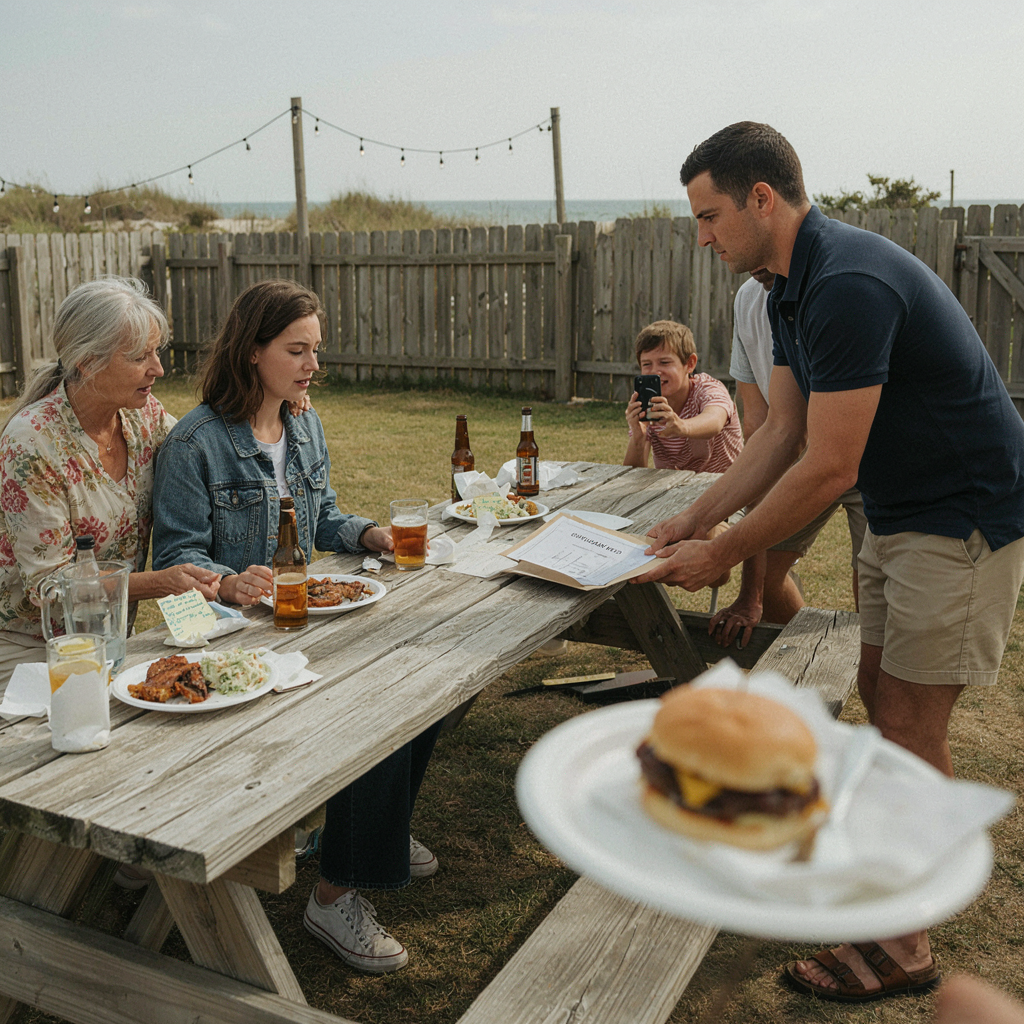
At our Memorial Day cookout on the Outer Banks, my brother Scott raised a beer and announced, “Next summer, this place belongs to Emily and Jake. Mom and Dad would love that.”
Everyone cheered.My cousin Emily laughed, her husband Jake pulling her closer.
My aunt Patricia clapped her hands.
Even my uncle nodded approvingly.
I looked across the picnic table at my brother.Then I set down my plate.“Scott,” I said quietly, “I own half this house.”The cheering stopped.Scott took one slow drink of his beer.
Then he reached beneath the table and pulled out a thick manila folder.
He slid it toward me.“Not after what you owe me.”
I stared at him.“What?”
He pushed the folder closer.Inside was a quitclaim deed transferring my half of the Outer Banks house to him.For ten dollars.
My stomach tightened.My name was printed beneath a blank signature line.
And clipped to the front was a handwritten note.
Sign before you leave Sunday, or I’ll sue you for the repairs.
For several seconds, I couldn’t hear the ocean.
I couldn’t hear the children running down the beach.
I couldn’t hear the music playing from the speaker near the deck.
All I could hear was my mother’s voice from twenty-two years earlier.
This house belongs to both of you.
I looked at Scott.
“You forged this?”
His expression hardened.
“No.”
“Then why does it say I owe you my half of the house?”
“Because I paid for it.”
I almost laughed.
“You paid for what?”
“The roof. The HVAC. The deck. The plumbing. The windows. The insurance. The taxes.”
“You paid some bills.”
“I paid almost everything for twelve years.”
My aunt Patricia leaned toward me.
“Laura, don’t be difficult. Scott has done a lot for this family.”
I looked at her.
“Did he tell you why?”
She shrugged.
“Because he loves this house.”
“No,” I said. “He loves owning it.”
Scott slammed his beer onto the table.
“You want to make this ugly?”
I looked down at the deed.
Then back at him.
“You already did.”
My name was Laura Bennett.
And that house had belonged to my parents long before it became the center of our family.
It sat on a quiet stretch of the Outer Banks, behind a line of wind-bent sea oats and a wooden fence that my father had built himself.
The first time I saw it, I was nine.
The house was small by vacation-home standards.
Two floors.
Four bedrooms.
A wraparound porch.
White siding.
Blue shutters.
A weathered wooden sign near the front door that read:
Bennett Family — Est. 1998
My father had built the sign.
My mother had planted the hydrangeas.
Scott had carved his initials into the railing when he was thirteen.
I had painted the shutters with Mom.
The house wasn’t fancy.
But it was ours.
After Dad died, Mom kept it.
After Mom died, she left it equally to Scott and me.
Fifty percent to him.
Fifty percent to me.
No conditions.
No debts.
No special arrangements.
I still remembered sitting in the attorney’s office after the funeral.
The attorney had looked at both of us and said, “Your mother wanted you to share this property equally.”
Scott had nodded.
I had cried.
Neither of us had argued.
For the first few years, we actually shared it.
Then Scott married Emily.
Then came Jake.
Then came their children.
And gradually, the house stopped being a family vacation home.
It became Scott’s home.
He started replacing things.
First, the refrigerator.
Then the water heater.
Then the deck boards.
He sent me pictures.
Thought I’d take care of this.
I always thanked him.
Sometimes I sent money.
Sometimes he said not to worry about it.
That was the part that mattered.
He never once told me he was keeping a ledger.
Until that Memorial Day.
I flipped through the folder.
Receipts.
Invoices.
Contractor statements.
Insurance payments.
Tax records.
Thousands of dollars.
My hands trembled.
Scott leaned back.
“See?”
“You’ve been keeping records.”
“Of course.”
“You never told me.”
“I didn’t need to.”
“Then why are you showing me now?”
His jaw tightened.
“Because I’ve decided enough is enough.”
I turned another page.
Then stopped.
There were repairs I’d never heard about.
A $14,800 roof.
A $9,300 HVAC replacement.
$6,700 for storm windows.
$4,100 for plumbing.
$12,000 for landscaping.
I looked at him.
“You paid all of this?”
“Yes.”
“From your account?”
“Yes.”
“Why?”
“Because somebody had to.”
I stared at the numbers.
Then I noticed something.
The dates.
Some of them were from years when I had sent him money specifically for the house.
I flipped faster.
My pulse began pounding.
There it was.
A $4,800 transfer.
Another for $3,200.
Then $6,000.
Then $2,500.
All marked in my bank statements as payments to Scott.
I looked up.
“I paid you.”
Scott’s expression didn’t change.
“For what?”
“For the roof.”
“You didn’t pay the whole roof.”
“No.”
“You paid part.”
“So did you.”
He smiled.
“Exactly.”
“So why are you claiming I owe you the entire amount?”
“I don’t.”
“You’re claiming I owe you enough to surrender my half.”
“That’s what the accounting shows.”
I pushed the folder away.
“No.”
Scott leaned forward.
“You have until Sunday.”
“What happens Sunday?”
“You sign.”
“And if I don’t?”
His voice became very calm.
“I’ll sue you.”
My aunt Patricia whispered, “Laura…”
I turned toward her.
“What?”
“You don’t want this to become a family fight.”
I looked at the woman who had spent years telling everyone I was the difficult one.
“Patricia, my brother just tried to take my property for ten dollars.”
“He says you owe him.”
“Then he can prove it in court.”
Scott laughed.
“You think you can afford court?”
I said nothing.
He knew exactly where to hit.
He knew I had spent years working as a school administrator.
He knew I wasn’t wealthy.
He knew I’d recently paid for my daughter’s college.
He knew I didn’t like conflict.
He had mistaken my reluctance to fight with weakness.
That was his first mistake.
His second was giving me the folder.
Because buried inside it was something he didn’t realize I’d notice.
A receipt.
A contractor invoice dated October 14, 2021.
The work:
Emergency roof repair following hurricane damage.
Amount:
$18,400.
I looked at Scott.
“When was this roof repair?”
“Three years ago.”
“Why?”
“Hurricane damage.”
“Did insurance pay?”
He hesitated.
“Some.”
“How much?”
“That’s irrelevant.”
“No.”
I held up the invoice.
“It isn’t.”
I knew something about insurance because my father had taught me.
After every storm, he photographed everything.
He documented damage.
He saved receipts.
He filed claims.
He used to say, “If you don’t document it, it didn’t happen.”
I pulled out my phone.
“I want to see the insurance claim.”
Scott’s face changed.
“What?”
“The claim.”
“Why?”
“Because you listed the entire roof replacement as one of the debts you supposedly paid.”
“I did pay it.”
“Did insurance reimburse you?”
He didn’t answer.
I looked around the table.
Everyone was watching.
I opened my phone.
“I have access to Mom’s old insurance account.”
Scott blinked.
“You don’t.”
“I do.”
After Mom died, I handled most of the paperwork.
I had maintained the digital records.
Scott had never cared.
Until now.
I opened the account.
There was the claim.
October 2021.
Hurricane damage.
Approved reimbursement:
$17,925.
I looked at Scott.
“You got almost eighteen thousand dollars from the insurance company.”
“That doesn’t mean anything.”
“You listed the entire $18,400 as money you personally spent.”
“I paid the contractor.”
“With money the insurance company reimbursed.”
“I still paid upfront.”
“So you want me to surrender my half because you temporarily fronted eighteen thousand dollars and got almost all of it back?”
His face reddened.
“That isn’t the only expense.”
“No.”
I kept scrolling.
“And this isn’t the only insurance payment.”
Another claim.
Another reimbursement.
Another repair.
I looked at the folder.
“Scott, how much money did you actually spend out of pocket?”
He stood.
“I’m done with this.”
“No.”
I stood too.
“I’m not.”
The backyard had gone silent.
Children were still playing near the beach, unaware.
Emily stared at her husband.
“Scott?”
He turned toward her.
“Stay out of it.”
She froze.
That was when I noticed something I’d never noticed before.
Emily wasn’t surprised.
She looked scared.
Not angry.
Not confused.
Scared.
I turned to her.
“Emily?”
She looked at me.
Her eyes filled with tears.
“Laura…”
Scott snapped.
“Don’t.”
Emily swallowed.
Then she whispered,
“You should see the rest.”
Scott turned white.
“What did you say?”
Emily looked at me.
“There’s another folder.”
My heart stopped.
“Where?”
She glanced toward the house.
“In the upstairs closet.”
Scott moved toward her.
“Emily.”
She stepped back.
“You told me this was all legal.”
“It is.”
“You told me Laura signed something.”
“I said I was handling it.”
“You told me she knew.”
Scott stared at his wife.
“You’re making a mistake.”
Emily shook her head.
“No. I made one three years ago.”
She turned toward the house.
“I’ll get it.”
Scott grabbed her wrist.
“Don’t.”
I stepped forward.
“Let her go.”
He released her.
Emily ran inside.
Everyone watched.
Five minutes later, she returned carrying a smaller blue folder.
She handed it to me.
“I found it in Scott’s office.”
I opened it.
The first page was a typed letter.
From an attorney.
Dated eight months earlier.
It said:
Re: Ownership of Bennett Family Property
My hands went cold.
I read the first paragraph.
Then the second.
Then I looked at Scott.
“What is this?”
He said nothing.
I continued reading.
The attorney had apparently advised Scott that he had no legal basis to force me to transfer my ownership simply because he had paid for repairs.
In fact, the letter warned him against representing himself as the sole owner.
There was another page.
Then another.
And then I found something that made my stomach turn.
A handwritten note from Scott.
Need Laura out before summer.
Underneath it:
Emily + Jake can move in permanently.
I looked at my brother.
“This was never about repairs.”
He didn’t answer.
“This was about getting me out.”
He finally spoke.
“Emily and Jake need a place.”
I stared at him.
“So you decided my house should become theirs.”
“It’s a family property.”
“Half mine.”
“You don’t even use it.”
“That doesn’t make it yours.”
“You live three states away.”
“So?”
“You barely come here.”
“Because you stopped inviting me.”
Silence.
I suddenly remembered every summer.
The texts that said the house was full.
The weekends Scott said Emily had guests.
The Thanksgiving when he told me the plumbing had failed.
The Christmas when he said the roads were dangerous.
I had believed him.
I had spent years thinking I was simply not making the effort.
But I wasn’t being excluded because the house was full.
I was being excluded because Scott wanted me to stop remembering that I owned half of it.
I looked at Emily.
“Why didn’t you tell me?”
She wiped her eyes.
“Because Scott told me you were planning to sell your half.”
“I wasn’t.”
“I know that now.”
“How long?”
She looked down.
“About six months.”
Scott laughed bitterly.
“You’re going to believe her?”
I looked at the folder.
Then at him.
“Yes.”
He slammed his hand on the table.
“You have no idea what I’ve done for this family!”
“No,” I said. “I know exactly what you’ve done.”
I gathered the papers.
“You’ve paid bills.”
He stared at me.
“You’ve made repairs.”
His breathing became heavier.
“You’ve also lied.”
He pointed at the folder.
“Those are real expenses!”
“I never said they weren’t.”
“Then you owe me!”
“I’ll reimburse you for legitimate shared expenses.”
His expression changed.
“What?”
“Every dollar I actually owe.”
I looked him directly in the eyes.
“But I’m not signing away half my house for ten dollars.”
My aunt Patricia suddenly spoke.
“Laura, maybe you should compromise.”
I turned to her.
“Would you sign away your house for ten dollars because your brother asked?”
She said nothing.
I continued.
“No?”
Silence.
“Then don’t ask me to.”
Scott grabbed the deed.
“You’re making a huge mistake.”
“No.”
I picked up my phone.
“I think I’m finally correcting one.”
That evening, I drove to a hotel twenty minutes away.
I didn’t sleep.
At 2:14 in the morning, I started reading every document I had.
At 3:02, I found something.
A tax statement from two years earlier.
Scott had claimed the property as his primary residence.
I checked the county records.
There was another filing.
A homestead exemption.
Under Scott’s name.
But the property was jointly owned.
And I had never signed anything giving up my interest.
At 3:47, I called an attorney.
Her name was Margaret Ellis.
She listened for almost an hour.
Then she said something I’ll never forget.
“Laura, do not sign that deed.”
“I wasn’t planning to.”
“Good.”
“What should I do?”
“Send me every document.”
“I have them.”
“And don’t confront your brother again.”
I almost laughed.
“That’s going to be difficult.”
“Then let him do the talking.”
She explained that the quitclaim deed could not simply erase my ownership.
She also told me that Scott’s repair claims would need to be documented and properly allocated.
But then she asked something that made my stomach tighten.
“Did he have access to your mother’s estate records?”
“Yes.”
“Bank statements?”
“Yes.”
“Insurance information?”
“Yes.”
“Tax documents?”
“Yes.”
“Then we need to find out whether he represented himself as the sole owner anywhere else.”
I froze.
“Why?”
“Because if he did, we may have a bigger issue.”
The next morning, I gave her everything.
By noon, she called.
“Laura?”
“Yes?”
“I found something.”
“What?”
“Your brother filed a mortgage application.”
My heart stopped.
“When?”
“Last year.”
“For what?”
“The Outer Banks property.”
“But there’s no mortgage.”
“Not now.”
“What does that mean?”
“He tried to use the property as collateral.”
I couldn’t speak.
“He listed himself as the sole beneficial owner.”
I sat down.
“Did the bank approve it?”
“No.”
“Why?”
“Because the title search showed you.”
I closed my eyes.
Scott had tried to borrow money against a property he didn’t own outright.
And when that failed, he had created a different plan.
Get me to sign away my half.
For ten dollars.
Then the property would belong entirely to him.
Or, more precisely, to him and Emily.
Margaret said something else.
“There is one more thing.”
“What?”
“The county records show a recent request to change the mailing address for the property.”
“To what?”
Scott’s address.
“He tried to make the property correspondence come only to him.”
I whispered,
“He wanted me erased.”
“Yes.”
That afternoon, I drove back to the house.
Scott was sitting on the porch.
He looked at me.
“You’re back.”
“Yes.”
“Did you think about it?”
“I did.”
“And?”
“I won’t sign.”
He stood.
“You’re going to regret this.”
“I don’t think so.”
“You have no idea what I’m capable of.”
“I know.”
He stared at me.
“You’re my sister.”
“And you’re my brother.”
“Then act like family.”
I almost smiled.
“Family doesn’t threaten family with lawsuits.”
He said nothing.
“Family doesn’t hide deeds.”
Nothing.
“Family doesn’t try to take someone’s inheritance.”
His jaw tightened.
“Mom would be ashamed of you.”
That sentence hurt.
He knew it would.
I looked toward the house.
“No.”
I said quietly,
“Mom would be ashamed of what you’re doing.”
He turned away.
For the first time, he looked uncertain.
Then I noticed something on the porch table.
A small wooden box.
My father’s box.
I hadn’t seen it in years.
I walked over.
Scott grabbed it.
“That’s mine.”
“No.”
“It was Dad’s.”
“Yes.”
“And he gave it to me.”
“When?”
He didn’t answer.
I looked at the box.
“Open it.”
He shook his head.
“Laura, just go.”
“Open it.”
He refused.
So I called Margaret.
She told me not to force anything.
But I didn’t need to.
Because Emily came out of the house.
She was holding a key.
She walked over to the box.
Then she handed me the key.
“Scott doesn’t know I found it.”
I unlocked it.
Inside were old photographs.
Receipts.
A watch.
And one folded envelope.
My mother’s handwriting was on the front.
For Laura and Scott.
I unfolded it.
The letter was dated two months before Mom died.
My children,
If you’re reading this, I hope you’re reading it together.
This house was never meant to be a prize.
It was the one place where our family could always return.
I leave it to both of you equally because I trust you to protect each other.
If one of you needs money, ask.
If one of you needs help, ask.
But never use the house to punish the other.
And never let someone convince you that ownership means love.
Love is what you do when nobody is watching.
I couldn’t see through my tears.
Scott looked away.
Emily began crying.
I folded the letter.
Then I said,
“Mom knew.”
Scott looked at me.
“Knew what?”
“That one day we’d fight over this.”
“No.”
“She knew.”
He shook his head.
“She knew we were different.”
I looked at him.
“You became exactly what she warned us not to become.”
He walked away.
I didn’t chase him.
I didn’t need to.
Three weeks later, Margaret called.
“The county has responded.”
“To what?”
“Our request for the property records.”
“And?”
“Your brother filed another document.”
My stomach tightened.
“What document?”
“A declaration claiming you abandoned your interest in the property.”
I laughed.
Not because it was funny.
Because it was unbelievable.
“When?”
“Last year.”
“But I stayed here in July.”
“I know.”
“I paid the insurance.”
“I know.”
“I paid property taxes.”
“I know.”
“And I have the emails.”
“Exactly.”
Margaret paused.
“There is also something else.”
“What?”
“He signed the declaration under oath.”
I went silent.
“Meaning?”
“If he knowingly made false statements, that could become a serious problem for him.”
I didn’t ask what kind.
I didn’t want revenge.
I wanted the truth.
A month later, we met at the house.
Scott arrived with an attorney.
I arrived with Margaret.
Emily came too.
Jake stayed outside.
The room felt smaller than I remembered.
Scott’s attorney opened a folder.
“My client believes this matter can still be resolved privately.”
Margaret nodded.
“Good.”
Scott looked at me.
“Laura, I’m willing to give you twenty thousand dollars.”
I stared at him.
“For my half?”
“Yes.”
“No.”
“Thirty.”
“No.”
“Forty.”
“No.”
He frowned.
“What do you want?”
I looked around the room.
“My house.”
“You don’t need it.”
“That’s not your decision.”
He leaned back.
“Then we’re going to court.”
Margaret smiled.
“Fine.”
Scott’s attorney looked uncomfortable.
Then Margaret placed a document on the table.
“Before we discuss litigation, I’d like your client to explain this.”
She slid over the mortgage application.
Scott went pale.
Then the insurance records.
Then the tax records.
Then the false declaration.
Then the note:
Need Laura out before summer.
Finally, she placed my mother’s letter on top.
Scott stared at it.
“You found that?”
“Yes.”
He looked at me.
“Laura…”
I shook my head.
“Don’t.”
He looked down.
For several seconds, nobody spoke.
Then Emily stood.
“I can’t do this anymore.”
Scott turned.
“What?”
“You told me Laura abandoned the house.”
“I thought she had.”
“No.”
Emily looked at him.
“You knew she hadn’t.”
He said nothing.
“You lied to me too.”
Scott’s face collapsed.
Emily walked outside.
Jake followed her.
Scott remained at the table.
For the first time since Memorial Day, he looked less like my enemy and more like my little brother.
The boy who used to race me down the beach.
The teenager who carved his initials into the porch.
The man who once called me every Sunday after Dad died because neither of us knew how to live without him.
I wanted to forgive him.
But forgiveness and trust were not the same thing.
Margaret gathered the papers.
“The property remains jointly owned.”
Scott looked at me.
“So that’s it?”
“No,” I said.
“What do you want?”
I thought about it.
“I want you to pay your legitimate share of the expenses.”
He looked surprised.
“You’re not taking the house?”
“No.”
“Why?”
“Because Mom was right.”
I touched the letter.
“It was never supposed to be a prize.”
Scott’s eyes filled with tears.
“I was scared.”
I looked at him.
“Of what?”
“That you’d sell.”
“Why?”
“Because Emily and Jake were planning their future here.”
“You could have asked me.”
“I thought you’d say no.”
“You never gave me the chance.”
He lowered his head.
“I know.”
There was a long silence.
Then he whispered,
“I’m sorry.”
I believed that he was sorry.
But I didn’t pretend everything was fixed.
Some wounds don’t close because someone says the right words.
Some take years.
We eventually reached an agreement.
Scott reimbursed me for several expenses I’d previously paid that he’d never credited.
I agreed to contribute my share of future repairs.
We hired a property manager for the summers.
And the house stayed jointly owned.
No one moved in permanently.
No one got to erase the other.
The following Memorial Day, we held another cookout.
Same porch.
Same ocean.
Different people.
Scott arrived carrying a cooler.
He stood beside me for a moment.
“You know,” he said, “Mom would have liked this.”
I smiled.
“She would.”
He looked toward the ocean.
“Think she’d be mad about what happened?”
I thought about her letter.
Then shook my head.
“No.”
“Why?”
“Because she told us exactly what to do.”
He looked at me.
“What?”
I smiled.
“Ask.”
He laughed.
Then he handed me a beer.
We stood together watching the waves.
Later that evening, after everyone left, I walked upstairs.
I opened the closet where we’d found the blue folder.
I pulled out my mother’s letter.
At the bottom, beneath her signature, there was one final sentence I’d somehow missed.
I read it twice.
Then I sat down on the floor.
The sentence said:
And if either of you ever tries to take this house from the other, remember this: the house can be sold, but what you lose with each other may never be bought back.
I folded the letter carefully.
Then I walked downstairs.
Scott was still on the porch.
I handed him the letter.
He read it.
His eyes filled with tears.
He looked at me.
“I almost destroyed everything.”
I shook my head.
“No.”
He frowned.
“What?”
“You almost destroyed us.”
He nodded.
“I know.”
We sat there in silence.
The sun was setting over the Outer Banks.
The same place where, one year earlier, my brother had tried to take my half of the house for ten dollars.
The same place where our family had cheered for a future I had never agreed to.
The same place where I had learned that sometimes the person trying hardest to call something “family” is the one quietly trying to take it away.
I never signed the quitclaim deed.
Not for ten dollars.
Not for forty thousand.
Not for a million.
Because the house wasn’t just wood, windows, and ocean views.
It was my mother’s handwriting.
My father’s fingerprints in the porch railing.
My childhood summers.
My brother’s initials carved into a board.
And every memory we still had left.
Scott didn’t get the house.
But he got something else.
A chance to earn back his sister.
And this time, he knew he couldn’t buy that with receipts.