For twenty years, my son Vince had ridden on the back of a garbage truck through Scranton.Twenty years.Long enough for whole neighborhoods to change.
Long enough for children who used to wave at him from porches to grow up, move away, get married, and have children of their own.
Long enough for Vince to know which houses had dogs that barked at the truck,
which old ladies liked to leave cookies for the crew, and which streets flooded after a hard summer storm.
He knew the route better than some people knew their own families.And that route knew him.There was old Mr. Pauley, who lived alone in a little brick house with green shutters.
One Tuesday morning, Vince noticed that Mr. Pauley’s trash cans were still sitting exactly where they had been the week before.
He knocked.No answer.He knocked again.Nothing.
Something didn’t feel right.
Vince called his supervisor, then 911.Paramedics found Mr. Pauley on the kitchen floor after suffering a stroke.They told us later that another day might have been too late.
Mr. Pauley survived.He sent Vince a Christmas card every year after that.”To the man who noticed,” he always wrote.
That was Vince.He noticed.He helped.He carried things.He fixed things.
If somebody needed a couch moved, Vince showed up.
If a neighbor’s basement flooded, Vince was there with boots and a pump.
If a friend was remodeling a kitchen, Vince spent his Saturday carrying cabinets.
And if family needed help?
He never said no.
For twenty years, my son had done honest work with his hands.
And for twenty years, my daughter’s husband Doug had treated him like something he had scraped off the bottom of his shoe.
Doug was an accountant at a downtown firm.
He wore expensive suits.
Drove a black SUV.
Talked about investment portfolios at dinner.
He had a framed master’s degree hanging in his home office and liked reminding people that he had “built a respectable career.”
Apparently, Vince’s career wasn’t respectable.
“Still hauling trash, Vince?”
That was one of Doug’s favorites.
The first time he said it, everyone laughed.
The second time, Vince laughed too.
The tenth time, nobody even reacted.
Eventually, it became background noise.
Doug would walk into my kitchen while Vince was washing his hands after helping me carry something.
“How’s it smell out there, buddy?”
Vince would grin.
“Better than your office.”
Doug would laugh.
“See? He can take a joke.”
Then Vince would go get another plate of food.
One Christmas, Doug gave Vince a book.
I remember the title because I still wish I could erase it from my memory.
Finding a Respectable Career.
Doug handed it over with a smile.
“Thought you might need this.”
My daughter laughed nervously.
Vince looked at the book.
Then at Doug.
Then he smiled.
“Thanks.”
And he put it on the table.
I saw the way his fingers tightened around the cover.
I saw it.
And I said nothing.
That’s the part that still hurts.
I was his father.
I should have said something.
I should have told Doug to stop.
Instead, I told myself Vince was tough.
I told myself he didn’t care.
I told myself it was easier not to make family gatherings uncomfortable.
Those were lies.
And I was the one telling them.
Then came our fortieth anniversary dinner.
My wife and I had been married forty years, and we’d invited everyone.
My daughter Melissa came with Doug.
Vince came alone.
There were twelve of us around the table.
My wife had spent two days cooking.
There was roast beef, potatoes, green beans, rolls, and a chocolate cake she had ordered from the bakery downtown.
It should have been a beautiful night.
And for a while, it was.
We talked.
We laughed.
We looked through old photographs.
Vince told a story about me trying to assemble a barbecue grill twenty years earlier and somehow ending up with three extra bolts.
“Those bolts were optional,” I said.
Vince laughed.
“You said that after you threw the instructions into the bushes.”
Everyone laughed.
Even Doug.
Then dessert came.
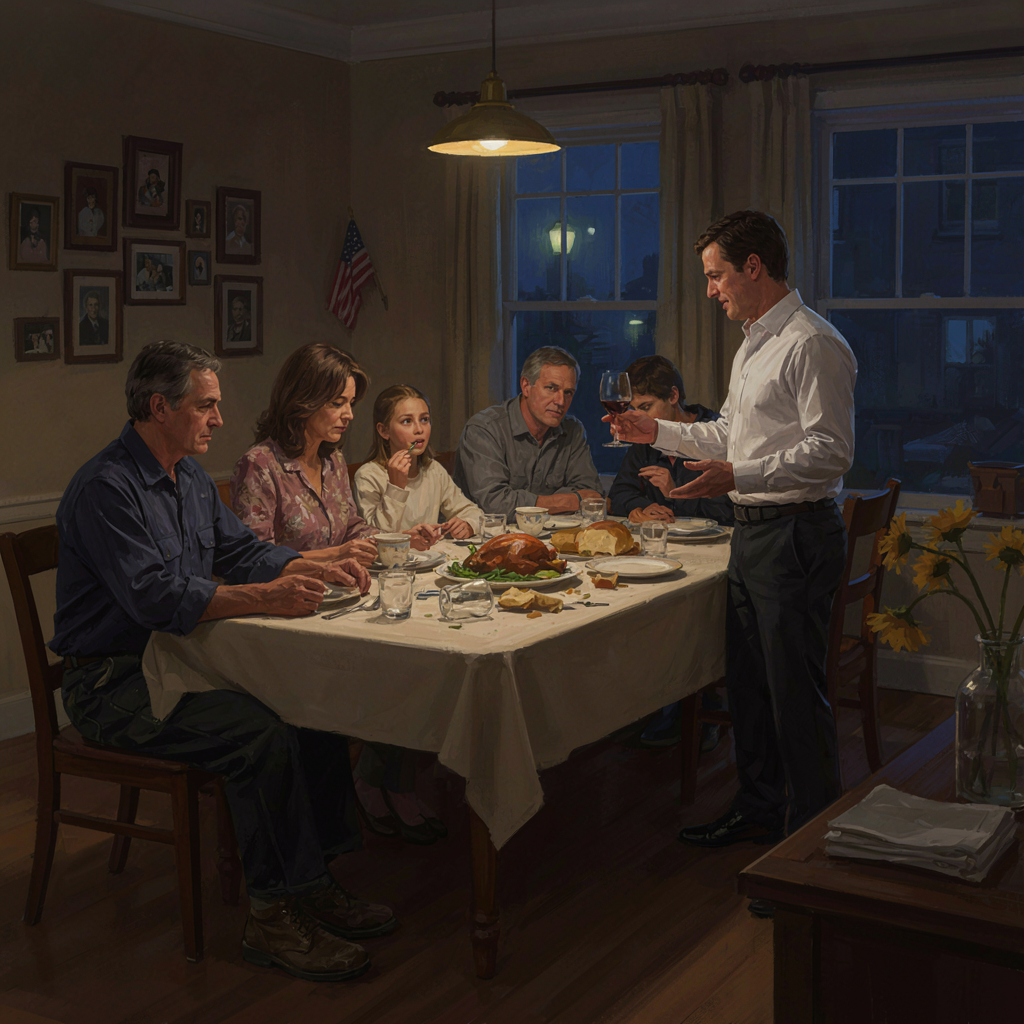
Doug stood up.
He lifted his glass.
“Before we cut the cake, I want to make a toast.”
Everyone raised their glasses.
Doug looked directly at Vince.
“To Vince.”
Vince’s smile disappeared slightly.
Doug continued.
“Proof that some men balance the books…”
He paused.
“…and some just empty the cans.”
Silence.
Doug laughed.
A couple of people gave uncomfortable smiles.
His wife Melissa giggled.
Doug wasn’t finished.
“Twenty years on the back of a truck, folks. Somebody’s gotta take out the garbage so the rest of us can do real work.”
The room went completely still.
I looked at Vince.
He wasn’t smiling.
He wasn’t angry either.
That somehow made it worse.
He simply stared at the table.
His hands rested beside his plate.
Then he picked up his water.
Took a slow drink.
Doug sat down, looking pleased with himself.
I opened my mouth.
Nothing came out.
My wife looked at me.
Her eyes said everything.
Do something.
But I had already failed.
Then the food started moving around the table again.
Someone passed the potatoes.
Someone asked about the cake.
Usually, that was when Vince would get up.
He was always the one who jumped up.
“Anybody need anything?”
He’d refill drinks.
Bring extra napkins.
Clear plates.
Get more bread.
That night, he stayed seated.
He set down his glass.
Then he looked directly at Doug.
“I’ve been wondering something.”
Doug leaned back.
“What’s that?”
Vince’s voice was calm.
“Why do you hate me?”
Nobody moved.
Doug laughed.
“Hate you?”
“Yeah.”
“I don’t hate you.”
“Then why have you spent twenty years trying to make me ashamed of what I do?”
Doug shrugged.
“I’m just joking.”
Vince nodded.
“I used to believe that.”
He looked around the table.
“All of you did.”
My heart sank.
He looked at me.
“Even Dad.”
I felt my face burn.
“Vince…”
He raised his hand.
“Don’t.”
One word.
Quiet.
But it stopped me.
“I spent twenty years pretending those jokes didn’t hurt because I didn’t want Dad to have to choose between his son and his daughter’s husband.”
My wife covered her mouth.
Vince looked back at Doug.
“But you were wrong about something.”
Doug smirked.
“What’s that?”
“You think I stayed on that truck because I couldn’t do anything else.”
Vince leaned forward.
“I stayed because I wanted to.”
Doug’s smile faded.
Vince continued.
“I make a good living. I have benefits. I have a pension. I’ve worked the same route for twenty years. I know every street, every business, every family.”
He paused.
“And I’ve never been ashamed to tell people what I do.”
Doug crossed his arms.
“Congratulations.”
Vince nodded.
“Thank you.”
Then he reached into his jacket.
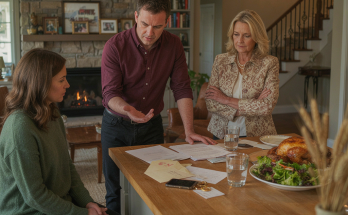
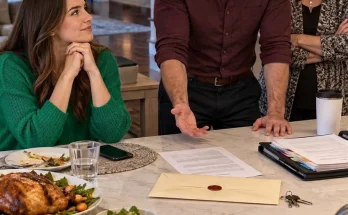
He pulled out a folded document.
“I wasn’t going to bring this tonight.”
Doug glanced at it.
“What is that?”
Vince placed it on the table.
“It’s the reason I stayed on that truck.”
Doug laughed.
“Let me guess. Your big garbage-truck empire?”
Nobody laughed.
Vince looked at me.
“Dad, do you remember when I was twenty-two and Grandpa’s house almost went into foreclosure?”
I nodded.
Of course I remembered.
My father had died, leaving behind an old house and more debt than anyone realized.
I had been struggling financially.
Vince had been working garbage collection for two years.
“I remember,” I said.
“You told me we might have to sell.”
“Yes.”
“You were going to lose it.”
I swallowed.
“Yes.”
Vince looked around the table.
“I bought it.”
Doug frowned.
“What?”
“I bought Grandpa’s house.”
I stared at him.
“What are you talking about?”
Vince unfolded the document.
“I bought it through the estate. I paid the back taxes. I paid the mortgage balance. Then I rented it out.”
My mouth went dry.
“That was you?”
Vince nodded.
“You thought Dad found the money somewhere?”
“I thought your mother and I managed it.”
“You didn’t.”
I looked at my wife.
She was crying.
Vince continued.
“I didn’t tell you because you were proud. You wanted to believe you’d saved the house.”
My voice cracked.
“Vince…”
He looked down.
“I was twenty-two. I didn’t want you to feel like your son had to rescue you.”
The room was silent.
Doug shifted in his chair.
“But that house isn’t worth enough to explain—”
Vince smiled slightly.
“I know.”
He pulled out another paper.
“And that isn’t what I came here to talk about.”
He slid the second document across the table.
“Three years after I bought Grandpa’s house, the owner of the small waste company I worked for approached me.”
Doug looked confused.
“He was retiring.”
Vince continued.
“He offered to sell me his route.”
Doug laughed.
“You?”
Vince nodded.
“Me.”
“I didn’t have enough money.”
“So I worked extra shifts. Nights. Weekends. I saved everything.”
He tapped the paper.
“I bought into the company.”
My wife whispered, “You never told us.”
“I didn’t want anyone to think I was trying to prove something.”
Vince looked at Doug.
“I bought another share five years later.”
Then another.
And another.
“Today, I own a significant portion of the company.”
Doug stared at him.
“You’re a partner?”
Vince nodded.
“Among other things.”
Doug laughed nervously.
“Okay.”
Vince reached into his jacket again.
This time, he pulled out a business card.
He put it on the table.
Doug picked it up.
His face changed.
I couldn’t read it from where I sat.
“What does this mean?” Doug asked.
Vince answered quietly.
“That company you keep calling a garbage business?”
Doug stared.
“Yeah?”
“We’ve been contracted by the city for years.”
Doug’s eyes narrowed.
“Okay.”
“Your accounting firm handles financial consulting for several of our municipal contracts.”
Doug went pale.
Melissa looked at him.
“Doug?”
Vince leaned back.
“Your firm submitted a proposal last month for our largest contract.”
Doug’s face had gone completely white.
I looked at him.
“What?”
Vince nodded.
“I know.”
Doug stared at the card.
“How?”
“Because I sat in the meeting.”
Doug’s mouth opened.
No words came out.
Vince continued.
“I was there when your firm’s representative presented the numbers.”
Doug swallowed.
“You didn’t say anything.”
“No.”
“Why?”
Vince looked at him.
“Because I wanted to know whether you respected me when you didn’t know who I was.”
Doug looked away.
“And?”
Vince smiled sadly.
“You didn’t.”
The silence was unbearable.
Then Vince said something that none of us expected.
“But that’s not even the worst part.”
He looked at me.
“Dad, you remember the winter you almost had to close your repair shop?”
I nodded.
“Yes.”
“Who do you think bought the building?”
I froze.
My wife looked at me.
“Vince?”
He nodded.
“I bought it.”
I stared at him.
“You’ve been paying the mortgage?”
“For thirteen years.”
My hands started shaking.
“Why?”
“Because I knew you couldn’t afford it.”
I couldn’t speak.
Vince’s voice softened.
“You gave me everything you could when I was growing up. You paid for my school clothes. You fixed my first car. You worked overtime when Mom was sick.”
He paused.
“I couldn’t watch you lose the shop.”
I covered my face.
The tears came before I could stop them.
For twenty years, I’d watched my son climb onto the back of a garbage truck.
For twenty years, I’d let another man make him feel small.
And all that time, Vince had been quietly taking care of the family.
Not for praise.
Not for recognition.
Just because that was who he was.
Doug suddenly pushed his chair back.
“So what? You’re rich now?”
Vince looked at him.
“No.”
Doug scoffed.
“Then what’s the point of all this?”
“The point?”
Vince’s voice remained calm.
“The point is that you’ve spent twenty years measuring a man’s worth by the title on his business card.”
He pointed at the book still sitting on the sideboard.
“That book you gave me?”
Doug looked at it.
“I read it.”
Doug blinked.
“Really?”
“Yeah.”
Vince smiled.
“I kept it.”
“Why?”
“To remind myself never to become the kind of man who thinks someone else’s job makes him better.”
Doug’s face tightened.
Melissa finally spoke.
“Doug, stop.”
He looked at her.
“What?”
“Just stop.”
She turned toward Vince.
“I’m sorry.”
Vince nodded.
“I know.”
She started crying.
“I should have said something.”
“You should have.”
She looked down.
“I laughed because I didn’t want Doug angry with me.”
Vince’s expression softened.
“I know.”
Then he looked at me.
“And Dad…”
I couldn’t meet his eyes.
“I’m sorry,” I whispered.
Vince said nothing.
“I should’ve defended you.”
He looked at me for a long time.
“You should have.”
That hurt more than anger would have.
I nodded.
“I was afraid of making things worse.”
Vince smiled sadly.
“You know what made things worse?”
I shook my head.
“Watching my father pretend he didn’t hear.”
My wife reached across the table and took my hand.
Nobody touched their food.
Then Vince stood.
For a moment, I thought he was leaving.
Instead, he walked toward me.
He stopped beside my chair.
“Dad.”
I looked up.
“I’m not angry anymore.”
I started crying again.
“But I’m done pretending.”
He hugged me.
I held him like I hadn’t held him in years.
And for the first time in a very long time, I felt the little boy who used to climb into my lap.
When we pulled apart, Vince turned toward Doug.
“One more thing.”
Doug looked nervous.
“The contract?”
Vince shook his head.
“No.”
He picked up his jacket.
“I’m not going to use my position to punish you.”
Doug looked surprised.
“But I’m also not going to pretend we’re friends.”
Doug nodded slowly.
“Fair.”
Vince walked toward the door.
Then he stopped.
He looked back at the table.
“You know what’s funny?”
Nobody answered.
“I’ve spent twenty years taking garbage away from people.”
He smiled faintly.
“But tonight I realized I don’t have to keep carrying other people’s garbage.”
Then he left.
The door closed.
Nobody spoke for almost a minute.
Finally, my wife whispered:
“He’s right.”
She looked at me.
“He shouldn’t have had to.”
I nodded.
That night changed our family.
Not instantly.
Families don’t heal because one person makes a speech.
They heal because people finally stop lying about what happened.
Doug apologized to Vince.
Not once.
Several times.
The first apology wasn’t good.
“I’m sorry if you were offended.”
Vince rejected it.
The second one was different.
“I’m sorry I made you feel ashamed of your work.”
Vince accepted it.
But forgiveness didn’t mean friendship.
Doug and Vince became civil.
Eventually, they could sit at the same table.
But Doug stopped making jokes.
And Melissa stopped laughing at things that weren’t funny.
As for me?
I changed the way I looked at my son.
Not because I discovered he had money.
That would have been the wrong lesson.
I changed because I finally understood something I’d missed for twenty years.
Vince had never needed a respectable career.
He needed a father who respected him.
A few months later, Mr. Pauley came to Vince’s workplace.
He was older now, walking slowly with a cane.
He brought a small wooden plaque.
It read:
VINCE — THANK YOU FOR NOTICING.
Vince hung it in his office.
Yes.
His office.
Because by then, he’d moved into management.
But every once in a while, he still rode the route.
He said he missed it.
He missed the people.
The conversations.
The familiar streets.
The feeling of knowing you had done something useful before most people had finished their coffee.
One morning, I rode with him.
I climbed into the passenger seat.
We drove through Scranton before sunrise.
The streets were quiet.
Vince pointed toward a house.
“Mrs. Donnelly.”
Then another.
“The Wilsons.”
Then another.
“That guy always forgets to put his cans out.”
I laughed.
“Some things never change.”
“Nope.”
We stopped at a curb.
Vince got out.
He lifted two heavy cans like they weighed nothing.
I watched him carry them back.
And I thought about that anniversary dinner.
About Doug’s toast.
About the silence afterward.
About the twenty years I had spent allowing someone to make my son feel small.
Then Vince climbed back into the truck.
“You okay, Dad?”
I nodded.
“Yeah.”
“What are you thinking?”
I looked out at the street.
“I’m thinking I should’ve been proud of you a long time ago.”
Vince smiled.
“You were.”
“No.”
I shook my head.
“I loved you.”
He looked at me.
“But I wasn’t proud enough.”
He was quiet for a moment.
Then he reached over and squeezed my shoulder.
“You are now.”
The truck rolled forward.
Sunlight began creeping between the buildings.
And as we turned onto the next street, I realized something.
For twenty years, I had thought my son was the man who took out the garbage.
I had been wrong.
Vince was the man who carried what other people couldn’t carry.
He carried old people’s trash.
He carried broken furniture.
He carried my family’s financial burdens.
He carried his mother’s worries.
He carried his father’s pride when I didn’t have enough of my own.
And for twenty years, he carried Doug’s insults without dropping them on anyone else.
Until that night.
Until he finally put them down.
I wish I could say I defended him the first time Doug made that joke.
I didn’t.
I wish I could say I recognized my son’s strength before I discovered his success.
I didn’t.
But I learned something that night that no accounting degree, business title, or expensive suit could ever teach me.
A person’s value isn’t determined by the job that puts food on their table.
It’s determined by what they do with the life they’ve been given.
And my son Vince?
He spent twenty years doing something most people never notice.
He showed up.
Every morning.
In the rain.
In the snow.
On holidays.
When people were sick.
When neighborhoods flooded.
When someone needed help.
He showed up.
And that, I finally understood, was the most respectable career of all.
The last time Doug ever made a joke about garbage, it wasn’t about Vince.
We were all sitting around my kitchen table.
Doug started telling a story about something that had happened at work.
He caught himself halfway through.
Then he laughed.
“Sorry.”
Vince looked at him.
“For what?”
Doug smiled.
“Old habits.”
Vince shook his head.
“It’s okay.”
Doug nodded.
Then he looked around the table.
“Actually…”
He raised his glass.
“To Vince.”
Everyone smiled.
Doug paused.
“Twenty years of doing work most of us are too comfortable to notice.”
Vince lifted his glass.
“Now that’s a toast.”
We laughed.
And this time, nobody was laughing because they were uncomfortable.
We were laughing because the truth had finally replaced the joke.
And I raised my glass last.
“To my son.”
Vince looked at me.
I held his eyes.
“Who never needed to become somebody else to make me proud.”
His eyes turned red.
He looked down.
Then he lifted his glass.
“Thanks, Dad.”
And for the first time in twenty years, I didn’t feel ashamed of the silence that had once filled our family.
Because it was gone.
Replaced by something better.
Respect.
The kind Vince had earned long before any of us were smart enough to see it.