After my husband died, my sixteen-year-old stepson packed a duffel bag and told me he wanted to live with his biological mother.I told him I understood.
Then I waited until his car disappeared at the end of the street before I closed the door, slid down against it, and finally let myself cry.
I had helped raise Caleb since he was six.
For ten years, I had packed his lunches,
sat beside him through fevers, attended parent-teacher conferences, learned which foods he hated, which songs he secretly liked, and exactly how he took his hot chocolate.
But when his father died unexpectedly, everything changed.Caleb’s grief didn’t look like mine.
I wanted to hold onto every piece of the life we’d built.
He wanted to escape every room that reminded him of his father.
So when his biological mother, Marissa, called three days after the funeral and said, “Caleb thinks he needs to come home with me,” I didn’t fight.
Even though the word home hurt.I had never tried to replace Marissa.I had only tried to be there.
But apparently, when a boy loses his father, he starts asking himself questions no one can answer.
Who am I now?Where do I belong?Who is still my family?
And sometimes, grief makes people push away the very person who is hurting beside them.
Six months passed.
I barely saw Caleb.
At first, he sent short messages.
“I’m okay.”
“School’s fine.”
“Mom says hi.”
Then even those stopped.
I learned from Marissa that he had joined a basketball program and was doing well.
I learned from a neighbor that he’d gotten his driver’s permit.
I saw a photograph online of him standing beside Marissa at his school’s winter formal.
He looked taller.
Older.
Happy.
I stared at that photograph for almost an hour.
Then I closed my phone and whispered to the empty house, “I’m glad you’re okay.”
The house was unbearably quiet.
His sneakers were still by the back door.
His old baseball glove sat on a shelf in the garage.
His bedroom remained exactly as he’d left it because I couldn’t bring myself to change anything.
I had told myself I was preserving his room in case he came back.
But secretly, I think I was preserving the possibility that I still mattered.
Then Mother’s Day arrived.
I hadn’t planned anything.
I didn’t even think I deserved to.
I woke before sunrise, made coffee for one, and sat at the kitchen table staring at the chair where my husband, Daniel, used to sit.
Daniel had always teased me about Mother’s Day.
“You aren’t technically a mother,” he’d say.
I’d pretend to be offended.
“Then why do I have gray hair?”
“Because you’re married to me.”
“Then I should be getting two presents.”
He’d laugh and kiss my forehead.
“Fine. Three.”
I smiled at the memory.
Then the smile disappeared.
Because Daniel was gone.
And Caleb was gone.
And for the first time in ten years, Mother’s Day felt like a day that belonged to everyone except me.
At exactly 7:03 a.m., someone knocked on my door.
I froze.
Nobody visited that early.
I walked toward the entryway.
Another knock.
I opened the door.
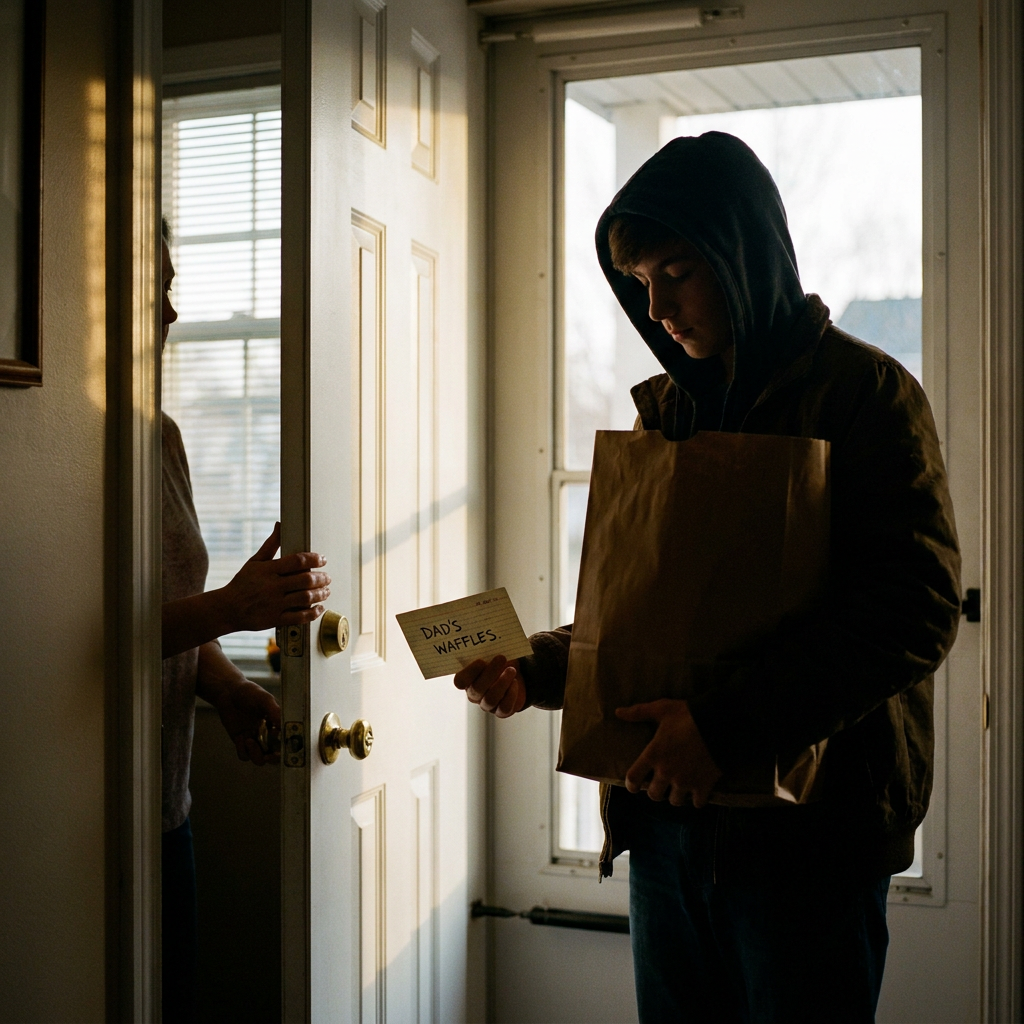
Caleb stood on the porch.
He was holding a grocery bag in one hand and something small and yellowed in the other.
For a second, neither of us spoke.
He looked different.
His hair was longer.
His shoulders were broader.
But his eyes were exactly the same.
My heart practically stopped.
“Caleb?”
He swallowed.
“Hi.”
I couldn’t think of anything else to say.
Then he held up the yellowed piece of paper.
It was one of Daniel’s old recipe cards.
I recognized the handwriting immediately.
Daniel’s handwriting had always leaned slightly to the right, with certain letters pressed so hard into the paper that they left impressions.
Caleb looked at me.
“Dad made me promise something.”
My throat tightened.
“What?”
He looked down at the recipe card.
“That if anything happened to him, you wouldn’t spend today alone.”
I couldn’t breathe.
“Why didn’t he tell me?”
Caleb’s eyes filled with tears.
“Because he wasn’t supposed to die.”
That sentence broke something inside me.
I stepped aside.
“Come in.”
Caleb walked through the doorway.
He looked around the house as if he hadn’t seen it in years.
Maybe, in some ways, he hadn’t.
Then he set the grocery bag on the kitchen counter.
“I brought breakfast.”
I almost laughed.
“You came at seven in the morning to make me breakfast?”
“I didn’t make it.”
“Good.”
He smiled for the first time.
“I figured we’d both survive that way.”
I laughed.
It was a small laugh.
But it was the first real one I’d had in months.
Then Caleb pulled out eggs, bread, fruit, pancake mix, and a carton of orange juice.
“Mom said I should stay until lunch.”
I stopped.
“Your mother knows you’re here?”
“Yeah.”
Something about that surprised me.
I had expected this to be rebellion.
It wasn’t.
Caleb was there because he wanted to be.
We made breakfast together.
And for the first hour, neither of us mentioned the six months apart.
We talked about school.
Basketball.
His driver’s test.
A teacher he couldn’t stand.
He complained about cafeteria food.
I listened.
Then, while I was washing dishes, he said quietly,
“I was angry at you.”
I stopped.
“I know.”
“No, you don’t.”
I turned around.
Caleb was sitting at the kitchen table, staring at his father’s recipe card.
“I thought you weren’t angry enough.”
I frowned.
“What does that mean?”
“When Dad died, you were always taking care of everything.”
His voice cracked.
“Funeral. Bills. Calls. His clothes. The house. Me.”
He rubbed his eyes.
“You cried, but you still got up the next morning.”
“I had to.”
“I know.”
He looked at me.
“But I was sixteen. I didn’t know how to do that.”
I sat across from him.
“You didn’t have to.”
“I thought you wanted me to be strong.”
“I wanted you to survive.”
He looked away.
“I thought if I stayed here, I’d have to become him.”
My heart sank.
“What?”
“Dad.”
He stared at his hands.
“Everyone kept saying I was the man of the house now.”
“I never said that.”
“Other people did.”
He swallowed.
“And I hated it.”
I reached across the table.
“You were never supposed to become your father.”
“I know that now.”
He took a breath.
“But there’s something else.”
“What?”
He pushed the recipe card toward me.
“Read the back.”
I turned it over.
There were words written in Daniel’s handwriting.
My hands began shaking.
“Claire,
If you’re reading this, I probably didn’t get to explain everything.”
I stared at the first line.
Daniel had never called me Claire in writing.
Except when he was being serious.
I kept reading.
“I know Caleb will be scared. He may even be angry. Please don’t mistake his anger for lack of love.”
My eyes blurred.
“He may decide he needs his mother. Let him go if he asks. Don’t make him choose between the people who love him.”
I covered my mouth.
Then I read the next line.
“And Claire, don’t you dare spend Mother’s Day alone.”
A tear fell onto the card.
Caleb looked at me.
“He wrote that three months before he died.”
I couldn’t speak.
“Why?”
“Because he knew something.”
I looked at him.
“What did he know?”
Caleb hesitated.
“That he might not be around.”
The room suddenly felt colder.
“Caleb, your father didn’t know he was going to die.”
“I know.”
“Then why would he write this?”
“I don’t know.”
He reached into his jacket.
He pulled out an envelope.
It was sealed.
My name was written across the front.
CLAIRE.
I recognized the handwriting.
Daniel.
“I found it in Dad’s desk last week,” Caleb said.
“Why didn’t you give it to me?”
“Because I was afraid.”
“Of what?”
“Of what it would say.”
I stared at the envelope.
Six months of silence.
Six months of grief.
And now my dead husband was speaking to me through a piece of paper his son had carried across town.
I opened it.
Inside was a single sheet.
Claire,
There are things I should have told you.
Things I thought I had more time to explain.
If I am gone, please remember one thing:
You didn’t marry me and become Caleb’s stepmother.
You became his family.
But family isn’t something you can force.
So if he leaves, let him.
If he comes back, open the door.
And if he ever tells you he thinks you aren’t his mother because you didn’t give birth to him, tell him this:
A mother isn’t only the person who gives you life.
Sometimes she’s the person who stays.
I stopped reading.
I couldn’t see the rest through my tears.
Caleb was crying too.
“I hated you,” he whispered.
I looked up.
“For a while.”
“I know.”
“No.”
He shook his head.
“You don’t.”
He wiped his face.
“I hated you because you stayed calm.”
I stared at him.
“When Dad died, I wanted you to fall apart. I wanted you to scream. I wanted you to say you couldn’t do it.”
He laughed bitterly.
“But you kept making dinner.”
“I didn’t know what else to do.”
“I know.”
His voice became smaller.
“And then I started thinking maybe you didn’t love him enough.”
That hurt.
But I didn’t interrupt.
“And then I thought maybe you didn’t love me enough.”
I reached for his hand.
He let me take it.
“I was wrong.”
“No.”
I squeezed his fingers.
“You were grieving.”
He shook his head.
“I hurt you.”
“Yes.”
His face crumpled.
“I’m sorry.”
I pulled him into my arms.
For a moment, he resisted.
Then he collapsed against me.
He was sixteen years old.
But in my arms, he was six again.
The little boy who used to fall asleep on the couch.
The boy who once asked me if monsters were real.
The boy who had cried when Daniel taught him to ride a bicycle.
I held him until his breathing slowed.
Then he whispered,
“I want to come home.”
I closed my eyes.
“Okay.”
“But Mom—”
“Your mother loves you.”
“I know.”
“And you don’t have to choose.”
He pulled away.
“What if she gets mad?”
“Then we’ll deal with it.”
He stared at me.
“We?”
I smiled through my tears.
“We.”
That should have been the end.
It wasn’t.
Because later that afternoon, Marissa called.
Her voice was calm.
Too calm.
“Claire, I need to talk to you.”
“Okay.”
“Caleb wants to move back.”
I looked at him.
He was sitting on the couch, watching an old video of Daniel teaching him how to grill burgers.
“He does.”
“I know.”
There was silence.
Then Marissa said,
“There’s something you don’t know.”
My stomach tightened.
“What?”
“Daniel came to see me two weeks before he died.”
I stood.
“Why?”
“He was worried about Caleb.”
“About what?”
“He told me there might be a chance he wouldn’t be around to raise him.”
I sat down.
“Did he know something was wrong?”
“Not exactly.”
“Then what did he say?”
Marissa sighed.
“He told me he’d arranged something.”
“What?”
“I don’t know the details.”
“Then why are you telling me?”
“Because I found a box.”
My heart began pounding.
“What kind of box?”
“Daniel gave it to me before he died.”
“Why?”
“He told me not to open it unless Caleb ever decided to leave you.”
I looked at Caleb.
He was still watching the video.
“What was inside?”
“Documents.”
“What documents?”
“I haven’t opened it.”
“Why?”
“Because Daniel asked me not to.”
I couldn’t understand.
“What did he say?”
Marissa’s voice dropped.
“He said, ‘If Caleb ever leaves Claire because he thinks she isn’t his family, show him the truth.'”
My entire body went still.
“Marissa…”
“I’ll bring it.”
An hour later, she arrived.
Caleb opened the door.
For several seconds, he and his mother simply stared at each other.
Then Marissa hugged him.
Hard.
He hugged her back.
I stood several feet away.
Watching them together, I felt something I hadn’t expected.
Relief.
Because whatever happened next, Caleb had two people who loved him.
Marissa carried a small wooden box.
She placed it on the dining table.
Daniel’s name was written across the lid.
We opened it together.
Inside were photographs.
School records.
Medical documents.
Receipts.
Letters.
And at the very bottom was a folder.
On its cover were three words:
CALeb’s future.
Inside was a letter from an attorney.
I read it twice before I understood.
Daniel had created a trust for Caleb.
Not an enormous fortune.
Not millions.
Just enough to provide for his education and future.
But there was another document.
A guardianship plan.
Daniel had named me as Caleb’s preferred guardian if anything happened to him.
I looked at Marissa.
“He named me?”
She nodded.
“But that’s not all.”
She handed me another paper.
It was a letter addressed to both of us.
Claire and Marissa,
If you’re reading this, Caleb has lost me.
The worst thing you can do is make him choose.
He has two mothers in his life.
Don’t turn that into a competition.
Let him have both.
Then came the sentence that made Caleb cry.
“And if he decides he wants Claire, don’t punish him for loving her.”
Marissa covered her mouth.
Caleb looked at her.
“Mom…”
She walked toward him.
“I never wanted you to stop loving her.”
“But you let me leave.”
“I thought you needed me.”
“I needed both of you.”
Marissa nodded.
“I know that now.”
Then she looked at me.
“I was jealous.”
I hadn’t expected that.
“When Daniel died, I thought if Caleb stayed with you, I’d lose him all over again.”
She wiped her eyes.
“So I told myself I was protecting him.”
“You were protecting yourself,” I said gently.
She nodded.
“Yes.”
Nobody spoke for a while.
Then Caleb said,
“I don’t want to move back permanently.”
Marissa smiled sadly.
“I know.”
“I want to stay here during the school week.”
“Okay.”
“And weekends with you.”
Marissa nodded.
“Okay.”
“And holidays…”
She laughed through her tears.
“We’ll figure it out.”
Caleb looked between us.
“You’re both really bad at this.”
I laughed.
Marissa laughed too.
And for the first time since Daniel died, the house didn’t feel like a grave.
It felt like a home again.
But the biggest surprise came that evening.
Caleb and I were cleaning the kitchen when he found another recipe card behind the refrigerator.
“How did that get there?”
I took it from him.
Daniel’s handwriting.
Again.
On the front was his famous meatloaf recipe.
On the back were four words:
“Save this for Mother’s Day.”
I smiled.
Caleb frowned.
“What does that mean?”
“I have no idea.”
Then I noticed a small folded piece of paper taped to the bottom.
I opened it.
It said:
Claire,
If you are reading this, then Caleb came home.
Good.
Now make the meatloaf.
I laughed so hard I had to sit down.
Caleb stared at me.
“What?”
I handed him the note.
He read it.
Then he burst out laughing.
“Dad was ridiculous.”
“Completely.”
There was one final sentence.
I read it aloud.
“Claire, you always said you weren’t a mother because you didn’t give birth to him.”
My throat tightened.
“Well, you’re wrong.”
I looked at Caleb.
He was already crying.
The note continued:
“You became his mother every morning you packed his lunch.
Every night you waited up.
Every fever you sat through.
Every terrible school project.
Every time he slammed a door.
Every time he came back and you opened it.
Don’t let biology erase ten years of love.”
I couldn’t finish.
Caleb took the note from my hand.
He read the final line silently.
Then he looked at me.
“What did he write?”
I smiled.
“He said you owe me a Mother’s Day card.”
Caleb laughed.
“Seriously?”
“Apparently.”
He disappeared upstairs.
Ten minutes later, he came back carrying a piece of notebook paper.
He handed it to me.
It said:
Happy Mother’s Day.
I’m sorry I left.
I’m sorry I thought leaving meant I didn’t love you.
I’m sorry I made you think you weren’t my mom.
You are.
Not because Dad married you.
Not because you raised me.
Because when I came back, you opened the door.
I love you.
Mom.
I couldn’t speak.
I pulled him into my arms.
This time, he hugged me first.
That night, we made Daniel’s meatloaf.
It was terrible.
We burned it.
The potatoes were somehow both raw and overcooked.
The kitchen filled with smoke.
We laughed until our stomachs hurt.
And afterward, Caleb asked if he could sleep in his old room.
I looked at him.
“Of course.”
He paused at the hallway.
“Mom?”
I froze.
It was the first time he’d called me that since his father died.
“Yeah?”
“Can you leave the hallway light on?”
I smiled.
“Always.”
He went upstairs.
I stood alone in the kitchen.
But I wasn’t lonely anymore.
On the refrigerator, I placed Daniel’s final recipe card beneath a photograph of the three of us from years earlier.
Daniel in the middle.
Caleb on one side.
Me on the other.
We were laughing.
None of us knew that photograph would one day become a piece of evidence.
Evidence that family wasn’t created by blood alone.
It was created by showing up.
By staying.
By forgiving.
By opening the door when someone finally finds the courage to come home.
Six months earlier, I had watched Caleb’s car disappear and believed I’d lost my son.
On Mother’s Day, he had walked back through that same door carrying groceries, a recipe card, and a promise from his father.
But what he really brought me was something I hadn’t realized I’d been waiting for.
Permission to call myself his mother.
And as I turned off the kitchen light, I looked at Daniel’s photograph one last time.
“Happy Mother’s Day,” I whispered.
Then I smiled.
Because for the first time since his death, I knew exactly what Daniel had been trying to tell us.
Love doesn’t disappear when someone leaves.
Sometimes it waits.
Sometimes it hurts.
Sometimes it takes six months.
But if the door is still open…
love can always find its way home.