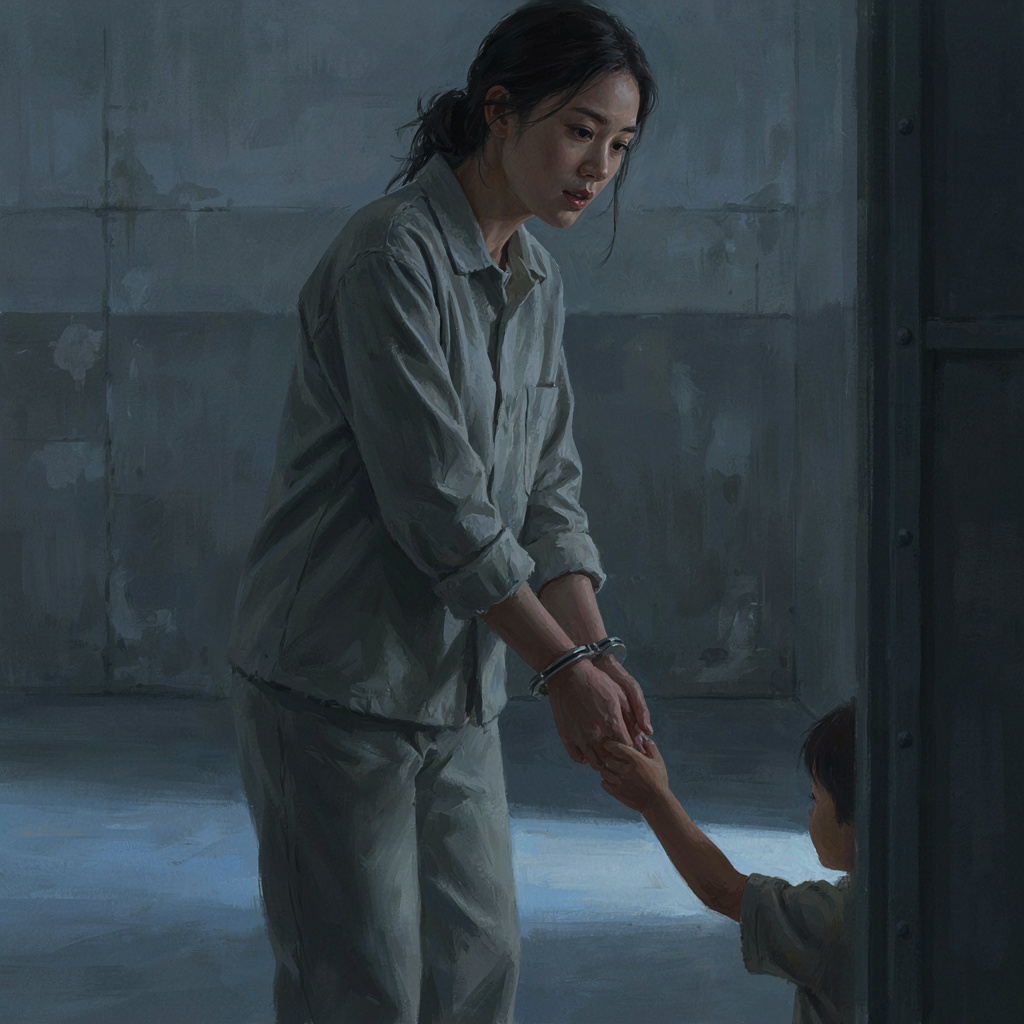
The execution room smelled like bleach, cold metal, and rain.My mother sat behind a glass partition with her hands cuffed in front of her.She looked smaller than I remembered.
Six years in prison had changed her. Her dark hair had turned almost completely gray, and the lines around her eyes had deepened.
But when she looked at me, I still saw the woman who used to wake me before school, braid my hair, and sneak pancakes onto my plate when Dad wasn’t looking.
A clock above the door showed 11:47 p.m.Thirteen minutes.That’s all she had left.
The state had scheduled her execution for midnight.My mother had been convicted of murdering my father.Everyone believed she had done it.The police.The prosecutor.The jury.
Our neighbors.Even me.Especially me.I was seventeen when Dad died.My little brother Matthew was eleven.
He had been too young to understand the courtroom, but old enough to understand one thing:
Everyone was saying Mom killed Dad.
For six years, Mom had written us letters from prison.Every letter contained the same sentence in one form or another.I didn’t kill him.I didn’t know how to answer her.Sometimes I didn’t answer at all.
That was the part I would carry for the rest of my life.The guard opened the door.”Five minutes.”My mother nodded.
I pressed my palms against the glass.”I’m sorry,” I whispered.She smiled.
“You don’t have to apologize for being seventeen.”
“I should have believed you.”
“You were scared.”
“I knew you.”
“You knew me before the trial,” she said softly. “The trial changed everything.”
The door opened again.
This time Matthew entered.
He was seventeen now.
The same age I had been when our lives collapsed.
He walked slowly toward Mom.
His face was wet with tears.
Mom stood.
The guard unlocked the cuffs connecting her hands.
Matthew threw his arms around her.
She held him tightly.
Then he leaned toward her ear.
I couldn’t hear what he said.
Mom suddenly pulled back.
Her face changed.
“Matthew…”
He whispered again.
Mom stared at him.
Then she looked at me.
“Where did you hear that?”
Matthew shook his head.
“I remembered.”
“Remembered what?”
His eyes moved toward the guard.
Then toward the clock.
“Mom,” he said, “I know who hid the knife under your bed.”
Everything inside me stopped.
Because for six years, everyone had believed the knife was the thing that proved Mom was guilty.
But Matthew had just told us something that could change everything.
And he had remembered it only thirteen minutes before my mother was supposed to die.
Six years earlier, I woke up to screaming.
Not my mother’s.
Our neighbor’s.
Mrs. Alvarez lived across the street, and I could hear her shouting through the open windows.
“Call the police!”
I ran downstairs.
Mom was standing in the kitchen.
She was barefoot.
Her white robe was covered in blood.
Dad was lying on the floor.
I remember his hand.
That is what I remember most.
One hand was curled beneath him.
The other was stretched toward the refrigerator.
There was blood everywhere.
Mom looked at me.
Her eyes were wide with terror.
“Emma,” she whispered.
I couldn’t move.
“Emma, listen to me.”
I stared at the blood on her robe.
“What happened?”
“I don’t know.”
Then the police arrived.
Everything happened quickly after that.
They separated us.
They photographed the kitchen.
They searched the house.
They found the knife under Mom’s bed.
It was the kitchen knife.
Dad’s blood was on it.
Mom’s fingerprints were on the handle.
Her blood was on her robe.
The prosecutor said the case was simple.
A husband and wife had argued.
The wife killed him.
She hid the knife.
Then she pretended she didn’t know what happened.
The defense argued that the evidence was circumstantial.
But the jury heard one devastating detail.
A neighbor claimed she had heard Mom and Dad arguing that night.
Another said Dad had threatened to leave her.
And a detective testified that Mom had scratches on her arm.
The prosecutor said those scratches were from Dad trying to defend himself.
Mom said they happened earlier that week when she fell against the rose bushes.
Nobody cared.
Then came the knife.
The prosecutor held it up in court.
“Mrs. Carter,” he said, “can you explain why your husband’s blood was found on a knife hidden beneath your bed?”
Mom stared at him.
“No.”
“Can you explain how it got there?”
“No.”
“Can you explain why your fingerprints were on it?”
“I used that knife before.”
“But you cannot explain why it was beneath your bed?”
“No.”
The prosecutor turned toward the jury.
“Because there is no reasonable explanation.”
There was.
We just didn’t know it.
Not then.
Mom was convicted.
First-degree murder.
Life imprisonment was the original sentence.
Then the prosecutor filed for the death penalty.
The appeals began.
For years, they failed.
I stopped visiting after the first year.
I told myself I was protecting Matthew.
The truth was uglier.
I couldn’t look at Mom.
Every time I saw her, I saw the kitchen.
The blood.
The knife.
Dad’s body.
And her robe.
Matthew kept visiting.
Every month.
He sat across from her through the glass.
He drew pictures for her.
He told her about school.
He told her when he made the basketball team.
He told her when he got his first girlfriend.
Mom kept asking about me.
“How’s Emma?”
“She’s fine.”
“Does she still draw?”
“Sometimes.”
“Is she happy?”
Matthew always lied.
He said yes.
I wasn’t.
I was angry.
At Mom.
At Dad.
At myself.
At the whole world.
But mostly, I was afraid that if I allowed myself to believe Mom was innocent, I would have to admit that I had abandoned her.
Then, six years after Dad’s death, the final execution date was set.
December 17.
Midnight.
Matthew was eighteen days from his eighteenth birthday.
He begged me to come with him.
“I don’t know if I can,” I said.
“You have to.”
“What if she really did it?”
Matthew looked at me.
“You don’t believe that.”
I said nothing.
He stepped closer.
“Emma, you’ve spent six years pretending you don’t care because caring hurts.”
“Stop.”
“Mom never stopped saying she loved you.”
“Stop.”
“She never blamed you.”
“Matthew!”
He stared at me.
Then he said something I never forgot.
“If she’s guilty, why is she still protecting someone?”
I frowned.
“What do you mean?”
“I don’t know.”
“What did she say?”
“Nothing.”
“Then why would you say that?”
Matthew shook his head.
“I don’t know yet.”
The night before the execution, I found a box in my closet.
It was old.
Dusty.
Inside were the things I had shoved away after Dad died.
A photograph of the four of us.
My school certificate.
A birthday card from Mom.
And six years of letters.
I had never opened them.
I don’t know why I opened the first one that night.
Maybe because I knew she might die the next day.
The letter was dated three years earlier.
Emma,
I don’t know if you’ll ever forgive me for not being able to protect you from everything that happened.
But I want you to know one thing.
Your father did not die because of something you did.
And he did not die because of something I did.
There are things I could tell you, but I promised someone I wouldn’t.
I made that promise because I thought it would protect you and Matthew.
If I ever get the chance, I will explain.
Love,
Mom.
I read it twice.
Then a third time.
A cold feeling spread through me.
I opened another.
Then another.
The same strange references appeared.
Promises.
Someone she couldn’t name.
Something she was protecting.
I called Matthew.
“Did Mom ever tell you anything about Dad?”
“No.”
“Are you sure?”
“Emma, why?”
“She wrote that she promised someone she wouldn’t talk.”
Silence.
Then Matthew said:
“I remember something.”
“What?”
“When Dad died, I saw someone.”
My heart stopped.
“Who?”
“I don’t know.”
“Matthew, what do you mean?”
“I was upstairs.”
“That night?”
“Yes.”
“You never told me.”
“I was eleven.”
“What did you see?”
He breathed shakily.
“I saw a man coming out of Mom’s bedroom.”
I sat down.
“What man?”
“I don’t know.”
“What did he look like?”
“I couldn’t see his face.”
“Why didn’t you tell the police?”
“Because Dad had told me not to talk about it.”
“What?”
“I heard Dad arguing with someone earlier that evening.”
“Who?”
“I don’t know.”
Matthew began crying.
“He told me to stay upstairs. Then I heard a door slam. I came into the hallway. There was a man in our house.”
“Matthew…”
“He looked at me.”
“What happened?”
“He put his finger over his mouth.”
Then Matthew said something that made my blood run cold.
“He was carrying something.”
“What?”
“A knife.”
We went to the prison the next morning.
Mom had less than an hour.
Matthew told her what he remembered.
She closed her eyes.
For several seconds, she didn’t speak.
Then she whispered:
“Your father knew.”
“Knew what?” I asked.
Mom looked at me.
“That someone wanted him dead.”
“Who?”
“I don’t know.”
“Then why didn’t you tell anyone?”
“Because your father begged me not to.”
“Why?”
“He said if I went to the police, you children would be in danger.”
I shook my head.
“That makes no sense.”
“I know.”
“Mom, who was in the house?”
She hesitated.
Then she said:
“Your father’s business partner.”
I stared at her.
“Daniel?”
She nodded.
Daniel Brooks had been Dad’s closest friend for twenty years.
He had attended the funeral.
He had testified at Mom’s trial.
He had even told reporters that Dad had been afraid of Mom in the months before his death.
“He lied,” Mom said.
“Why?”
“I don’t know.”
Matthew suddenly stood.
“Mom, was Daniel the man you promised to protect?”
Mom’s eyes filled with tears.
“No.”
“Then who?”
She looked at him.
“I promised your father.”
“To do what?”
“To never tell you children about the money.”
I frowned.
“What money?”
Mom swallowed.
“Your father had discovered Daniel was stealing from his company.”
The room went silent.
“How much?”
“Millions.”
I couldn’t breathe.
“Daniel killed him?”
“I don’t know.”
“You just said—”
“I said he had a motive.”
Mom leaned closer.
“But I never saw Daniel kill your father.”
“Then why was the knife under your bed?”
Mom looked at Matthew.
And suddenly, she began crying.
“Because someone wanted it to be found.”
At 11:18 p.m., I called the attorney.
At 11:21, he arrived.
At 11:23, we told him everything.
At 11:26, the prison administrator was notified.
At 11:29, the execution was temporarily delayed.
But a delay wasn’t an acquittal.
We needed evidence.
Real evidence.
Something stronger than a six-year-old memory.
Matthew remembered something else.
A sound.
After seeing the man leave Mom’s bedroom, he had gone back to his room.
Then he heard Dad’s voice downstairs.
Not arguing.
Calling someone.
Dad had said:
“You can’t do this.”
Then there was a crash.
Then silence.
Matthew had looked through the railing.
He saw Dad lying in the kitchen.
He saw Mom running toward him.
Then he saw the man enter Mom’s bedroom.
Minutes later, he left.
That meant something important.
The knife might not have been hidden before Dad died.
It could have been planted afterward.
But how could we prove it?
Then I remembered Mom’s letter.
Something about a promise.
Something about protecting us.
I asked the attorney to investigate Dad’s company records.
Two hours later, he called.
“There was an account.”
“What account?”
“A private account opened by your father three months before his death.”
“How much?”
“Two point eight million dollars.”
“Where?”
“Offshore.”
My stomach tightened.
“Who had access?”
“Your father.”
“And?”
“Daniel Brooks.”
The attorney paused.
“There’s more.”
“What?”
“The account was emptied the morning after your father died.”
“Where did the money go?”
“Into an account controlled by Daniel’s wife.”
Everything suddenly made sense.
The motive.
The lies.
The missing money.
But we still needed proof that Daniel had been in the house.
Then the attorney found something else.
A security company had installed cameras around the exterior of our home six months before Dad died.
The cameras had been removed after his death.
But the company kept archived recordings for seven years.
One camera faced the side entrance.
At 9:43 p.m. on the night Dad died, a black sedan pulled into the driveway.
The driver was Daniel Brooks.
At 10:16, he left.
But the most important footage came from a second camera.
It showed Daniel carrying a long kitchen knife into the house.
Then, nearly forty minutes later, he left empty-handed.
My hands shook.
“That’s him.”
The attorney stared at the screen.
“Are you certain?”
“Yes.”
Matthew was beside me.
He pointed at the screen.
“That’s the man.”
At 11:42 p.m., the prosecutor was shown the footage.
At 11:46, police arrived at Daniel’s house.
At 11:51, detectives found the old jacket he had worn that night.
Inside one pocket was a photograph.
It was Dad.
On the back were three words.
YOU KNOW TOO MUCH.
At 11:54, Daniel was arrested.
At 11:57, the governor signed an emergency stay.
At 11:59, my mother was told she would not be executed.
The clock struck midnight.
My mother was alive.
I collapsed against the wall.
Matthew cried.
The attorney put his hand on my shoulder.
“She has another hearing.”
“Will she be free?”
“Not yet.”
But for the first time in six years, there was hope.
Daniel’s trial began eight months later.
The security footage became the centerpiece of the prosecution’s case.
Then came the financial records.
Then DNA evidence.
Then a former employee testified that Daniel had confessed to stealing from Dad.
But the biggest revelation came from an unexpected place.
Daniel’s own sister testified.
She told the court that two days after Dad’s murder, Daniel had called her.
He had been panicking.
He told her that he had “taken care of the problem.”
She assumed he meant the money.
He meant my father.
Daniel had planted the knife under Mom’s bed because he knew investigators would immediately suspect her.
He had smeared Dad’s blood on her robe while she was unconscious.
And he had relied on one thing above all else.
Her silence.
Because Daniel had threatened Mom before the murder.
He told her that if she spoke about the stolen money, he would hurt Matthew and me.
So she remained silent.
Even when the police arrested her.
Even when the prosecutor called her a liar.
Even when I stopped visiting.
She stayed silent because she believed she was protecting us.
The jury convicted Daniel.
Life imprisonment without parole.
Mom’s conviction was overturned.
The judge apologized to her.
The state offered compensation.
None of it could give her six years back.
None of it could erase the years she missed.
But one thing could begin healing the wound.
Her children.
Mom walked out of prison on a rainy morning.
No cameras.
No reporters.
Just Matthew and me.
She stopped at the gate.
For a moment, she simply stared at the sky.
Then she laughed.
A tiny, broken laugh.
“I forgot how big it was.”
I started crying.
“I’m sorry.”
She shook her head.
“You’ve said that.”
“I should have believed you.”
She walked toward me.
I thought she might hug me.
Instead, she touched my face.
“You were seventeen.”
“I was your daughter.”
“You still are.”
Then she pulled me into her arms.
I cried against her shoulder like a child.
“I’m sorry I stopped visiting.”
“I know.”
“I read your letters.”
“All of them?”
“All of them.”
She smiled.
“Then you know I never stopped loving you.”
Matthew joined us.
Mom wrapped both of us in her arms.
For several minutes, none of us spoke.
Then Matthew whispered:
“I remembered the knife.”
Mom kissed his forehead.
“You saved my life.”
He shook his head.
“No.”
She looked at him.
“You saved all of us.”
Three years later, we moved into a small house near the ocean.
Mom planted roses along the fence.
She said she wanted something alive growing where the old memories couldn’t reach.
Matthew became a lawyer.
He said he wanted to defend people who had nobody left to believe them.
I became a journalist.
I wrote about wrongful convictions.
But I never wrote about my mother.
That story belonged to us.
One evening, I found Mom sitting on the porch.
She held an old photograph.
Dad was in it.
She looked at him for a long time.
“Do you miss him?” I asked.
She nodded.
“Even after everything?”
“He was your father.”
I sat beside her.
“Do you ever wish you had done something differently?”
She looked at the ocean.
“Every day.”
“What?”
“I wish I had told you the truth sooner.”
“You were trying to protect us.”
“Sometimes protecting people with silence only makes the darkness stronger.”
She folded the photograph.
Then she looked at me.
“Promise me something.”
“What?”
“If you ever know something is wrong, don’t stay silent just because you’re afraid.”
I nodded.
“I promise.”
Mom smiled.
Then she looked toward the roses.
One red flower had opened.
“Your father loved roses,” she said.
“I know.”
For a moment, neither of us spoke.
Then Matthew came running up the path.
“Mom!”
She turned.
“What?”
He was holding an envelope.
“I found this in the old storage box.”
“Whose is it?”
Matthew handed it to her.
Mom opened it.
Inside was a handwritten note from Dad.
She read the first line.
Her face went pale.
I took the letter from her.
There were only two sentences.
If anything happens to me, don’t trust Daniel.
And whatever you do, never believe the knife was the whole story.
We looked at each other.
For six years, we had believed the knife was the answer.
It wasn’t.
It had been the beginning of the lie.
And my mother had nearly died because everyone stopped looking once they found something that seemed to make sense.
I folded the letter carefully.
Then I looked at Mom.
She reached for my hand.
This time, I didn’t let go.
Because I finally understood the truth she had been trying to tell me for six years:
Sometimes innocence doesn’t look like innocence.
Sometimes the person who seems guilty is simply the person someone else chose to blame.
And sometimes, the smallest memory—a frightened child remembering a shadow in a hallway—can become the one piece of truth strong enough to bring a mother home.