After my husband died, my sixteen-year-old stepson packed a duffel bag and told me he wanted to live with his biological mother.I said, “I understand.”
Then I waited until his car disappeared around the corner before I closed the front door, slid down against it, and cried so hard I couldn’t breathe.
His name was Caleb.
I had helped raise him since he was six years old.
I had packed his lunches, learned how to braid the complicated knots he wanted in his shoelaces, sat beside him during thunderstorms, attended every parent-teacher conference,
and spent three miserable months teaching him fractions when he insisted that mathematics was personally designed to ruin his life.
But I wasn’t his mother.Not legally.Not biologically.
And after his father died, I suddenly felt as if I had no right to ask Caleb to stay.
His biological mother, Rachel, had always been somewhere in the background.She wasn’t cruel.She wasn’t absent.She simply lived three states away, remarried, and had built another life.
Caleb visited her during school breaks, but his home had always been with us.
Until his father died.
The funeral changed everything.
For weeks, Caleb barely spoke.He stopped eating at the kitchen table.He stopped playing basketball.He stopped leaving his bedroom except for school.
And one night, nearly a month after the funeral, he stood in the doorway of my bedroom holding a duffel bag.
“I think I should go live with Mom.”
My heart broke before he even finished the sentence.
I wanted to say no.
I wanted to tell him that his father had trusted me with him.
I wanted to say that I was his family too.
Instead, I swallowed everything I was feeling and said, “If that’s what you need, I’ll help you pack.”
He stared at me.
“You’re not mad?”
“No.”
“You’re not going to try to stop me?”
I shook my head.
“Your dad would want you to be where you feel safe.”
Caleb looked down.
For just a second, I thought he might cry.
Instead, he picked up his bag.
“I’ll visit.”
“I know.”
He hugged me quickly.
It lasted maybe two seconds.
Then he was gone.
For six months, he barely visited.
There were occasional phone calls.
Short text messages.
Happy birthday.
How are you?
Fine.
How’s school?
Good.
I learned to stop asking questions that had only one-word answers.
I went back to work.
I learned how to cook for one.
I stopped buying Caleb’s favorite cereal.
I stopped leaving the porch light on.
And I packed away the photographs.
Not because I wanted to forget him.
Because seeing them every morning hurt too much.
Then came Mother’s Day.
I woke up at 6:42 a.m.
The house was silent.
My husband’s coffee mug still sat in the cabinet where I’d left it.
His old baseball cap was hanging beside the back door.
I hadn’t been able to move it.
I made coffee and sat alone at the kitchen table.
My phone stayed silent.
I told myself I didn’t care.
That was a lie.
At exactly 7:00, someone knocked on my front door.
Three quick knocks.
I frowned.
Nobody visited that early.
I walked to the door and opened it.
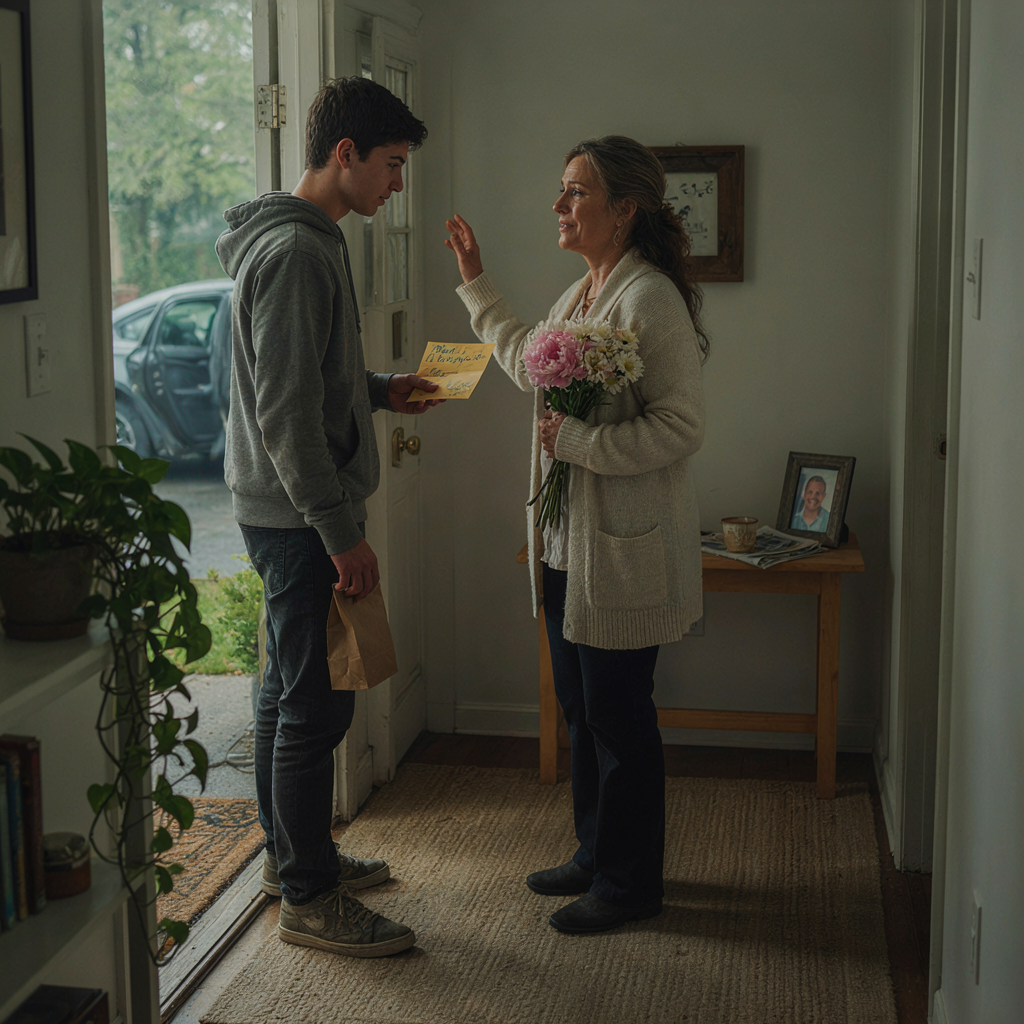
Caleb was standing on the porch.
He was taller.
Much taller.
His hair was longer.
He was wearing an old gray hoodie that belonged to his father.
In one hand, he carried a grocery bag.
In the other, he held one of my husband’s old recipe cards.
For several seconds, neither of us spoke.
Then Caleb looked at me.
“Dad made me promise something.”
My throat tightened.
“What?”
He held out the recipe card.
“He told me that if anything ever happened to him, I wasn’t allowed to let you spend Mother’s Day alone.”
I couldn’t speak.
Caleb looked embarrassed.
“So… I’m here.”
I stared at him.
“You drove all the way here?”
“Mom brought me halfway. I took the bus from there.”
“You came here at seven in the morning?”
He shrugged.
“Dad said seven.”
I laughed through my tears.
“That sounds like him.”
Caleb smiled.
Then he handed me the grocery bag.
Inside were eggs, flour, strawberries, butter, cinnamon, and a box of the coffee my husband always bought.
I looked at the ingredients.
“What are you making?”
“French toast.”
“You don’t know how to make French toast.”
“I watched videos.”
I laughed again.
He frowned.
“What?”
“Nothing.”
I stepped aside.
“Come in.”
Caleb walked into the house.
And somehow, for the first time in six months, it felt like home again.
We cooked breakfast together.
Or, more accurately, I cooked while Caleb attempted to help.
He burned the first batch.
The second batch was raw in the middle.
The third was almost edible.
We sat at the table with strawberries and powdered sugar scattered everywhere.
Then Caleb reached into his pocket.
He pulled out a folded envelope.
“There’s something else.”
I looked at him.
“What is it?”
“I don’t know.”
He slid it across the table.
“Dad gave it to me before he died.”
My hands froze.
“What?”
“He told me not to open it.”
I stared at the envelope.
There was handwriting on the front.
Mine.
My name was written in my husband’s handwriting.
“Why didn’t you give it to me before?”
Caleb looked down.
“Because I was angry.”
“At me?”
“At everyone.”
He took a breath.
“I thought Dad was supposed to get better.”
I nodded slowly.
“So did I.”
“He told me he wasn’t sure he would.”
My eyes filled with tears.
“He knew?”
Caleb nodded.
“Near the end.”
I opened the envelope.
Inside was a letter.
My husband’s handwriting filled three pages.
My hands shook as I began reading.
My love,
If you’re reading this, then I’m not there to explain everything myself.
I’m sorry.
I wish I had more time.
But there’s something I need you to know.
Caleb isn’t leaving because he doesn’t love you.
And if he tells you he wants to live with Rachel, let him go.
Don’t make him choose.
He’s going to think leaving means he’s betraying you.
Tell him it doesn’t.
I stopped reading.
Caleb stared at the table.
“Keep going,” he whispered.
I continued.
You have spent years being the person Caleb runs to when he’s sick, scared, angry, hungry, or confused.
You became his mother long before either of you realized it.
But grief makes children do strange things.
Sometimes they run toward the person who reminds them of what they’ve lost.
Rachel is his biological mother.
Let him find whatever he needs there.
But please don’t believe that leaving means he stopped loving you.
And please don’t let him believe that either.
I had to stop again.
Caleb wiped his eyes.
There was more.
One last thing.
I know you will try to be strong.
Don’t.
Cry when you need to.
Laugh when you can.
And when Mother’s Day comes, don’t sit alone pretending you don’t care.
Because you are a mother.
Maybe not by blood.
Maybe not by paperwork.
But by every lunch packed, every fever watched, every nightmare survived, every birthday remembered, every pair of shoes bought when money was tight, every time you chose Caleb even when nobody was watching.
You are his mother.
You are my family.
And if I’m not there, I need him to remind you.
Love always,
David.
I couldn’t see the page anymore.
My tears had blurred everything.
Caleb stood up.
Then he walked around the table.
He hugged me.
This time, he didn’t let go after two seconds.
He held me like a little boy again.
“I should’ve come back sooner,” he whispered.
I held him tighter.
“You came back when you were ready.”
“I thought you hated me.”
I pulled away.
“Never.”
“You didn’t call much.”
“I didn’t want to pressure you.”
“I thought you didn’t care.”
My heart broke.
“Caleb, I cared so much I was afraid I’d scare you away.”
He looked at me.
“I was scared too.”
We sat there for nearly an hour.
He told me what had happened during those six months.
Rachel had been kind.
Her husband, Mark, had tried.
But Caleb couldn’t sleep.
He couldn’t concentrate.
He kept having nightmares about the hospital.
He said he kept expecting his father to call him.
Eventually, he realized he didn’t need a replacement father.
He needed the people who had loved him before everything fell apart.
“I told Mom I wanted to come home,” he said.
I swallowed.
“Did she understand?”
“She cried.”
“Why?”
“She said she knew.”
I smiled sadly.
“What about school?”
“I want to finish the year here.”
My heart skipped.
“Here?”
“With you.”
I didn’t answer immediately.
I was afraid if I did, I would cry again.
So I stood and started clearing the plates.
Caleb laughed.
“You always do that.”
“Do what?”
“Clean when you’re emotional.”
“I do not.”
“You absolutely do.”
He grabbed a plate.
“I’ll help.”
And just like that, we were back in the kitchen.
But things weren’t magically fixed.
Grief doesn’t work that way.
Caleb still had nightmares.
I still cried in the shower.
There were days when we argued.
There were days when Caleb said he wanted to be alone.
And there were days when I wasn’t sure whether I was doing the right thing.
Then, three weeks after Mother’s Day, something happened that changed everything.
I received a phone call from Rachel.
“I need to tell you something.”
Her voice sounded nervous.
“What is it?”
“I found something in David’s old things.”
My stomach tightened.
“What?”
“A box.”
“What kind of box?”
“Documents.”
She paused.
“And a video.”
I sat down.
“What video?”
“I think you should see it.”
The next evening, Rachel came to my house.
Caleb was upstairs.
She carried a small cardboard box.
She put it on the table.
“I almost threw this away.”
Inside were old photographs, receipts, birthday cards, and a small USB drive.
Rachel looked at me.
“I don’t know what he intended to do with it.”
We plugged the drive into my laptop.
A video appeared.
David was sitting in his office.
He looked thinner than I remembered.
Tired.
But he smiled at the camera.
“If you’re watching this, then I probably lost the argument with my doctor.”
My heart cracked.
He continued.
“I made this because there are things I can’t say when Caleb is sitting across from me.”
He looked directly into the camera.
“Caleb, if you’re watching this someday, listen carefully.”
The boy beside me stopped breathing.
David smiled.
“You’re going to feel guilty.”
Caleb’s eyes filled with tears.
“You’re going to think you should have noticed things sooner. You’re going to think you should have said more. You may even convince yourself that somehow you caused this.”
David shook his head.
“You didn’t.”
The video continued.
“And don’t punish the people who love you because you’re angry at me for leaving.”
Caleb covered his mouth.
“You’re allowed to be angry,” David said. “But don’t confuse anger with truth.”
Then David looked toward the camera.
“And don’t punish her.”
He meant me.
“She’s going to tell you she’s okay.”
I laughed through tears.
“She won’t be.”
Rachel squeezed my hand.
“She’ll pretend because she thinks that’s what strong people do.”
David smiled.
“But she’s not strong because she doesn’t cry.”
“She is strong because she keeps loving people even when loving them hurts.”
The screen went black.
Nobody moved.
Finally, Caleb whispered:
“I wish Dad could see me now.”
I pulled him against me.
“He would.”
“How do you know?”
“Because he knew you.”
Caleb cried into my shoulder.
Rachel sat quietly across from us.
After a moment, she said something I never expected.
“I think David was right.”
I looked at her.
“About what?”
“About you being his mother.”
I couldn’t answer.
Rachel continued.
“I used to be jealous.”
“Of me?”
“Yes.”
She looked down.
“I hated that he called you when he was sick. I hated that you knew his teachers. I hated that you knew which cereal he liked.”
She smiled sadly.
“But then I realized something.”
“What?”
“You weren’t replacing me.”
She looked toward the stairs.
“You were giving him another person to love.”
For the first time, Rachel and I cried together.
Not because we were enemies.
Because we had both loved the same boy in different ways.
Over the next year, our family changed.
Not perfectly.
Not easily.
But honestly.
Caleb lived with me during the school year and spent summers with Rachel.
We attended counseling together.
We celebrated David’s birthday every year by making his terrible homemade chili.
Caleb eventually learned to make French toast properly.
Mostly.
One evening, nearly a year after that Mother’s Day, I found him in the kitchen.
He was holding a recipe card.
The same one he’d brought to my door.
“What’s that?”
“Dad’s pancakes.”
“You hate pancakes.”
“I know.”
“Then why are you making them?”
He smiled.
“Because you like them.”
I stared at him.
He looked at the recipe.
Then he said:
“I’ve been thinking.”
“That’s dangerous.”
He laughed.
“I know.”
He turned serious.
“I want to ask you something.”
“Okay.”
“Can I call you Mom?”
The room went completely still.
I couldn’t breathe.
“You don’t have to,” I whispered.
“I know.”
“You can call me whatever feels right.”
He nodded.
Then he smiled.
“Okay, Mom.”
That one word destroyed me.
I turned away because I didn’t want him to see me crying.
But he did.
And instead of pretending he hadn’t noticed, he hugged me.
“You’re doing it again.”
“Doing what?”
“Crying while cleaning.”
I laughed.
“I am not cleaning.”
“You’re wiping the counter.”
“Because it’s dirty.”
“Sure, Mom.”
I stopped.
He smiled.
And I realized something.
Motherhood had never been about blood.
It had been about showing up.
Again.
And again.
And again.
Even when the child didn’t know how to say thank you.
Even when grief made him run away.
Even when fear convinced him that leaving was easier than staying.
That Mother’s Day, Caleb had arrived at my door with a grocery bag and an old recipe card.
But what he really brought me was something far more important.
He brought me back my family.
Years later, I still keep that recipe card in a frame above the kitchen table.
The edges are worn.
There are tiny grease stains on it.
And beneath David’s handwriting, Caleb eventually wrote three words.
For Mom. Always.
Sometimes people ask me whether I ever regretted letting Caleb leave.
I tell them the truth.
Yes.
There were nights I wished I had begged him to stay.
There were mornings I wondered whether I had made the biggest mistake of my life.
But I understand now.
Love isn’t always holding someone close.
Sometimes love is opening the door.
Letting them go.
Trusting that if what you built together was real, distance won’t erase it.
Caleb didn’t leave because he stopped loving me.
He left because he was sixteen, grieving his father, and trying to figure out where he belonged in a world that had suddenly changed.
And I wasn’t supposed to stop him from searching.
I was supposed to make sure he knew he could always come home.
He did.
And when he finally did, he didn’t come back as the frightened little boy I’d helped raise.
He came back as a young man who had learned something I had needed to learn too.
Families aren’t always the ones we’re born into.
Sometimes they’re the people who keep showing up.
Sometimes they’re the people who remember promises made in hospital rooms.
Sometimes they’re the people who stand on your porch at seven in the morning with burned French toast and an old recipe card.
And sometimes…
they’re the ones who look you in the eyes and say one small word that changes your entire life.
“Mom.”