When my daughter was sixteen, her little brother fell from the porch while she watched him.I blamed her for months.“You were supposed to be responsible,” I told her.
She had been responsible for him that afternoon.That was the part I couldn’t deny.She was sixteen. He was six.
I had asked her to watch him for twenty minutes while I drove to the grocery store.
Twenty minutes.That was all.
But when I came home, my son was lying on the grass beneath the porch, crying so hard he could barely breathe.His arm was bent at an angle that made my stomach turn.
My daughter, Emily, stood frozen beside the porch steps.She was barefoot.Her face was white.
There was blood on one of her hands—not his, but hers.
She had cut her palm trying to climb over the railing after him.
“Mom,” she whispered.I didn’t hear the rest.I ran to my son.The ambulance came.The hospital came.The X-rays came.The surgery came.
And somewhere between the emergency room and the operating room, I decided that what happened was Emily’s fault.
She had been watching him.
She should have stopped him.
She should have known better.
She should have been more careful.
She should have been more like the daughter I thought I had raised.
I never asked what she had actually seen.
I never asked why she had blood on her hand.
I never asked why there was a broken flowerpot beneath the porch railing.
I never asked why my son kept saying, “It wasn’t Emily.”
I was too angry.
And guilt is sometimes easier to carry when you put it in someone else’s hands.
For months, I reminded Emily of that afternoon.
Every time my son complained about his arm, I looked at her.
Every physical therapy appointment reminded me of her.
Every sleepless night reminded me.
“You were supposed to be responsible.”
“You were sixteen, not six.”
“I trusted you.”
“You failed him.”
The words became so normal that eventually I stopped noticing how much they hurt her.
Emily tried to explain.
At first, she tried constantly.
“I didn’t let him fall.”
“He ran toward the railing.”
“I grabbed him.”
“Mom, I tried.”
But I didn’t listen.
One evening, she stood in the kitchen with tears running down her face.
“I’ve told you what happened.”
“And I’ve told you what I think.”
She stared at me.
“What do you think?”
“I think you weren’t paying attention.”
Her lips trembled.
“I was.”
“No, Emily.”
“I was.”
“Then how did he fall?”
She looked at me for a long time.
Then she said something I would remember for the next seventeen years.
“Because I was holding him when he fell.”
I didn’t understand.
Or maybe I didn’t want to.
She wiped her face.
“He climbed onto the railing. I grabbed him. He slipped. I caught his shirt, but the shirt ripped.”
I said nothing.
“I fell too. I cut my hand on the railing.”
Still, I said nothing.
“I didn’t watch him fall, Mom.”
She looked down.
“I watched him almost fall. And I tried to save him.”
Then she whispered:
“But you already decided I didn’t.”
That was the last real conversation we had.
Three months later, Emily packed a small suitcase.
She had $120 in cash.
My sister, Linda, lived three hours away and had offered to let her stay.
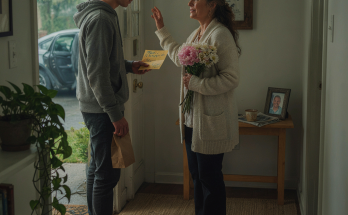
I remember standing at the front door as Emily carried her suitcase down the steps.
I wanted her to turn around.
I wanted her to apologize.
I wanted her to say she was sorry.
Instead, she looked at me.
“Are you coming home?”
I crossed my arms.
“If you need time, take it.”
Her eyes filled with tears.
“That isn’t what I asked.”
I didn’t answer.
She nodded.
Then she walked away.
She was sixteen.
She never came back.
That was 2009.
Seventeen years.
I kept her bedroom untouched.
At first, I told myself it was because she might return.
Then because I couldn’t bear to clean it.
Eventually, I stopped giving myself reasons.
Her blue walls stayed blue.
Her old bookshelf stayed in the corner.
A dried friendship bracelet hung from the bedpost.
There was a tiny crack in the mirror she’d complained about.
Her winter coat remained behind the door.
I never moved it.
My son, Daniel, grew up.
He recovered.
His arm healed.
He went to college.
Got married.
Had a daughter.
Life kept moving.
Except for one room in my house.
Emily’s room remained seventeen years behind.
Sometimes, when I walked past it, I imagined her at sixteen.
Sometimes I imagined her at twenty.
Then twenty-five.
Thirty.
I wondered what she looked like.
Whether she still had the same laugh.
Whether she hated me.
Whether she ever thought about home.
I searched for her once.
I found a social media account with her name, but I wasn’t sure it was hers.
There was a photograph of a woman standing beside a man and two little boys.
The woman’s hair was longer.
Her face was thinner.
But her eyes were unmistakable.
Emily.
I stared at that photograph for almost an hour.
The two boys were smiling.
One had his arm around her waist.
She looked happy.
I closed the page.
I didn’t send a message.
Pride is a strange thing.
It can survive seventeen years on almost nothing.
Then last winter, my body finally betrayed me.
It started as a dull pain in my back.
Then numbness.
Then weakness in my legs.
One morning, I dropped a coffee cup because my fingers wouldn’t close around it.
My doctor ordered scans.
The results came quickly.
There was severe compression in my spine.
I needed surgery.
Not someday.
Soon.
The estimate was $44,000.
I had insurance, but the surgery, rehabilitation, medications, and related costs were still going to leave me with a frightening amount to pay.
I was sixty-three years old.
I had spent most of my adult life believing I was strong enough to handle anything.
Suddenly, walking from my bedroom to the bathroom felt like crossing a football field.
I scheduled the operation.
Then I was admitted to the hospital.
The morning before surgery, a volunteer came into my room carrying paperwork.
She was a cheerful woman in her fifties.
“Marianne Cole?”
I nodded.
She smiled.
“I need you to sign these forms.”
I took the pen.
She glanced at the name on my chart.
Then she froze.
Her eyes moved from the paperwork to my face.
“Are you Marianne Cole?”
“Yes.”
She swallowed.
Then she looked toward the hallway.
“Do you have a daughter named Emily?”
My hand stopped.
The pen hovered over the paper.
“What?”
“Emily Cole?”
I stared at her.
“How do you know my daughter?”
The volunteer’s expression changed.
“I think you should talk to her.”
My heart began pounding.
“Is she here?”
The woman nodded.
“She works in physical therapy.”
The room suddenly felt too small.
“She works here?”
“Yes.”
I couldn’t speak.
The volunteer stepped toward the door.
“She saw your name on the surgical schedule.”
I looked down at the blanket covering my legs.
For seventeen years, I had imagined this moment.
Sometimes Emily would come back angry.
Sometimes crying.
Sometimes successful.
Sometimes alone.
I had imagined what I would say.
But I had never imagined she would be standing just outside my hospital room.
The volunteer asked quietly:
“Would you like me to call her?”
I folded the blanket with trembling hands.
Then I looked toward the doorway.
“Tell her I’m ready to…”
The words caught in my throat.
I closed my eyes.
“Tell her I’m ready to listen.”
The volunteer nodded.
Then she left.
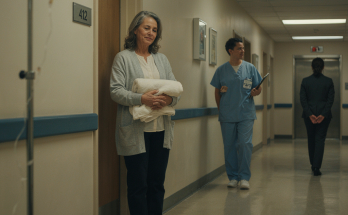
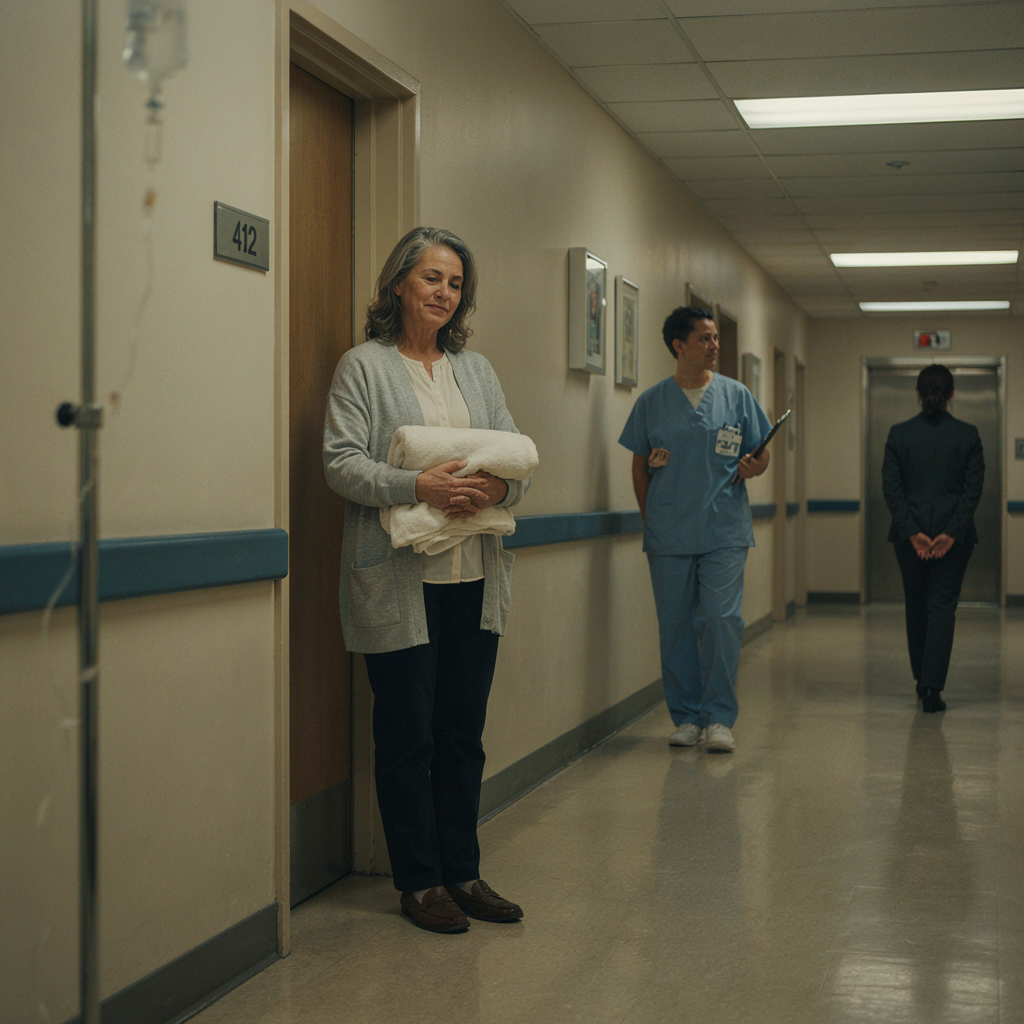
Five minutes later, I heard footsteps.
Slow footsteps.
They stopped outside my door.
I knew those footsteps before I saw her.
The door opened.
Emily stood there.
She was thirty-three years old.
She wore navy hospital scrubs.
Her hair was pulled into a loose ponytail.
A wedding ring was on her finger.
She carried a folder against her chest.
And for a moment, neither of us spoke.
Then she whispered:
“Hi, Mom.”
I broke.
Not loudly.
Not dramatically.
I simply covered my mouth because the sound that came out of me didn’t feel like it belonged to a sixty-three-year-old woman.
It sounded like the mother of a sixteen-year-old girl.
“Emily.”
She nodded.
“I heard you were having surgery.”
“How long have you known?”
“Since yesterday.”
“Why didn’t you come sooner?”
She looked at me.
“Because I wasn’t sure you wanted me here.”
That sentence hurt more than anything anyone had ever said to me.
I looked away.
“I do.”
She pulled the chair closer.
But she didn’t sit.
“I can leave if you want.”
“No.”
My voice cracked.
“Please sit.”
She sat.
For several seconds, we stared at each other.
Then I noticed something.
Her left hand had a faint scar across the palm.
The scar ran diagonally from beneath her thumb toward her wrist.
I remembered that hand.
Blood.
The porch.
The day I’d blamed her.
My eyes filled with tears.
“You still have the scar.”
She looked at her palm.
“Yes.”
“From that day?”
She nodded.
I couldn’t breathe.
“Emily…”
She looked at me.
“I owe you an apology.”
She gave a tiny, sad smile.
“You don’t owe me anything.”
“I do.”
“You really don’t.”
“I blamed you.”
“Yes.”
“For months.”
“Yes.”
“I said things I shouldn’t have.”
“Yes.”
I swallowed.
“Why didn’t you come home?”
Her eyes dropped.
“Because you told me I wasn’t safe around Daniel.”
I closed my eyes.
“I don’t remember saying that.”
“I do.”
The room became silent.
She opened the folder.
Inside was a photograph.
She placed it on the blanket.
It was an old photograph of Daniel at six years old.
He was sitting on the hospital bed.
His arm was wrapped in a cast.
And beside him was Emily.
Sixteen.
Her palm bandaged.
Her face swollen from crying.
I stared at it.
“I kept that.”
“Why?”
“Because I wanted to remember the truth.”
I looked at her.
“What truth?”
“That I didn’t abandon him.”
She reached into the folder again.
This time, she pulled out a folded piece of paper.
“I wrote this the night I left.”
I unfolded it.
The handwriting was unmistakably hers.
Mom,
I know you think I don’t care about Daniel.
I do.
I love him.
I was holding him when he slipped.
I tried to catch him.
I couldn’t.
I’m sorry I couldn’t save him.
I’m sorry you don’t believe me.
I hope someday you do.
I read it twice.
Then a third time.
The tears blurred the words.
“I never saw this.”
“I left it on your dresser.”
I looked at her.
“I never found it.”
“I figured you threw it away.”
“I didn’t.”
She shook her head.
“I know.”
“What?”
“You kept my room.”
I stared at her.
“How do you know?”
She smiled sadly.
“Daniel told me.”
My heart stopped.
“Daniel?”
She nodded.
“He found me three years ago.”
I sat up as far as my aching back allowed.
“What?”
“He contacted me.”
“Why didn’t he tell me?”
“He asked me not to.”
“Why?”
“Because he was afraid you’d be angry.”
I looked toward the window.
For seventeen years, I had believed Emily had disappeared from all of us.
She hadn’t.
My son had found her.
He had spoken to her.
He had known where she was.
And he hadn’t told me.
“Does Daniel know you’re here?”
“Yes.”
“What did he say?”
Emily hesitated.
“He said I should do what I thought was right.”
I nodded slowly.
Then I asked the question that had haunted me for nearly two decades.
“Did you ever hate me?”
She looked at me for a long time.
“Yes.”
The honesty hurt.
“But not forever.”
She leaned back.
“For a while, I hated you because I was a child and I needed someone to blame too.”
My eyes lowered.
“But then I became an adult.”
She smiled faintly.
“I got married.”
I looked at her ring.
“His name is David.”
“And the boys?”
“My stepsons.”
She smiled.
“They’re twelve and nine.”
“You raised them?”
“Yes.”
“Are they yours?”
“They’re mine.”
Her voice became warmer.
“I learned that family isn’t always about who you’re related to. Sometimes it’s about who stays.”
I closed my eyes.
That word.
Stays.
It cut through me.
“I wasn’t very good at staying,” I whispered.
She didn’t answer.
I looked at her.
“Are you a physical therapist?”
“Yes.”
“Here?”
“Yes.”
“How did you…”
I couldn’t finish.
She smiled.
“After Daniel’s accident, I became obsessed with physical therapy.”
I stared at her.
“I wanted to understand how people recover after something goes wrong.”
She looked down.
“Maybe I was trying to understand myself.”
I started crying again.
She reached for my hand.
I almost pulled away from shame.
But she held it.
Her palm was warm.
The scar was still there.
“I thought you hated me,” I said.
“I hated what happened.”
She squeezed my fingers.
“There is a difference.”
The next morning, I went into surgery.
The last thing I remembered before anesthesia was Emily standing beside the bed.
She said:
“I’ll be here when you wake up.”
For the first time in seventeen years, I believed my daughter.
When I opened my eyes, she was there.
So was Daniel.
He stood at the foot of my bed, crying.
I looked at him.
“You knew.”
He nodded.
“I found her three years ago.”
“Why didn’t you tell me?”
“Because she wasn’t ready.”
I looked at Emily.
“She wasn’t ready?”
Emily shook her head.
“I was scared.”
“Of me?”
“Yes.”
The word crushed me.
Daniel stepped closer.
“Mom, there is something else you need to know.”
I looked at him.
He took a breath.
“The day I fell, Emily didn’t just try to catch me.”
He pulled out his phone.
On the screen was a video.
It was from a neighbor’s security camera.
The footage was old and grainy.
But it showed our porch.
It showed Daniel running outside.
It showed him climbing onto the railing.
It showed Emily sprinting after him.
She grabbed him.
He slipped.
She caught his shirt.
The shirt tore.
They both fell.
Emily landed partly on him.
She had taken the worst of the fall.
I watched the footage once.
Then again.
Then I covered my face.
For seventeen years, I had blamed a sixteen-year-old girl for failing to prevent an accident.
The evidence had existed all along.
I simply hadn’t cared enough to look.
“Why didn’t you show me this?”
Daniel looked at me.
“Because Dad deleted the original recording.”
I froze.
“Your father?”
Daniel nodded.
My ex-husband had died years earlier.
“He said it would make things worse.”
“Worse?”
“He told me you needed someone to blame.”
I couldn’t speak.
Daniel sat down.
“He thought if you blamed Emily, you’d stop blaming yourself.”
I stared at the ceiling.
All those years.
All that pain.
All because none of us had known how to face the truth.
I turned toward Emily.
“I destroyed seventeen years.”
She shook her head.
“You didn’t destroy all of them.”
“I missed your wedding.”
“Yes.”
“I missed your first home.”
“Yes.”
“I missed your boys growing up.”
“Yes.”
“I missed everything.”
She looked at me.
“So did I.”
We sat in silence.
Then I said:
“Can you forgive me?”
She looked at my face.
“I don’t know.”
My heart sank.
“But I can try.”
That was enough.
Recovery took months.
Emily became part of my rehabilitation.
Not because she had to.
Because she wanted to.
She taught me how to stand correctly.
How to walk without fear.
How to climb stairs.
How to trust my body again.
Sometimes I caught her watching me.
And I knew she was remembering another time when she had tried to help someone walk.
Her little brother.
A six-year-old boy.
A sixteen-year-old girl.
A mother who had been too angry to listen.
One afternoon, I asked her:
“Do you still have my number?”
She smiled.
“Yes.”
“You never called.”
“I called.”
“What?”
“Hundreds of times.”
I stared at her.
“When?”
“After I left.”
She laughed softly.
“You changed your number.”
I covered my face.
Of course I had.
I had changed it after my divorce.
Then again.
Then again.
She had tried.
And I had convinced myself she hadn’t.
When I was finally discharged, I returned home with a walker.
The house looked smaller.
Quieter.
But one thing hadn’t changed.
The blue bedroom.
Emily stood in the hallway.
“Do you want to see it?”
She nodded.
I opened the door.
She stopped.
Her eyes widened.
Everything was still there.
The bookshelf.
The mirror.
The bracelet.
The coat.
The old bedspread.
Even a tiny stuffed rabbit she’d owned since childhood.
Emily stepped inside.
She touched the wall.
“You kept it.”
“I couldn’t let it go.”
She turned toward me.
“You should have.”
I looked down.
“Maybe.”
She walked to the bookshelf.
There was a framed photograph of her at twelve.
She picked it up.
“I look ridiculous.”
I laughed through my tears.
“You always hated that haircut.”
“I still do.”
For the first time in seventeen years, we laughed together.
It wasn’t perfect.
It didn’t erase anything.
But it was real.
Then Emily turned around.
“Mom?”
“Yes?”
“Can I ask you something?”
“Anything.”
“Why did you never come looking for me?”
I felt the question in my bones.
“Because I thought you were happier without me.”
She stared at me.
“I was.”
I nodded.
“That makes sense.”
“But I was also waiting.”
I looked at her.
“For what?”
“For you to admit you were wrong.”
My throat tightened.
“I should have.”
“Yes.”
“I was ashamed.”
“I know.”
“I thought if I admitted it, I’d have to face everything I had done.”
She nodded.
“And now?”
I looked around the room.
“Now I don’t have seventeen years left to waste.”
She began crying.
I opened my arms.
For one terrible second, she stood still.
Then she stepped forward.
My daughter was no longer sixteen.
She was thirty-three.
She was a wife.
A mother.
A physical therapist.
A woman who had built an entire life without me.
But when she hugged me, I felt the sixteen-year-old girl I’d lost all those years ago.
I held her as tightly as my healing body allowed.
“I am so sorry,” I whispered.
She cried against my shoulder.
“I know.”
A month later, Emily brought her two boys to my house.
The older one stood in the doorway.
“Grandma?”
I smiled.
“Yes.”
He looked at me suspiciously.
“Mom says you’re learning to walk.”
“I am.”
“Can I help?”
I laughed.
“You can.”
He grabbed my walker.
His younger brother ran beside us.
Emily watched from the kitchen.
And suddenly the house wasn’t quiet anymore.
There were footsteps.
Laughter.
Noise.
Life.
That evening, after they left, I walked upstairs alone.
I opened the blue bedroom.
Then I did something I hadn’t done in seventeen years.
I opened the closet.
I took down Emily’s old coat.
I folded it.
And I put it into a box.
Not because I was forgetting her.
Because I wasn’t waiting for her anymore.
I didn’t need a museum to prove that she had once been my daughter.
She was here.
She called me Mom.
Her children called me Grandma.
And the room could finally become something new.
A week later, Emily came over with a small paint sample.
“Mom.”
“Yes?”
“Would you mind if we changed the room?”
I smiled.
“What color?”
She held it up.
A soft warm green.
I laughed.
“You always hated blue.”
“I was sixteen.”
“You hated it at ten.”
“Okay, fair.”
She smiled.
Then she said:
“I think we should make it a guest room.”
I looked at her.
“Who will use it?”
She shrugged.
“Maybe me.”
My eyes filled with tears.
“Maybe the boys.”
I nodded.
“Maybe all of us.”
That weekend, we painted the walls together.
Daniel came too.
He brought pizza.
The boys got paint on the floor.
Emily got paint on my sleeve.
I pretended to be angry.
She laughed.
At one point, I stood in the doorway and watched all of them.
My family.
Not the family I had imagined.
The family I had almost lost.
And I realized something.
Some mistakes don’t disappear when you apologize.
Some wounds never completely close.
But sometimes, if you’re lucky, you get another chance to stop making them worse.
Seventeen years ago, I had watched my daughter walk away with $120 in her pocket.
I thought I was punishing her.
I didn’t understand that I was punishing myself too.
Last winter, when the hospital volunteer asked whether I wanted my daughter called, I had started to say:
“Tell her I’m ready to…”
I had almost said, “Tell her I’m ready to forgive her.”
But that would have been wrong.
She was never the one who needed forgiveness.
So I said:
“Tell her I’m ready to listen.”
And that became the beginning of everything.
Because sometimes the person you’ve spent years waiting to come back isn’t the person who needs to change.
Sometimes it’s you.
And sometimes the door you thought your child slammed shut seventeen years ago wasn’t locked at all.
You were simply too proud to turn the handle.