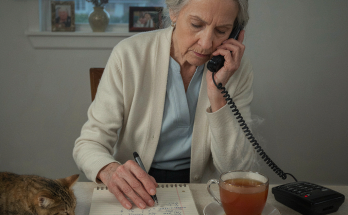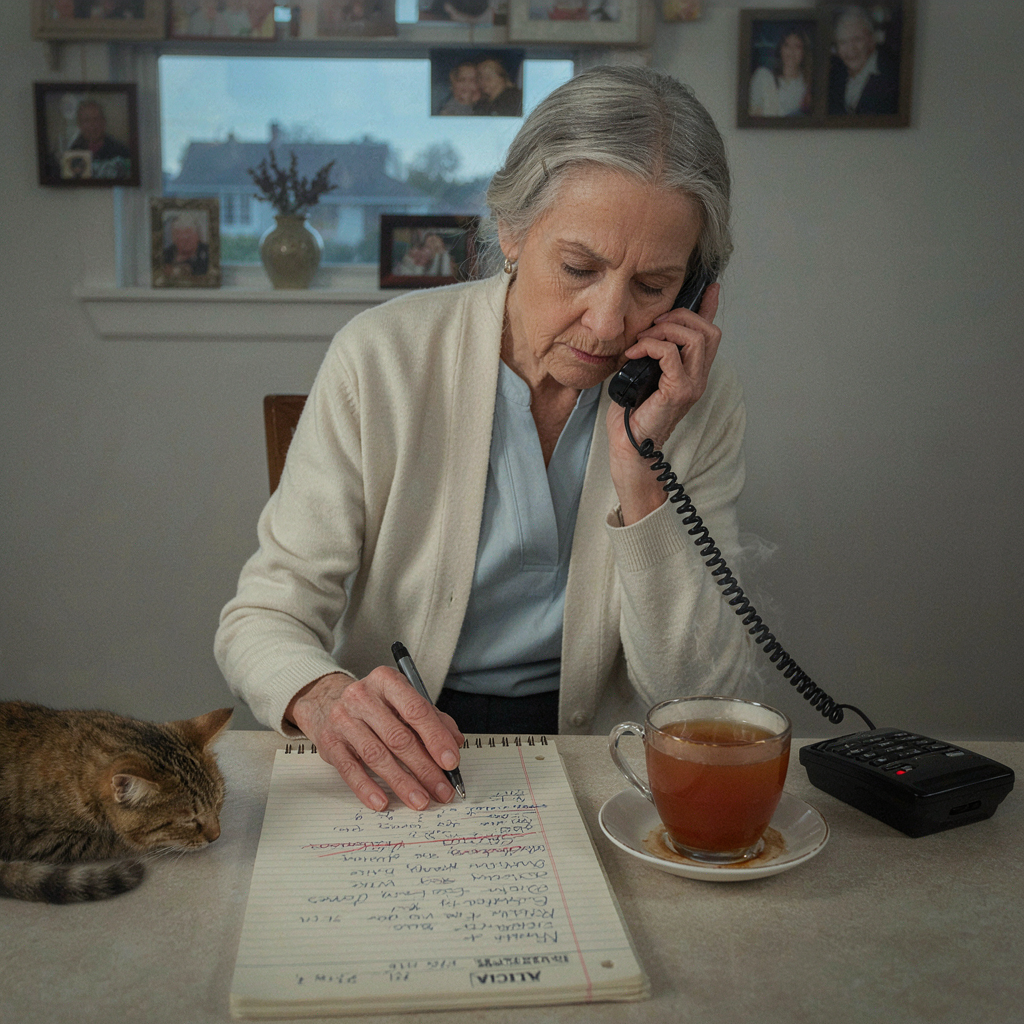
My daughter-in-law pocket-dialed me at 7:15 that morning.She never knew I answered.For nineteen minutes, I sat at my kitchen table with my tea going cold and listened to her and my son plan, in detail, what they were going to do with me by Christmas.
They were in the car.They were driving to my house.So I pulled my grocery notepad closer, clicked my pen, and started writing down every word.
My name is Dorothy.I am seventy-three.My husband, Raymond, has been gone four years now.
My son Mark calls me every Sunday at five, for exactly eleven minutes.
His wife, Alicia, calls me “Mother D” in a voice like sweet tea with something floating in it.The phone rang at 7:15, and her name came up.I thought someone was in the hospital.
“Alicia?”Road noise.Then her voice.”Did you bring the documents?”I froze.A man’s voice answered.Mark.
“No. Mom keeps everything in that little filing cabinet.”
My hand tightened around my teacup.
They weren’t calling me.They didn’t know I was listening.I lowered the phone from my ear for half a second, staring at the screen as if it might explain what was happening.
Then I put it back.Alicia sighed.”I’m telling you, Mark, we can’t keep waiting. Christmas is less than three months away.”
“We’ll handle it today.”
“She won’t agree.”
“She doesn’t have to.”
Those four words made my stomach turn.
I wrote them down.
She doesn’t have to.
Alicia laughed softly.
“Exactly.”
The car hummed beneath their voices.
I could hear the windshield wipers.
Then Mark said something that made my blood run cold.
“Once she’s in the assisted-living place, the house is ours.”
My pen stopped.
The house.
My house.
The house Raymond and I had bought thirty-eight years ago.
The house where Mark had taken his first steps.
The house where I had kept his school drawings in a box beneath my bed.
The house where Raymond had died in our bedroom four years earlier, holding my hand.
Our house.
Alicia said, “The realtor said we could get at least six hundred thousand.”
Six hundred thousand.
I stared around my kitchen.
The yellow curtains Raymond had complained were too bright.
The little wooden rooster he’d carved for me.
The refrigerator covered with magnets from places we’d visited before his knees got bad.
Six hundred thousand dollars.
That’s what my son and daughter-in-law saw when they looked at my home.
Not memories.
Not thirty-eight years.
Six hundred thousand dollars.
I kept writing.
Mark lowered his voice.
“What about Mom’s accounts?”
Alicia replied, “We’ll deal with those after the house.”
“And her jewelry?”
“Mark.”
“What?”
“You’re making me nervous.”
“I just asked.”
“You know what the lawyer said. Once she signs the power of attorney, we can handle everything.”
My pen moved faster.
Power of attorney.
Lawyer.
Accounts.
Jewelry.
Then Alicia said something that made me stop breathing.
“Your father left more than the house.”
Silence.
Mark said, “I know.”
“You never told me exactly how much.”
“Because Mom doesn’t know.”
My eyes narrowed.
They were quiet for several seconds.
Then Mark said:
“At least three million.”
My teacup slipped from my hand.
It hit the table and rolled onto its side.
Tea spread across the notepad.
Three million dollars.
I grabbed another piece of paper.
My heart was pounding.
Where had Raymond hidden three million dollars?
I knew every account we had.
Or I thought I did.
Raymond had been a careful man.
He was an accountant for most of his life.
He hated debt.
He hated gambling.
He hated talking about money.
When he died, our attorney had gone through everything with me.
House.
Savings.
Retirement.
Insurance.
Investments.
Nothing remotely close to three million.
Unless…
Unless Raymond had deliberately hidden something from me.
I put the phone closer to my ear.
Alicia spoke again.
“The important thing is that she believes we’re helping her.”
Mark laughed.
“She trusts me.”
That hurt more than everything else.
My son was right.
I did trust him.
I had trusted him since the day I held him in my arms.
He was my only child.
My boy.
The one person I believed would never deliberately hurt me.
Then Alicia said:
“She’ll sign anything if you tell her it’s for her safety.”
Mark answered:
“That’s why we’re taking her to the doctor first.”
“The doctor?”
“Her memory.”
I stopped writing.
Alicia whispered, “You’re going to tell the doctor she’s forgetting things.”
“I’ve already started.”
My entire body went cold.
“What have you told him?”
“That she’s been confused lately. Missing appointments. Repeating herself.”
Alicia laughed.
“She does repeat herself.”
“Everyone does at seventy-three.”
“Not like her.”
Then Mark said:
“By Christmas, she’ll either be in the facility or under guardianship.”
I stared at the phone.
Guardianship.
They weren’t planning to help me.
They were planning to take control of my life.
And they were driving to my house right now.
I looked at the clock.
7:34.
The call continued.
Alicia said, “We’re ten minutes away.”
Mark replied, “Good. Act normal.”
The call ended.
I sat completely still.
My tea was cold.
The kitchen was silent.
And for the first time in my life, I understood something terrifying.
The person who knew exactly how to destroy you wasn’t always your enemy.
Sometimes it was the person who knew where you kept the spare key.
I looked at the grocery notepad.
Nineteen minutes of evidence.
Names.
Statements.
Plans.
Numbers.
Dates.
I tore off the page.
Then I did something I hadn’t done in years.
I opened Raymond’s old desk.
His office had remained almost untouched since his death.
People told me that was unhealthy.
Maybe it was.
But grief isn’t a room you leave just because someone tells you to.
I pulled open the bottom drawer.
Inside were old tax returns, insurance papers, receipts, and three notebooks.
Raymond’s handwriting covered the first.
I flipped through pages.
Nothing.
Second notebook.
Nothing.
Third.
My fingers stopped.
On the inside cover, Raymond had written:
Dorothy—If Mark ever comes asking questions about the house, don’t answer him until you’ve read page 47.
I nearly dropped the notebook.
I turned to page 47.
There were only six words.
He knows where I hid it.
Below that was an address.
Not ours.
A bank.
A safety-deposit bank downtown.
My heart began pounding.
I heard a car pull into the driveway.
Mark and Alicia had arrived.
I closed the notebook.
Then I smiled.
For the first time that morning, I was not afraid.
I was curious.
I slipped the notebook into my robe pocket.
Then I walked to the front door.
Mark stood outside holding flowers.
Alicia carried a bakery box.
“Mom!”
Mark smiled.
He hugged me.
His arms felt exactly the same as they had when he was a child.
And yet I felt like I was hugging a stranger.
“Surprise,” he said.
Alicia kissed my cheek.
“Good morning, Mother D.”
“Good morning.”
She looked around.
“Are you all right?”
I smiled.
“Never better.”
Mark’s eyes flicked toward the kitchen.
“What happened here?”
“Tea.”
He laughed.
“Still spilling things.”
Alicia looked at him.
He looked at her.
It was brief.
But I saw it.
They were checking whether I looked confused.
Whether I looked weak.
Whether I remembered what was happening.
I invited them inside.
We sat around my kitchen table.
Alicia opened the bakery box.
“Cinnamon rolls.”
“Thank you.”
Mark reached across the table and squeezed my hand.
“Mom, we need to talk about your future.”
There it was.
I smiled gently.
“My future?”
“Your health.”
“I’m healthy.”
“We’re worried.”
“About what?”
He hesitated.
Alicia jumped in.
“You’re alone here.”
“I’ve been alone for four years.”
“And things happen.”
“What things?”
Mark looked uncomfortable.
“Mom, you’ve forgotten things.”
“Such as?”
He glanced at Alicia.
She sighed.
“You forgot your doctor’s appointment last month.”
“I didn’t have an appointment.”
“You did.”
“No.”
Her smile tightened.
“See?”
I took a sip of tea.
“What else?”
Mark said, “You called me three times last Sunday.”
I stared at him.
“No, I didn’t.”
“You did.”
“Your call log says otherwise.”
His face changed.
Only slightly.
But I saw it.
He had expected me to argue emotionally.
Instead, I was being precise.
Alicia said, “Mom, nobody is accusing you of anything.”
“I didn’t say anyone was.”
Mark leaned closer.
“We think it might be safer if you stayed somewhere with people around.”
“An assisted-living community?”
He nodded.
“Just temporarily.”
“Until Christmas?”
His face went pale.
Alicia stopped breathing.
I smiled.
“That seems to be the plan.”
Silence.
Mark stared at me.
“What?”
I reached into my robe pocket.
Pulled out the grocery notepad.
And placed it on the table.
Nineteen minutes.
His face drained of color.
Alicia whispered:
“Oh my God.”
“You pocket-dialed me,” I said.
Mark slowly stood.
“Mom…”
“No.”
I held up my hand.
“Sit down.”
He sat.
I looked at both of them.
“I heard everything.”
Alicia began crying.
Not because she was sorry.
Because she realized the plan had failed.
Mark stared at the table.
“I can explain.”
“You said I don’t have to agree.”
“I didn’t mean it like that.”
“You said you would tell the doctor I was confused.”
“Mom, I was worried.”
“You lied.”
He looked up.
His eyes filled with tears.
“Mom, I need the house.”
I felt something inside me break.
Not because he wanted money.
Because he said it without shame.
“Why?”
He rubbed his face.
“Business.”
“What business?”
“I owe money.”
“How much?”
“About two hundred thousand.”
Alicia corrected him.
“Three hundred.”
He glared at her.
She shrugged.
“You can’t hide it now.”
I looked at my son.
“How did you get three hundred thousand dollars in debt?”
His voice cracked.
“I thought I could fix it.”
“With my house?”
He didn’t answer.
Then Alicia said:
“The house isn’t the only thing.”
I turned toward her.
“What did Raymond leave?”
She stared at Mark.
Mark whispered:
“Three million.”
I nodded.
“That’s what I heard.”
Mark looked at me.
“You don’t know where it is.”
“No.”
“But you do know something.”
“Yes.”
I pulled Raymond’s notebook from my pocket.
Mark saw it.
His expression changed completely.
“Where did you get that?”
“Your father’s desk.”
He stood again.
“Give it to me.”
“No.”
“Mom.”
“Sit down.”
He didn’t.
I opened the notebook.
“Raymond wrote something here.”
Mark’s face had gone white.
“He wrote that if you ever came asking about the house, I should read page forty-seven.”
Alicia whispered:
“What did it say?”
I looked at Mark.
“He knows where I hid it.”
Mark sat down.
I watched him.
“Did you know your father was hiding money?”
He swallowed.
“No.”
“Then why did you tell Alicia you knew?”
Silence.
That was the moment I realized something.
Mark hadn’t been honest with Alicia either.
I turned to her.
“How much did you know?”
She shook her head.
“I heard rumors.”
“From whom?”
“Your son.”
Mark snapped, “I never told you anything.”
“You told me your father had investments.”
“That’s different.”
“Then where did the three million figure come from?”
Alicia looked at me.
“Your husband had a business partner.”
I remembered.
Thomas Reed.
Raymond’s old business partner.
He had disappeared from our lives years before Raymond died.
I suddenly remembered something else.
A Christmas card.
Thomas had sent one every year.
Except the final year.
Raymond had burned it.
At the time, I had thought it was strange.
Now I understood.
I stood.
“I’m going to the bank.”
Mark stood too.
“I’m coming.”
“No.”
“Mom, if Dad left something—”
“You will not come with me.”
He stopped.
I picked up my purse.
Then I looked at Alicia.
“And neither will you.”
She began crying again.
I walked out.
At the bank, I showed them Raymond’s documents.
The manager disappeared for several minutes.
Then he returned with an envelope.
“Mrs. Hayes?”
“Yes.”
“This was placed here four years ago.”
My hands trembled.
“By my husband?”
“Yes.”
I opened the envelope.
Inside was a letter.
My eyes blurred as I read.
My dearest Dorothy,
If you’re reading this, something has happened that I prayed would never happen.
I didn’t tell you about the money because I was afraid it would put you in danger.
Thomas and I discovered that someone had been stealing from our investment company. We traced it back to people connected to our business. I moved the remaining funds into a protected trust under your name.
I stopped.
Under my name.
I kept reading.
The amount is approximately three million dollars.
My knees nearly gave out.
Mark knows about the investigation. I don’t believe he participated, but I believe he knows more than he has ever told us.
I closed my eyes.
Raymond had suspected our son.
Then came the sentence that broke my heart.
If Mark ever tries to take control of your home or finances, do not trust him until you know the truth.
There was another document.
A trust agreement.
My name was on it.
The money was legally mine.
Protected.
Untouchable by anyone without my written consent.
But Raymond had left something else.
A flash drive.
I took it home.
That evening, Mark called.
I didn’t answer.
He called again.
Then Alicia.
Then again.
At 9:40, someone knocked on my door.
It was Mark.
I opened it only halfway.
He looked exhausted.
“Mom, please.”
“No.”
“I made mistakes.”
“Yes.”
“But I’m still your son.”
I looked at him.
“That is exactly why this hurts.”
He lowered his head.
“I was desperate.”
“Desperation doesn’t explain lying about my memory.”
“I thought if I scared you enough, you’d agree.”
“Agree to what?”
“Moving.”
“Why?”
He looked away.
Finally he whispered:
“Because the debt collectors were coming.”
I stared at him.
“How much?”
He said nothing.
“Mark.”
“Eight hundred thousand.”
My heart sank.
Eight hundred thousand.
Not three hundred.
Not a small business problem.
He had gambled.
I could see it in his face.
“Did you gamble?”
He began crying.
“Yes.”
I closed my eyes.
“How long?”
“Two years.”
“Alicia knew?”
He nodded.
“And she helped you?”
“No.”
Then he looked up.
“She wanted the house more than I did.”
That explained everything.
The sweet voice.
The fake concern.
The urgency.
Alicia wasn’t simply protecting my son.
She was protecting her future.
The next morning, I called my attorney.
Her name was Evelyn Grant.
She had handled Raymond’s estate.
I told her everything.
She came to my house with another attorney and a forensic accountant.
We opened the flash drive.
It contained recordings, financial records, and emails from Raymond’s investigation.
Then we found the truth.
Mark had not stolen Raymond’s money.
But he had discovered the trust after Raymond died.
Instead of telling me, he and Alicia had spent four years trying to gain control of it.
They had contacted doctors.
They had consulted lawyers.
They had even spoken to a realtor.
They had built an entire plan around convincing everyone I was incapable of managing my own affairs.
But Raymond had anticipated it.
His recordings documented everything.
Including one conversation with Mark from six months before his death.
My son was twenty-nine.
Raymond’s voice was weak.
“Mark, you need to understand something.”
“Understand what?”
“Money won’t save you from your choices.”
“I don’t know what you’re talking about.”
“If you ever come after your mother’s home, you will lose more than money.”
There was silence.
Then Mark said:
“You’re hiding something.”
Raymond replied:
“I’m protecting something.”
The recording ended.
I sat in Evelyn’s office and cried.
Not because Raymond had hidden three million dollars.
Because even when he was dying, he had been trying to protect me.
Evelyn placed a hand over mine.
“You have options.”
“What options?”
“We can pursue guardianship fraud and financial misconduct.”
I looked down.
“Against my son?”
“If you choose.”
I was quiet.
Then I said:
“I don’t want revenge.”
Evelyn nodded.
“I want accountability.”
That was what happened.
The evidence was undeniable.
The doctor Mark had contacted admitted that Mark had exaggerated my supposed memory problems.
The realtor produced emails.
The attorney Mark had consulted provided documentation.
Alicia’s messages showed they had already planned how to sell my house.
And the bank records showed Mark had nearly lost everything through gambling.
Christmas came early that year.
Not with presents.
With consequences.
Mark and Alicia came to my house one final time.
Mark stood on the porch.
He looked older.
Smaller.
“Mom.”
I opened the door.
“I have something to say.”
I waited.
“I’m sorry.”
I believed he was sorry.
But forgiveness and trust are not the same thing.
“I believe you,” I said.
He looked relieved.
“But you’re not getting the house.”
He nodded.
“I know.”
“And you’re not getting the money.”
“I know.”
“And you’re not managing my finances.”
“I know.”
His eyes filled.
“Can I still be your son?”
That question broke me.
I stepped aside.
“Come inside.”
He entered.
Alicia remained outside.
I looked at her.
“You can come in too.”
She didn’t move.
“I don’t deserve it.”
“No,” I said. “But that’s not my decision to make for you.”
She looked at me for a long time.
Then she walked away.
Mark sat at the kitchen table.
The same table where I’d sat months earlier with my cold tea.
I made fresh tea.
We didn’t talk about money.
We talked about Raymond.
Mark told me he remembered his father teaching him to ride a bicycle.
I told him Raymond had cried when Mark went to college.
For the first time in years, my son and I spoke without pretending.
Eventually Mark asked:
“What will you do with the money?”
I smiled.
“Live.”
He laughed softly.
“I guess you earned that.”
“No.”
I looked toward the window.
“Your father earned it.”
Then I added:
“But he left it to me.”
Mark nodded.
And that was the end of the battle.
But not the end of the story.
Because six months later, I sold the house.
Not because Mark forced me.
Because I wanted to.
I bought a smaller home near the lake.
I donated a portion of the trust to a hospice center.
Another portion went to scholarships for students studying accounting.
And I kept enough to make sure I would never again depend on anyone who could use my dependence against me.
On the first Christmas morning in my new home, there was a knock at the door.
I opened it.
Mark stood there holding a small wooden box.
He smiled.
“I made something.”
I opened it.
Inside was a little wooden rooster.
Just like the one Raymond had carved for me decades earlier.
“I remembered Dad making yours,” Mark said.
I touched the rooster.
“You made this?”
He nodded.
“It took me six tries.”
I laughed.
“Your father would have said you needed seven.”
Mark smiled.
Then he hugged me.
This time, it didn’t feel like hugging a stranger.
It felt like hugging my son.
Not the boy I remembered.
Not the man who had betrayed me.
But someone in between.
Someone trying to become better.
Before he left, he turned around.
“Mom?”
“Yes?”
“Why didn’t you destroy us when you had the chance?”
I thought about it.
Then I answered honestly.
“Because revenge would have made you the center of my life again.”
He stared at me.
“And you don’t want that?”
I smiled.
“No.”
I looked around my little house.
At the sunlight coming through the windows.
At Raymond’s photographs.
At the wooden rooster.
At the quiet life I had rebuilt.
“My life is finally mine.”
Mark nodded.
Then he left.
I closed the door.
And for the first time in four years, Christmas morning didn’t feel like something I had to survive.
It felt like something I was allowed to enjoy.
I made tea.
I sat at my kitchen table.
And I opened my old grocery notepad.
The page with those nineteen minutes was still there.
Every word.
Every lie.
Every plan.
I looked at the sentence I’d written at the very top:
She doesn’t have to agree.
Then I turned the page.
On the clean paper, I wrote something new.
I don’t have to agree either.
I smiled.
At seventy-three, I had finally learned something my younger self never understood.
Being someone’s mother doesn’t mean surrendering your life to them.
Being someone’s wife doesn’t mean disappearing when they die.
And being old doesn’t mean becoming powerless.
Sometimes, the strongest thing an aging woman can do is sit quietly at her kitchen table…
listen carefully…
write everything down…
and wait.
Because when people think they’ve already won, they stop being careful.
And when they stop being careful, the truth has a way of answering the phone.
Even when they never meant to call you.