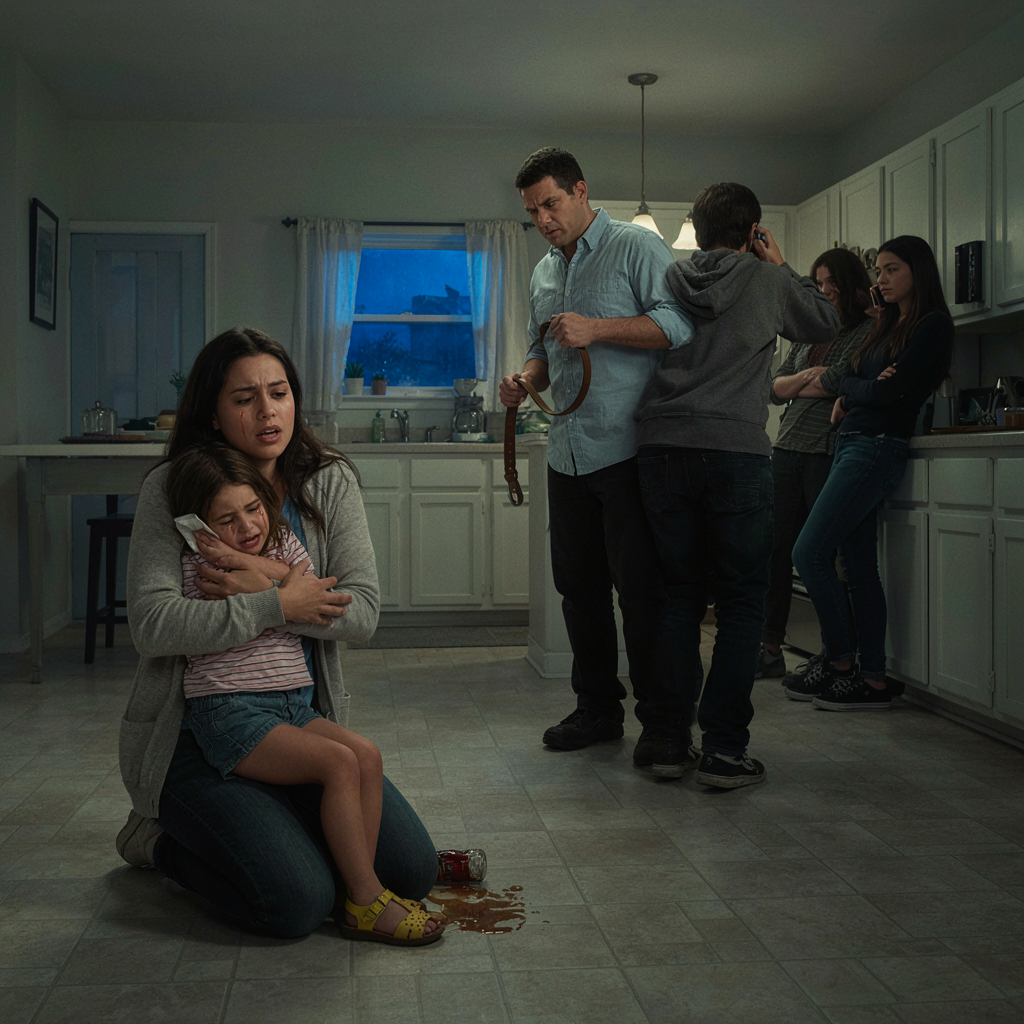
My father yanked off his belt to punish my three-year-old daughter, Camila, over a soda.As I cradled her after she slammed onto the kitchen tile, my mother looked at us and said,”She had it coming.”
Camila’s yellow sandal had slipped on a wet spot while she tried to run from him, and the crack of her head against the floor silenced the band outside.
I pressed a napkin to her injury and begged, “Cami, sweetheart, please look at Mommy. I’m here.”
My father still held the belt.My sister said someone had to teach Camila respect.
Then Diego stepped between my father and me, phone still pressed to his ear.”Yes,” he said calmly into the phone. “I’m still at the house.”My father stared at him.”Who are you calling?”
Diego didn’t answer.He simply looked at me and said,”Is she breathing normally?”I nodded, barely able to speak.”Take her to the hospital,” he said. “I’ll handle this.”
My father laughed.”Handle what?”Diego finally lowered the phone.”The police.”The room went completely silent.
My name is Elena Vargas, and until that afternoon, I had spent most of my adult life believing that family meant forgiveness.
I had forgiven my father for missing my college graduation.I had forgiven my mother for always defending him.
I had forgiven my older sister, Marissa, for taking things that weren’t hers and somehow convincing everyone that I had been selfish for wanting them back.
And when I became a single mother, I forgave all of them again.
Because I thought Camila deserved grandparents.
I thought she deserved cousins.
I thought she deserved a family Christmas where nobody had to wonder whether they belonged.
I was wrong.
That Saturday had started innocently enough.
My parents were celebrating their thirty-fifth wedding anniversary in their backyard.
There was a rented band, tables covered with white cloth, strings of lights, and enough food to feed fifty people.
I had brought Camila because my mother insisted.
“She’s family,” Mom had told me that morning. “Don’t keep her away from us just because you and your father don’t get along.”
So I swallowed my pride.
I dressed Camila in a little blue dress with yellow sandals.
She looked adorable.
She spent the afternoon chasing bubbles around the yard while adults talked and laughed.
Diego, my mother’s nephew, had arrived around three.
He was twenty-nine and worked as a paramedic.
Unlike most people in my family, Diego had never treated me like I was difficult simply because I refused to obey my father.
He had always been kind to Camila.
That afternoon, he had spent nearly twenty minutes helping her build a tower out of plastic cups.
Everything changed over one can of soda.
Camila had seen the other children drinking orange soda.
She came into the kitchen and pointed at the refrigerator.
“Mommy, orange.”
I smiled.
“Okay, sweetheart. One small cup.”
I poured her some and set it on the counter.
Then my father walked in.
He had already been drinking.
I could smell alcohol on him.
He looked at Camila.
“What is that?”
“Soda,” I said.
“I said no soda in my kitchen.”
I blinked.
“She has one small cup.”
“Did I ask you how much?”
Camila looked at him nervously.
My father pointed at her.
“Put it down.”
She hugged the cup against her chest.
“No.”
It was the first time I had ever heard her tell him no.
My father stepped closer.
“What did you say?”
I immediately moved between them.
“She’s three, Dad.”
“Then teach her.”
“I’m teaching her.”
“You’re raising a spoiled little brat.”
My stomach tightened.
“Don’t call my daughter that.”
My father laughed.
“Look at you. Suddenly you’re a mother who knows everything.”
I took Camila’s hand.
“Come on, baby.”
We started walking toward the back door.
Then my father shouted,
“Come back here!”
Camila ran.
Not because she was defiant.
Because she was scared.
Her little sandals slapped against the tile.
I turned.
My father grabbed his belt.
Everything happened in seconds.
He swung it once through the air.
Camila screamed.
She ran faster.
Her yellow sandal slipped on the water she had spilled near the sink.
Her feet shot forward.
Her body slammed onto the floor.
And her head hit the tile.
The sound still lives inside me.
It was not loud.
That was the worst part.
It was one sharp crack.
Then silence.
I dropped beside her.
“Cami!”
She wasn’t crying.
That terrified me more than anything.
I scooped her into my arms.
Her eyes fluttered.
“Mommy…”
“I’m here.”
I pressed a napkin against the back of her head.
Blood immediately soaked through it.
My father stood over us, belt still in his hand.
My mother came into the kitchen.
She looked at Camila.
Then at my father.
Then she sighed.
“She had it coming.”
I stared at her.
For a moment, I couldn’t understand the words.
“What?”
Mom crossed her arms.
“Your father told her to stop.”
“She is three years old!”
“Exactly. If you don’t discipline her now, she’ll become impossible.”
Marissa appeared behind her.
She looked at Camila and rolled her eyes.
“Someone has to teach her respect.”
Something inside me broke.
Not because my father had threatened my daughter.
Not because my mother defended him.
But because my sister said it like she had been waiting for the opportunity.
I stood.
I was shaking.
“You stay away from my daughter.”
My father raised the belt again.
“Don’t you dare talk to me like that in my house.”
Then Diego stepped between us.
Phone pressed to his ear.
“Yes,” he said. “I’m still at the house.”
My father stopped.
“Who are you calling?”
Diego looked directly at him.
“The police.”
My father’s face changed.
“Hang up.”
“No.”
“I’m warning you.”
Diego’s voice remained calm.
“I heard everything.”
Marissa stepped forward.
“You can’t call the police over a family argument.”
Diego looked at her.
“This stopped being a family argument when a three-year-old hit her head because an adult chased her with a belt.”
Mom started crying.
Not because of Camila.
Because she realized the police might actually come.
“Diego, please.”
He shook his head.
“I’m sorry, Aunt Rosa.”
My father lunged toward him.
Diego didn’t move.
“Touch me,” he said quietly, “and I’ll add assault to the report.”
My father froze.
I carried Camila outside.
Someone called an ambulance.
The band had stopped playing.
Fifty people stood in the yard watching me walk past them with my bleeding child.
Nobody said anything.
Nobody asked if she was okay.
Except one woman.
An elderly neighbor named Mrs. Alvarez came running toward me.
“Oh, sweetheart.”
She touched my shoulder.
“Let me help.”
That small act of kindness almost made me cry.
The ambulance arrived six minutes later.
The paramedic examined Camila.
“She’s conscious, but she needs to be evaluated.”
I climbed into the ambulance.
Diego followed in his car.
At the hospital, doctors performed scans.
We waited.
I sat beside Camila’s bed, holding her tiny hand.
She had finally fallen asleep.
A small bandage covered the back of her head.
I stared at it.
My mother called.
I didn’t answer.
She called again.
Then Marissa.
Then my father.
Finally, I turned my phone off.
Diego sat beside me.
“You okay?”
I laughed bitterly.
“No.”
He nodded.
“I know.”
“What happens now?”
“The police will want statements.”
I looked at him.
“Are you sure you want to do this?”
His expression hardened.
“Elena, I saw your father holding the belt.”
He paused.
“And I heard what they said afterward.”
I looked down.
“Maybe I should have left years ago.”
“You should have.”
His honesty surprised me.
“I kept thinking family could change.”
“People change when they want to.”
He glanced toward Camila.
“Not because we keep giving them opportunities to hurt us.”
The doctor returned.
“Good news. No skull fracture or brain bleed.”
My knees nearly gave out.
“But she has a concussion,” the doctor continued. “She’ll need monitoring.”
I closed my eyes.
Thank God.
That night, I took Camila home to my small apartment.
I sat beside her bed until sunrise.
Around two in the morning, she woke up.
“Mommy?”
“I’m here.”
“Grandpa mad?”
My heart shattered.
I kissed her forehead.
“No, baby.”
I couldn’t tell her the truth yet.
“Mommy won’t let anybody hurt you.”
She fell asleep holding my finger.
And I made a promise.
One I would never break.
The next morning, my mother arrived at my apartment.
She stood outside crying.
“Please let me see her.”
I didn’t open the door.
“Why?”
“I want to apologize.”
“To me?”
“To Camila.”
I stared at her through the doorway.
“Then start by telling me what you should have done yesterday.”
She cried harder.
“I should have stopped him.”
“Yes.”
“I was scared.”
“So was my daughter.”
Mom lowered her head.
“I know.”
“Then why did you say she deserved it?”
She didn’t answer.
Finally she whispered,
“Because if I admitted your father was wrong, I’d have to admit I’ve been protecting him for thirty-five years.”
That sentence stayed with me.
I opened the door.
But I didn’t let her inside.
“Go home, Mom.”
She nodded.
“I understand.”
“No.”
I looked her directly in the eyes.
“You don’t understand yet.”
I closed the door.
Three days later, the police contacted me.
They had interviewed witnesses.
There was video.
My parents had installed security cameras around the property years earlier.
One camera faced the kitchen entrance.
Another captured the backyard.
My father had apparently forgotten about them.
The footage showed everything.
My father taking off his belt.
Swinging it.
Chasing Camila.
Her slipping.
Her falling.
Me screaming.
My mother saying, “She had it coming.”
Marissa saying someone needed to teach Camila respect.
The detective asked if I wanted to press charges.
I looked at the video.
I saw my three-year-old daughter running for her life.
Then I said,
“Yes.”
The case moved quickly.
My father was charged with child endangerment and assault.
My mother wasn’t charged, but the detective told me her statement mattered.
Marissa initially lied.
She claimed my father never swung the belt.
Then the detective showed her the footage.
Her story changed.
She said she had been afraid of our father.
I believed her.
But I wasn’t going to rescue her anymore.
Not at my daughter’s expense.
Two weeks later, something unexpected happened.
My mother came to my apartment carrying a box.
She looked exhausted.
“I found this.”
She handed it to me.
Inside were old photographs, letters, and documents.
“What is this?”
“Things your father told me to destroy.”
I looked at her.
“What things?”
She swallowed.
“Proof that he has been controlling the family finances for years.”
I frowned.
My parents owned several properties.
My father always claimed everything belonged to him.
Mom continued.
“Your grandmother left money to both of us.”
I knew that.
“What I didn’t know,” she said, “was that your father moved the money into an account controlled only by him.”
I stared at her.
“How much?”
“Almost four hundred thousand dollars.”
I couldn’t believe it.
“Why are you telling me now?”
“Because I finally understand something.”
She wiped her eyes.
“Protecting him didn’t protect our family.”
She opened the box.
At the bottom was an old letter.
It was from my grandmother.
It said:
Elena deserves the same opportunity as her sister. If anything happens to me, make sure both girls are treated equally.
I read it twice.
Then I understood.
My father hadn’t just been cruel.
He had spent years dividing us.
Marissa received opportunities.
I received guilt.
Marissa got help with her business.
I was told to be independent.
Marissa got money for her house.
I was told family shouldn’t be about money.
I had always thought I was simply the less-loved daughter.
Now I realized my father had deliberately made me believe that.
My mother had allowed it.
And I had spent years apologizing for things I had never done.
I gave the documents to an attorney.
The investigation uncovered more.
My father had transferred assets into accounts under Marissa’s name.
She had known some of it.
Not everything.
When confronted, she broke down.
“I didn’t know it was stolen.”
“You knew it wasn’t yours.”
She cried.
“I was afraid of Dad.”
I looked at her.
“So was I.”
“But you always fought him.”
“No.”
I shook my head.
“I just stopped pretending he was right.”
The legal battle lasted months.
During that time, my father tried everything.
He called relatives.
He told them I was destroying the family.
He claimed I had exaggerated what happened.
He said Camila’s injury was an accident.
He said the belt had never touched her.
He said I was mentally unstable.
Then the courtroom received the security footage.
The room became silent.
My father watched himself chase a three-year-old girl with a belt.
He watched her fall.
He watched himself stand over her.
And then the recording played my mother’s voice.
“She had it coming.”
My father lowered his head.
For the first time in my life, he had nothing to say.
The judge sentenced him to prison time and ordered him to complete counseling and anger-management programs.
My mother filed for divorce.
Marissa moved out of the house.
And I walked away from all of them.
Not because I hated them.
Because I finally understood that forgiveness did not require access.
I could forgive someone from a distance.
I could love my mother without allowing her to be part of Camila’s daily life.
I could even feel sorry for my sister without pretending she hadn’t failed my daughter.
Six months later, Camila was running around our new home.
We had moved to a quieter neighborhood.
She had a little garden outside her bedroom.
One afternoon, she found a yellow sandal in an old box.
She brought it to me.
“Mommy!”
I smiled.
“What?”
“Look!”
She held it up.
“The yellow shoe.”
I knelt beside her.
“Do you remember?”
She thought for a moment.
Then she nodded.
“Grandpa made me scared.”
My heart tightened.
I hugged her.
“Yes.”
“Is Grandpa coming here?”
“No.”
“Why?”
I looked into her eyes.
“Because Mommy promised you’d always be safe.”
She smiled.
“Okay.”
Then she ran outside.
I watched her go.
A little girl.
Three years old when she learned that adults could be dangerous.
But also three years old when she learned that her mother would stand between her and anyone who tried to hurt her.
One year after the incident, my mother came to my house again.
This time she didn’t bring flowers.
She didn’t bring excuses.
She brought a letter.
“I wrote this for Camila,” she said.
I accepted it.
“Can I read it?”
“If you want.”
I opened it.
It was short.
Dear Camila,
I failed you.
When you needed me to protect you, I protected the person who scared you.
There is no excuse for that.
You did not deserve what happened.
You were a little girl who wanted a soda.
I hope someday you understand that none of it was your fault.
Love, Grandma.
I folded the letter.
“Thank you.”
My mother looked toward the house.
“Can I see her?”
I thought about it.
Then I shook my head.
“Not yet.”
She nodded.
“I understand.”
This time, I believed her.
Months passed.
Eventually, I allowed supervised visits.
My mother never made excuses again.
She never blamed Camila.
She never defended my father.
She simply showed up, sat on the floor, and let Camila decide whether she wanted a hug.
Trust returned slowly.
Never completely.
But enough.
As for Marissa, she eventually apologized too.
Not because she suddenly became a perfect sister.
Because she finally admitted what she had done.
“I thought if I agreed with Dad, he’d love me more,” she told me.
I said nothing.
She looked down.
“And I was jealous of you.”
“Why?”
“Because you didn’t need his approval.”
That surprised me.
I had spent my entire childhood believing she was the confident one.
She had spent hers believing I was.
Maybe we had both been trapped in the same house in different ways.
But understanding her didn’t erase what happened.
It simply allowed me to stop carrying the anger.
Two years after that terrible afternoon, Camila turned five.
She wore a yellow dress to her birthday party.
When I saw her running through the backyard, laughing with her friends, I realized something.
The yellow sandals had once represented the worst day of our lives.
Now yellow meant something else.
Sunshine.
Courage.
A second chance.
Diego came to the party carrying a huge stuffed bear.
Camila ran straight into his arms.
“Uncle Diego!”
He laughed.
“Happy birthday, troublemaker.”
She hugged the bear.
“Mommy says I’m not trouble.”
I smiled.
“Mommy says you’re perfect.”
Diego looked at me.
“How’s the little fighter?”
I watched Camila run toward the cake.
“She’s good.”
Then I looked around the yard.
There were no arguments.
No screaming.
No fear.
Just children laughing and adults talking.
A peaceful home.
The kind I had spent years thinking my family could give me.
I finally realized I had been looking in the wrong place.
Family isn’t defined by blood.
It’s defined by who protects you when you’re vulnerable.
Who believes you when you’re afraid.
Who doesn’t ask you to sacrifice your child’s safety for the sake of keeping everyone comfortable.
And sometimes, the bravest thing a mother can do isn’t saving her family.
It’s ending the cycle that came before her.
My father once believed that a belt could command respect.
He was wrong.
Respect cannot be beaten into a child.
Love cannot be demanded.
And family cannot be held together by fear.
The day he raised that belt, he thought he was teaching my daughter a lesson.
Instead, he taught me one.
He taught me that I had waited too long.
That I had confused forgiveness with surrender.
That I had mistaken silence for peace.
And that sometimes the moment you finally stand up to the person who has controlled you your entire life is the moment you discover just how strong you really are.
Camila never drank orange soda that day.
But years later, whenever she saw one, she’d smile.
“Mommy,” she’d say, “can I have orange?”
And I’d laugh.
“Of course.”
Because she could.
Because she was safe.
Because nobody was going to chase her anymore.
And because the little girl who once ran across a kitchen floor trying to escape a belt had grown into the happiest child I knew.
I never forgot that afternoon.
I never forgot the sound of her head hitting the tile.
I never forgot my mother’s words.
She had it coming.
But I also never forgot Diego stepping between us.
I never forgot the neighbor who ran to help.
I never forgot the paramedics.
The doctor.
The detective.
The people who proved that family doesn’t have to mean blood.
Sometimes family is the person who picks up the phone.
The person who steps forward.
The person who says, “Enough.”
And sometimes…
family is the mother who finally looks at her frightened child, gathers her into her arms, and decides that the cycle ends with her.
Mine did.
That was the day I stopped being the daughter who begged for her family’s approval.
And became the mother who would never again beg anyone to treat her child with love.