The Thirty-Eight Dishes
My wife stayed awake for two nights preparing thirty-eight dishes for our granddaughter’s birthday celebration.Her hands were swollen by the second morning.Her eyes were red from exhaustion.
But every time I told her to sit down, she smiled and said, “Just one more thing, Daniel. Emma deserves a beautiful birthday.”
Emma was turning eight.She was our only granddaughter, and my wife, Margaret, had loved that little girl from the moment she was born.
So when our son, Michael, told us they were expecting seventy-five relatives at Emma’s birthday celebration, Margaret immediately volunteered to cook.
“Seventy-five?” I asked.”Yes.””Margaret, that’s a wedding.”She laughed.”It’s our granddaughter’s birthday.”And that was all it took.For the next two weeks, our kitchen became a small restaurant.
Margaret made lists.She calculated portions.She bought ingredients.
She washed vegetables until midnight and woke before sunrise to begin chopping.
She made roast chicken, honey-glazed carrots, mashed potatoes, macaroni and cheese, baked ham, three kinds of salad, stuffed mushrooms, pasta primavera, garlic bread, fruit trays, deviled eggs, meatballs,
fried rice, roasted vegetables, potato casserole, chicken wings, homemade rolls, and dozens of other dishes.Thirty-eight in total.
And because she knew Michael’s childhood favorite was her famous cinnamon-baked apples, she made those too.
She hadn’t prepared them in years.”Remember when he was twelve?” she asked me one night.
“How could I forget?””He’d come home from baseball practice and eat half the pan.”
I smiled.”That boy could eat.”Margaret smiled too.There was something tender in her expression.She still saw our son as the little boy who used to run through our backyard with muddy shoes.
Not the thirty-eight-year-old businessman he’d become.Not the man who now rarely called unless he needed something.
Just her son.And perhaps that was her weakness.
She loved people according to who they had once been.
Even when they had changed.
By Friday evening, the refrigerator was packed.
The second refrigerator in the garage was packed.
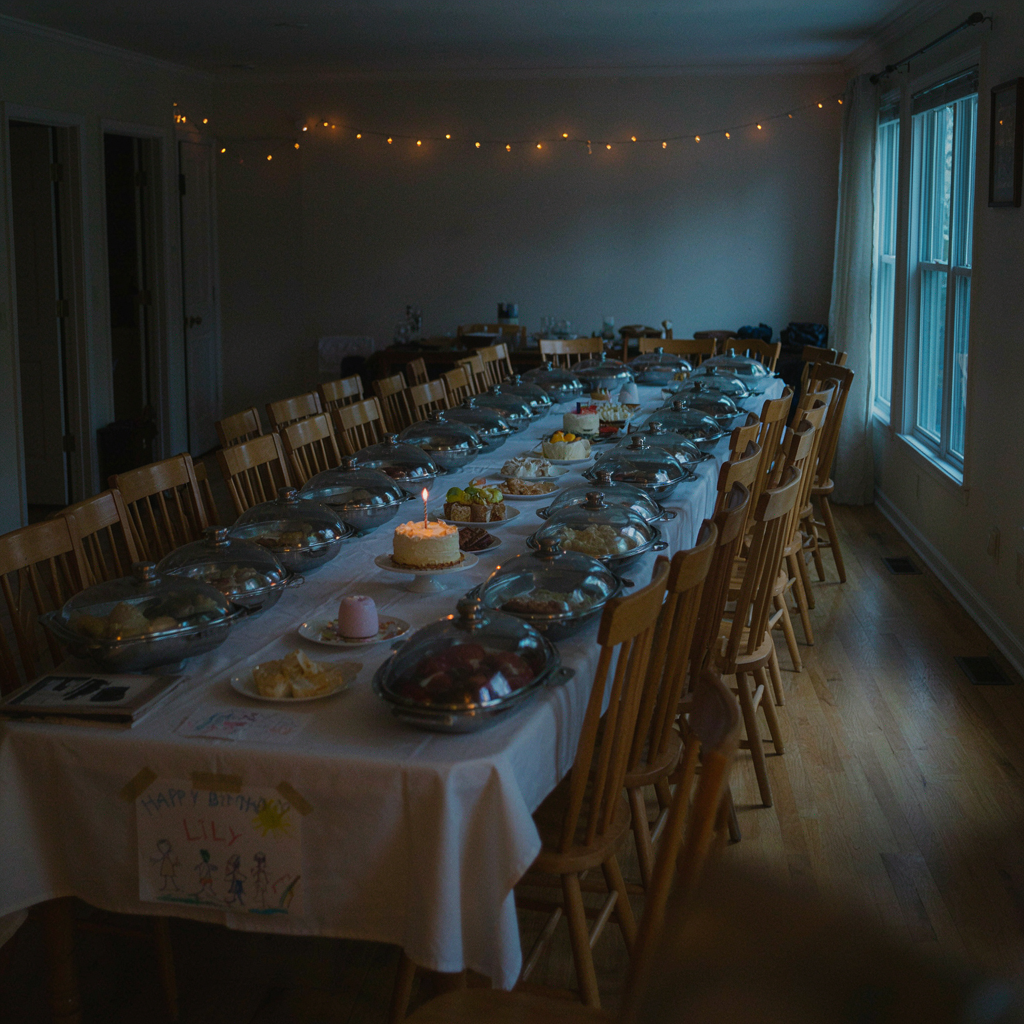
Our dining room was filled with trays covered in foil.
The kitchen counters disappeared beneath mountains of food.
Margaret had spent $587 of her own money on ingredients.
She refused to let me reimburse her.
“It’s my gift to Emma.”
“You’ve already bought her a bicycle.”
“And the bicycle isn’t dinner.”
She laughed.
Then she rubbed her wrist.
I noticed.
“You’ve done enough.”
She looked at the food.
“Not yet.”
That night, I woke at 2:13 a.m.
Margaret wasn’t beside me.
I found her in the kitchen.
She was standing over a tray of chicken wings.
Barefoot.
Wearing her old blue robe.
Her hair was tied messily behind her head.
“Margaret.”
She jumped.
“Oh. You scared me.”
“What are you doing?”
“Checking the sauce.”
“It’s two in the morning.”
“I know.”
“You need sleep.”
She sighed.
“Tomorrow is Emma’s birthday.”
“She’ll survive if the chicken wings aren’t perfect.”
Margaret smiled.
“Maybe.”
Then she looked at me.
“But I want her to remember this day.”
I walked behind her and wrapped my arms around her.
“You know what she’ll remember?”
“What?”
“That Grandma loved her.”
Margaret’s eyes softened.
“That’s all I want.”
I wish I could say that the next day went the way she imagined.
It didn’t.
Not even close.
Saturday morning arrived with bright sunshine.
By nine o’clock, our backyard looked beautiful.
We had rented seventy-five chairs and several folding tables.
Margaret had arranged everything herself.
White tablecloths.
Blue napkins.
Small flower arrangements.
A giant pink-and-purple birthday banner.
At the center of the yard was a table holding Emma’s cake.
Margaret had even placed little handwritten cards beside several dishes explaining what they were.
She had thought of everything.
At eleven, the first relatives arrived.
By eleven-thirty, the driveway was crowded.
Uncles.
Aunts.
Cousins.
Neighbors.
Family friends.
Children running everywhere.
Margaret stood near the food tables, smiling.
Every few minutes someone would compliment her.
“This smells amazing.”
“Margaret, you made all this?”
“Thirty-eight dishes? Are you serious?”
She would laugh and wave them away.
“It’s nothing.”
But I knew it wasn’t nothing.
I knew what her hands felt like.
I knew how little she had slept.
I knew the $587 receipt sitting in her purse.
And I knew why she had done it.
For family.
For Emma.
For the hope that all of us could sit together for one afternoon and remember what family used to feel like.
At 11:47, Michael and his wife, Claire, finally arrived.
Emma jumped out of their SUV.
“Grandma!”
Margaret’s entire face lit up.
She hurried toward her.
“Birthday girl!”
Emma ran into her arms.
Margaret hugged her tightly.
“I made your favorite cupcakes.”
Emma gasped.
“The ones with the strawberry frosting?”
“The very same.”
“I love you, Grandma!”
Margaret kissed her forehead.
“I love you more.”
Claire walked toward us wearing sunglasses despite being in the shade.
She glanced at the tables.
Then at the food.
Her expression changed.
Not dramatically.
Just enough for me to notice.
“Mom,” she said.
Margaret smiled.
“Hi, Claire.”
Claire removed her sunglasses.
“Is this all the food?”
Margaret blinked.
“All?”
Claire looked around.
“There are seventy-five people coming.”
“Yes.”
“And this is what we’re serving?”
Margaret looked confused.
“Thirty-eight dishes.”
Claire stared at her.
Then she gave a small laugh.
“I mean…”
She glanced toward Michael.
“This is too simple.”
The words landed harder than they should have.
Margaret’s smile disappeared.
“Too simple?”
Claire shrugged.
“Mom, it’s Emma’s birthday. People are going to expect something nicer.”
I felt my jaw tighten.
Michael said nothing.
That bothered me more than Claire’s words.
Margaret looked at the tables.
“We have roast chicken, ham, pasta, salads, vegetables, homemade rolls—”
“I know,” Claire interrupted.
She sighed.
“It’s just…”
She lowered her voice.
“I booked a restaurant.”
Margaret stared at her.
“You did what?”
“A nice one downtown.”
Claire looked almost relieved.
“I thought it would be easier.”
“For whom?”
I asked.
She looked at me.
“For everyone.”
Margaret’s face turned pale.
“But I cooked.”
“I know.”
“For two days.”
“I know.”
“I bought all this food.”
“I know.”
“Why didn’t you tell me?”
Claire’s shoulders lifted.
“I didn’t think you’d actually make everything.”
That sentence changed something inside me.
Margaret stood completely still.
Behind her, Emma was laughing with her cousins.
The birthday decorations moved gently in the wind.
Seventy-five chairs sat waiting.
Thirty-eight dishes waited beneath silver foil.
And my wife stood there realizing that the person she had tried hardest to please hadn’t even considered what her effort meant.
Claire clapped her hands.
“Okay, everyone! We’re leaving in twenty minutes. The restaurant has a private room.”
People began looking at each other.
Then one uncle picked up his jacket.
A cousin told her children to get their shoes.
Someone started gathering gifts.
And one by one…
The chairs emptied.
I watched seventy-five chairs become empty.
One.
Then another.
Then another.
Until only a handful remained.
The food remained untouched.
The cake remained untouched.
The cupcakes remained untouched.
The cinnamon-baked apples remained untouched.
Margaret stood beside the table.
She didn’t cry.
That almost broke my heart.
She simply looked down at her hands.
“I should have known,” she whispered.
I walked toward her.
“Known what?”
“That nobody wanted this.”
I took her hand.
“That’s not true.”
“It feels true.”
“No.”
She looked at me.
“Then why did they leave?”
I didn’t have an answer that would make the moment hurt less.
So I said the only thing I could.
“Because they forgot what you gave them.”
She looked at the empty chairs.
Then at the food.
Then at me.
“Daniel?”
“Yes?”
“Please don’t make a scene.”
I hadn’t planned to.
But I also hadn’t planned to let this happen.
I reached into my pocket.
I took out my phone.
And photographed the tables.
All of them.
The empty chairs.
The untouched food.
The birthday decorations.
Margaret standing alone.
I took one photograph.
Then another.
She looked at me.
“Why are you taking pictures?”
“So I never forget this.”
She frowned.
“Forget what?”
I looked toward the driveway where the last cars were disappearing.
“The day my wife learned exactly how much her kindness was worth to people who had grown accustomed to receiving it.”
Margaret didn’t respond.
I put my phone away.
Then I said something she didn’t expect.
“Let’s go inside.”
“What about the food?”
“Leave it.”
“But—”
“Let them leave something behind too.”
Inside the house, Margaret sat at the kitchen table.
I poured her a glass of water.
She stared at it.
After several minutes, she said, “Maybe Claire is right.”
I sat beside her.
“About what?”
“Maybe I am old-fashioned.”
“You are.”
She gave me a weak smile.
“But that’s not an insult.”
She looked down.
“I thought if I cooked for everyone, they’d feel welcome.”
“They should have.”
“I thought if we had one beautiful day together, maybe everyone would stop fighting.”
I reached across the table.
“You can’t cook people into loving each other.”
Her eyes filled with tears.
“I know.”
“No, Margaret. You don’t.”
She looked at me.
“You keep giving people more because you’re hoping they’ll finally give something back.”
A tear rolled down her cheek.
I wiped it away.
“You don’t have to earn your place in this family.”
She whispered, “Then why do I always feel like I have to?”
That was when I realized this wasn’t about dinner.
It had been building for years.
Michael had borrowed money from us.
Claire had asked Margaret to babysit.
They had expected birthday gifts, Christmas gifts, school supplies, emergency loans.
We had helped with their mortgage once.
Paid for Emma’s summer camp twice.
Bought furniture for their first house.
We had never kept score.
Because family wasn’t supposed to be a ledger.
But perhaps we had made one mistake.
We had taught them that our generosity had no limit.
And people often mistake unlimited generosity for unlimited obligation.
I opened my phone.
“Margaret.”
“What?”
“I’m making a decision.”
She looked worried.
“What kind?”
“One we’ve should have made years ago.”
The next morning, I called our bank.
I canceled every automatic payment connected to Michael and Claire.
Their phone plan.
Their car insurance supplement.
The monthly transfer we had quietly been making toward Emma’s private-school tuition.
The account we had established for emergencies.
Then I called our financial adviser.
“I want every joint financial obligation reviewed.”
Margaret sat across from me.
She watched quietly.
When I finished, she asked, “Are we punishing them?”
“No.”
“Then what are we doing?”
“Stopping the punishment of ourselves.”
She stared at me.
Then she nodded.
That afternoon, I called Michael.
He answered on the fourth ring.
“Dad, what’s up?”
“I want to talk about yesterday.”
A pause.
“Dad, if this is about Claire—”
“It is.”
“I don’t want drama.”
“Neither do I.”
“Mom worked hard. We appreciate it.”
“No.”
“What?”
“You don’t.”
He went silent.
I continued.
“Your mother stayed awake for two nights.”
“Dad—”
“She spent $587.”
“I didn’t ask her to.”
“Exactly.”
Silence.
“She made thirty-eight dishes.”
“I know.”
“And your wife called it too simple.”
“Dad, Claire didn’t mean—”
“She meant exactly what she said.”
“You’re overreacting.”
“No.”
I looked at Margaret.
She was listening.
I said, “From now on, we’re not paying your bills.”
Silence.
Then Michael laughed.
Not because it was funny.
Because he didn’t believe me.
“What bills?”
“All of them.”
“Dad, come on.”
“The phone plan. The insurance. The tuition contribution. The monthly transfer.”
“Dad!”
“You’ll handle them yourself.”
“You can’t just do that.”
I almost laughed.
“I just did.”
“Mom would never—”
“Your mother agrees with me.”
Another silence.
Then Michael’s voice changed.
“So you’re punishing us because we went to a restaurant?”
“No.”
“Then what is this?”
“This is about respect.”
“We didn’t disrespect you.”
“You disrespected your mother.”
“Dad, I said I’m sorry.”
“Tell her.”
“I will.”
“And Michael?”
“Yeah?”
“Don’t apologize because the money stopped.”
He didn’t answer.
I hung up.
For three days, nothing happened.
Then Claire called Margaret.
My wife put the phone on speaker.
“Mom, I think Daniel misunderstood what happened.”
Margaret said nothing.
Claire continued.
“I wasn’t insulting your cooking.”
“You said it was too simple.”
“I meant the presentation.”
“You didn’t even taste it.”
“I just thought a restaurant would be more appropriate.”
Margaret took a breath.
“You could have told me before I cooked.”
“I didn’t know you’d do all that.”
“You knew.”
Claire was silent.
Then she said, “Look, Mom, this whole thing has become ridiculous.”
Margaret’s voice was calm.
“No. What’s ridiculous is that I spent two nights making food for seventy-five people because I wanted to make Emma happy, and you couldn’t even say thank you.”
“Mom—”
“Don’t call me because the payments stopped.”
Claire froze.
Margaret continued.
“Call me when you want to talk to me as your mother-in-law and not as a service.”
Then she ended the call.
I stared at her.
She looked almost surprised by herself.
“What?”
I smiled.
“Nothing.”
“What?”
“I’ve been waiting twenty years to hear you say that.”
She laughed.
Then she cried.
And I held her.
A week later, something unexpected happened.
Emma came to our house.
Alone with her parents.
She walked into the kitchen holding a drawing.
“Grandma?”
Margaret turned.
“Hi, sweetheart.”
Emma handed her the paper.
It showed a giant table.
There were seventy-five little stick figures around it.
At the top, Emma had written:
GRANDMA’S BIRTHDAY PARTY
Margaret looked confused.
“My birthday?”
Emma shook her head.
“Mine.”
Margaret smiled.
“But we went to the restaurant.”
“I know.”
Emma’s face fell.
“But I wanted to eat your food.”
Margaret’s eyes filled with tears.
“Why?”
“Because Mommy told me Grandma made all my favorite things.”
Claire stood behind her daughter.
Her face was different.
Less defensive.
More ashamed.
Emma continued.
“She said you made the cinnamon apples Dad likes.”
Margaret nodded.
“I did.”
“Can we eat them?”
Margaret looked at me.
I smiled.
“Of course.”
Claire stepped forward.
“Mom…”
Margaret looked at her.
Claire swallowed.
“I owe you an apology.”
Margaret didn’t respond immediately.
Claire looked around the kitchen.
“I was embarrassed.”
“About what?”
Claire sighed.
“About having the birthday at home.”
“Why?”
“I thought people would judge us.”
Margaret frowned.
“Judge you?”
“I wanted Emma’s party to look successful.”
Margaret looked at her for a long moment.
“Claire, success isn’t seventy-five people eating expensive food.”
“I know that now.”
“No.”
Margaret shook her head.
“You don’t.”
Claire looked down.
“You’re right.”
She wiped her eyes.
“I was so worried about how the party looked that I forgot to think about how you felt.”
Margaret’s expression softened.
“That hurt.”
“I know.”
“And when everyone left…”
Her voice broke.
“I felt humiliated.”
Claire began crying.
“I’m sorry.”
Margaret stood.
She walked toward her.
For a second, I thought she would hug her.
But she didn’t.
Instead, she said something much more important.
“I forgive you.”
Claire looked up.
“But forgiveness doesn’t mean things go back to the way they were.”
Claire nodded.
“I understand.”
“From now on, if you want my help, ask.”
“I will.”
“And if I say no?”
“I’ll respect it.”
Margaret smiled.
“Good.”
Emma tugged on her grandmother’s robe.
“Can we have cinnamon apples now?”
Everyone laughed.
That evening, we sat around our kitchen table.
Not seventy-five people.
Just five.
Me.
Margaret.
Michael.
Claire.
Emma.
Margaret reheated the cinnamon apples.
Emma took the first bite.
Her eyes widened.
“Grandma!”
“What?”
“This is the best thing ever.”
Margaret laughed.
“You’ve had it before.”
“Not when I’m eight.”
Everyone smiled.
Then Michael spoke.
“Mom?”
“Yes?”
“I really am sorry.”
Margaret looked at him.
“I know.”
“I should have stopped Claire.”
“You should have.”
He nodded.
“I’ve been taking you for granted.”
Margaret reached across the table.
“Then don’t.”
He took her hand.
“I won’t.”
I watched them.
And for the first time in a long time, I felt something loosen inside me.
Not because everything was fixed.
It wasn’t.
But because boundaries had finally been drawn.
A month later, I did something else with that photograph.
The photograph of the seventy-five empty chairs.
I had it printed.
Not framed.
Not displayed.
I kept it in a drawer.
Margaret asked why.
I told her, “It’s a reminder.”
“Of what?”
“That love without boundaries becomes invisible.”
She thought about that.
Then she said, “I don’t want to remember that day.”
“I know.”
“So why keep it?”
“Because I want to remember what came after.”
“What came after?”
I smiled.
“The day you stopped proving that you belonged in your own family.”
She leaned against me.
“You know what I learned?”
“What?”
“People don’t always appreciate what you do for them.”
I nodded.
“And that’s okay.”
“That’s a big lesson.”
She smiled.
“But there’s another one.”
“What?”
“Sometimes the most loving thing you can do for your family is stop rescuing them.”
I kissed her forehead.
“Now you’re getting wise.”
She laughed.
“Don’t push it.”
Six months later, Emma’s ninth birthday came around.
Claire called us early.
“Mom, Dad, can we talk about the party?”
Margaret looked at me.
I raised an eyebrow.
She smiled.
“Sure.”
Claire said, “I was thinking we could have it here.”
Margaret blinked.
“Here?”
“At your house.”
“Why?”
“Because Emma keeps talking about your cinnamon apples.”
Margaret laughed.
“That’s the reason?”
“No.”
Claire paused.
“Because last year I learned something.”
“What?”
“A beautiful party isn’t about impressing seventy-five people.”
Margaret smiled.
“It’s about making the people you love feel loved.”
Claire’s voice softened.
“And I want to do that this year.”
So we had another party.
There were seventy-five people again.
But this time, nobody expected Margaret to cook.
Claire brought food.
Michael grilled chicken.
The cousins brought salads.
The uncles brought desserts.
Emma helped Margaret make cinnamon apples.
And when the tables were full, Claire stood in the middle of the backyard.
She raised her glass.
“I want to say something.”
Everyone became quiet.
Claire looked at Margaret.
“Last year, I made a terrible mistake.”
Margaret shook her head slightly.
But Claire continued.
“I confused expensive with meaningful.”
She looked around.
“I thought a restaurant would make Emma’s birthday special.”
Then she pointed toward the kitchen.
“But the most special thing here isn’t the food.”
She looked at Margaret.
“It’s the woman who taught me what family actually means.”
Margaret’s eyes filled with tears.
Claire walked over and hugged her.
This time, Margaret hugged her back.
The backyard filled with applause.
I looked at the tables.
Seventy-five chairs.
Seventy-five people.
But this time, nobody was leaving.
Not because the food was fancy.
Not because the restaurant had a private room.
Not because anyone was trying to impress anyone else.
They stayed because they wanted to be there.
I reached into my pocket and touched my phone.
The photograph was still there.
The empty tables.
The untouched dishes.
My wife’s tired face.
I didn’t delete it.
I never will.
Because sometimes a photograph captures more than a moment.
Sometimes it captures the exact second you realize something has to change.
That day, I had quietly made a decision.
I would never again let my wife spend her nights exhausted, her hands aching, her heart breaking, just to prove that our family deserved her love.
She had spent years giving everything she had.
Now it was time for the family to give something back.
Not money.
Not gifts.
Not expensive dinners.
Just effort.
Just gratitude.
Just respect.
And perhaps that was the greatest gift we could give Emma.
Not a perfect birthday.
Not thirty-eight dishes.
Not seventy-five people sitting around an expensive restaurant table.
But the example of two grandparents who finally understood that loving your family doesn’t mean allowing them to use you.
It means teaching them how to love you back.
As the birthday candles were lit, Emma closed her eyes.
“Make a wish!” everyone shouted.
She smiled.
Then she blew out all nine candles.
I leaned toward Margaret.
“What do you think she wished for?”
Margaret smiled.
“I don’t know.”
I looked around the table.
Everyone was laughing.
Everyone was eating.
Everyone was together.
And I said,
“I think she got it already.”
Margaret squeezed my hand.
“What?”
“Family.”
She smiled.
And this time, when I looked at the seventy-five chairs, I didn’t see people who owed us anything.
I saw people who had finally learned the value of showing up.
And that was worth far more than the $587 Margaret had spent the year before.
Because the food had never been the point.
The restaurant had never been the point.
The thirty-eight dishes had never been the point.
The point was love.
And love, I finally understood, should never have to beg for a seat at its own table.