The Last Page
After six painful years of trying to become a mother, my husband suddenly left me, shut off every source of financial support, and made sure I walked away from our marriage with almost nothing.
Then Garrison Blackwood—the quiet retired sheriff who lived alone across the street—offered me something I never imagined accepting.
Julian thought taking my home, my insurance, and my security would leave me powerless.
He never expected the man across the street to notice what he had done.
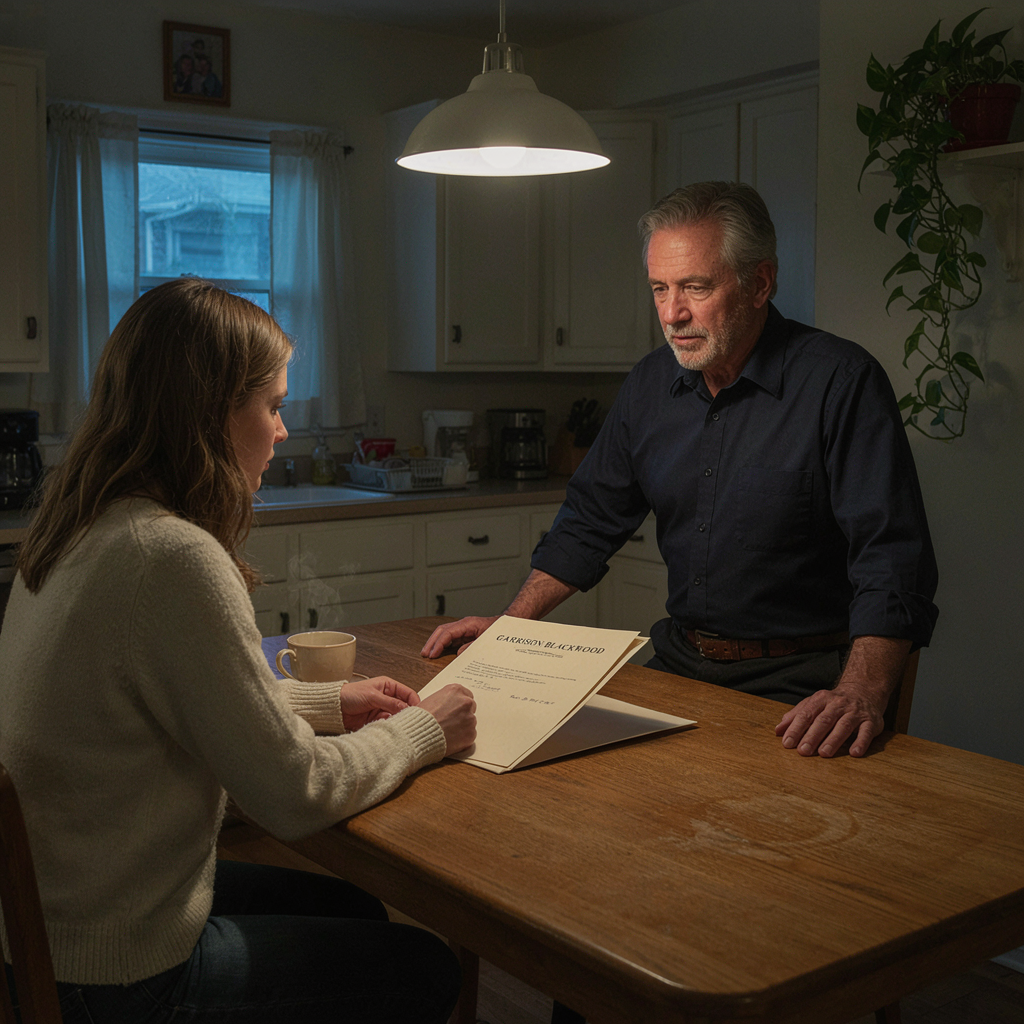
Garrison placed a folder on his kitchen table and slid one document toward me.My hands went cold when I saw Julian’s name.”Read the last page,” he said quietly.I stared at him.
“What is this?””Just read it.”My fingers trembled as I turned the pages.The first few were copies of bank statements.
Then insurance records.Then property documents.
Then something that made my stomach twist.
A letter from Julian’s attorney.I reached the final page.And there it was.Julian’s signature.Below it was a sentence that changed everything.
“I acknowledge that the marital residence, savings accounts, and insurance policies were funded in substantial part by my wife’s inherited assets and personal earnings.
I further acknowledge that I have knowingly concealed these facts from her.”
I stopped breathing.
“Where did you get this?”
Garrison leaned back in his chair.
“Julian dropped it.”
“That doesn’t make sense.”
“He didn’t drop the folder by accident.”
Garrison’s voice was calm.
“He left it in my mailbox.”
I looked up sharply.
“Why?”
“Because he thought I was someone else.”
The room suddenly felt very small.
Garrison folded his hands over his stomach.
“Julian has been trying to intimidate people who might interfere with his plans. He assumed I would be easy to scare because I’m retired.”
He gave a humorless smile.
“He forgot that retirement doesn’t erase twenty-eight years of being a sheriff.”
I looked down at the document again.
For six years, I had believed my marriage had failed because my body had betrayed me.
Now I wondered if my husband had betrayed me long before I ever knew it.
My name is Evelyn Hart.
And six months earlier, I had still believed I was married to the man I would grow old with.
I was wrong.
Julian and I had been married for eleven years.
The first five had been wonderful.
At least, that’s what I remembered.
We met at a charity dinner when I was thirty-one and he was thirty-four.
He was charming without seeming arrogant.
He remembered little things.
My coffee order.
My favorite flowers.
The fact that I hated thunderstorms.
When we married, Julian promised me something simple.
“Whatever happens,” he said during our vows, “we’ll face it together.”
I believed him.
For the first five years, we tried to have children naturally.
When that didn’t happen, we saw doctors.
Then specialists.
Then fertility clinics.
The tests became endless.
Blood draws.
Hormone treatments.
Procedures.
Appointments.
Hope.
Disappointment.
Hope again.
Every month became a countdown.
Every negative pregnancy test felt like a tiny funeral.
Julian changed gradually.
At first, he was supportive.
Then frustrated.
Then distant.
Eventually, he stopped coming to appointments.
“You’re obsessed with this,” he told me one night.
I stared at him.
“It’s our child.”
“It’s your obsession.”
Those words stayed with me.
Still, I blamed myself.
I thought if I could just fix whatever was wrong with me, Julian would come back.
I spent six years believing that.
Then one Tuesday morning, he came home with two suitcases.
I was standing in the kitchen making coffee.
“What’s that?”
“I’m leaving.”
I laughed.
Not because it was funny.
Because my brain couldn’t understand the sentence.
“Leaving where?”
“Here.”
He placed the suitcases beside the door.
“I’ve rented an apartment.”
My hands went numb.
“Julian…”
“I’m done, Evelyn.”
“Done with what?”
“All of it.”
He wouldn’t look at me.
“The treatments. The doctors. The disappointment. This marriage.”
I felt something inside me crack.
“You’re leaving me because we couldn’t have a baby?”
“No.”
His answer came too quickly.
“I’m leaving because I don’t love you anymore.”
That was worse.
I sank into a chair.
“Is there someone else?”
Silence.
That was my answer.
I whispered, “Who?”
He picked up one suitcase.
“Does it matter?”
“It matters to me.”
He looked at me then.
For the first time in eleven years, his eyes looked completely unfamiliar.
“Her name is Vanessa.”
I couldn’t speak.
He walked out.
Three weeks later, I discovered Vanessa wasn’t just someone he’d recently met.
She had been his colleague for almost two years.
Two years.
While I sat in fertility clinics praying for our marriage.
While he held my hand during failed procedures.
While he told me we were “in this together.”
He had already built another life.
But the worst part wasn’t Vanessa.
It was what happened afterward.
Julian froze our joint account.
Canceled the credit card.
Removed me from the company health insurance.
He even contacted the mortgage company and claimed I had “voluntarily abandoned the property.”
I hadn’t.
I was still living in the house.
Our house.
The house my grandmother had left me before we married.
I had sold my grandmother’s old farmhouse for $180,000 and used the money to purchase the property where Julian and I eventually built our home.
But during our marriage, Julian had slowly convinced me that the house was “ours.”
So when his attorney sent me papers suggesting I had no meaningful claim to it, I was terrified.
“Sign this,” Julian told me during one of our final meetings.
“What is it?”
“Property settlement.”
I read the first page.
He wanted me to keep my clothes, my car, and $12,000.
In exchange, I would surrender all claims to the house, retirement accounts, insurance benefits, and business assets.
I laughed bitterly.
“You’ve got to be kidding.”
“You can’t afford a lawyer.”
“I’ll find one.”
“With what money?”
He knew exactly what he was doing.
My checking account had been emptied.
My credit cards were canceled.
My insurance was gone.
I felt trapped.
That was when I began noticing Garrison Blackwood.
He lived across the street.
I’d seen him for years.
Tall.
Gray-haired.
Usually wearing an old sheriff’s jacket.
He rarely spoke to anyone.
Every morning at exactly seven, he walked down his driveway, collected his newspaper, and disappeared inside.
I had always thought of him as lonely.
I didn’t know he was watching.
One afternoon, I was sitting on my front steps with a box of my belongings.
Julian had sent movers to remove his furniture.
One of the movers asked me where I wanted my things.
I didn’t know.
I had nowhere to go.
Garrison crossed the street.
“You got somewhere to stay?”
I wiped my eyes.
“Not yet.”
He nodded toward his house.
“My guest room is empty.”
I stared at him.
“I can’t.”
“You can.”
“I don’t know you.”
“I know.”
He paused.
“But I know what desperation looks like.”
I looked away.
“I’ll manage.”
“Maybe.”
He studied me.
“But you shouldn’t have to manage alone.”
That was the first kindness anyone had offered me in weeks.
I accepted.
Garrison’s house was modest.
Old photographs lined the walls.
Most showed him in uniform.
Some showed him with other deputies.
One photograph caught my attention.
A young Garrison stood beside a woman and a little girl.
“Your family?”
He nodded.
“My wife, Margaret. Our daughter, Claire.”
“What happened?”
“Margaret died twelve years ago.”
“And Claire?”
His expression changed.
“She lives three states away.”
He never said more.
I respected that.
For the next several weeks, I lived in his guest room.
I found a temporary job at a local bookstore.
Garrison never asked me for rent.
When I insisted, he said, “Save it.”
For the first time in months, I slept without worrying about whether the electricity would be turned off.
But Julian wasn’t finished.
He started calling.
“You need to leave that house,” he said.
“I don’t live there anymore.”
“You know what I mean.”
“You want me to give up the property.”
“You don’t have the money to fight me.”
“I’ll find it.”
He laughed.
“You really think anyone’s going to believe you paid for that house?”
I froze.
“What do you mean?”
He hung up.
That night, I couldn’t sleep.
The next morning, Garrison found me sitting at the kitchen table.
“You heard from Julian.”
I nodded.
“He said no one would believe I paid for our house.”
Garrison’s face hardened.
“Did you?”
“Yes.”
“How?”
“My grandmother left me money.”
“How much?”
“Enough to buy the property.”
He was quiet.
“Do you still have records?”
“I don’t know.”
“Find them.”
So I did.
For three days, I searched.
Old boxes.
Tax folders.
Bank statements.
My grandmother’s probate documents.
Finally, I found a folder at the back of a closet.
Inside was the original wire transfer.
$180,000.
Sent directly from my inheritance account to the property seller.
The date was three months before Julian and I were married.
I stared at it.
“That’s it,” I whispered.
Garrison nodded.
“That’s your foundation.”
But then he asked a question that changed everything.
“Why would Julian deny it if the records exist?”
“I don’t know.”
“Maybe because there is something else.”
There was.
We just didn’t know what.
Two weeks later, Garrison called me into his kitchen.
That’s when he showed me the folder.
Julian had left it in Garrison’s mailbox.
Inside were documents connected to a company called Blackwood Development Holdings.
I recognized the name.
Julian had always told me the company was small.
A side business.
Nothing significant.
But the documents showed something different.
The company had acquired three properties.
One of them was our home.
Another was an apartment complex.
The third was a commercial building.
Millions of dollars moved through the company.
I looked at Garrison.
“Why didn’t I know about this?”
“Because Julian didn’t want you to.”
Then I saw a bank statement.
A transfer of $74,000 from our joint account.
Recipient:
Blackwood Development Holdings.
Date:
Three days after one of my fertility procedures.
I felt sick.
“What is this?”
“Keep reading.”
There were dozens of transfers.
Over six years, more than $300,000 had moved from our marital accounts into Julian’s company.
Then came something even worse.
A life insurance policy.
My name was the insured person.
Julian was the beneficiary.
Coverage:
$2 million.
I stared at it.
“Why would he take out a policy on me?”
Garrison didn’t answer immediately.
“When was it issued?”
I gave him the date.
His jaw tightened.
“That was six months before he left you.”
The room seemed to tilt.
I stood.
“I feel sick.”
Garrison rose immediately.
“Evelyn.”
“He wanted me dead?”
“We don’t know that.”
“But why else?”
“Because insurance policies can be used for many reasons.”
He looked directly at me.
“Don’t jump ahead. We need evidence.”
Then he handed me another page.
It was a medical authorization.
My signature was at the bottom.
Except I had never signed it.
I knew because the signature looked like mine.
But the date was during a fertility procedure when I had been heavily medicated.
“What is this?”
Garrison’s voice lowered.
“This is where I became concerned.”
The authorization allowed Julian to access my medical records.
“Why would he need that?”
“To see what doctors knew about your fertility.”
I read further.
Then I saw a line that made my heart stop.
Patient advised of suspected hereditary cardiac condition.
I looked at Garrison.
“I don’t have a heart condition.”
He nodded.
“Exactly.”
We took everything to an attorney.
Her name was Rebecca Sloan.
She reviewed the documents for nearly two hours without speaking.
Finally, she removed her glasses.
“Julian didn’t simply leave his wife.”
“What did he do?” I asked.
Rebecca pointed to the papers.
“He appears to have systematically transferred marital assets, concealed business income, forged at least one authorization, and attempted to create a record suggesting your property belonged to him.”
I swallowed.
“Can he be stopped?”
She smiled slightly.
“That’s the first good question you’ve asked.”
I almost laughed.
“Why?”
“Because yes.”
Rebecca filed for an emergency injunction.
She also demanded financial disclosures.
Julian responded aggressively.
He accused me of being unstable.
He claimed I had become obsessed with motherhood.
He said I had voluntarily left the home.
He called Garrison an “unrelated man interfering in a private marital dispute.”
That accusation nearly made Rebecca laugh.
“He doesn’t know Garrison, does he?”
“No.”
“Good.”
A week later, we went to court.
Julian walked in wearing an expensive suit.
Vanessa sat behind him.
He didn’t look at me.
Until Garrison entered.
Then Julian froze.
I watched the color drain from his face.
Garrison took a seat beside me.
Julian whispered something to his attorney.
His attorney looked confused.
The judge entered.
We stood.
The hearing began.
Julian’s lawyer argued that I had no right to the property.
Rebecca calmly presented the wire transfer.
Then the bank statements.
Then the company records.
Then the forged medical authorization.
Finally, she presented the life insurance policy.
The judge stared at Julian.
“Mr. Blackwood, why was a $2 million policy taken out on your wife?”
Julian shifted.
“It was standard financial planning.”
“And why was the beneficiary changed?”
He looked at me.
“Because we were married.”
Rebecca interrupted.
“Your Honor, the beneficiary was changed two months after Mr. Blackwood began transferring marital funds into his private company.”
Silence.
Then the judge asked the question that destroyed Julian’s story.
“Mr. Blackwood, do you dispute the authenticity of these financial records?”
Julian’s attorney stood.
“Your Honor, we’d like additional time.”
“You’ve had time.”
The judge looked at Julian.
“Where did these documents come from?”
Julian didn’t answer.
Then Garrison stood.
“I can explain.”
The courtroom went silent.
Garrison told the judge about the folder.
About Julian leaving it in his mailbox.
About the documents inside.
Julian suddenly spoke.
“He stole those!”
Garrison looked at him.
“No.”
He reached into his jacket.
“He left them.”
Julian’s face went pale.
Garrison continued.
“I have a security camera.”
Rebecca smiled.
We hadn’t known about the camera.
Neither had Julian.
Garrison had installed it after several suspicious incidents near his property.
The footage showed Julian walking to the mailbox at 11:43 p.m.
He placed the folder inside.
Then he looked directly at the camera.
The courtroom watched.
No one spoke.
Finally, the judge ordered an investigation into the financial transfers and froze Julian’s access to the disputed assets.
But the case wasn’t over.
Not even close.
Three weeks later, Rebecca called.
“You need to come to my office.”
I arrived with Garrison.
Rebecca looked serious.
“We found something.”
She pushed a document across the desk.
“Julian had another beneficiary.”
I frowned.
“For what?”
“The life insurance.”
I looked at the document.
The beneficiary wasn’t Vanessa.
It was a company.
Blackwood Family Trust.
Rebecca explained that the trust had been established shortly after Julian learned about my grandmother’s inheritance.
“Why?”
“Because he intended to place the house inside it.”
I stared at her.
“But the house was mine.”
“Yes.”
“Then why did he think he could?”
Rebecca pointed to another document.
“Because he had been planning to claim that your inheritance was marital property.”
Garrison leaned forward.
“There’s more.”
Rebecca nodded.
“There’s always more.”
She handed me a second file.
Inside was an email chain.
Julian had written to his accountant six months before leaving me.
The subject line read:
Project Evelyn.
My stomach turned.
I read the messages.
Julian wrote about my fertility treatments.
About my emotional state.
About the insurance policy.
About transferring assets.
Then I saw a sentence that made me feel like I couldn’t breathe.
“Once she believes the marriage failed because she can’t give me children, she’ll blame herself and accept almost anything.”
I closed my eyes.
For six years, I had believed I wasn’t enough.
Julian had counted on that.
He had weaponized my deepest pain against me.
Garrison reached across the table.
He didn’t touch me.
He simply placed his hand near mine.
“You didn’t fail.”
Those three words broke me.
I cried.
Not the quiet tears I’d cried in bathrooms and doctor’s offices.
I sobbed.
Six years of shame poured out.
Garrison waited.
When I finally looked up, he said softly:
“Someone else’s cruelty doesn’t become your truth just because you believed it.”
The investigation lasted eight months.
Julian’s company was audited.
His accounts were examined.
Several fraudulent transfers were uncovered.
The insurance policy was canceled.
The house was restored entirely to me.
The court also awarded me a substantial share of the marital assets Julian had tried to hide.
Vanessa left him.
His business collapsed.
And the man who had once told me I would have nothing was ordered to surrender nearly everything he had tried to steal.
But something unexpected happened during those months.
Garrison and I became friends.
Real friends.
We cooked dinner together.
Watched old movies.
Sat on his porch during summer storms.
He told me stories about being sheriff.
I learned about Claire.
About Margaret.
About the years after her death.
One evening, I asked him why he had helped me.
He looked across the street at my house.
“You reminded me of Margaret.”
I smiled.
“Was she stubborn?”
“Terribly.”
“Afraid?”
“Sometimes.”
“Did she pretend she wasn’t?”
“Every day.”
We laughed.
Then he grew quiet.
“After Margaret died, I thought I was finished with people.”
I looked at him.
“And now?”
He looked at me.
“Now I’m not so sure.”
My heart beat faster.
But I didn’t say anything.
Neither did he.
We let the moment pass.
A year after Julian left, I moved back into my house.
I repainted the kitchen.
Changed the curtains.
Removed every photograph of Julian.
Then I did something I never thought I’d do.
I planted roses.
My grandmother loved roses.
For years, I had been too busy trying to build a family to build a life.
Now I was learning how.
One evening, Garrison stood at my gate.
He held a small wooden box.
“What is that?”
“Something I’ve had for a long time.”
He opened it.
Inside was a silver sheriff’s badge.
“My retirement badge.”
“Why are you giving it to me?”
“Because I don’t need it anymore.”
I smiled.
“You earned it.”
He shook his head.
“No. I carried it for twenty-eight years. But you reminded me that protecting someone doesn’t always mean wearing a uniform.”
My eyes filled with tears.
“Garrison…”
“I’ve spent a long time alone.”
He took a breath.
“I’m not interested in pretending I’m not.”
He looked at me.
“I care about you, Evelyn.”
I couldn’t speak.
“Not because you need someone.”
He smiled.
“Because I want to be the man who stands beside you when you don’t.”
I cried.
Then I laughed through the tears.
“That’s a terrible proposal.”
He laughed.
“Good thing I wasn’t proposing.”
“Then what were you doing?”
“Trying to find out if I could take you to dinner.”
I wiped my cheeks.
“Just dinner?”
“Maybe dessert.”
“You’re very cautious for a former sheriff.”
“I learned to investigate before making arrests.”
I laughed.
“Fine.”
“Fine?”
“Take me to dinner.”
He smiled.
And for the first time in years, I felt something I thought had disappeared forever.
Hope.
Two years later, I stood in my garden wearing a simple ivory dress.
There were no fertility specialists.
No medical charts.
No negative tests.
No whispered conversations about whether my body was broken.
There were roses.
Friends.
Neighbors.
And one gray-haired former sheriff standing beneath an arch covered in flowers.
Garrison took my hands.
“I don’t have a perfect life to promise you.”
I smiled.
“Neither do I.”
“I can’t promise there won’t be hard days.”
“I know.”
“But I can promise that when they come, you won’t face them alone.”
I squeezed his hands.
“That’s enough.”
We married in the garden.
Afterward, everyone gathered around long tables beneath strings of lights.
Garrison raised his glass.
“To second chances.”
I raised mine.
“To the people who help us see our worth when we’ve forgotten it.”
Then I looked across the table.
My attorney, Rebecca, was smiling.
My friends were laughing.
And Garrison was holding my hand.
I thought about the woman I’d been two years earlier.
Broken.
Ashamed.
Terrified.
Convinced that losing a husband meant losing my future.
But Julian hadn’t taken my future.
He had only removed himself from it.
The real gift wasn’t the house.
It wasn’t the money.
It wasn’t even justice.
It was the realization that my life had never belonged to Julian.
Not my worth.
Not my dreams.
Not my future.
And certainly not my ability to become a mother.
Because six months after marrying Garrison, something happened that none of us expected.
I found a tiny pair of shoes on my kitchen table.
Beside them was a pregnancy test.
Positive.
I stared at it for nearly five minutes.
Then I started laughing.
Then crying.
Garrison came running into the kitchen.
“What’s wrong?”
I couldn’t speak.
I simply handed him the test.
He looked at it.
Then at me.
Then back at it.
“Is that…”
I nodded.
His eyes filled with tears.
He wrapped his arms around me.
We stood there silently.
No doctors.
No pressure.
No promises.
Just two people who had already learned that life could break your heart and still give you something beautiful afterward.
Months later, our daughter was born.
We named her Margaret Evelyn Blackwood.
Margaret after the woman who had once been Garrison’s greatest love.
Evelyn because I wanted my daughter to carry the name of the woman I had become.
The woman who survived.
The woman who stopped blaming herself.
The woman who learned that sometimes the person who rescues you isn’t the one who saves you.
Sometimes they simply stand beside you long enough for you to discover that you can save yourself.
Years later, my daughter would ask me about the framed document hanging in my study.
“Mommy, why is Daddy’s name on that paper?”
I’d smile.
“Because your father once made a very bad mistake.”
“What mistake?”
“He thought taking things away from me would make me powerless.”
She would wrinkle her nose.
“Did it?”
I’d shake my head.
“No.”
Then I’d look across the room at Garrison.
He would always smile.
Because we both knew the truth.
Julian thought the last page of that folder was proof that he had won.
It wasn’t.
It was proof that his lies had finally run out of pages.
And sometimes, that’s where a new life begins.