The Box She Left Me
When my mother-in-law died, I was happy.Not the kind of happy you feel when someone you love gets good news.It was relief.Pure, shameful, undeniable relief.
For eleven years, I had lived with the knowledge that no matter what I did, I would never be good enough for Margaret Hayes.
She never liked me.Not when Daniel brought me home for the first time.
Not when we got engaged.Not when we married.
Not when I gave birth to her first grandchild.Not even when I spent three nights sleeping upright in a hospital chair while she recovered from pneumonia.
I had stopped trying to win her over years ago.So when Daniel called me at 6:17 on a rainy Tuesday morning and said,
“Mom’s gone,” I sat on the edge of our bed and stared at the gray light coming through the curtains.
I didn’t cry.I didn’t gasp.I didn’t even say, “I’m sorry.”I simply closed my eyes.
And for the first time in eleven years, I felt like I could breathe.”Emma?” Daniel whispered.”I’m here.””She’s really gone.”There was something broken in his voice.
That was when guilt finally touched me.Because Margaret had been a terrible mother-in-law to me.
But she had been Daniel’s mother.And Daniel had loved her.
So I reached for his hand.”I’m sorry,” I said quietly.
He squeezed my fingers.Neither of us said anything else.
Three days later, we stood beneath the black umbrellas outside the funeral home.
People kept telling Daniel how sorry they were.
They hugged him.
They touched his shoulder.
They whispered stories about Margaret.
“She was so strong.”
“She always knew what she wanted.”
“She was a woman of principle.”
I stood beside my husband and listened.
A woman of principle.
That wasn’t exactly how I would have described her.
Margaret had opinions about everything.
My cooking.
My clothes.
My career.
The way I raised our children.
The neighborhood we lived in.
The car I drove.
Even the way I laughed.
She once told me, during Thanksgiving dinner, that my laugh was “too loud for a woman.”
I had laughed anyway.
She hadn’t spoken to me for three weeks afterward.
Then there were the gifts.
Or, more accurately, the lack of them.
Every Christmas, Daniel received expensive presents.
His father received expensive presents.
Our children received presents.
Even the family dog once received a monogrammed leather collar.
I received nothing.
Not a card.
Not a candle.
Not a box of chocolates.
Nothing.
At first, I pretended it didn’t bother me.
Then I started joking about it.
Eventually, I stopped expecting anything.
But there was one thing Margaret did give me.
A sentence I never forgot.
It happened six years into my marriage.
Daniel and I had been struggling financially. Our oldest daughter, Sophie, needed braces, our youngest had just started preschool, and I had reduced my hours at work because childcare had become too expensive.
One evening, Margaret came over.
She looked around our modest house and said, “You know, Daniel could have done better.”
I stared at her.
“What do you mean?”
“He’s educated. He’s hardworking. He could have married someone who brought more to the table.”
I felt my face burn.
Daniel wasn’t home.
For once, I didn’t stay silent.
“I love your son,” I said. “And I’ve built a life with him. Isn’t that enough?”
Margaret looked at me for a long moment.
“No.”
Then she walked out.
I never told Daniel.
Not until years later.
By then, it didn’t matter anymore.
Or at least that’s what I told myself.
At the memorial, I stood near the back of the room while photographs of Margaret played on a screen.
There she was at twenty-five.
At thirty-five.
At forty.
With Daniel as a little boy.
With Daniel’s father.
With her sisters.
With her grandchildren.
But there was something strange.
There wasn’t a single photograph of Margaret and me together.
Not one.
When the slideshow ended, Daniel stepped onto the small stage.
His voice shook as he talked about his mother.
“I know Mom could be difficult,” he said.
A few people laughed softly.
“She was stubborn. She was demanding. She didn’t always make things easy.”
I almost smiled.
That was the understatement of the century.
“But she loved deeply,” Daniel continued. “Even when she didn’t know how to show it.”
I looked down.
I wasn’t convinced.
After the service, people gathered for coffee and sandwiches.
I was standing beside a table when Daniel approached me.
His face looked exhausted.
“Emma.”
“Yeah?”
He was holding something.
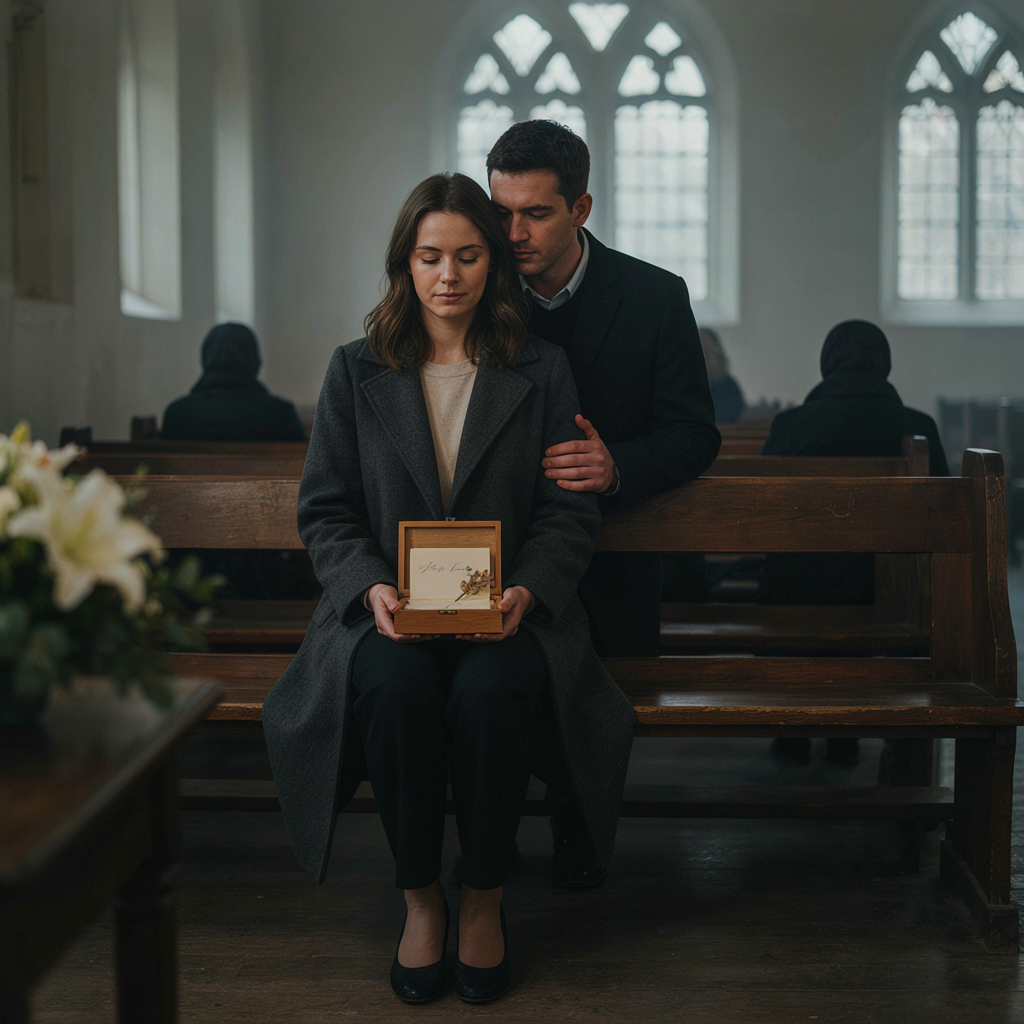
A small wooden box.
It was about the size of a paperback book.
Dark walnut.
Old.
There was a tiny brass clasp on the front.
He held it out to me.
“Mom asked me to give you this.”
I frowned.
“What?”
“She left instructions.”
“For me?”
He nodded.
“When?”
“Two weeks before she died.”
I stared at the box.
“What’s inside?”
“I don’t know.”
“You didn’t open it?”
“No.”
I looked at him suspiciously.
“Daniel.”
“I’m serious. She gave it to Dad’s attorney and told him I wasn’t allowed to see it until today.”
My stomach tightened.
“Today?”
“Her funeral day.”
I looked at the box again.
My first thought was that it was some kind of cruel joke.
That sounded exactly like Margaret.
Maybe there was a note inside telling me I had never been good enough.
Maybe she had finally found a way to insult me from beyond the grave.
I almost handed it back.
But Daniel said quietly,
“She specifically said it had to be given to you.”
I took it.
It was heavier than it looked.
“Did she say why?”
He shook his head.
“Only one thing.”
“What?”
Daniel swallowed.
“She said, ‘Emma will understand when she sees what’s inside.'”
I stared at him.
Then I opened the clasp.
Inside was a single envelope.
My name was written across it.
Not printed.
Handwritten.
Emma.
I knew Margaret’s handwriting immediately.
My fingers trembled.
I pulled out the letter.
There were only six words on the front.
You deserved to know the truth.
My heart began pounding.
I opened it.
The first sentence made the room disappear.
Emma, if you are reading this, I am dead, and you probably feel relieved.
I stopped breathing.
I looked at Daniel.
He was watching me.
“What does it say?”
I couldn’t answer.
I looked back at the letter.
I know you never understood why I treated you the way I did. You thought I hated you.
My eyes filled with tears.
Then I read the next line.
I didn’t hate you. I was afraid of you.
I frowned.
Afraid?
Of me?
I kept reading.
Not because you were dangerous. Because you were the only person who could have discovered what I had spent years protecting.
My hands went cold.
There was something else in the box beneath the letter.
A photograph.
I pulled it out.
It was old.
Yellowed at the edges.
The photograph showed Margaret standing outside a hospital.
Beside her was a young woman.
A woman I had never seen before.
And between them was a little boy.
Maybe five years old.
I looked at the child’s face.
My breath caught.
The boy was Daniel.
I knew that face.
Even though the photograph was thirty years old, there was no mistaking him.
But why was Margaret with another woman?
And why had I never seen this photograph?
I turned it over.
Written on the back were four words.
The day everything changed.
I looked at Daniel.
“Who is she?”
His eyebrows pulled together.
“I don’t know.”
“That’s your mother.”
“I know.”
“Then who is the woman?”
He stared at the photograph.
His face slowly changed.
“I’ve never seen her.”
I opened the letter again.
There was more.
Daniel believes he knows how his father died. He doesn’t.
My mouth went dry.
Daniel took a step toward me.
“What?”
I handed him the letter.
He read the sentence.
Then another.
His hands began shaking.
“My father died in a car accident,” he whispered.
I looked at him.
“That’s what you told me.”
“That’s what Mom told me.”
He kept reading.
Your father did not die in an accident.
Daniel sat down hard in the nearest chair.
“No.”
I crouched beside him.
“Daniel.”
“No.”
He read the next line.
He was killed because he discovered what I had done.
The noise around us seemed to fade.
People were laughing in another room.
Someone dropped a spoon.
A child ran past.
But Daniel and I were frozen.
He kept reading.
Thirty-one years ago, your father discovered that I had taken money from his business account. Not for myself. For someone else.
Daniel looked up.
“Who?”
The answer was in the next paragraph.
Your father had discovered that I had been secretly supporting my sister, Claire.
I had never heard the name.
“Your mother had a sister?”
Daniel shook his head.
“Not that I know of.”
The letter continued.
Claire was sick. She had a son. She had no money. I thought I could fix everything quietly.
I turned the photograph over again.
The woman beside Margaret.
Claire.
The boy.
Daniel.
I looked at my husband.
“Why are you in that picture?”
“I don’t know.”
Then we found the envelope beneath the photograph.
Inside were bank records.
Old documents.
Letters.
And one birth certificate.
The name on it wasn’t Daniel.
It was another child.
A boy named Michael Hayes.
Mother: Claire Hayes.
Father: Unknown.
I stared at the page.
“Who is Michael?”
Daniel shook his head.
“I don’t know.”
Then he saw another photograph.
His face went pale.
“Wait.”
He took it from me.
The photograph showed Margaret holding the same little boy from the first picture.
But this time, the boy was older.
Maybe eight.
On the back was written:
Michael — 1994.
Daniel stared at the child.
Then he looked at me.
“Emma…”
“What?”
“I remember him.”
I felt a chill.
“Who?”
“That boy.”
He touched the photograph.
“I remember him.”
He closed his eyes.
“When I was little, Mom used to take me somewhere. She told me we were visiting a friend.”
I leaned closer.
“Where?”
“I don’t know.”
“You don’t remember?”
“I remember a blue house.”
His breathing became shallow.
“There was a woman there.”
“Claire?”
“I think so.”
Then he whispered,
“And there was another little boy.”
I looked at the birth certificate.
“Michael.”
Daniel nodded slowly.
“I think I knew him.”
The letter suddenly made sense.
Or at least part of it.
Margaret had been hiding a family secret for decades.
But why had she treated me so badly?
I kept reading.
When I met Emma, I realized she was intelligent enough to eventually uncover the truth.
I frowned.
She noticed things. She asked questions. She remembered details. I was cruel because cruelty kept distance between us.
My eyes filled.
I whispered,
“She was afraid I’d find out.”
Daniel looked at me.
The letter continued.
I watched you love my son in ways I had failed to love him. You gave him patience. You listened to him. You stood beside him when he struggled. You never tried to control him.
I wiped my cheek.
I resented you for that.
There it was.
The truth.
Margaret hadn’t hated me because I was inadequate.
She hated me because I reminded her of everything she had done wrong.
But the letter wasn’t finished.
There is one more thing you need to know.
I felt my heart sink.
The man who killed your father was not a stranger.
Daniel’s face went white.
I read the next sentence.
It was my sister’s husband, Robert.
Daniel whispered,
“Why?”
The answer came immediately.
Because Robert believed your father was going to expose him for stealing from the company. Your father had evidence. He intended to go to the police. Robert confronted him. They fought. Your father fell down the basement stairs.
Daniel covered his mouth.
“And Mom?”
I kept reading.
I found your father alive. He was conscious. He begged me to call an ambulance.
My stomach twisted.
I didn’t.
Daniel stared at me.
“What?”
I continued.
Robert threatened to kill Daniel if I spoke. I believed him. So I let your father die. Then I helped make it look like an accident.
Daniel stood up.
“She let him die?”
His voice cracked.
“She watched him die?”
I couldn’t answer.
The final pages were worse.
I spent thirty-one years telling myself I had protected my son. But the truth is that I protected myself.
The letter ended with one final paragraph.
Emma, you once asked me what it meant to be family. I told you blood was the only thing that mattered. I was wrong. Family is the person who stays when staying is hard. You did that for Daniel. You did it for my grandchildren. You even did it for me, although I never deserved it.
I could barely see the words through my tears.
The documents in this box will lead you to the truth. Give them to the attorney. Do not let Daniel destroy them in anger. He deserves to know what happened, but he also deserves a chance to heal.
Then the last line.
I am sorry I waited until death to become honest.
The funeral home suddenly felt too small.
Daniel walked outside.
I followed him.
Rain had started again.
He stood beneath a tree, staring into nothing.
“My whole life,” he whispered.
I approached him.
“My whole life, I thought Dad died because of a drunk driver.”
I put my hand on his back.
“Daniel.”
“Mom knew.”
He turned toward me.
“She knew.”
“I know.”
“And she never told me.”
“No.”
He laughed bitterly.
“She told me you weren’t good enough for me.”
I looked away.
“She told me you would ruin my life.”
I said nothing.
“She told me your family was beneath ours.”
His eyes filled with tears.
“And all those years…”
He shook his head.
“She was hiding this.”
I nodded.
For the first time in eleven years, Daniel finally understood.
Every insult.
Every cold shoulder.
Every Christmas without a gift.
Every time Margaret tried to make him choose between us.
It hadn’t been about me.
It had been about control.
She needed to keep me far away from the truth.
But there was still one question.
Who was Michael?
The attorney helped us answer it.
Two days later, we sat in his office.
He placed another file on the table.
“Your mother left specific instructions.”
Daniel looked exhausted.
“What is it?”
The attorney slid the file toward him.
“DNA records.”
Daniel opened it.
Inside was a test report.
Michael Hayes was Daniel’s half-brother.
Claire was Margaret’s sister.
But there was more.
The attorney explained that Claire had died several years earlier.
Michael had been raised by another family.
He had changed his last name.
He lived less than two hours away.
Daniel stared at the page.
“I have a brother.”
“Yes.”
“Why didn’t Mom tell me?”
The attorney looked at me.
“Because she believed telling you would reopen everything.”
Daniel laughed softly.
“Everything was already open.”
The attorney sighed.
“Your mother wanted you to meet him.”
There was an address.
A phone number.
And another letter.
This one was addressed to Daniel.
We found Michael three days later.
He opened the door cautiously.
He was about forty years old.
Dark hair.
Same eyes as Daniel.
Same crooked smile.
He looked at us.
Then at Daniel.
Neither man spoke.
Finally, Michael said,
“You’re him.”
Daniel nodded.
“I think so.”
Michael stepped aside.
“Come in.”
They spent five hours talking.
About their childhoods.
About Margaret.
About Claire.
About the mysterious blue house.
About a childhood neither fully remembered.
At one point, Michael laughed.
“She used to bring you to see me.”
Daniel nodded.
“I remember.”
“I thought you were my cousin.”
“I thought you were my friend.”
They both laughed.
Then they cried.
And somehow, in the middle of all that pain, something beautiful happened.
Daniel found his brother.
I found the missing piece of the story.
And Margaret, in the strangest way possible, finally gave me something.
The truth.
But there was one final document in the box.
I didn’t find it until weeks later.
It was tucked inside the wooden lining.
A folded piece of paper.
My name was written on it.
I opened it alone.
It was a short note.
Emma,
If you have reached this page, then you probably understand why I treated you so badly.
But understanding does not mean forgiving.
I do not expect forgiveness.
I only want you to know one thing.
On the night Daniel was born, I sat beside his crib and promised I would spend my life protecting him.
I thought protection meant controlling everything around him.
I was wrong.
The day he married you was the first day I realized I had lost control of him.
And instead of being proud that he had found someone who loved him, I became jealous.
You became the woman he trusted more than me.
I hated that.
Then I watched you become the mother I should have been.
I hated that even more.
But secretly, I admired you.
I stopped reading.
My tears fell onto the paper.
The final lines were barely legible.
There were many times I wanted to tell you that I was sorry.
I never did.
Pride is a strange prison.
I hope you never live inside it.
Love Daniel.
Love the children.
And when you think of me, don’t remember the woman I pretended to be.
Remember that underneath all my anger was a frightened woman who made terrible choices and didn’t know how to undo them.
—Margaret
I folded the letter.
For a long time, I sat alone.
I expected to feel anger.
Instead, I felt something much more complicated.
Sadness.
Not for Margaret.
For the years she had wasted.
For the love she had pushed away.
For the family she could have had.
A week later, Daniel and I stood in our kitchen.
The box sat between us.
“Do you want to keep it?” he asked.
I looked at it.
“No.”
He looked surprised.
“Why?”
“Because I don’t want the box.”
“What do you want?”
I smiled.
“The truth.”
He reached across the table and took my hand.
“You have it.”
I squeezed his fingers.
Outside, our children were laughing in the backyard.
Michael had promised to visit that weekend.
For the first time, the word family didn’t feel complicated.
It didn’t mean blood.
It didn’t mean obligation.
It didn’t mean pretending.
It meant people who chose each other.
People who stayed.
People who told the truth.
People who loved you even when life became difficult.
Months passed.
Daniel eventually forgave his mother.
Not completely.
Not all at once.
But enough to stop carrying her anger around like a stone in his chest.
Michael became part of our lives.
Our children loved having an uncle they had never known existed.
And I changed too.
I stopped wondering why Margaret hadn’t loved me.
Because eventually I understood something.
Her inability to love me had never been a measurement of my worth.
It had been a measurement of her wounds.
For years, I had thought the greatest gift Margaret could have given me was acceptance.
I was wrong.
The greatest gift she gave me was the truth.
And perhaps that was why, on the anniversary of her death, I opened the wooden box one final time.
There was nothing inside now except her letters.
I took them out.
I carried the box to the backyard.
Daniel watched from the porch.
“What are you doing?”
I smiled.
“Letting it go.”
I placed the box on the old wooden table.
I didn’t burn it.
I didn’t destroy it.
I simply closed the lid.
Some things don’t need to be erased.
They only need to stop controlling you.
Daniel came up behind me and wrapped his arms around my waist.
“Mom would hate that you’re keeping the box.”
I laughed.
“Probably.”
“She’d say it wasn’t expensive enough.”
I laughed harder.
And for the first time, the memory didn’t hurt.
I looked at the little brass clasp.
Then at my husband.
“Do you think she knew we’d be okay?”
Daniel was quiet for a moment.
Then he said,
“I think she finally realized we didn’t need her permission to be happy.”
I leaned against him.
The evening sun stretched across the yard.
Our children were running through the grass.
Michael was arriving for dinner.
The house was loud.
Messy.
Warm.
Alive.
Exactly the kind of family Margaret had spent years trying to control.
Exactly the kind of family she had never known how to build.
I looked at the wooden box one last time.
For eleven years, I had believed my mother-in-law’s greatest weapon was her cruelty.
I had been wrong.
Her greatest weapon had been silence.
And when she finally broke that silence, she left me something I never expected.
Not jewelry.
Not money.
Not an apology big enough to erase the past.
She left me the truth.
And somehow, the truth was enough to set all of us free.
I once thought the day Margaret died would be the happiest day of my life.
I was wrong about that too.
The happiest day came months later.
It was an ordinary Sunday.
There were dishes in the sink.
Children shouting upstairs.
Daniel arguing with Michael over a football game.
Someone had burned the toast.
Someone else had spilled juice on the floor.
I stood in the middle of the kitchen listening to all of it.
And suddenly I realized what Margaret had never understood.
Love isn’t quiet.
It isn’t perfect.
It isn’t controlled.
Love is messy.
Love is choosing someone again and again.
Love is staying.
Love is telling the truth.
Love is giving people room to become better than the mistakes they made yesterday.
And as I watched Daniel laugh with his brother, I finally understood why Margaret had left me that box.
She couldn’t change the years she’d spent hurting me.
She couldn’t undo what she’d done to her husband.
She couldn’t give Daniel back the father he lost.
She couldn’t give Michael back the childhood he never had.
But she could tell the truth.
And sometimes, when the truth arrives too late, it doesn’t repair the past.
It simply gives the future a chance.
That was her final gift.
And this time, I accepted it.