THE LOCK ON THE DOOR
That morning, my son texted me:Plans changed. You’re not coming on the cruise. My wife only wants her family there.I stared at the message for almost a full minute.
Not because I didn’t understand the words.Because I understood them perfectly.
I was sitting at my kitchen table, drinking coffee from the chipped blue mug Patrick had given me for Mother’s Day eleven years earlier.
Outside, the maple trees were beginning to turn yellow, and sunlight spilled across the floor in long, quiet rectangles.
On the counter beside me sat the cruise documents.Four tickets.Four passports.Four sets of luggage tags.I had paid for all of it.The cruise had been my idea.
Patrick had said it was too expensive. Megan had said she didn’t want to travel with “too many people.” The grandchildren had begged to go.
So I had quietly paid the deposit.Then the balance.Then the excursions.Then the upgraded rooms.
I had even arranged for the children to have their own little welcome package waiting in the cabin.
And now, apparently, I wasn’t invited.I typed:“Okay.”Then I deleted it.I typed:“I hope you all have a wonderful time.”Deleted.Finally, I sent one word.“Understood.”Patrick responded almost immediately.
“Mom, don’t make this a thing. Megan just wants her family there. You know how she is.”
I looked at that sentence.Then I looked around my kitchen.
The refrigerator had a photograph of Patrick at age eight held beneath a magnet. On another magnet was a picture of my grandchildren, Emma and Noah, smiling with missing teeth.
For twenty-eight years, I had thought of Patrick as my little boy.
But sitting there that morning, I realized something.
He wasn’t my little boy anymore.
He was a grown man who had just told his mother that she wasn’t family.
And maybe I had spent too many years pretending otherwise.
I stood up.
I walked to the window.
Across the street, a delivery truck pulled into the driveway of the house I’d lived in for thirty-four years.
My house.
The house where Patrick had taken his first steps.
The house where I had packed his school lunches.
The house where he had brought Megan to meet me for the first time.
The house where my grandchildren had spent nearly every weekend of their childhood.
And suddenly I remembered something Patrick had said three years earlier.
He had been standing in my living room, looking around.
“This will always be the family house, Mom.”
I’d smiled.
“Of course.”
At the time, I thought he meant family in the sentimental sense.
I hadn’t realized he meant it in the financial sense.
Because over the years, Patrick and Megan had slowly stopped treating my house as mine.
They treated it like something they were waiting to inherit.
They kept clothes here.
The children had bedrooms here.
Their mail came here.
Their packages came here.
When their basement flooded, I let them move in temporarily.
Temporary became six months.
Then a year.
Then they moved back into their own house but continued using mine as if it were an extension of theirs.
I paid their electric bill once when Patrick said his paycheck was late.
Then their mortgage payment during Megan’s maternity leave.
Then daycare.
Then car repairs.
Then school tuition.
Then groceries.
Then Christmas.
Then summer camp.
Every time, Patrick promised the same thing.
“Mom, we’ll get you back.”
They never did.
And I never asked.
Because I told myself that was what mothers did.
Until that morning.
I walked upstairs.
I opened the desk drawer in my bedroom.
Inside was a folder labeled PROPERTY.
I pulled it out.
For the first time in years, I actually read everything.
The deed.
The tax records.
The insurance.
The mortgage statements.
The renovation receipts.
And then I opened my bank account.
I stared at the automatic payments.
Patrick and Megan’s mortgage.
Electricity.
Internet.
Their children’s tuition account.
Car insurance.
Credit card balance.
Cell phones.
A monthly transfer for groceries.
I had never added it all up.
So I did.
My hands stopped moving.
Nearly $7,400 every month.
Seven thousand four hundred dollars.
I had been financing another household while telling myself I was helping my family.
And the family had just told me I wasn’t invited on a cruise.
I closed my laptop.
Then I made the first phone call.
My bank.
“Good morning,” I said. “I’d like to cancel several recurring transfers and automatic payments.”
The woman on the phone asked if I was sure.
I looked at the cruise documents.
“Yes.”
One by one, I canceled everything.
Then I called the mortgage company.
Then the insurance company.
Then the utility provider.
Then the school payment service.
When I finished, I sat quietly for several minutes.
The house was strangely silent.
And for the first time in years, I felt something I hadn’t felt in a very long time.
Peace.
But I wasn’t finished.
There was one more call.
I picked up my phone and called a realtor I’d used years earlier.
“Linda?”
“Margaret? It’s been forever!”
“I need to sell my house.”
There was silence.
“Your house?”
“Yes.”
“Are you sure?”
I looked around.
“Completely.”
She asked when I wanted to meet.
“Today.”
Linda arrived at two o’clock.
She walked through the house carefully, taking notes.
“This is going to move quickly,” she said. “Location is excellent. The renovations are beautiful.”
“I renovated most of it myself.”
“I remember.”
She smiled.
“Patrick used to call this the family house.”
I didn’t answer.
Linda looked at me.
“Is something wrong?”
I handed her my phone.
She read the message.
Her expression changed.
“Margaret…”
“I’ve spent thirty years building something I thought would keep my family together.”
I looked toward the staircase.
“But apparently it was only keeping them comfortable.”
Linda closed the phone.
“What do you want to do?”
“List it.”
She nodded.
“At market price?”
“No.”
She raised an eyebrow.
“I want it sold quickly.”
“Are you planning to move?”
“Yes.”
“Where?”
I smiled for the first time.
“I don’t know yet.”
And that was the truth.
For decades, every decision I’d made had been about someone else.
Patrick’s needs.
Megan’s needs.
The grandchildren’s needs.
Bills.
Birthdays.
School.
Holidays.
Emergencies.
I had forgotten how to make a decision simply because I wanted it.
So I started.
The house went on the market three days later.
Patrick didn’t know.
Megan didn’t know.
The children didn’t know.
Nobody knew.
I didn’t tell them because I knew exactly what would happen.
They would call.
They would cry.
They would accuse me.
They would tell me I was selfish.
And somehow, I’d end up apologizing for protecting myself.
So I remained silent.
The next morning, I received a text from Patrick.
“Mom, we’re boarding tomorrow. Can you make sure someone checks the house while we’re gone?”
I stared at it.
I almost laughed.
He hadn’t apologized.
He hadn’t asked why I wasn’t coming.
He hadn’t asked how I felt.
He simply wanted to make sure his house was safe.
Except it wasn’t his house.
It was mine.
I replied:
“Everything will be handled.”
He sent a thumbs-up emoji.
That was it.
The following day, they left for the cruise.
Patrick posted photographs from the airport.
Megan posted a picture of herself holding a champagne glass.
Then came photographs from the ship.
Sunset.
Dinner.
The pool.
A family selfie.
Megan’s parents were there.
Her brother was there.
Her sister was there.
Her nieces were there.
Everyone looked happy.
Everyone except me.
And strangely, I didn’t feel angry.
I felt free.
Eight days later, the house sold.
Cash offer.
No contingencies.
The closing was scheduled immediately.
I packed quietly.
I kept only what mattered.
Photographs.
My mother’s jewelry.
Patrick’s childhood drawings.
My father’s watch.
A small box of letters.
Everything else could go.
The house sold for more than I expected.
The money went directly into an account in my name.
For the first time in decades, I had no mortgage.
No automatic payments.
No financial obligations to Patrick.
No reason to stay.
I bought a small condominium near the lake.
It had two bedrooms.
A balcony.
A little kitchen.
And nobody had ever called it “the family house.”
It was simply mine.
Patrick and Megan returned on a Tuesday afternoon.
Their cruise ship arrived around noon.
They collected their luggage.
They rented a car.
And they drove home.
They were tired.
Sunburned.
Happy.
Megan was already talking about posting the final vacation photos.
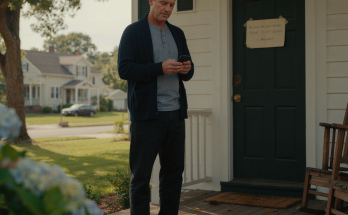
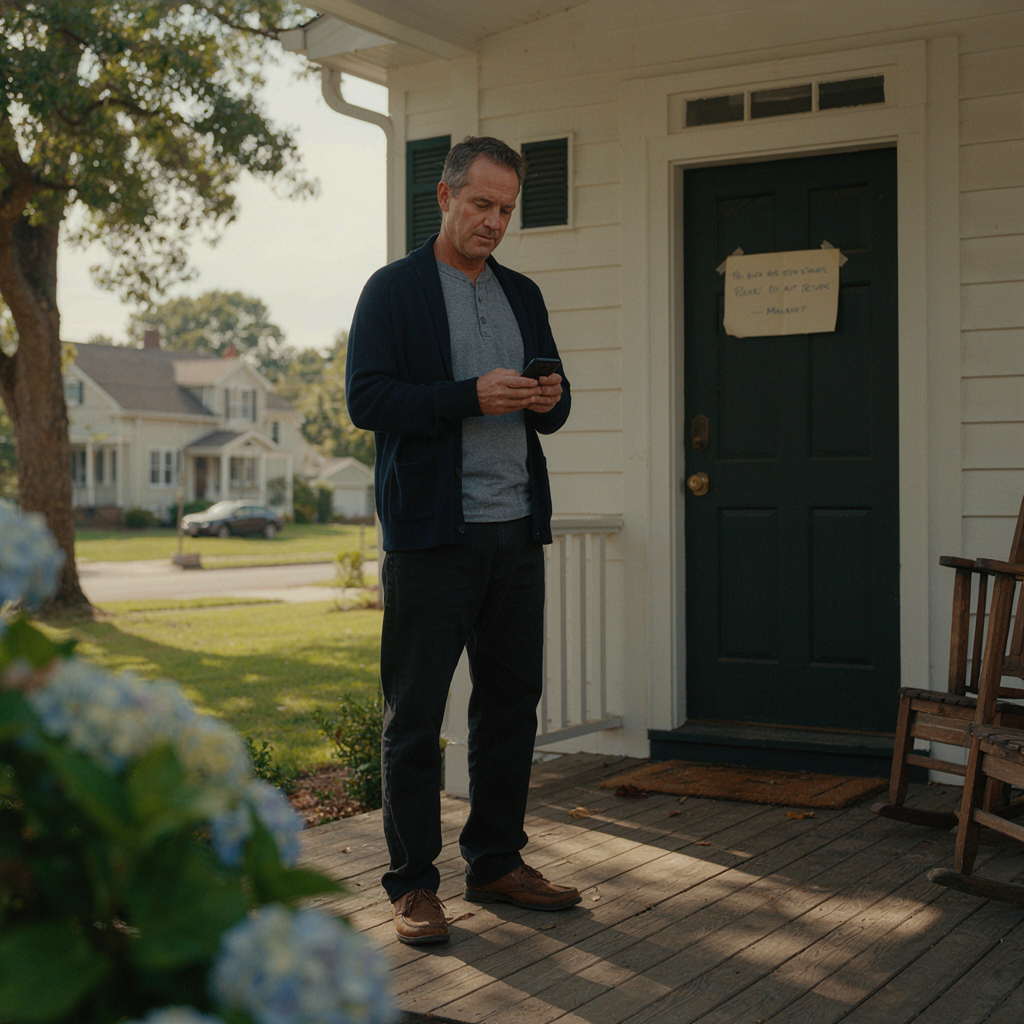
Patrick pulled into the driveway.
He got out.
He opened the trunk.
Then he walked toward the front door.
He reached into his pocket.
Stopped.
Tried the handle.
Locked.
He frowned.
He tried again.
Then he looked at Megan.
“Mom?”
She walked over.
“What’s wrong?”
“It’s locked.”
“So?”
“She always leaves the side door open.”
Megan rolled her eyes.
“Maybe she finally learned to lock it.”
Patrick knocked.
Nothing.
He knocked again.
“Mom!”
Silence.
He pulled out his key.
Inserted it.
Turned.
Nothing.
The lock had been changed.
Megan stared at him.
“What the hell?”
Patrick stepped back.
“Wait.”
He noticed the envelope taped to the door.
His name was written across it.
PATRICK.
He tore it open.
Inside was one sheet of paper.
He read it once.
Then again.
His face went pale.
Megan snatched it from his hand.
Her eyes moved across the page.
Then she whispered:
“No.”
Patrick swallowed.
“What?”
She looked at him.
“She sold the house.”
The note was short.
There was no anger.
No insults.
No dramatic accusations.
Just facts.
Patrick,
You told me I wasn’t family enough to come on the cruise. I believed you.
So I made some changes.
The house has been sold. Your belongings were packed and placed in storage. The mortgage, utilities, insurance, tuition payments, and other expenses I have been covering have all been transferred or canceled.
You and Megan are responsible for your own household from this point forward.
I hope the cruise was worth it.
Mom.
Megan read it again.
“This can’t be legal.”
Patrick didn’t answer.
She turned toward him.
“Patrick!”
He finally said:
“It’s her house.”
“What?”
“It’s her house.”
Megan’s mouth opened.
“But we live here.”
“No.”
“We’ve lived here.”
He looked at the house.
“No. We never lived here.”
He paused.
“We lived in our house.”
Megan stared at him.
“Our house?”
“Our house.”
“The one with the mortgage?”
“Yes.”
“The mortgage your mother has been paying?”
Patrick said nothing.
Megan’s face changed.
“How much did she cancel?”
He didn’t answer.
“Patrick.”
“I don’t know.”
She pulled out her phone.
She opened the bank app.
Her face drained of color.
“Patrick.”
“What?”
“The mortgage payment didn’t go through.”
He closed his eyes.
She kept scrolling.
“The electricity is disconnected.”
Silence.
“The school payment is missing.”
Patrick sat down on the front steps.
Megan stood over him.
“You told me your mother would keep paying everything.”
Patrick looked up.
“I thought she would.”
“She always does.”
He stared at the locked door.
“Not anymore.”
That evening, they went to a hotel.
The next morning, Patrick called me twenty-three times.
I didn’t answer.
Then came the messages.
Mom, we need to talk.
Please call me.
You can’t do this.
The kids don’t understand what’s happening.
Megan is furious.
Then:
I’m sorry about the cruise.
Then:
Please don’t punish the children because you’re angry at me.
I finally replied.
I’m not punishing anyone. I’m no longer paying for adults who can support themselves.
He called immediately.
I answered.
“Mom!”
“Hello, Patrick.”
“Why did you sell the house?”
“Because it’s mine.”
“You could have warned us.”
“I could have.”
“Why didn’t you?”
I looked out at the lake from my new balcony.
“Because every time I’ve tried to set a boundary with you, you’ve talked me out of it.”
Silence.
“Mom, this is extreme.”
“No.”
“It is.”
“No, Patrick. Extreme was spending $7,400 a month to support your family while you told me I wasn’t part of it.”
He exhaled.
“Megan didn’t mean it like that.”
“Maybe she didn’t.”
“So then why are you doing this?”
“Because you did.”
Another silence.
Then his voice became softer.
“Mom, you’re my mother.”
“I know.”
“You’re family.”
I closed my eyes.
“Then why wasn’t I family on the cruise?”
He had no answer.
I waited.
Finally he said:
“I was wrong.”
“I know.”
“I’m sorry.”
“I believe you.”
“So you’ll help us?”
“No.”
He sounded stunned.
“But we’re struggling.”
“You’ll figure it out.”
“Mom—”
“Patrick, you are forty-two years old.”
He said nothing.
“You have a wife. You have two children. You have a job. You own a house.”
“But—”
“You don’t need a mother who pays your bills.”
“I need my mother.”
My heart tightened.
“I am still your mother.”
“Then help me.”
“I will.”
His voice brightened.
“Really?”
“Yes.”
“How?”
“I’ll give you advice.”
Silence.
“That’s not what I meant.”
“I know.”
The next few weeks were difficult.
Patrick and Megan had never realized how much they depended on me.
The first problem was the mortgage.
They had been making partial payments, assuming my automatic transfer would cover the rest.
Now they had to face the full amount.
Then came the utilities.
Then insurance.
Then the children’s activities.
Then groceries.
Megan called me twice asking for money.
I refused.
Patrick called three times asking if I’d reconsider.
I refused.
Then, unexpectedly, Patrick stopped asking.
He got a second job on weekends.
Megan started working part-time from home.
They sold the second car.
They canceled expensive subscriptions.
They stopped eating out.
For the first time in years, they were living according to their actual income.
And slowly, something changed.
Patrick began calling me just to talk.
Not to ask for money.
Not to ask me to solve something.
Just to talk.
One evening, he called.
“Mom?”
“Yes?”
“I found something in storage.”
“What?”
“The old photo album.”
I smiled.
“The blue one?”
“Yes.”
He was quiet.
“There’s a picture of me when I was six.”
“I remember.”
“You were holding me.”
“I remember that too.”
He laughed softly.
“I used to think you were invincible.”
“I wasn’t.”
“I know that now.”
He paused.
“Mom?”
“Yes?”
“I’m ashamed.”
“Of what?”
“How I treated you.”
I didn’t respond.
“I really thought you’d always be there.”
“I was always going to be there.”
“I know.”
“But being there doesn’t mean paying for everything.”
“I understand now.”
I looked across the lake.
The sunset was turning the water orange.
“I hope you do.”
Six months passed.
Patrick and Megan invited me to dinner.
At first I hesitated.
Then I agreed.
I drove to their house.
The same house whose bills I had once paid.
The same house they had once nearly lost.
The yard looked different.
Smaller somehow.
But they looked different too.
Patrick opened the door.
“Hi, Mom.”
“Hi.”
He hugged me.
Not the quick, distracted hug I’d become used to.
A real hug.
Megan stood behind him.
“Come in.”
Dinner was simple.
Roast chicken.
Potatoes.
Green beans.
No expensive restaurant.
No wine they couldn’t afford.
Just family.
After dinner, Patrick cleared the plates.
I watched him carry them into the kitchen.
“You don’t have to do that,” I said.
He smiled.
“Yes, I do.”
Megan sat beside me.
“I owe you an apology.”
I looked at her.
“For the cruise.”
“Yes.”
She swallowed.
“I was wrong.”
I nodded.
“I know.”
“I thought your presence would make it awkward.”
“Why?”
“Because my parents were coming.”
I waited.
“And I wanted it to feel like my family vacation.”
There it was.
The sentence that had started everything.
I said quietly:
“Do you understand what hurt?”
She nodded.
“You didn’t just say I couldn’t come.”
“What did I say?”
“You made me feel like I wasn’t family.”
Her eyes filled with tears.
“I know.”
Patrick came back into the room.
He heard the last part.
He sat down.
“I did the same thing.”
I looked at both of them.
“And that’s why I had to leave.”
Patrick nodded.
“I understand now.”
He reached into his pocket.
Pulled out an envelope.
He placed it on the table.
“What is this?”
“Open it.”
Inside was a check.
I stared at the amount.
It wasn’t huge.
But it was significant.
“What is this?”
“The first installment.”
“For what?”
“Everything.”
I shook my head.
“Patrick—”
“Let me finish.”
He looked directly at me.
“We calculated what you paid for us over the years.”
My throat tightened.
“It was more than we expected.”
“I don’t want it back.”
“We know.”
He pushed the envelope toward me.
“So we’re paying it back anyway.”
I looked at him.
“Why?”
“Because you gave it freely.”
He swallowed.
“And we accepted it selfishly.”
Megan nodded.
“We can’t undo the past.”
Patrick continued.
“But we can stop pretending your love is an unlimited bank account.”
I smiled through tears.
“That’s a good lesson.”
He smiled.
“I learned it the hard way.”
A year after the cruise, Patrick called me again.
“Mom, are you busy?”
“No.”
“I wanted to ask you something.”
“What?”
“Would you come on a trip with us?”
I laughed.
“What kind of trip?”
He hesitated.
“A cruise.”
I stopped laughing.
“Really?”
“Yes.”
“Who is going?”
“Our family.”
I smiled.
“Your family?”
“Our family.”
There was a pause.
“And this time, Mom, we’re paying.”
I laughed again.
“All right.”
“Really?”
“Yes.”
He sounded relieved.
“But I have one condition.”
“Anything.”
“I get my own room.”
He laughed.
“Deal.”
“And I’m not babysitting.”
“Deal.”
“And I choose at least one excursion.”
“Mom.”
“What?”
“You’ve changed.”
I smiled.
“So have you.”
I never regretted selling that house.
People sometimes ask me whether I was too harsh.
Maybe I was.
Maybe I should have warned Patrick.
Maybe I should have sat him down and explained everything before putting the house on the market.
But here’s what I’ve learned:
Sometimes people don’t understand your boundary until it affects them.
Patrick and Megan didn’t understand what I was giving until I stopped giving it.
And strangely enough, losing the house didn’t destroy our family.
It saved it.
Because once money disappeared from the middle of our relationship, we had to figure out whether there was anything left underneath.
There was.
Love.
Real love.
Not obligation.
Not dependence.
Not guilt.
Not automatic payments.
Just love.
A few weeks before our second cruise, Patrick came to my condominium with the grandchildren.
Emma ran onto my balcony.
“Grandma!”
Noah followed her.
They both hugged me.
Patrick stood by the door.
I looked at him.
“You know, I still have the note.”
“What note?”
“The one I left on the door.”
He laughed.
“You kept it?”
“I did.”
“Why?”
I thought about it.
“Because it reminded me of the day I finally understood something.”
“What?”
I looked at my grandchildren playing outside.
“That protecting your family doesn’t mean destroying yourself for them.”
Patrick nodded.
“I know.”
“And loving your children doesn’t mean allowing them to forget how to stand on their own.”
“I know.”
“And sometimes…”
I paused.
“Sometimes the hardest thing a mother can do is lock a door.”
Patrick smiled.
“Even when her son is standing on the other side?”
“Especially then.”
He came over and hugged me.
“Thank you.”
“For what?”
“For locking it.”
I looked at him.
He was no longer the boy I’d carried through that old house.
He was a grown man.
A husband.
A father.
And finally, his own person.
I smiled.
“You’re welcome.”
Then Noah shouted from the balcony.
“Grandma! We’re going on the cruise!”
I laughed.
“Yes, we are.”
Emma ran inside.
“Are you coming?”
I looked at Patrick.
He smiled.
“She’s family.”
I smiled back.
“That’s what I wanted to hear.”
And for the first time, those words didn’t sound like an assumption.
They sounded like a choice.
A real one.
Made freely.
And that was worth far more than any house I’d ever owned.