He Cut Me Off at My MIT Graduation—Then the Dean Opened the Folder
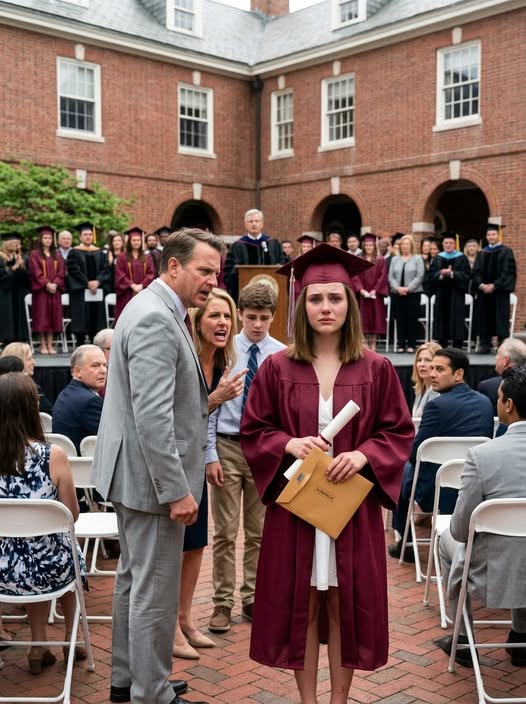
My father sent one last text from the front row at my MIT graduation.I was standing in the tunnel beneath the auditorium, waiting for my name to be called, when my phone vibrated inside my rented graduation robe.
I glanced down.Dad: Don’t count on me for anything after today. You’re on your own.For a few seconds, I simply stared at the screen.
Then I looked toward the auditorium entrance.There he was.Front row.
Perfect posture. Gray suit. Silver watch. Arms folded across his chest.
My mother sat beside him, wearing the blue dress I had helped her choose over FaceTime three weeks earlier.I had paid for both of their flights.Their hotel.Their rental car.
I had even reserved them a table at the faculty dinner afterward because I thought—despite everything—that maybe this day could finally be different.
My father looked up.Our eyes met.He smiled.Not a proud smile.A satisfied one.
The kind of smile a man gives when he believes he has finally won an argument.
I locked my phone and slipped it back into my pocket.For years, I had imagined my MIT graduation differently.I imagined my father standing when my name was announced.
I imagined him clapping until his palms turned red.I imagined him telling everyone, That’s my son.
Instead, he had just told me I was on my own.
What he didn’t know was that I had been on my own for a long time.
And he had no idea that, sitting in the dean’s hands, was a cream-colored folder containing my name, a forty-eight-million-dollar deal, and a secret that would change everything my father thought he knew about me.
I grew up believing that intelligence was something my father respected.
I was wrong.What my father respected was success he could understand.
Doctors.Lawyers.Executives.
People with impressive titles and predictable salaries.
When I was nine, I took apart our kitchen radio because I wanted to understand how sound came out of a box.
My mother screamed.
My father laughed.
“Leave him alone,” he said.
For one brief moment, I thought he was defending me.
Then he added, “He’ll grow out of it.”
I never did.
At twelve, I built a weather sensor from discarded electronics.
At fourteen, I created a program that predicted local flooding using rainfall patterns.
At sixteen, I won a statewide science competition.
My father barely looked at the certificate.
“Can it make money?” he asked.
I said no.
He shrugged.
“Then it’s a hobby.”
That sentence stayed with me.
When MIT accepted me, I called him first.
I was standing outside our house, shaking so badly I could barely hold my phone.
“Dad,” I said. “I got in.”
Silence.
Then:
“How much?”
I laughed because I thought he was joking.
“Tuition.”
“No. How much are they giving you?”
“Financial aid covers most of it.”
Another silence.
Then he said, “Good. At least you won’t need me.”
That was the first time I realized something.
My father didn’t want me to fail.
He wanted me to succeed in a way that proved he had been right about me.
And I had spent years trying to give him that proof.
MIT changed that.
Not because it was easy.
It wasn’t.
My first semester nearly broke me.
I slept four hours a night.
I failed my first advanced mathematics exam.
I once spent thirty-six consecutive hours debugging a system only to discover the problem was one missing character.
But for the first time in my life, I was surrounded by people who didn’t laugh when I talked about impossible problems.
They leaned closer.
They asked questions.
They challenged me.
And somewhere between midnight laboratories and vending-machine dinners, I stopped trying to become the son my father wanted.
I started becoming myself.
My project began during my second year.
It was supposed to be a research exercise.
A system designed to detect dangerous structural changes in critical infrastructure—bridges, tunnels, power facilities, water systems—before those changes became catastrophic.
The idea was simple.
The execution was not.
Traditional monitoring systems depended on sensors that measured specific variables.
Stress.
Temperature.
Vibration.
Movement.
My system attempted something different.
Instead of asking, Is this sensor reading dangerous?
It asked:
Does the entire structure’s behavior still make sense?
I called the prototype Aegis.
At first, it was terrible.
Then it got better.
Much better.
By my final year, Aegis could identify subtle patterns humans routinely missed.
Tiny changes in vibration.
Unexpected stress distribution.
Micro-movements.
Environmental correlations.
It didn’t predict disasters with magical certainty.
It did something more useful.
It gave engineers earlier warnings.
Sometimes hours.
Sometimes days.
And in certain cases, weeks.
The first time I realized what it could do, I was sitting alone in the lab at 2:13 a.m.
Aegis flagged a bridge outside Boston.
The probability wasn’t dramatic.
Only 81 percent.
But the system showed a pattern that didn’t make sense.
I contacted the supervising engineering team.
They investigated.
Three days later, they discovered a structural defect that could have caused a catastrophic failure under certain conditions.
Nobody died.
Nobody even knew my name.
That was fine with me.
I had built something that mattered.
Then came the fire.
A large industrial facility in the Midwest experienced an electrical event.
Aegis had been running there as part of a controlled research deployment.
The system detected a combination of thermal anomalies and electrical fluctuations.
It issued a high-priority warning.
Engineers evacuated one section.
Minutes later, a transformer failed.
The resulting fire destroyed millions of dollars of equipment.
But nobody died.
After that, people started paying attention.
Researchers contacted me.
Engineering firms contacted me.
Government agencies contacted my advisor.
And then, one afternoon, my advisor closed his office door.
“How would you feel,” he asked, “about turning Aegis into a company?”
I stared at him.
“A company?”
“Yes.”
“That sounds expensive.”
He smiled.
“It could also become very valuable.”
I didn’t tell my father.
Not yet.
I wanted to wait.
I wanted something real.
Something undeniable.
Then an investor group approached us.
They offered forty-eight million dollars for a controlling commercial partnership around Aegis.
Forty-eight million.
The number felt absurd.
I had grown up watching my father argue with utility companies over fifty-dollar bills.
Now a piece of software I had built in a university laboratory was being valued at forty-eight million dollars.
But there was a condition.
The technology had to remain independent.
No single investor could control the safety thresholds.
No company could suppress warnings because they were inconvenient.
No one could force Aegis to stay silent when it detected danger.
I agreed.
The deal was finalized shortly before graduation.
Only a handful of people knew.
My advisor.
The dean.
The legal team.
The investors.
And me.
My parents knew nothing.
I almost told them.
Then I remembered my father’s last conversation with me.
“You’ll never make anything of yourself playing with computers.”
That was six months earlier.
I decided I didn’t need his approval.
I just wanted him there at graduation.
Maybe some part of me still wanted him to see me.
That morning, I picked my parents up from their hotel.
My mother hugged me.
“You look so handsome.”
My father shook my hand.
“Big day.”
“Yeah.”
He looked at my cap.
“What’s the next step?”
“I’m working on a company.”
“Still?”
I smiled.
“Still.”
He sighed.
“I hope you have a backup plan.”
My mother glanced at him.
“Today is not the day.”
He ignored her.
“College is over. Eventually you have to live in the real world.”
I didn’t argue.
I had learned something important over the years.
You cannot convince someone to see a world they have already decided doesn’t exist.
So I drove them to MIT.
They sat in the front row.
I sat backstage.
And then my phone vibrated.
Don’t count on me for anything after today.
For a moment, anger burned through me.
Then sadness.
Then something unexpected.
Relief.
Because suddenly, I didn’t have to wonder anymore.
The ceremony began.
Names were called.
Families cheered.
Phones rose into the air.
Graduates crossed the stage.
My heart pounded.
Then the dean stepped toward the podium.
“Before we confer the next degree,” he said, “MIT would like to recognize a graduate whose work has already protected millions of people.”
The auditorium became quiet.
My father lowered his phone.
My mother leaned forward.
The dean continued.
“This graduate has developed a predictive infrastructure safety system capable of identifying dangerous structural and electrical anomalies before conventional monitoring systems can reliably detect them.”
My father frowned.
I watched from the tunnel.
The dean lifted the cream folder.
“His work has already contributed to the prevention of multiple potentially catastrophic incidents.”
My mother’s hand went to her mouth.
My father looked around.
Then the dean said my name.
“Please welcome Daniel Mercer.”
The auditorium erupted.
I walked onto the stage.
My legs felt strangely light.
The dean shook my hand.
Then he whispered:
“You ready?”
I nodded.
He opened the folder.
“Daniel’s technology has been selected for a commercial deployment agreement valued at forty-eight million dollars.”
The applause grew louder.
My father didn’t move.
Not a single inch.
The dean looked toward the audience.
“And more importantly, Daniel has insisted that the technology remain independent from commercial pressure, ensuring that safety alerts cannot be suppressed for financial reasons.”
That was when my father finally stood.
But he wasn’t applauding.
He was staring at me.
As if seeing a stranger.
After the ceremony, people surrounded me.
Professors.
Classmates.
Investors.
Engineers.
My mother pushed through the crowd first.
She hugged me so tightly I could barely breathe.
“I’m so proud of you.”
I closed my eyes.
“Thanks, Mom.”
Then she whispered:
“Your father didn’t know.”
“I know.”
She pulled back.
“He thought you were wasting your time.”
“I know.”
Behind her stood my father.
For the first time in my life, he looked small.
He approached.
“Daniel.”
I waited.
“I didn’t know.”
“No.”
“Why didn’t you tell me?”
I almost laughed.
“You never asked.”
His face tightened.
“I was trying to prepare you for reality.”
“You told me I’d never amount to anything.”
“I was trying to motivate you.”
“You told me not to count on you.”
He looked down.
“I was angry.”
“You sent that message five minutes before my name was called.”
He swallowed.
“I didn’t think…”
“What?”
He couldn’t finish.
I stepped closer.
“You didn’t think I’d succeed.”
He looked at me.
“No.”
That honesty hurt more than an excuse would have.
“I didn’t.”
For several seconds, neither of us spoke.
Then he said something I never expected.
“I was wrong.”
I stared at him.
He continued.
“I thought you were chasing fantasies.”
“You were.”
“I know.”
His voice cracked slightly.
“I thought if I pushed you hard enough, you’d eventually become practical.”
I shook my head.
“You didn’t push me.”
He looked confused.
“You made me afraid.”
Silence.
“You made me think I had to prove I deserved to exist in my own family.”
My mother began crying quietly.
My father looked away.
“I didn’t know you felt that way.”
“You never asked.”
That evening, something happened that neither of us expected.
The dean invited my parents to a private reception.
My father almost refused.
Then the dean approached him directly.
“Mr. Mercer?”
My father turned.
“Yes?”
“I wanted to speak with you.”
My father looked nervous.
“About Daniel?”
“About Daniel’s work.”
The dean led us into a quieter room.
On the table were several reports.
Photographs.
Engineering diagrams.
Graphs.
The dean pointed to one.
“This was a water treatment facility.”
He showed my father another.
“This was a transportation tunnel.”
Another.
“Electrical infrastructure.”
My father stared at the documents.
“These are…”
“Real incidents,” the dean said.
“Daniel’s system identified warning patterns before conventional systems detected them.”
My father looked at me.
“How many people?”
The dean understood the question.
“Potentially?”
My father nodded.
“Millions.”
My father sat down.
For several seconds, he didn’t speak.
Then he whispered:
“All this time…”
I sat across from him.
“All this time what?”
He rubbed his hands together.
“I thought you were hiding in a laboratory because you couldn’t handle the real world.”
I smiled sadly.
“I was hiding in the laboratory because I finally found a world where I belonged.”
That broke something inside him.
He lowered his head.
“I don’t know how to fix this.”
I didn’t answer immediately.
Because the truth was, neither did I.
Money couldn’t fix it.
The forty-eight-million-dollar deal couldn’t fix it.
An apology couldn’t erase eighteen years.
But maybe something could begin the process.
I said:
“You can start by not trying to fix it.”
He looked up.
“Then what do I do?”
“Listen.”
He nodded.
So I told him everything.
The failed experiments.
The nights I cried in the laboratory.
The bridge.
The fire.
The investment.
The fear.
The loneliness.
The moments when I almost quit.
And finally, the message.
Don’t count on me for anything after today.
When I finished, my father sat silently.
Then he reached into his jacket.
He pulled out his phone.
He opened our conversation.
He stared at the message.
Then he deleted it.
I watched.
“That doesn’t change anything,” I said.
“I know.”
He put the phone away.
“But I didn’t want those words to be the last thing I ever said to you.”
Three months later, Aegis officially launched.
The forty-eight-million-dollar agreement became public.
News organizations began calling.
Technology magazines wanted interviews.
Investors wanted meetings.
Government agencies wanted demonstrations.
I declined most of them.
I didn’t want to become famous.
I wanted Aegis to work.
And it did.
Within its first year, the system helped identify serious vulnerabilities across dozens of facilities.
Some were minor.
Some were expensive.
A few were potentially catastrophic.
The company grew quickly.
I hired engineers.
Researchers.
Ethics specialists.
Infrastructure experts.
People who were smarter than me.
That was the best decision I ever made.
My father followed everything from a distance.
He never asked me for money.
Never asked for a job.
Never bragged about me to his friends.
Instead, he started sending messages.
Not many.
Just small ones.
Good luck today.
Saw the article. Proud of you.
Hope you’re sleeping enough.
At first, I barely responded.
Then, slowly, I began answering.
A year after graduation, I returned to MIT.
The same auditorium.
The same stage.
This time I wasn’t a nervous graduate.
I had been invited to speak to engineering students.
Before the ceremony, I walked through the tunnel where I had once waited.
I remembered the rented robe scratching my neck.
The vibration of my phone.
The words that had nearly ruined the most important day of my life.
Then I looked toward the front row.
My father was sitting there.
Not because I had paid for his flight.
Not because he expected anything.
He had bought his own ticket.
My mother sat beside him.
The dean walked onto the stage.
The ceremony began.
When it was my turn to speak, I looked out at hundreds of students.
I could have talked about money.
Success.
Innovation.
Technology.
Instead, I told them the truth.
“Some of you will graduate with people cheering for you.”
I paused.
“Some of you won’t.”
The room became still.
“Some of you will spend years trying to prove yourself to someone who has already decided you aren’t enough.”
I looked toward my father.
He didn’t look away.
“And eventually, you have to make a choice.”
I continued.
“You can spend your life trying to convince them.”
“Or you can build something so meaningful that you no longer need their permission to believe in yourself.”
The audience applauded.
I smiled.
“But here’s what I learned.”
I looked at my father again.
“Success isn’t revenge.”
The applause faded.
“Success is waking up one morning and realizing you don’t hate the person who doubted you anymore.”
My father wiped his eyes.
I continued.
“Because you finally understand that their limitations were never yours.”
The auditorium erupted.
I stepped away from the microphone.
My father stood.
This time, he applauded.
Not loudly.
Not dramatically.
Just steadily.
Proudly.
Like he should have done the first time.
Afterward, he waited for me outside.
“I liked your speech.”
“Thanks.”
“You were talking about me.”
I smiled.
“A little.”
He nodded.
“I deserved it.”
We walked together across campus.
After a minute, he said:
“Do you remember the text?”
“Every word.”
“I’m sorry.”
“I know.”
“No.”
He stopped walking.
“I mean it.”
I looked at him.
“I know.”
He took a breath.
“I can’t give you back those years.”
“No.”
“I can’t undo what I said.”
“No.”
“But if you’ll let me…”
He hesitated.
“I’d like to be your father again.”
I looked across the campus.
Students rushed between buildings.
Bikes passed.
Leaves moved in the wind.
For years, I had believed forgiveness meant pretending nothing happened.
It didn’t.
Forgiveness meant remembering everything and deciding it didn’t have to control what happened next.
I turned toward him.
“You can start by coming to dinner.”
He smiled.
“I’d like that.”
“You’re paying.”
He laughed.
“Fair.”
We started walking again.
Halfway to the parking lot, my phone vibrated.
Aegis alert.
I looked down.
A major infrastructure anomaly had been detected.
High priority.
My father glanced at the screen.
“Work?”
“Yeah.”
He nodded.
“Go.”
I looked at him.
“You don’t mind?”
He smiled.
“No.”
Then he said something that made me stop.
“I’m finally beginning to understand.”
“What?”
He looked toward the buildings.
“You weren’t running away from the real world.”
He smiled.
“You were trying to make it safer.”
I didn’t know what to say.
So I hugged him.
It wasn’t a perfect hug.
It didn’t erase anything.
But it was real.
And sometimes real is better than perfect.
Years later, people would remember the forty-eight-million-dollar deal.
They would remember the patents.
The company.
The technology.
The bridges, tunnels, power stations, and facilities where Aegis helped engineers catch problems before they became disasters.
Some people would call me a genius.
Others would call me lucky.
Some would say MIT made me.
They would all be missing the point.
MIT gave me an opportunity.
Aegis gave me a purpose.
But the thing that changed me most was that text.
Don’t count on me for anything after today.
At the time, I thought those words were a rejection.
Later, I realized they were a strange kind of freedom.
Because for the first time, I stopped waiting for my father to tell me I was enough.
I stopped needing anyone’s permission.
I stopped measuring my worth by someone else’s expectations.
And that was the moment I truly became successful.
Not when the investors offered forty-eight million dollars.
Not when the dean opened that cream-colored folder.
Not when an auditorium full of people stood and applauded.
It happened earlier.
Much earlier.
It happened alone in a laboratory at two in the morning, when I looked at a broken prototype and decided to try one more time.
Because somewhere along the way, I learned something my father never intended to teach me.
You don’t become strong because someone believes in you.
Sometimes you become strong because they don’t.
And sometimes the person who cuts you loose thinks they’re watching you fall.
They don’t realize they’re watching you fly.
My father had sent one last text from the front row of my MIT graduation.
He thought he was ending his responsibility for me.
Instead, he accidentally gave me the final permission I had been waiting for.
To stop living for his approval.
To build my own life.
To become my own man.
And years later, when people asked me about the moment that changed everything, I never mentioned the forty-eight-million-dollar deal.
I told them about a phone vibrating inside a rented graduation robe.
I told them about a father who thought his son was a disappointment.
And I told them about the day that son finally stopped trying to prove otherwise.
Because the greatest thing I ever built wasn’t Aegis.
It wasn’t a company.
It wasn’t technology.
It was a life I no longer needed anyone else to validate.
And when my father finally learned to be proud of me, it was meaningful.
But by then, I had already learned the most important lesson of all:
I had been enough long before he knew it.