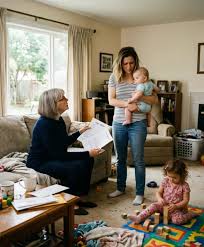
My 73-Year-Old Mother Babysat Our Neighbor’s Child for Four Weeks Without Getting Paid—Then She Told Her “You Shouldn’t Take Jobs Without Contracts.” That Night, I Walked Into the Garage
The first thing my mother did when she came home that afternoon was take off her shoes.She didn’t slam the door.She didn’t complain.She didn’t even look angry.
She simply walked into the kitchen, placed her purse on the counter, washed her hands, and sat down at the little wooden table where she had kept the same notebook for nearly twenty years.
I watched her open it.She turned to a page filled with neat handwriting.
Week 1 — $400
Week 2 — $400
Week 3 — $400
Week 4 — $400
Underneath, she’d written:Total owed: $1,600Then, very slowly, my seventy-three-year-old mother drew a line through all four entries.I stared at her.”Mom?”
She closed the notebook.”It’s fine.””No, it isn’t.”She gave me that little smile mothers give when they’re trying to convince their children they’re okay.
“I should have known better.”That sentence broke something inside me.
Because my mother wasn’t a woman who asked for much.
She had raised three children on very little. She had worked as a school cafeteria assistant for twenty-eight years, saved every penny she could, and spent most of her retirement helping everyone except herself.
She never wanted expensive vacations.She never asked us for money.She didn’t even like when we bought her groceries.
Her favorite phrase was:
“Save it. You might need it someday.”
So when our neighbor Claire asked if Mom could watch her five-year-old daughter, Lily, for four weeks, Mom agreed immediately.
The arrangement was simple.
Claire worked at a medical billing company and had suddenly been assigned extra shifts.
She told Mom she needed someone trustworthy.
Someone nearby.
Someone who wouldn’t treat Lily like a burden.
And she offered Mom $80 a day.
Monday through Friday.
Four weeks.
Forty hours a week.
Mom had hesitated.
Then Claire said, “Honestly, your mom is perfect. Lily already loves her.”
So Mom accepted.
And she gave that job everything she had.
Every morning, she’d arrive at Claire’s house at 7:15.
She brought homemade banana muffins.
Apple slices.
Little cheese sandwiches.
Sometimes she’d even pack Lily’s favorite cinnamon cookies.
She cleaned up after breakfast.
She washed Lily’s dishes.
She folded the little girl’s clothes.
She swept the kitchen.
Once, when Claire came home late, Mom even made dinner.
She wasn’t just babysitting.
She was caring for Lily like she was one of her own grandchildren.
And Lily adored her.
For four weeks, that little girl ran to the door every morning shouting:
“Grandma Rose!”
Mom wasn’t actually her grandmother.
But Lily didn’t care.
Neither did Mom.
The first week ended.
No payment.
Claire said, “My paycheck got delayed.”
Mom shrugged.
“That’s okay.”
Second week.
Still nothing.
“Claire said payroll messed something up.”
Mom said, “These things happen.”
Third week.
Nothing.
This time, Mom gently reminded her.
“Claire, dear, whenever you have a chance, don’t forget about the babysitting money.”
Claire barely looked up from her phone.
“Of course. Next Friday.”
Then came the fourth week.
And that’s when everything changed.
On Friday afternoon, Mom stood at Claire’s front door holding Lily’s backpack.
Claire was standing inside the house, scrolling through her phone.
Mom smiled politely.
“Claire, I just wanted to ask about the payment. Four weeks have passed now.”
Claire looked up.
And smiled.
Not apologetically.
Not embarrassed.
She smiled as though Mom had said something amusing.
Then she said:
“At your age, you really shouldn’t take jobs without contracts.”
Mom froze.
Claire continued.
“Besides… it’s not like you had anything better to do anyway.”
For a moment, neither of them spoke.
Then Lily appeared behind Claire.
“Grandma Rose, are you coming tomorrow?”
Mom’s expression softened.
She crouched down.
“No, sweetheart.”
“Why?”
“Because your mommy doesn’t need me anymore.”
Lily’s eyes filled with tears.
Claire rolled her eyes.
“Don’t make this dramatic.”
Mom stood.
She nodded once.
“Goodbye, Claire.”
And she walked home.
Quietly.
That’s when I saw the notebook.
And that’s when something inside me snapped.
I looked at Mom.
“Where’s the agreement?”
She shook her head.
“There wasn’t a contract.”
“Did she ever text you about the $80?”
Mom nodded.
“Several times.”
“Do you still have them?”
She looked confused.
“Why?”
“Mom, do you still have them?”
She went to her purse and pulled out her phone.
I took it.
There they were.
Weeks of messages.
Claire writing:
“Yes, $80 a day. I’ll pay you every Friday.”
Another:
“Thank you so much. I don’t know what I’d do without you.”
Another:
“I’ll catch up everything next payday, I promise.”
And another from three days earlier:
“Don’t worry, Rose. You will absolutely get your money.”
I stared at the screen.
Then I looked at Mom.
“How much did she owe you?”
“$1,600.”
I stood.
Mom grabbed my wrist.
“Please don’t make trouble.”
“She made trouble.”
“No.”
“She used you.”
Mom sighed.
“Maybe she was struggling.”
“Mom, she told you that you were too old to take a job.”
Mom looked away.
“And said I had nothing better to do.”
Her voice cracked slightly.
That was the first time I’d heard the hurt underneath her calmness.
I sat back down.
“What do you want me to do?”
She thought for a moment.
“Nothing.”
But I knew my mother.
When she said nothing, she usually meant:
“I don’t want you to fight my battles.”
And normally, I would have respected that.
But this wasn’t just about $1,600.
It was about what Claire believed she could get away with.
She had mistaken my mother’s kindness for weakness.
And I couldn’t let that stand.
I stood again.
Mom sighed.
“Where are you going?”
“To the garage.”
She frowned.
“Why?”
“Because I need something.”
I walked outside.
The garage was packed with old boxes.
My father had died six years earlier, and we’d never completely gone through his things.
There were tools.
Old receipts.
Boxes of photographs.
A filing cabinet.
And in the corner, beneath a dusty blue tarp, sat my father’s old laptop.
I pulled it out.
Then I found what I was looking for.
A small black metal case.
Inside were my father’s business records.
My father had owned a small property management company before he retired.
Nothing huge.
Just a few rental houses and small commercial buildings.
But he’d been meticulous.
Every agreement.
Every payment.
Every repair.
Every receipt.
He had kept everything.
I remembered something.
Three years before he died, he had bought the small house next to ours.
The one Claire lived in.
He had purchased it as an investment.
After his death, the property had passed to Mom.
I found the deed.
My hands stopped moving.
I stared at the name.
Rose Bennett.
Owner.
I smiled.
Suddenly, Claire’s little speech about contracts didn’t sound so clever.
Because Claire wasn’t just our neighbor.
She was renting a house owned by my mother.
And Claire was already three months behind on rent.
I knew that because I’d helped Mom organize the property records earlier that year.
She had been too kind to enforce anything.
Every time Claire said she’d pay next month, Mom accepted it.
“She has a child,” Mom would say.
“Things are expensive.”
“Give her time.”
I remembered the garage.
The boxes.
The paperwork.
The ignored notices.
And suddenly, I understood.
Claire hadn’t simply taken advantage of Mom’s babysitting.
She had been taking advantage of her kindness for months.
I carried the documents into the kitchen.
Mom looked at them.
“What is that?”
“Your property file.”
She stared at me.
“Why?”
“Because Claire thinks you don’t know how contracts work.”
Mom’s face changed.
“What are you thinking?”
“I’m thinking she should learn.”
The next morning, I didn’t go to Claire’s house.
I called a local attorney.
I explained everything.
The unpaid babysitting.
The messages.
The rent.
The verbal agreement.
The lawyer listened carefully.
Then he said something I’ll never forget.
“Your mother doesn’t need to yell at this woman. She needs documentation.”
So we documented everything.
The messages.
The dates.
The hours Mom worked.
The written acknowledgment of the $80 daily rate.
The missed payments.
The rental agreement.
The unpaid rent.
And most importantly, the attorney explained that even without a formal contract, Claire’s written messages acknowledging the work and agreed rate could be important evidence.
Then he asked:
“Does your mother own the house?”
“Yes.”
“Then don’t threaten her. Don’t harass her. Follow the proper legal process.”
That’s exactly what we did.
Mom was nervous.
“Maybe we should just forget the babysitting money.”
I shook my head.
“No.”
“Why?”
“Because you earned it.”
She stared at me.
“I don’t want $1,600 if it causes trouble.”
“It isn’t trouble, Mom. It’s your wages.”
She was silent.
Then she whispered:
“I just wanted to help.”
“I know.”
She smiled sadly.
“Maybe that’s my problem.”
“No.”
I took her hand.
“That’s your strength. The problem is people who think kindness is permission.”
Three days later, Claire knocked on our door.
She looked furious.
“Rose!”
Mom opened the door.
Claire held a letter.
“What is this?”
Mom looked at me.
I was sitting at the kitchen table.
She turned back to Claire.
“It’s a notice.”
“You can’t do this.”
Mom’s voice was calm.
“It’s my house.”
Claire’s mouth opened.
Then closed.
She looked at me.
“You put her up to this.”
“No.”
“Yes, you did.”
I stood.
“My mother made her own decision.”
“You think you can intimidate me because you’re younger?”
“No.”
I pointed toward the letter.
“The letter explains your options.”
Claire laughed.
“This is ridiculous. I have a child.”
Mom’s expression softened.
“I know.”
“Then how can you do this?”
Mom looked at her for several seconds.
“How could you?”
Claire blinked.
“What?”
“You knew I was seventy-three.”
“Yes.”
“You knew I was helping you because you needed help.”
“Yes.”
“You promised to pay me.”
Claire crossed her arms.
“I told you I would.”
“You didn’t.”
Claire looked away.
Mom continued.
“You let me work four weeks without paying me. Then when I asked for what you owed me, you told me I was too old to take a job and had nothing better to do.”
Claire’s face reddened.
“I was frustrated.”
“So was I.”
It was the first time I’d ever heard my mother raise her voice.
Only slightly.
But enough.
“You hurt me.”
Claire said nothing.
Mom held out the letter.
“I don’t want you to leave Lily without a home. I don’t want your child to suffer.”
Claire’s eyes flickered.
“But I also won’t allow you to treat me like I don’t matter.”
That silenced her.
Then something unexpected happened.
Lily appeared behind her mother.
She was holding a small paper drawing.
She ran to Mom.
“Grandma Rose!”
Claire tried to stop her.
But Lily slipped past.
She hugged Mom around the waist.
Mom bent down and hugged her back.
“I miss you.”
“I miss you too.”
Lily handed her the drawing.
It was a picture of two people holding hands beneath a giant yellow sun.
At the top, in crooked letters, Lily had written:
ME AND GRANDMA ROSE
Mom started crying.
So did I.
Claire looked away.
For a moment, I thought she might apologize.
Instead, she said:
“Fine.”
Then she walked away.
But the story didn’t end there.
Because two days later, Claire came back.
This time, she wasn’t angry.
She looked exhausted.
She stood on the porch holding an envelope.
“I have $800.”
Mom looked surprised.
Claire swallowed.
“I can’t pay everything today.”
Mom said nothing.
“I’ve been having money problems.”
I stepped forward.
“Then why didn’t you tell her?”
Claire looked at me.
“Because I was embarrassed.”
I wanted to be angry.
But Mom spoke first.
“You should have told me.”
Claire nodded.
“I know.”
She looked at the envelope.
“I can pay the other $800 in two weeks.”
Mom looked at me.
I didn’t say anything.
She turned back to Claire.
“Okay.”
Claire looked relieved.
“But there’s one condition.”
“What?”
“No more promises you don’t keep.”
Claire nodded.
“I understand.”
Mom took the envelope.
Then she said something that surprised all of us.
“And if you need help with Lily in the future, ask.”
Claire looked at her.
“After everything?”
Mom smiled.
“Helping isn’t the problem.”
She paused.
“Being taken for granted is.”
Claire’s eyes filled with tears.
“I’m sorry.”
Mom nodded.
“I accept your apology.”
Claire left.
I thought that was the end.
It wasn’t.
The following week, something strange happened.
I was outside checking the mail when a woman from two houses down approached me.
She said:
“Are you Rose’s son?”
“Yes.”
She hesitated.
“Can I tell you something?”
“Sure.”
She lowered her voice.
“Claire has been telling everyone your mother babysat Lily for free because she likes being useful.”
My jaw tightened.
“She said that?”
The woman nodded.
“She also said your mother was demanding money afterward.”
I went inside.
Mom was sitting at the table drinking tea.
I told her.
She sighed.
“I expected that.”
“Why didn’t you tell me?”
“Because it doesn’t matter.”
“It matters to me.”
Mom shook her head.
“People can say whatever they want.”
Then she opened her notebook.
The same notebook.
She turned to a fresh page.
I expected to see her writing down another expense.
Instead, she wrote:
Things I Learned at 73
Then she began writing.
I watched.
- Kindness should never require silence.
- Helping someone doesn’t mean owing them your dignity.
- If someone promises payment, write it down.
- Age does not determine worth.
- Never confuse being generous with being available to be used.
She looked up at me.
“What do you think?”
I smiled.
“I think number five should be number one.”
She laughed.
A month passed.
Claire paid the remaining $800.
But something else changed.
She stopped making excuses.
She stopped asking Mom for favors without asking first.
And surprisingly, she started treating Mom differently.
One Saturday afternoon, she knocked on our door carrying a small cake.
“I made this.”
Mom looked surprised.
“For what?”
Claire smiled.
“Because I owe you more than money.”
Mom invited her inside.
They talked for nearly an hour.
Claire admitted she had been overwhelmed.
She had been struggling financially.
She had felt ashamed.
And instead of asking for help, she had convinced herself that Mom didn’t need the money.
Because Mom was retired.
Because Mom was older.
Because Mom had always been generous.
That was the lie she’d told herself.
The truth was simpler.
She had taken advantage of someone because she thought there would be no consequences.
But there were consequences.
Not because I threatened her.
Not because Mom humiliated her.
Because Mom finally decided her own time had value.
Six months later, Claire found a better-paying job.
She moved into a smaller apartment.
And before she left, she came to say goodbye.
Lily hugged Mom so tightly she nearly knocked her over.
“I love you, Grandma Rose.”
Mom kissed her forehead.
“I love you too.”
Claire stood beside them.
Then she handed Mom a folded piece of paper.
Mom opened it.
It was a reference letter.
It said:
To Whom It May Concern,
Rose Bennett is one of the most dependable, compassionate, hardworking people I have ever known. She cared for my daughter with patience, responsibility, and love. I regret deeply that I once mistook her kindness for weakness.
She deserves to be treated with respect.
Claire Morgan
Mom read it twice.
Then she folded it carefully.
“Thank you.”
Claire nodded.
“I’m the one who should thank you.”
After they left, Mom sat beside me on the porch.
The evening sun was fading.
She looked peaceful.
“You know,” she said, “I don’t regret helping Lily.”
“I know.”
“I don’t regret loving that child.”
“I know.”
“I only regret that I let someone convince me my time wasn’t worth anything.”
I looked at her.
“Your time is priceless.”
She smiled.
Then she reached into her purse and pulled out the little notebook.
She turned to the page where she’d crossed out the four weeks of unpaid wages.
Underneath, she had written something new.
$1,600 — PAID IN FULL
And below that:
Lesson learned.
I laughed.
“You really kept the notebook.”
“Of course.”
She closed it.
“You know what your father always said?”
“What?”
“Never throw away the receipts.”
I smiled.
“Your father would’ve loved this.”
She laughed.
“He would’ve sent Claire an invoice before she finished week one.”
We sat quietly.
Then Mom looked toward the house next door.
“Do you think I was wrong?”
I shook my head.
“No.”
“Even though everything got complicated?”
“No.”
“Even though you had to get involved?”
I smiled.
“Especially because you shouldn’t have had to.”
She leaned her head against my shoulder.
And that’s when I realized something.
The $1,600 was never really the point.
The point was that my mother had spent seventy-three years believing that being a good person meant putting everyone else first.
She had spent decades giving away her time.
Her energy.
Her food.
Her patience.
Her love.
And somewhere along the way, she’d forgotten that she was allowed to say:
This matters.
I matter.
My time matters.
The next morning, Mom woke up early.
But for the first time in four weeks, she didn’t go to Claire’s house.
Instead, she made herself coffee.
She sat on the porch.
And read a book.
At 9:00, I walked outside.
“Doing anything today?”
She smiled.
“Actually, yes.”
“What?”
“I’m going to the senior center.”
“Why?”
“They need someone to teach knitting.”
I laughed.
“Are they paying you?”
She pointed a finger at me.
“Don’t start.”
We both laughed.
Then she added:
“But yes.”
“How much?”
“Thirty dollars an hour.”
I smiled.
“Good.”
She took a sip of coffee.
“And I’m getting a contract.”
I nearly spit out my drink.
Mom laughed so hard she had tears in her eyes.
“See?” she said.
“At seventy-three, I’m learning.”
I looked at her.
“No, Mom.”
She raised an eyebrow.
“What?”
“At seventy-three, you’re teaching everyone else.”
She smiled.
And for the first time in a long time, I saw something in her eyes that hadn’t been there before.
Not anger.
Not bitterness.
Something better.
Self-respect.
Because Claire had been right about one thing.
At seventy-three, my mother shouldn’t take jobs without contracts.
But she was completely wrong about the rest.
My mother absolutely had something better to do.
She had a life to live.
And she had finally realized that her kindness was a gift—not an obligation.
And from that day forward, nobody in our neighborhood ever again mistook the kindness of a seventy-three-year-old woman for weakness.