The Garage Table
Leo was ten years old when my sister-in-law decided his wheelchair was ruining my parents’ anniversary dinner.Not Leo.His wheelchair.That distinction mattered.
Because Leo had spent two years learning how to live in a world that suddenly looked very different from the one he’d known before his accident.
He had learned how to transfer from his chair to the couch.
How to maneuver through narrow doorways.
How to laugh when someone nervously asked a question they didn’t know how to phrase.He had learned how to ignore stares.He had learned how to pretend he didn’t notice when children whispered.
But that evening, at my parents’ fortieth wedding anniversary, I watched something in my son disappear.
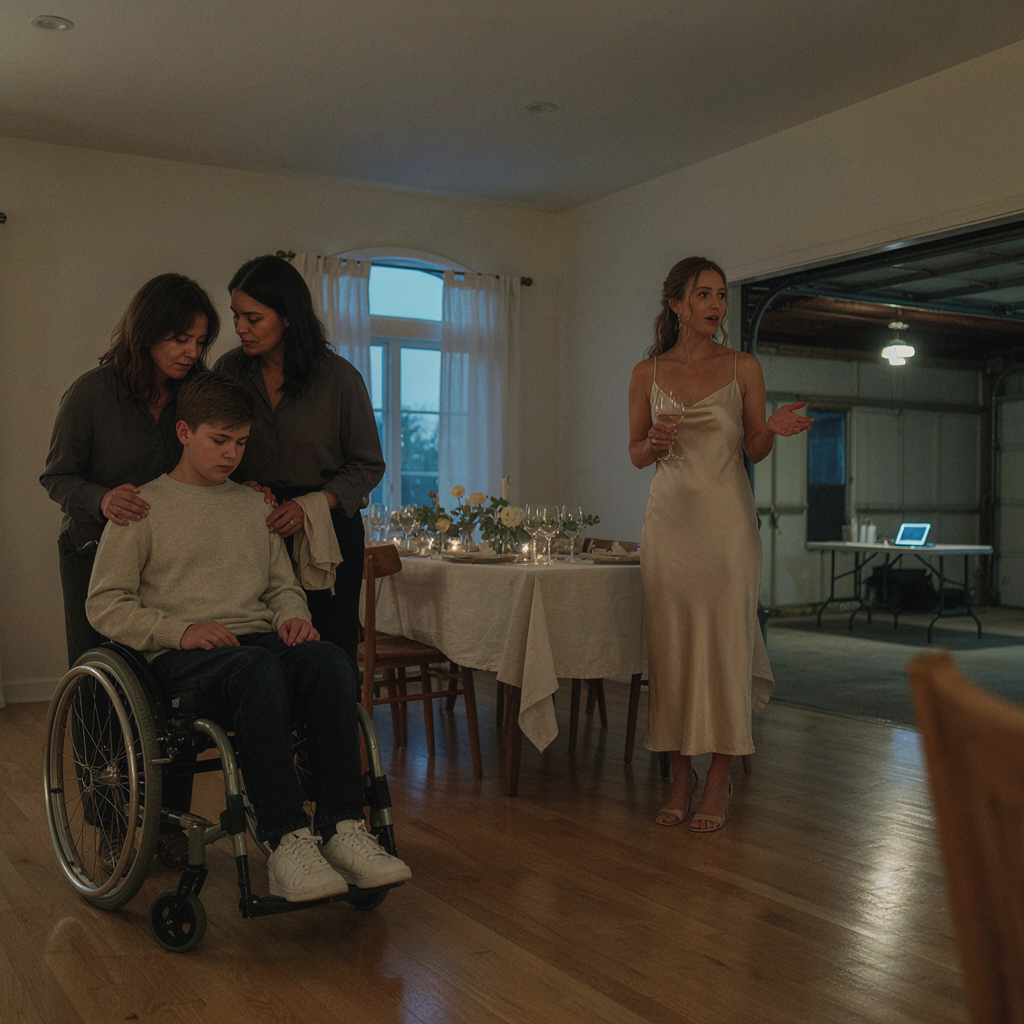
And it happened because of a folding table in my parents’ heated garage.
The dinner had been my mother’s dream.Forty years.Four decades of marriage.
My parents had met when they were twenty-one, married at twenty-five, and somehow survived everything life had thrown at them: layoffs, mortgages, three children, cancer scares, arguments about money, and my father’s terrible habit of buying cars he didn’t need.
My mother had spent weeks planning the celebration.She wanted it intimate.Twenty-two people.Family.
Good food.Candles.The antique china she’d inherited from her grandmother.
White roses in low glass vases.Cream-colored linen napkins.
She had even hired a photographer.And my sister-in-law Chloe had volunteered to handle the dining-room decorations.At first, I thought that was sweet.Chloe loved decorating.
She had a social media account dedicated to minimalist interiors, and apparently her definition of happiness involved neutral colors, perfectly aligned furniture, and absolutely nothing that could be described as “visually disruptive.”
I didn’t think much of it.Until I arrived.The first thing I noticed was the dining room.It looked beautiful.Almost too beautiful to eat in.
Every chair was positioned at exactly the same angle. Every glass was exactly the same distance from the edge of the table. A long arrangement of white roses ran down the center.
There wasn’t much space between the chairs.
That was the problem.
I noticed it immediately.
Leo noticed it too.
“Mom,” he whispered, looking at the table, “where am I sitting?”
“Right there,” I said, pointing to the space beside me.
His eyes brightened.
“Really?”
“Of course.”
He smiled.
That smile was the reason I had spent the past two years fighting so many battles.
Leo had been eight when the accident happened.
A distracted driver ran a red light.
Leo had been crossing the street with his father.
One second, he had been walking.
The next, our lives had split into a before and an after.
The doctors told us he might never walk again.
Leo didn’t understand what that meant at first.
He kept asking when his legs would “turn back on.”
I told him we didn’t know.
I cried in hospital bathrooms.
He cried in physical therapy rooms.
Then one morning, he rolled himself across the therapy floor, looked at me, and said, “Mom, I think I’m going to be okay.”
He was.
Not because everything was easy.
Because he refused to let the accident become the only thing people saw when they looked at him.
He was still Leo.
He loved dinosaurs.
He hated broccoli.
He could beat me at chess.
He watched ridiculous superhero movies and believed pizza counted as a food group.
His wheelchair wasn’t his identity.
It was simply how he got around.
That evening, he wore a navy-blue shirt and a little silver watch my father had given him for his tenth birthday.
He was excited.
He had practiced a speech for Grandma and Grandpa.
He’d written it himself.
Three paragraphs.
He was terrified of reading it aloud.
But he wanted to.
I was helping him straighten his collar when Chloe walked into the dining room.
She stopped.
Looked at Leo.
Looked at the table.
Then looked back at Leo.
Her smile tightened.
“Oh,” she said.
I knew immediately.
“Hi, Chloe.”
She walked toward us.
“Where is Leo sitting?”
I pointed.
“Here.”
She stared at the chair beside mine.
“That’s going to be difficult.”
“For whom?”
She gave a little laugh.
“I just mean the space is tight.”
“I’ll manage.”
Chloe looked around the room.
Then she lowered her voice.
“The chair is really bulky.”
Leo stopped moving.
I felt his hand tighten around the edge of his wheel.
Chloe continued.
“It’s just better for the aesthetic.”
I stared at her.
“What?”
She gestured toward the table.
“We worked really hard on the room. The photographs are going to look so much cleaner if we don’t have… you know…”
Her eyes dropped to Leo’s wheelchair.
“…that.”
Silence.
Leo looked down.
I felt heat rising through my chest.
“Chloe,” I said slowly, “Leo is sitting at the table.”
She sighed.
“I knew you’d take it personally.”
“Because you’re talking about my son.”
“I’m not saying he can’t attend.”
She pointed toward the hallway.
Then toward the garage.
“There is a folding table out there. It’s heated. We can make it really nice.”
I didn’t move.
Neither did Leo.
Chloe continued as if she’d solved a logistical problem.
“He can sit there with his iPad. It’ll be quieter for him, too.”
I looked at my ten-year-old son.
His shoulders had collapsed.
The excitement was gone.
The little speech he’d been practicing was still in his hand.
He’d written it on blue construction paper.
I looked back at Chloe.
“You want him to eat dinner alone in the garage?”
“It’s not like that.”
“It is exactly like that.”
“It’s only for dinner.”
“At his grandparents’ fortieth anniversary?”
Chloe crossed her arms.
“You’re making this dramatic.”
Before I could answer, another voice came from behind us.
“What’s dramatic?”
My father.
He had been standing in the doorway.
I hadn’t heard him.
Chloe’s expression changed.
“Oh, nothing, Dad.”
My father looked at Leo.
Then at me.
Then at the dining table.
“Why isn’t Leo sitting down?”
Nobody answered.
He looked at Chloe.
“What’s going on?”
Chloe smiled nervously.
“We were just figuring out seating.”
My father waited.
Chloe eventually said, “The dining room is a little tight with the wheelchair.”
My father’s eyes moved to Leo.
“Is it?”
Leo shrugged.
“I can fit.”
“I know you can.”
My father walked over to the table.
He looked at the chairs.
Then he looked at the empty space beside mine.
Then he turned toward the garage.
“What’s in there?”
Chloe brightened.
“A folding table.”
“Why?”
“For Leo.”
My father’s face went completely still.
“For Leo?”
Chloe nodded.
“It’s heated.”
My mother appeared in the hallway.
“What are you all doing?”
Nobody answered her.
Then my father said something that made the entire room freeze.
“Everyone, get up.”
Chloe blinked.
“What?”
“I said get up.”
“Dad, what are you—”
“Everyone.”
My father walked to the head of the dining table.
He placed both hands on the back of his chair.
“This is my anniversary dinner.”
He looked around the room.
“Forty years ago, your mother and I stood in front of our families and promised we’d never let pride, appearances, or other people’s opinions become more important than the people we loved.”
He looked directly at Chloe.
“And apparently we’ve forgotten that.”
Chloe’s mouth opened.
“Dad, I wasn’t trying to—”
“I know exactly what you were trying to do.”
The room became silent.
My father pulled his chair away from the table.
Then he did something nobody expected.
He picked up the entire centerpiece of white roses.
“Move these.”
My mother stared.
“What?”
“Move them.”
He lifted the flowers from the center of the table and carried them into the kitchen.
Then he removed two decorative chairs that were never meant to be used.
“These too.”
Chloe looked horrified.
“But the symmetry—”
My father turned.
“To hell with the symmetry.”
Nobody spoke.
He moved another chair.
Then another.
Within two minutes, the perfectly arranged dining room looked completely different.
Not perfect.
Better.
There was room.
Plenty of it.
My father returned to Leo.
He crouched beside him.
“Want to sit with Grandpa?”
Leo nodded.
My father smiled.
“Then that’s where you’re sitting.”
He guided Leo toward the table.
Leo rolled forward.
His wheels crossed the threshold.
And when he reached his place beside my father, Grandpa pulled out the chair next to him.
“There.”
Leo looked at him.
“But Mom said—”
“I know what your mom said.”
My father winked.
“And your grandpa says this is your table.”
Leo smiled.
Then my father looked at everyone else.
“Anyone who has a problem with that can use the garage.”
Someone snorted.
My mother covered her mouth.
My brother laughed.
Even Leo giggled.
Everyone except Chloe.
She stood rigidly beside the doorway.
“You embarrassed me,” she said.
My father frowned.
“No.”
He shook his head.
“You embarrassed yourself.”
Chloe’s face reddened.
“I was trying to make the evening special.”
My father nodded.
“You did.”
She looked confused.
“How?”
“Because now we’ll never forget it.”
The dinner began twenty minutes later.
And for a while, I thought that would be the end of it.
It wasn’t.
Chloe sat across from Leo.
She barely spoke.
Whenever Leo moved his chair, she glanced at him.
Whenever his wheels touched the table leg, she looked irritated.
Leo noticed.
Of course he did.
Kids notice everything adults think they’re hiding.
During the appetizer, he leaned toward me.
“Mom?”
“Yeah?”
“Does Aunt Chloe hate my chair?”
I swallowed.
“No.”
He looked at me.
“She hates that it doesn’t match.”
I didn’t know what to say.
So I told him the truth.
“Some people care too much about how things look.”
Leo nodded thoughtfully.
Then he looked at his wheelchair.
“I like how it looks.”
I smiled.
“Me too.”
Halfway through dinner, my mother stood.
She raised her glass.
“I’d like to say something.”
Everyone quieted.
She looked at my father.
“Forty years ago, I thought marriage was about finding someone who would always make me happy.”
My father smiled.
“I’ve failed miserably.”
Everyone laughed.
My mother continued.
“Then I learned marriage is really about finding someone who will stand beside you when life is hard. Someone who will sit beside you when you don’t know what to say. Someone who will help you up when you fall.”
Her eyes moved to Leo.
“Sometimes literally.”
Leo smiled.
My mother raised her glass.
“To family.”
Everyone raised their glasses.
“To family.”
Then Leo remembered his speech.
“Oh!”
He reached into his pocket.
“I have something.”
My mother smiled.
“Of course you do.”
He rolled his chair forward.
His hands trembled.
He looked at the paper.
Then at Grandpa.
Grandpa nodded.
Leo began.
“Grandma and Grandpa…”
His voice was tiny.
The room became silent.
“…you’ve been married forty years.”
He looked down at his paper.
“That’s longer than dinosaurs were married.”
My brother burst out laughing.
Leo grinned.
“Okay, maybe not.”
Everyone laughed.
Even Chloe.
For the first time all evening.
Then Leo continued.
“You taught us that family means staying together.”
My mother’s eyes filled with tears.
Leo’s voice became steadier.
“And when something is difficult, you don’t put the difficult thing somewhere nobody can see it.”
The room went completely silent.
I stopped breathing.
My father looked at Leo.
Leo didn’t look at Chloe.
He simply read the words he’d written.
“You make room.”
My mother’s hand covered her mouth.
“And if someone needs a little more room, you make more.”
Leo lowered the paper.
“Happy anniversary.”
For three seconds, nobody moved.
Then my father stood.
He walked around the table.
And hugged his grandson.
Leo buried his face against Grandpa’s shoulder.
Everyone applauded.
I cried.
My mother cried.
My brother cried.
And Chloe stared at the centerpiece sitting on the kitchen counter.
The centerpiece she’d been so desperate to protect.
A week later, Chloe called me.
I almost didn’t answer.
But I did.
“Hello?”
There was silence.
Then she said, “I owe you an apology.”
I sat down.
“Okay.”
“I was wrong.”
I didn’t say anything.
She continued.
“I kept thinking about that night.”
“Good.”
She exhaled.
“I told myself I was helping. That I was trying to make things look nice.”
“You weren’t helping Leo.”
“I know.”
She paused.
“Actually, I think I was trying to make myself look good.”
That surprised me.
“Why?”
“Because I wanted the photographs to look perfect.”
Her voice cracked.
“I wanted everyone to see how beautiful the dinner was.”
She laughed bitterly.
“And I forgot there were supposed to be people in those pictures.”
I leaned back.
“Chloe…”
“I know you don’t have to forgive me.”
“No.”
“I don’t?”
“You don’t have to ask me.”
She was quiet.
“Then who do I ask?”
I looked toward the hallway.
Leo was there, playing a video game.
“You know who.”
That weekend, Chloe came over.
She brought something.
A small wooden plaque.
She handed it to Leo.
He read it.
MAKE ROOM.
He looked up.
“For me?”
“For everyone,” Chloe said.
Leo thought about it.
Then smiled.
“Okay.”
He placed the plaque on his desk.
I thought that was the end.
But months later, something happened that showed me just how much that evening had changed Chloe.
My mother hosted Thanksgiving.
Chloe arrived early.
I walked into the dining room and stopped.
She had rearranged the entire room.
The table was pushed against one wall.
There were no decorative chairs.
No narrow pathways.
No fragile centerpiece.
There was a wide, clear path from the hallway to the table.
Leo rolled into the room.
He stopped.
Looked around.
Then looked at Chloe.
“Aunt Chloe?”
“Yeah?”
“Did you make room for me?”
Chloe smiled.
“I did.”
Leo nodded.
“Good.”
Then he rolled straight to the table.
He didn’t thank her.
He didn’t need to.
He simply took his place.
And Chloe understood.
Because sometimes inclusion isn’t about making a grand announcement.
It isn’t about applause.
It isn’t about pretending disability doesn’t exist.
It’s about looking at the person in front of you and asking a simple question:
What do you need to be part of this?
Not:
How can we hide what makes you different?
That anniversary dinner became a family story.
We told it every year.
Not because Chloe had humiliated herself.
Not because Grandpa had moved the furniture.
But because Leo had taught all of us something that night.
Years later, he would still talk about it.
He’d joke that Grandpa had “declared war on chairs.”
My father would laugh.
My mother would say, “Your grandfather declared war on foolishness.”
And Chloe?
She became one of Leo’s loudest supporters.
She attended his wheelchair basketball games.
She helped him redesign his bedroom.
She even started volunteering with a local organization that taught businesses about accessibility.
Once, I asked her why.
She said, “Because I finally realized something.”
“What?”
She looked at Leo, who was across the room arguing with Grandpa about basketball statistics.
“I thought making room meant moving him somewhere else.”
She shook her head.
“Now I understand it means moving everything else.”
I never forgot that.
Neither did Leo.
Because that night, my father didn’t simply move a chair.
He moved the entire family’s understanding of what mattered.
He showed us that a celebration isn’t ruined because someone needs more space.
A family isn’t less beautiful because life isn’t perfectly symmetrical.
And a child shouldn’t have to disappear so everyone else can feel comfortable.
Leo didn’t belong at the garage table.
He never had.
He belonged exactly where he had always belonged.
At the table.
With his family.
With a plate in front of him.
A glass beside him.
His grandfather on one side.
His mother on the other.
And a whole room finally willing to make space.
Years later, I still have one photograph from that anniversary.
It isn’t the picture Chloe wanted.
The chairs aren’t perfectly aligned.
The flowers aren’t centered.
Someone’s napkin is crooked.
My brother is laughing with his mouth full.
My mother is crying.
My father has one arm around Leo.
And Leo is looking straight at the camera.
He’s smiling.
Not the polite smile he used when adults tried to make him feel better.
His real smile.
The one I hadn’t seen when Chloe pointed toward the garage.
I keep that photograph framed in my living room.
And beneath it, I wrote four words.
The words my son taught us that night:
Always make room.