The Weekend They Tried to Steal
All I wanted was one quiet weekend.After thirty-two years of military service, followed by another six years consulting for defense contractors, I had learned to appreciate silence in a way most people never could.
Not empty silence.Peaceful silence.The kind that came with waves rolling onto the shore at six in the morning, gulls crying somewhere beyond the dunes, and wind moving through the sea oats behind my beach house.
That house was mine.Every board.Every window.
Every mortgage payment.Every repair bill.
I had bought it eight years earlier with money I had saved while serving in the U.S. Army. After retiring as a colonel, it became my refuge.
I called it Harbor House.My family called it “the beach place.”That distinction mattered.
Because “the beach place” made it sound like a family resort.
Harbor House was not a resort.It was my home.And that weekend, I desperately needed it.
For three straight months, I’d been working nearly every day. A major consulting project had consumed my life. I’d skipped birthdays, postponed dinners, ignored invitations and survived on coffee and four-hour nights.
So on Friday morning, I packed two bags, turned off my work phone, and drove three hours to the coast.
I imagined myself sitting on the back deck with a book.
Maybe grilling a steak.Maybe sleeping until eight.
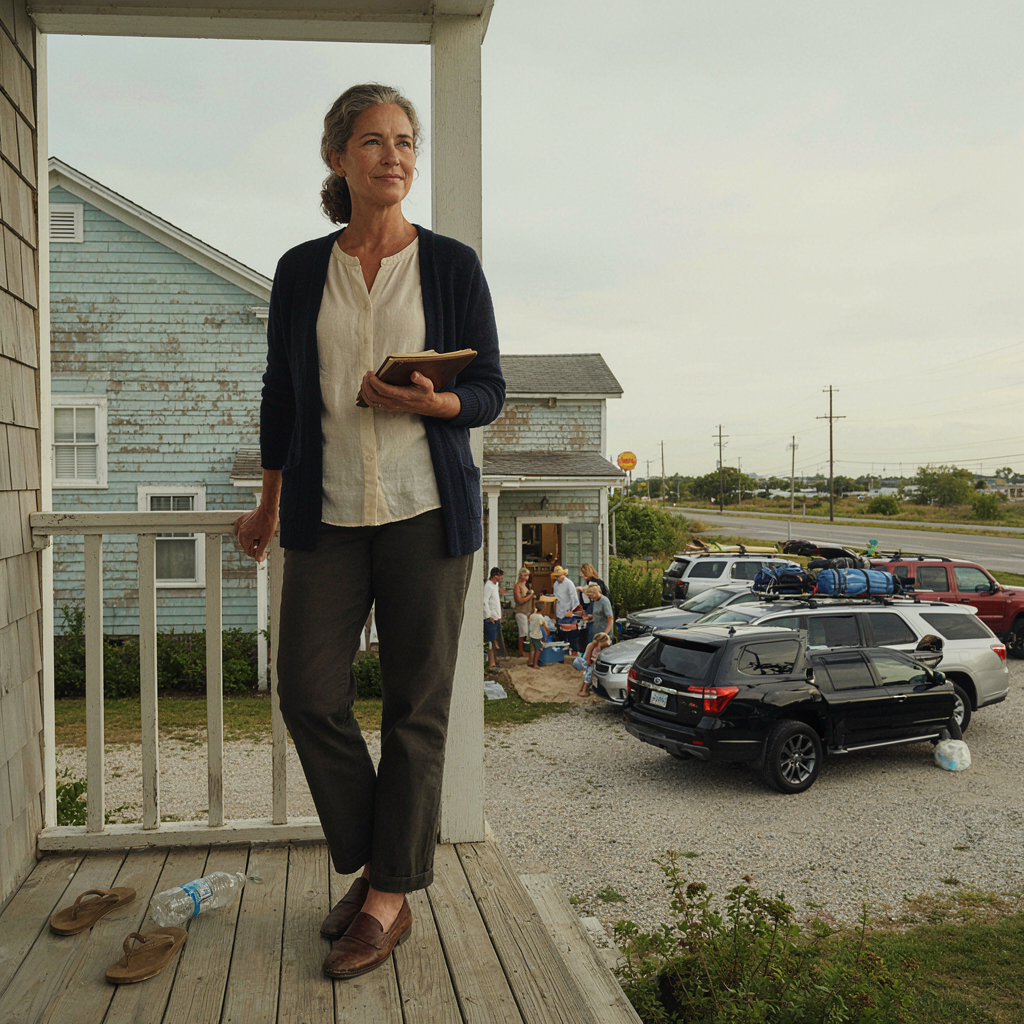
Maybe doing absolutely nothing.I should have known better.The trouble began before I even reached the front door.I turned onto my street just after two in the afternoon and immediately noticed three SUVs parked along my driveway.
One was black.One was white.The third was a giant silver vehicle I didn’t recognize.I slowed.My stomach tightened.
Then I saw the beach chairs.Coolers.Children’s bicycles.Inflatable pool toys.
Someone had even hung a bright blue beach towel over my porch railing.
I parked at the curb.For several seconds, I simply stared.
Then I noticed people.Lots of them.
Children ran across my lawn.
Music blasted from speakers on the deck.
Someone was laughing loudly in my kitchen.
Fifteen people.Fifteen.
My first thought was that there had been some terrible misunderstanding.
Then I saw my sister Camille standing near the sliding glass doors.
She looked directly at me.
And froze.
I got out of my car.
Camille walked toward me slowly.
“Claire,” she said.
I stared at her.
“What is this?”
She glanced behind her.
“It’s just the family.”
“Why are they in my house?”
Her lips tightened.
“I thought we’d talked about this.”
“No, Camille. We talked about me coming here this weekend.”
“I know.”
“Then why are fifteen people in my house?”
She sighed.
“Richard thought it would be fine.”
That was when Richard appeared.
My sister’s husband.
Six feet two inches of confidence wrapped in a polo shirt and expensive sunglasses.
He walked onto the porch holding a beer.
He looked at me like I was an employee who had arrived late.
Then he laughed.
“Well, look who finally showed up.”
I didn’t answer.
He walked down the steps.
“What are you doing here?”
I stared at him.
“What am I doing here?”
“Yeah.”
“This is my house.”
He took a long drink.
“I know.”
My jaw tightened.
“Then you know why I’m here.”
Richard glanced toward the SUVs.
“There’s fifteen of us and one of you.”
I said nothing.
He smiled.
“Come back next weekend.”
For a moment, I thought I’d misheard him.
“Excuse me?”
“This is a family weekend. The kids have been looking forward to it.”
“You never asked me.”
“Camille gave me the keys.”
I looked at my sister.
She looked away.
“Camille.”
She finally met my eyes.
“I thought you wouldn’t mind.”
“You knew I was coming.”
“I thought you could come another time.”
I felt something cold settle in my chest.
“Another time?”
Richard stepped closer.
“Don’t make this dramatic, Claire.”
I looked around.
My furniture was being used as a playground.
My kitchen counters were covered with food.
Someone had opened bottles of wine I’d been saving.
There were wet towels on the floor.
A child’s muddy footprints crossed my hallway.
And suddenly I understood.
This wasn’t a misunderstanding.
They had decided my plans didn’t matter.
Richard pointed toward my car.
“Go home. We’ll clean up Sunday.”
I looked him directly in the eyes.
“You are standing on my property.”
He laughed.
“What’s this parasite doing here? Get off this property!”
The porch went silent.
Even the children stopped.
I stared at him.
He had no idea who he was speaking to.
Or what he had just started.
I looked at Camille.
She whispered, “Claire, please.”
I turned around.
I walked back to my car.
I didn’t argue.
I didn’t scream.
I didn’t threaten anyone.
I simply drove away.
Three minutes later, I pulled into a gas station overlooking the highway.
I parked.
Turned off the engine.
And called my attorney.
His name was Daniel Brooks.
He had represented me for years.
He answered on the second ring.
“Claire?”
“Daniel, I need your help.”
Something in my voice made him sit up.
“What happened?”
I explained everything.
The keys.
The family.
The unauthorized stay.
Richard ordering me off my own property.
Daniel didn’t interrupt.
When I finished, there was silence.
Then he said something that surprised me.
“Make the other two calls now.”
“What calls?”
“The ones we discussed six months ago.”
I frowned.
Then I remembered.
Six months earlier, Daniel had helped me restructure several documents connected to Harbor House.
At the time, I hadn’t understood why he insisted on certain precautions.
Now I did.
“You’re telling me it’s that serious?”
“Claire,” he said quietly, “if your sister gave someone your keys without your permission, I don’t want you going back there alone.”
“Why?”
“Because this isn’t just about trespassing.”
My pulse quickened.
“What do you mean?”
“I mean call the sheriff’s office first.”
I stared through the windshield.
“And the second call?”
“Your insurance company.”
I did both.
The sheriff’s office sent a deputy to the property.
The insurance company opened a claim because several belongings had already been damaged.
Then Daniel called me back.
“Now we wait.”
I spent the next hour sitting in that gas station parking lot.
At four twenty-three, my phone rang.
It was the deputy.
“Ms. Bennett?”
“Yes.”
“I’ve spoken with your sister and her husband.”
“And?”
“They’ve agreed to leave.”
I exhaled.
“Thank you.”
“But there’s something you should know.”
“What?”
“They told me they believe they have permission to use the property.”
“I never gave them permission.”
“I understand.”
The deputy hesitated.
“They also produced a document.”
My stomach dropped.
“What document?”
“A handwritten letter they claim gives your sister permission to use the property whenever she wants.”
I closed my eyes.
“That’s not my signature.”
“I figured you’d say that.”
“Can you photograph it?”
“I already did.”
“Please send it to my attorney.”
“Already done.”
Twenty minutes later, Daniel called.
His voice had changed.
“Claire.”
“What?”
“Don’t go back yet.”
“Why?”
“Because the letter isn’t the biggest problem.”
My hands tightened around the steering wheel.
“What is?”
“The county records show that someone filed a document two weeks ago concerning Harbor House.”
“What kind of document?”
“A property authorization.”
“I didn’t file anything.”
“I know.”
“What does it say?”
“It claims Camille has authority to act on your behalf regarding the property.”
I laughed once.
Not because it was funny.
Because I couldn’t believe the stupidity of it.
“Daniel, Camille isn’t my power of attorney.”
“I know.”
“She never has been.”
“I know.”
“Then how did this get filed?”
“That’s what we’re going to find out.”
The next morning, I met Daniel at his office.
He had a folder waiting for me.
Inside were copies of the document filed with the county.
My name.
My address.
My property description.
And a signature that looked disturbingly close to mine.
But it wasn’t mine.
Daniel tapped the paper.
“This is a forged signature.”
“How do you know?”
“Because I have your actual signature from your estate documents.”
He placed another page beside it.
The differences were subtle.
But once he pointed them out, I could see them.
“The loop here is wrong,” he said.
“The pressure on the final letter is wrong. And this signature was written slowly.”
He looked at me.
“Who had access to your old documents?”
I thought about it.
“My sister.”
“Anyone else?”
“Richard.”
Daniel nodded.
“That’s what I was afraid of.”
I sat back.
“Why would they do this?”
“I don’t know yet.”
“What were they trying to accomplish?”
“Possibly control of the property.”
“But why?”
He turned another page.
“Because they filed for a short-term rental license.”
I stared at him.
“Using my house?”
“Yes.”
“Without my permission?”
“Yes.”
“How much were they planning to charge?”
Daniel pushed another document across the desk.
My eyes widened.
“They were advertising it for four thousand dollars a week.”
For a moment, I couldn’t speak.
Then everything made sense.
The fifteen relatives.
The three SUVs.
The sudden vacation.
The keys.
They weren’t simply taking a family weekend.
They were testing whether they could take control.
Daniel leaned forward.
“There is more.”
I looked at him.
“What?”
“They’ve already accepted deposits.”
My blood ran cold.
“From whom?”
“Vacation renters.”
“How many?”
“Six bookings.”
I sat there in silence.
Six families had apparently paid thousands of dollars to stay in my house.
And Camille and Richard had collected the money.
Daniel closed the folder.
“We can stop this.”
“How?”
“First, we document everything. Then we file an emergency notice with the county. Then we notify the booking platform. Then we deal with the fraudulent filing.”
“And the family?”
“That comes last.”
I nodded.
But I knew something Daniel didn’t.
The family wasn’t going to be last.
They were going to be the hardest part.
Because Camille was my sister.
And once upon a time, she had been my best friend.
We grew up sharing a bedroom.
She knew every secret I had.
She was the first person I called after my divorce.
The first person who visited me after my final deployment.
When our mother died, Camille and I held each other in the hospital parking lot and promised we’d never let money divide us.
Now she had helped someone forge my signature.
I didn’t understand how we’d gotten here.
That evening, I returned to Harbor House.
The driveway was empty.
The house looked like a storm had passed through it.
There were dirty dishes everywhere.
A lamp was broken.
One of my dining chairs had a cracked leg.
The guest bedroom smelled like spilled beer.
I walked onto the back deck.
The ocean was calm.
Beautiful.
Exactly as I’d imagined it would be.
Except now the peace felt different.
I found a stack of papers on the kitchen island.
Rental agreements.
Names.
Dates.
Amounts.
At the bottom was a handwritten note.
“Once Claire gets over herself, she’ll understand this benefits everyone.”
I recognized Camille’s handwriting.
I photographed everything.
Then I heard my phone ring.
Richard.
I answered.
“Hello?”
“You’ve gone too far.”
I said nothing.
“You called the police.”
“You trespassed.”
“We’re family.”
“You forged documents.”
Silence.
Then he said, “You can’t prove that.”
“I don’t need to.”
“Claire—”
“You collected deposits for a property you don’t own.”
His voice changed.
“Who told you that?”
I smiled bitterly.
“That’s not important.”
“Listen to me.”
“No. You listen.”
I had spent thirty-two years commanding soldiers.
But I’d learned something more important than command.
Real authority didn’t require shouting.
“Richard, you had three minutes of my patience yesterday. You used all of them.”
He cursed.
Then hung up.
The following Monday, the county investigator contacted me.
She wanted to meet.
At the meeting, she showed me a second document.
It was worse than the first.
According to the filing, I had supposedly granted Camille permanent authority over Harbor House.
The investigator looked uncomfortable.
“We’ve seen forged documents before,” she said. “But whoever prepared this knew enough about property filings to make it look legitimate.”
“Can you tell who filed it?”
“Yes.”
She slid the record toward me.
Camille Bennett.
I stared at her name.
My sister had done this.
Not Richard.
Not some stranger.
Camille.
I went home that evening and cried for the first time in years.
Not because I was afraid of losing the house.
I wasn’t.
I cried because I realized my sister had looked at everything we’d shared and decided it could be converted into money.
The next morning, Daniel filed the legal paperwork.
The county froze the disputed authorization.
The booking platform canceled the fraudulent listings.
The insurance investigator documented the damage.
And then the sheriff’s office opened a criminal investigation.
Three days later, Camille came to my house.
Alone.
She stood on the porch.
I opened the door.
She looked exhausted.
“Can I come in?”
“No.”
She swallowed.
“Claire, please.”
“You knew I was coming.”
She looked down.
“I know.”
“You gave Richard my keys.”
“I know.”
“You let fifteen people stay here.”
“I know.”
“You filed documents claiming I gave you control of this property.”
Her eyes filled with tears.
“I didn’t think it would go this far.”
I stared at her.
“That’s your defense?”
She shook her head.
“No.”
“Then what is?”
She took a breath.
“Richard told me you were going to sell it.”
“What?”
“He said you’d talked about selling Harbor House.”
“I never did.”
“I know that now.”
“Camille, you knew me for forty-nine years.”
She began crying.
“He said you were going to leave everything to charity.”
I almost laughed.
“So you stole it before I could give it away?”
She covered her face.
“It wasn’t supposed to happen like this.”
“How was it supposed to happen?”
She couldn’t answer.
Finally, she whispered, “Richard said we could turn it into a rental business.”
“And you believed him.”
“I wanted to believe him.”
“Why?”
She looked at me.
“Because I was tired of feeling like I had nothing.”
That sentence hit me harder than anything else.
Camille had spent years comparing herself to me.
My military career.
My pension.
My house.
My independence.
I had never realized how deeply it had bothered her.
“I would have helped you,” I said.
She cried harder.
“I know.”
“No, Camille. You don’t know.”
I stepped onto the porch.
“I would have helped you because you’re my sister. You didn’t have to steal anything.”
She whispered, “I’m sorry.”
I believed she was sorry.
But being sorry didn’t undo what she had done.
“Where is Richard?”
She looked away.
“At home.”
“Tell him I’m not interested in talking.”
“He wants to apologize.”
“No.”
“Claire—”
“An apology is not a magic eraser.”
She nodded.
“I know.”
She walked away.
I thought that was the end.
It wasn’t.
Two weeks later, the investigator called.
“Ms. Bennett, we’ve identified who created the forged documents.”
My heart sank.
“Richard?”
“Yes.”
“And Camille?”
“She admitted providing him with copies of your old documents.”
I closed my eyes.
“Is she being charged?”
“That’s up to the prosecutor.”
I thanked her and hung up.
That night, I sat alone on the deck.
The same deck where Richard had told me to leave.
The moon reflected across the ocean.
For the first time in weeks, I felt calm.
Then my phone rang.
Camille.
I almost ignored it.
But I answered.
“Hello?”
Her voice was small.
“Claire.”
“What?”
“I need to tell you something.”
“What?”
“Richard lied to me.”
I said nothing.
“He told me you were selling the house. He told me you had already signed papers.”
“Why?”
“I don’t know.”
“Camille.”
She began crying.
“He was going to refinance it.”
My body went still.
“What?”
“He had plans to take out a loan against the property.”
I stared into the darkness.
“How?”
“With the authorization.”
I understood.
They weren’t trying to rent my house forever.
They wanted control of it.
Then they wanted to borrow against it.
Potentially hundreds of thousands of dollars.
My house wasn’t a vacation.
It was collateral.
“Why didn’t you tell me?”
“I was scared.”
“You should have been scared before you helped him.”
“I know.”
There was a long silence.
Then she said something I never expected.
“I’m going to testify.”
I closed my eyes.
“Against Richard?”
“Yes.”
That testimony became crucial.
The investigation eventually uncovered messages between Richard and several people involved in the rental scheme.
He had planned everything.
The fake authorization.
The rental listings.
The deposits.
And eventually, a loan application.
Camille had initially helped him because she believed his story.
But when she realized what he intended to do, she cooperated with investigators.
Richard was charged with fraud, forgery, and related offenses.
Camille avoided the most serious charges because she cooperated and admitted her role.
Our relationship, however, did not magically heal.
Some things don’t.
For nearly a year, we barely spoke.
Then, one autumn afternoon, she came to Harbor House.
I opened the door.
She held a small wooden box.
“I found this in Mom’s attic.”
I took it.
Inside were old photographs.
Camille and me as children.
Me in my first Army uniform.
Camille at my commissioning ceremony.
Our mother between us at Christmas.
At the bottom was a photograph of the two of us sitting on a beach when we were teenagers.
Camille smiled.
“Remember that?”
I did.
We had promised each other we’d own houses beside the ocean someday.
She looked at me.
“I broke everything.”
I shook my head.
“You broke trust.”
She nodded.
“Can it ever come back?”
I looked at the ocean.
“I don’t know.”
She accepted that.
And somehow, that mattered.
She didn’t demand forgiveness.
She didn’t ask me to forget.
She simply said, “I’m sorry.”
This time, I believed her.
Months passed.
Eventually, Camille and I began speaking again.
Slowly.
Carefully.
There were boundaries.
No keys without permission.
No financial arrangements.
No assumptions.
No using family as an excuse to cross a line.
And Harbor House remained mine.
One year after that terrible weekend, I drove down to the coast again.
This time, I brought nothing but a suitcase and a book.
No work.
No meetings.
No relatives.
Just me.
I unlocked the front door.
The house was clean.
Quiet.
Safe.
I walked onto the deck and listened to the ocean.
Then I noticed something nailed to the porch wall.
A small wooden sign.
I’d forgotten I’d put it there years earlier.
It read:
HOME IS WHERE YOU ARE ALLOWED TO STAY.
I smiled.
Because that weekend had taught me something I should have understood long before.
Family does not give anyone ownership of your life.
Love does not mean surrendering your boundaries.
And forgiveness does not require forgetting.
Sometimes the strongest thing you can do is say no.
Sometimes you have to walk away instead of fighting.
Sometimes you have to make the right phone calls and let the truth do the fighting for you.
And sometimes, the people who think you’re powerless discover far too late that they picked the wrong person to push.
Richard had looked at me and called me a parasite.
He had pointed toward my car and ordered me off my own property.
He thought he was sending away one woman who had no choice but to surrender.
He was wrong.
He wasn’t dealing with a helpless homeowner.
He was dealing with a retired Army colonel who had spent thirty-two years learning exactly what to do when someone tried to take what wasn’t theirs.
I never raised my voice.
I never threatened him.
I never touched him.
I simply documented the truth.
And the truth did the rest.
That weekend, I finally got the quiet I wanted.
It just took me a year to understand why it mattered so much.
I wasn’t protecting a beach house.
I was protecting the life I’d spent decades building.
And Harbor House wasn’t valuable because of its ocean view.
It was valuable because it belonged to me.
Completely.
Legally.
And finally, peacefully.
That evening, as the sun disappeared beneath the horizon, my phone buzzed.
A message from Camille.
I hope you’re having a peaceful weekend.
I stared at it for a long moment.
Then I replied:
I am.
I put the phone down.
The waves rolled toward shore.
The wind moved through the sea oats.
No music.
No shouting.
No strangers.
No family invasion.
Just silence.
The kind I’d wanted all along.
And this time, nobody could order me out of it.