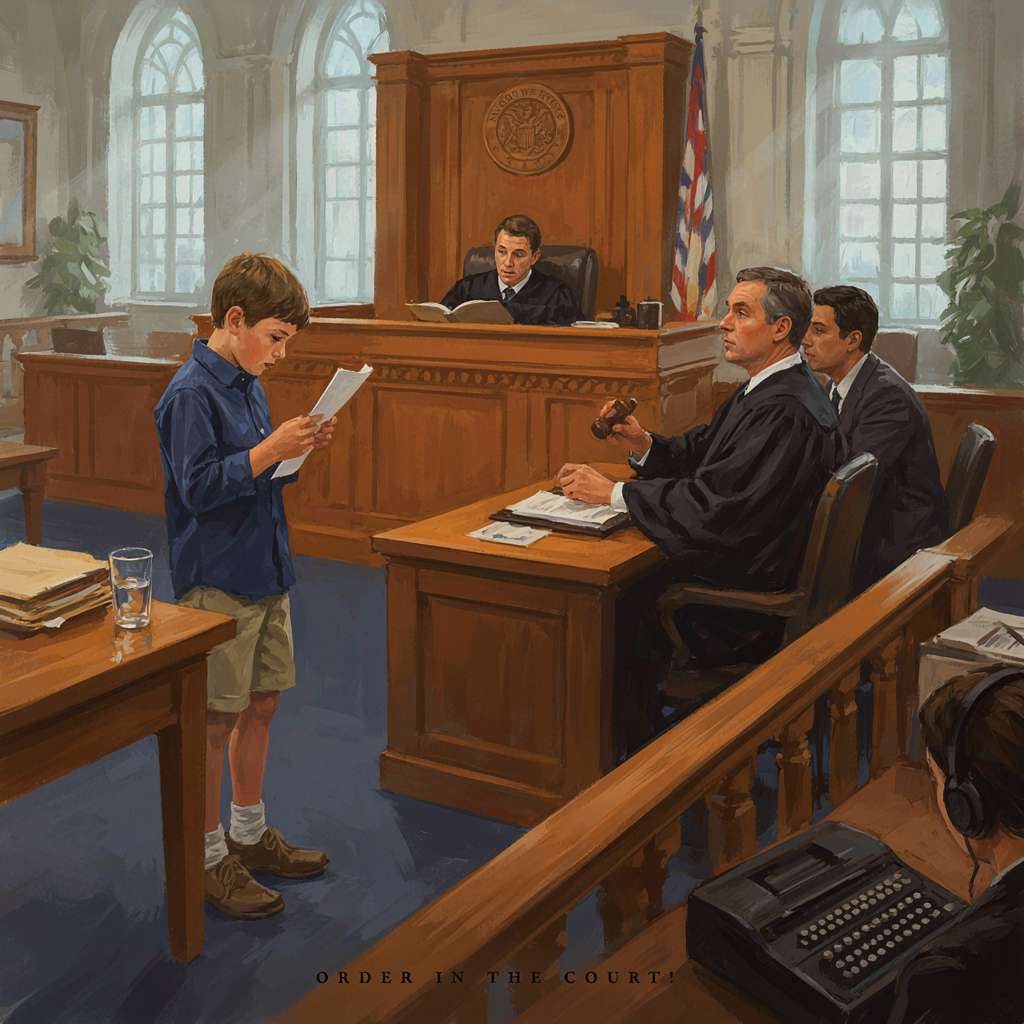
The Message My Seven-Year-Old Read in Court
The morning after I caught my husband with his co-worker, he didn’t apologize.He didn’t cry.He didn’t ask me to forgive him.
He stood in our kitchen, poured himself coffee, and spoke as casually as if we were discussing weekend groceries.
“I’m taking the dog,” he said.I stared at him.
“What?””The dog. You can have the kid.”
For a moment, I genuinely thought I had misheard him.”You mean Mark?”He shrugged.”Obviously.”Our seven-year-old son was sitting at the kitchen table eating cereal.
His spoon stopped halfway to his mouth.
My husband, Daniel, leaned against the counter and added, “It’s only fair. You wanted the responsibility of being the primary parent anyway.”
I couldn’t believe what I was hearing.
The night before, I had come home early from work.Daniel had told me he was staying late at the office.Instead, I found him in a hotel room with his co-worker, Lauren.
There hadn’t been any misunderstanding.
There hadn’t been any innocent explanation.
I had seen enough.And somehow, by the next morning, he had already turned our marriage into a negotiation over who got the dog.
His mother was sitting at the table.She had come over “to help him through this difficult time.”
When Daniel said I could have Mark, she chuckled.
“At least the dog is trained.”
I looked at her.
Then at Daniel.
Then at my son.
Mark’s eyes were fixed on his cereal bowl.
His little shoulders had gone completely still.
I walked over and knelt beside him.
“Mark?”
He didn’t answer.
“Buddy, are you okay?”
He finally looked at me.
His eyes were wet.
“Mommy… am I something you can give away?”
That question broke something inside me.
“No,” I whispered.
I pulled him into my arms.
“Never.”
That afternoon, I called a divorce attorney.
Within days, Daniel moved into a rented apartment.
He filed for joint custody.
Then, apparently realizing that his affair had made him look terrible, he began constructing a different story.
According to Daniel, I was unstable.
According to his mother, I was “emotionally punishing” him.
According to Lauren, she and Daniel had been “close friends” who had simply made “a mistake.”
And according to Daniel’s lawyer, I was trying to keep a father away from his son.
The truth was much simpler.
I wasn’t trying to keep Mark from his father.
I was trying to protect my child from becoming a bargaining chip.
The custody battle became ugly.
Daniel demanded alternating weeks.
I asked for primary physical custody.
Mark continued going to school, doing his homework, playing soccer, and pretending everything was normal.
But children notice things adults think they hide.
He started waking up at night.
He stopped asking when his father was coming to pick him up.
And sometimes, when Daniel called, Mark would look at me before answering.
One evening, I found him sitting on his bedroom floor holding his tablet.
“What’s wrong?”
“Nothing.”
“Mark.”
He looked down.
“Dad sends me messages sometimes.”
My heart tightened.
“What kind of messages?”
He shrugged.
“I don’t know.”
“Can I see them?”
He hesitated.
Then he handed me the tablet.
There were several messages.
Some were ordinary.
Good luck at soccer.
Miss you, buddy.
Dad loves you.
But farther down were messages that made my stomach turn.
Remember, Mommy and Daddy are having grown-up problems.
You know Daddy loves you more than anything.
Don’t let Mommy make you think I’m a bad dad.
I looked at Mark.
“Did Daddy tell you not to show me these?”
He shook his head.
“He said they’re just between us.”
I sat beside him.
“Mark, you never have to keep secrets from me.”
He nodded.
Then he said something I’ll never forget.
“Dad said if I tell the judge I want to live with him, everything will be okay.”
I felt my blood run cold.
“Did he say that?”
Mark nodded.
“He said you’ll be happier too.”
I closed my eyes.
I wanted to scream.
Instead, I hugged my son.
“None of this is your job, Mark.”
“But I want everyone to stop fighting.”
“I know.”
“Can I make it stop?”
I kissed the top of his head.
“No, buddy. That’s the adults’ job.”
A week later, we went to court.
The courtroom was packed.
Daniel sat beside his attorney in a dark suit, looking calm and confident.
His mother sat behind him.
She glanced at me with a small smile.
I sat beside my lawyer.
Mark was allowed to be present for part of the hearing.
He sat quietly between us.
The judge asked both sides questions.
Daniel’s lawyer painted him as a devoted father.
He talked about soccer games.
Family vacations.
Weekend breakfasts.
He never mentioned Lauren.
He never mentioned the hotel.
He never mentioned the affair.
And he certainly never mentioned the messages.
Then the judge asked whether she wanted to speak directly with Mark.
My stomach tightened.
Mark nodded.
The judge leaned forward.
“Mark, do you understand why you’re here today?”
“Yes, ma’am.”
“Do you understand that nobody is asking you to choose which parent you love?”
Mark nodded.
“I love both.”
The courtroom became silent.
The judge smiled gently.
“That’s good. Now, is there something you’d like me to know?”
Mark raised his hand.
Like he was in school.
The judge raised an eyebrow.
“Yes, Mark?”
“Can I read what Dad sent me yesterday?”
My heart stopped.
Daniel’s head snapped toward his lawyer.
His attorney immediately leaned over and whispered something into his ear.
Daniel shook his head.
The judge noticed.
“Mr. Carter?”
Daniel’s lawyer stood.
“Your Honor, we object to the child being used as a witness against his father.”
The judge’s expression hardened.
“Nobody is using this child as anything. I asked him what he wanted to tell me.”
Mark was still holding the tablet.
The judge looked at him.
“Mark, you may read it.”
He swallowed.
Then unlocked the screen.
My hands were shaking.
Mark began.
“Dad said…”
He paused.
Then continued.
“Mark, tomorrow the judge is going to ask you who you want to live with.”
The courtroom went completely still.
Daniel’s lawyer stood again.
“Your Honor—”
“Sit down,” the judge said.
He sat.
Mark continued.
“I want you to tell her you want to live with Dad. You can still see Mom whenever you want.”
My eyes filled with tears.
Mark looked at me.
I nodded for him to continue.
He read the next message.
“If you tell the judge what we talked about, Daddy can stay close to you. If Mommy gets custody, she might move away and you won’t see me as much.”
A murmur moved through the courtroom.
The judge’s face changed.
Mark kept reading.
“You don’t have to tell Mommy about our plan because she’ll get upset. This is our secret.”
Daniel suddenly stood.
“That’s not what I meant.”
The judge slammed her hand against the bench.
“Order in the court!”
Mark flinched.
I immediately reached for his hand.
“It’s okay,” I whispered.
The judge looked directly at Daniel.
“Mr. Carter, you will not interrupt again.”
Daniel sat down.
Mark stared at the tablet.
Then he said quietly:
“There’s more.”
The judge nodded.
“Go ahead.”
Mark read.
“And remember what I told you. Mom needs to understand that Daddy deserves the house and the dog because Daddy paid for most of them.”
My lawyer looked at me.
I looked back at Daniel.
That wasn’t even the worst part.
Mark continued.
“If the judge asks whether Mom is a good mom, say yes. But tell her you feel safer with Dad.”
Mark stopped.
The courtroom was silent.
Then he looked up.
“Can I read the last one?”
The judge nodded.
Mark’s voice trembled.
“You’re my little man. Don’t let Mommy ruin our family. Daddy knows you can fix this.”
Mark lowered the tablet.
And then, in the smallest voice imaginable, he said:
“I tried.”
The judge leaned forward.
“What do you mean?”
Mark wiped his cheek.
“I tried to fix it.”
Nobody spoke.
Mark continued.
“I told Dad I didn’t want to lie.”
Daniel’s face had gone pale.
“I told him Mommy wasn’t bad.”
He looked at me.
“I told him I didn’t want to choose.”
His voice cracked.
“But Dad said if I loved him, I would help him.”
That was when I broke.
I covered my mouth.
Not because I was surprised.
Because suddenly I understood how much pressure my little boy had been carrying.
The judge asked Mark if he wanted to take a break.
He nodded.
My lawyer escorted him out.
The moment the door closed behind him, the judge turned toward Daniel.
“Mr. Carter, did you send these messages?”
Daniel’s lawyer stood.
“My client needs a moment to review—”
“Did he send them?”
Daniel stared at the floor.
Finally, he whispered.
“Yes.”
His attorney closed his eyes.
The judge’s voice was controlled.
“You instructed your seven-year-old child to tell this court something untrue.”
Daniel swallowed.
“I was scared.”
“You were scared of losing custody.”
“Yes.”
“So you put your child in the middle.”
“I just wanted him with me.”
“You wanted him to manipulate the court.”
Daniel didn’t answer.
His mother suddenly stood.
“Your Honor, he’s a good father!”
The judge looked at her.
“Ma’am, sit down.”
She sat.
The judge continued.
“Mr. Carter, the court understands that divorce is emotionally difficult. Infidelity is not a custody determination. But attempting to coach a seven-year-old child to influence a custody proceeding is extremely serious.”
Daniel’s lawyer whispered something to him.
Daniel finally looked at me.
For the first time since the affair, he didn’t look angry.
He looked afraid.
After a long pause, the judge ordered a temporary arrangement.
Mark would remain primarily with me.
Daniel would have supervised visitation until a custody evaluation could be completed.
But the story didn’t end there.
Because there was another message.
One I hadn’t seen.
The court-appointed evaluator requested access to the full message history.
That’s when something unexpected happened.
Daniel’s phone contained dozens of conversations with Lauren.
And among them was a message sent the morning after I caught them.
Lauren had written:
“You need to stop pretending this is about the dog.”
Daniel replied:
“It isn’t.”
Lauren:
“Then what is it about?”
Daniel:
“If she gets custody, she’ll control everything. The house, the money, the schedule. I need leverage.”
Lauren:
“And Mark?”
Daniel:
“He’s the leverage.”
Those messages changed everything.
Daniel’s lawyer withdrew from the case.
The custody evaluator recommended that Mark remain primarily with me.
Daniel was required to attend parenting classes and counseling before unsupervised visitation could resume.
But the financial side of the divorce became its own battle.
Daniel had claimed that I had contributed little to the household.
That was false.
I had worked full-time for years.
I had handled most of the bills.
I had taken Mark to medical appointments.
I had attended school meetings.
I had spent countless nights helping with homework while Daniel traveled for work.
And then my attorney discovered that Daniel had been quietly transferring money into an account I didn’t know existed.
The same week he demanded the dog, he had tried to move $38,000.
He had thought I wouldn’t notice.
He was wrong.
The divorce lasted almost a year.
There were hearings.
Evaluations.
Arguments.
Documents.
More tears than I thought a person could cry.
But something changed during that year.
Mark changed.
He started sleeping through the night.
He laughed again.
He stopped asking whether his father was angry.
And he stopped thinking it was his responsibility to make adults happy.
One afternoon, he came home from school carrying a drawing.
“What is that?”
“It’s our family.”
I looked at the picture.
There were three people.
Me.
Mark.
And our dog, Buddy.
Daniel wasn’t in it.
I didn’t ask why.
Mark simply said:
“It’s peaceful.”
I hugged him.
“That’s all I ever wanted for you.”
Eventually, Daniel was granted regular unsupervised visitation.
He became more involved.
He went to soccer games.
He attended parent-teacher meetings.
He started taking responsibility for what he’d done.
Not immediately.
Not perfectly.
But eventually.
One evening, nearly two years after the custody hearing, Daniel asked if he could talk to me.
We stood outside the school after Mark’s soccer practice.
“I owe you an apology,” he said.
I didn’t answer.
“I thought I could control everything.”
I looked at him.
“You tried to control our son.”
“I know.”
“You made him think he had to save you.”
“I know.”
He looked toward the field.
“That message in court…”
He stopped.
“I’ll never forget his face.”
Neither will I.
Daniel sighed.
“I lost my family because I was selfish.”
“No,” I said quietly.
“You lost your marriage because you chose to betray it.”
He nodded.
“And you almost lost your relationship with your son because you tried to make him choose.”
He looked at me.
“I know.”
For a while, neither of us spoke.
Then Daniel said:
“Is there anything I can do?”
I thought about it.
“Be his father.”
He nodded.
“Not my enemy. Not his judge. Not his therapist.”
He swallowed.
“Just his father.”
“I’ll try.”
“You don’t have to try for me.”
He looked at the field.
“I know.”
That evening, Mark ran toward us.
“Dad!”
Daniel smiled.
“Hey, buddy.”
Mark hugged him.
I watched them.
And for the first time, I didn’t feel anger.
I felt relief.
Because Mark no longer looked like a child trapped between two adults.
He looked like a child.
Just a child.
A few months later, the custody order became permanent.
Mark lived primarily with me.
Daniel had regular weekends, holidays, and school involvement.
The house remained mine.
The finances were divided fairly.
And the dog?
Buddy stayed with me.
Mark insisted.
“He needs Mommy.”
I laughed.
“Apparently he’s not the one who gets to choose.”
Mark smiled.
Then he said something that made me freeze.
“Actually, Mom…”
“What?”
“Buddy chose you a long time ago.”
I laughed so hard I almost cried.
Years later, Mark would barely remember the courtroom.
He wouldn’t remember the lawyers.
He wouldn’t remember the legal arguments.
But he remembered the question the judge asked him.
And he remembered that, for the first time, an adult had listened.
He once told me that was the moment he stopped being scared.
“Because the judge let me tell the truth.”
I hugged him.
“You were very brave.”
He shook his head.
“No.”
“What?”
“I was just tired of secrets.”
That sentence stayed with me.
Because that was what had nearly destroyed our family.
Not just the affair.
Not just the betrayal.
The secrets.
The lies.
The manipulation.
The belief that a child could be turned into a weapon.
Daniel had thought taking the dog would be easier than taking responsibility.
He had thought giving me the child would hurt me.
He had thought Mark could be coached.
He had thought a seven-year-old wouldn’t understand what was happening.
But children understand more than adults realize.
They notice whispered conversations.
They notice doors closing.
They notice when a parent suddenly stops smiling.
And sometimes, when given the chance, they tell the truth with a courage adults don’t have.
Years later, I still had the screenshot of that message.
Not because I wanted revenge.
Not because I wanted to remember Daniel at his worst.
I kept it because it reminded me of something important.
A courtroom can decide custody.
A judge can sign an order.
A lawyer can argue facts.
But sometimes the most important evidence isn’t a document.
Sometimes it’s a frightened little boy raising his hand and asking:
“Can I read what Dad sent me yesterday?”
That one question changed everything.
And the message he read didn’t just expose his father.
It freed him.
It told the court what adults had been too afraid to say.
It told me that my son had been carrying a burden that was never his to carry.
And most importantly, it taught Mark something I repeated to him for years afterward:
“You never have to choose between the people you love.”
“Adults are responsible for their own mistakes.”
“And no matter what happens between grown-ups, you are never responsible for fixing it.”
Mark grew up.
He became confident.
Kind.
And remarkably protective of people who couldn’t speak for themselves.
When he turned eighteen, he asked me to show him the old courtroom messages.
I hesitated.
“Are you sure?”
He nodded.
“I want to understand.”
So I showed him.
He read them silently.
When he finished, he sat there for a long time.
Finally, he looked at me.
“I can’t believe I was only seven.”
“You were.”
“And Dad really asked me to do that?”
“Yes.”
He looked down.
Then he smiled sadly.
“But I didn’t.”
“No.”
“You helped me.”
I shook my head.
“You helped yourself.”
He smiled.
Then he hugged me.
“Thanks for letting me be a kid.”
I closed my eyes.
And for the first time, I understood that was the real victory.
Not the house.
Not the custody order.
Not the money.
Not even surviving the betrayal.
It was giving my son back the childhood that someone had tried to turn into a courtroom strategy.
Daniel lost his marriage.
But eventually, he learned how to be a father.
I lost the husband I thought I knew.
But I discovered a strength I didn’t know I had.
And Mark?
He never lost himself.
Because on the day his father tried to make him choose, my seven-year-old son chose something far more powerful.
He chose the truth.