The Fourteen Letters
I never told my wife about Margaret.For forty-two years, I carried that name in a quiet corner of my heart, not because I loved my wife any less, but because some memories become so old that speaking them aloud feels almost like disturbing a grave.
My wife, Eleanor, was a good woman.A wonderful woman, really.
She gave me two children, four grandchildren, and forty-two years of ordinary happiness—the kind of happiness you don’t appreciate properly until it becomes a memory.
We argued over thermostat settings.
We burned pancakes on Sunday mornings. We drove to the coast every summer until our knees got too bad for long walks.She knew almost everything about me.Almost.
She knew I had enlisted in the Army when I was eighteen.She knew I spent most of 1963 overseas.
She knew I had written letters home.
She knew that fourteen of those letters never received an answer.
What she didn’t know was who I had written them to.Her name was Margaret.It was the summer of 1962, and we were both eighteen.Back then, eighteen felt like being immortal.
I worked at my father’s hardware store after school, and Margaret worked at a little ice cream shop on Lake Street.
It wasn’t anything fancy. Three booths inside, four stools at the counter, and a red-and-white striped awning that had faded pink under the summer sun.
But every afternoon, I found a reason to walk past it.
Sometimes I bought a root beer float.Sometimes I bought a single scoop of chocolate ice cream.Once, I bought a banana split I couldn’t afford just because Margaret laughed when I told her I’d never had one.
“You’ve never had a banana split?” she asked.”No.”She shook her head. “Robert, that’s tragic.””Can you fix it?”
She smiled.”I suppose I can.”That was how it started.
Not dramatically.There was no music.No lightning.
Just two teenagers sitting at a tiny table while the ceiling fan rattled overhead, talking about everything and nothing.
Margaret had blue eyes.
I remember that more clearly than almost anything.
Not because they were unusually bright, although they were.
Because she looked directly at people when she listened.
When Margaret looked at you, you felt like the rest of the room had disappeared.
We spent that summer together.
We went swimming at the lake.
We sat on the hood of my father’s old Ford and watched the stars.
We shared fries at a diner.
She kept a little notebook where she wrote down song lyrics, movie quotes, and things people said that made her laugh.
One night, she wrote something in it and closed it quickly when I tried to look.
“What did you write?”
“Nothing.”
“Was it about me?”
“Maybe.”
“Then I need to see it.”
“No.”
I laughed.
She smiled.
We were eighteen.
We thought there would always be another summer.
Then September came.
I enlisted.
I hadn’t expected to.
But my father had been talking about responsibility, and the country was tense, and I’d convinced myself that joining the Army was the brave thing to do.
When I told Margaret, she went quiet.
“How long?”
“I don’t know.”
“How long will you be gone?”
“I don’t know.”
She stared down at her hands.
Then she looked at me.
“Come back.”
“I will.”
“You promise?”
“I promise.”
The day I left, she stood at the bus station wearing a pale blue sweater.
She handed me a photograph.
On the back, she had written:
Come home, Robert.
I kissed her goodbye.
Then the bus pulled away.
I watched her until she disappeared.
I didn’t know that would be the last time I’d see her for sixty-three years.
At least, that’s what I believed.
My first letter was written three days after I arrived overseas.
I wrote about everything.
The heat.
The food.
The barracks.
How strange it felt sleeping in a room with dozens of other men.
I told her I missed her.
I told her I still carried her photograph.
I told her I was saving money for when I came home.
Then I wrote:
I love you.
I sent it.
No answer came.
I waited.
Two weeks.
Then three.
I wrote again.
Then another.
Fourteen letters in all.
Fourteen.
I still remember the number because I counted them.
Each one began the same way.
Dear Margaret,
And each one ended with the same promise.
Come back to me.
But Margaret never answered.
At first, I thought she was angry.
Then I thought maybe she had met someone else.
Then I thought perhaps something terrible had happened.
Eventually, I stopped writing.
When I came home, I went to the ice cream shop.
It was gone.
The building had been sold.
A hardware store occupied the space.
I asked around.
No one knew where Margaret had gone.
Her family had moved, someone said.
Another person said she’d gone to college.
Someone else claimed she’d married.
I was twenty years old.
I was tired.
I was hurt.
And I was too young to understand that sometimes unanswered questions become permanent.
So I moved on.
That’s when I met Eleanor.
She was twenty-one, studying nursing, and had a laugh that could fill a room.
She wasn’t Margaret.
And that mattered.
But not in the way people might think.
Eleanor didn’t have to be Margaret.
She was Eleanor.
And she was wonderful.
We dated for a year.
Then I proposed.
She said yes.
We married in 1967.
For the next forty-two years, I built a life with her.
We bought a small house.
We had children.
We worked.
We traveled when we could.
We celebrated birthdays and anniversaries.
We buried parents.
We watched our children become adults.
Then grandchildren came.
Life became busy.
And the memory of Margaret became something I rarely touched.
Not because I’d forgotten.
I hadn’t.
But because remembering someone from your youth can feel dangerous when you’re holding the hand of the person you chose to spend your life with.
Eleanor knew there had been a girl before her.
She never asked much.
Once, in our thirties, she found an old photograph while cleaning a drawer.
“Who is she?”
I looked at it.
Margaret.
Eighteen years old.
Blue eyes.
That same smile.
“Someone I knew a long time ago.”
Eleanor studied my face.
“Someone important?”
I hesitated.
“Once.”
She handed me the photograph.
Then she said, “We all have a once.”
That was Eleanor.
She understood things without forcing them open.
I put the photograph back in the drawer.
Years passed.
Then Eleanor got sick.
She fought for two years.
I sat beside her hospital bed.
I held her hand.
I told her stories.
I lied when I said everything would be okay.
One evening, she squeezed my fingers.
“Robert.”
“I’m here.”
“I’ve had a good life.”
“So have I.”
She smiled.
“Don’t become one of those old men who stops living because his wife died.”
I laughed through my tears.
“I don’t know how to do this without you.”
“You’ll learn.”
She died in 2019.
I kept my promise.
At least, I tried.
For years, I lived quietly.
I attended church.
I watched baseball.
I took my grandchildren fishing.
I learned how to cook three meals.
My granddaughter Emily worried about me.
She was twenty-four and had inherited Eleanor’s stubbornness.
One Saturday afternoon, she showed up at my house.
“Pop.”
“Yes?”
“You’re coming with me.”
“Where?”
“Bingo.”
I stared at her.
“No.”
“Yes.”
“I don’t play bingo.”
“You don’t have to play. You just have to sit there.”
“That’s worse.”
She laughed.
“Five dollars a card. Senior center. Lots of people your age.”
“I’m not old.”
She looked at me.
I looked at her.
“Fine,” I said.
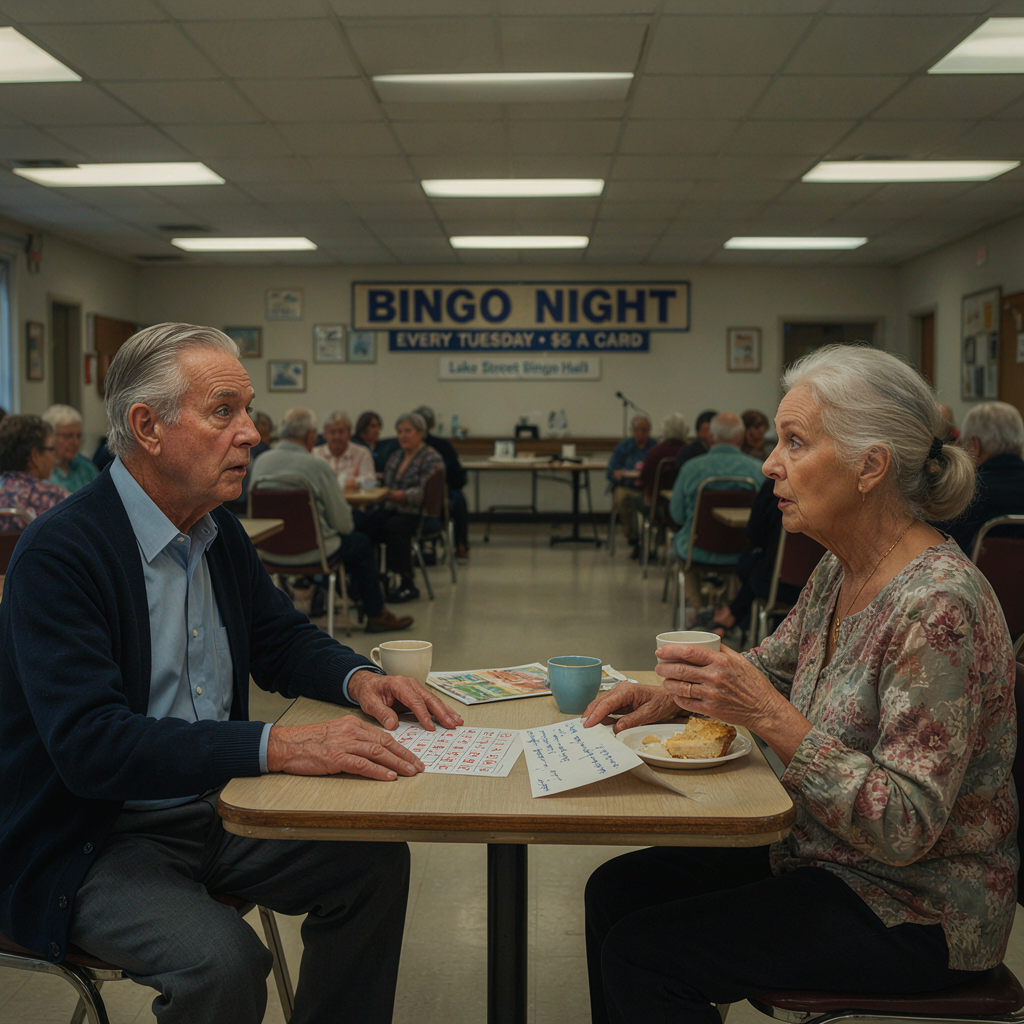
The senior center smelled like coffee, floor polish, and someone’s cinnamon cookies.
There were about forty people in the room.
Emily bought me a bingo card.
“Here.”
“I don’t even know the rules.”
“You listen for numbers.”
“I know how bingo works.”
“Good.”
She kissed my cheek.
“I’ll be back in an hour.”
I sat down.
That’s when I saw her.
At first, I didn’t recognize her.
Why would I?
Sixty-three years had passed.
She was sitting across the table, sorting her bingo cards.
White hair.
Thin silver glasses.
Blue eyes.
Then she looked up.
Our eyes met.
She froze.
So did I.
Her lips parted.
She whispered one word.
“Robert?”
My hand began to shake.
I stared at her.
There are moments in life when the past doesn’t return gradually.
It crashes through the door.
“Margaret?”
She smiled.
But tears were already filling her eyes.
“Hello.”
I couldn’t breathe.
She looked at my face.
“You’re older.”
I laughed once.
“So are you.”
She laughed.
Then we both cried.
Around us, people continued calling numbers.
“G-47!”
“O-72!”
Neither of us heard them.
Margaret reached into her purse.
She pulled out a bingo card.
Then she turned it over.
On the back was a phone number.
And beneath it, one sentence.
I never opened your letters because your mother told me you married my sister.
I stared at the words.
“What?”
Margaret swallowed.
“My sister.”
I couldn’t speak.
“My mother told me you married my sister.”
“What sister?”
“Rebecca.”
I shook my head.
“I never married Rebecca.”
Margaret stared at me.
“I know.”
The room seemed to tilt.
“Then why did she say that?”
Margaret looked down.
“Because she wanted us apart.”
“Why?”
She took a breath.
“Because she thought I wasn’t good enough for you.”
I felt something crack inside me.
Not anger.
Not exactly.
Something older.
Something that had been waiting sixty-three years for an explanation.
“Tell me.”
Margaret looked toward the other people in the room.
Then back at me.
“Not here.”
We exchanged numbers.
That evening, I sat at my kitchen table with the old photograph in front of me.
I hadn’t seen Margaret in sixty-three years.
But suddenly I was eighteen again.
The next morning, my phone rang.
“Robert?”
It was Margaret.
“Yes.”
“I didn’t sleep.”
“Neither did I.”
She laughed softly.
“I kept thinking you’d be dead.”
“I was hoping you’d be more tactful.”
“I’m sorry.”
“Don’t be.”
Silence.
Then I asked the question that had haunted me for decades.
“Why didn’t you answer?”
She took a long breath.
“Because I never received your letters.”
“I sent fourteen.”
“I know.”
“How?”
“Your mother.”
I sat down.
“My mother?”
“She came to my house.”
“When?”
“A few weeks after you left.”
Margaret explained.
My mother had visited her parents.
She told Margaret that I had met another girl.
That I’d written home saying I was marrying someone else.
That I had asked my family to stop Margaret from contacting me.
Margaret didn’t believe her.
But then my mother showed her a letter.
At least, that’s what Margaret remembered.
It appeared to be written by me.
The handwriting looked similar.
It said I had moved on.
That I was going to marry someone from my hometown.
That Margaret should forget me.
“Why didn’t you contact me?”
“I tried.”
“How?”
“I wrote you.”
“Where?”
“To your family’s house.”
“I never got anything.”
“I know.”
She paused.
“Your mother sent everything back.”
My chest tightened.
I remembered my mother’s old habit of collecting the mail.
She had always been protective.
At the time, I’d never questioned it.
Margaret continued.
“Then she told me you’d married my sister.”
“But Rebecca?”
“She was dating someone else.”
“Exactly.”
Margaret sighed.
“Years later, I discovered my mother had lied to me.”
I stared at the wall.
“Why?”
“She thought I would marry you and leave home.”
“That’s it?”
“Not exactly.”
“What else?”
“She believed your family was going to move.”
“We were.”
“She thought if I married you, I’d become isolated from everyone.”
“So she destroyed everything?”
“Yes.”
I closed my eyes.
For sixty-three years, I had blamed Margaret.
She had probably blamed me.
And the truth had been sitting between us all that time.
A lie.
One woman’s fear.
Two eighteen-year-olds separated by a handful of false words.
Margaret and I met the following Sunday.
We chose a diner.
Not the old ice cream shop.
That was gone.
We sat across from each other.
For three hours, we talked.
She had married once.
She had a daughter.
Her husband died twenty years earlier.
She had three grandchildren.
She had worked as a teacher for thirty-five years.
She had lived in three states.
She had traveled to Europe.
She had never forgotten me.
“Did you ever hate me?” I asked.
She looked down.
“Yes.”
I nodded.
“I hated you too.”
She smiled sadly.
“Good.”
“Good?”
“It means we were young enough to believe the other person was responsible.”
I laughed.
She did too.
Then she reached into her purse.
She pulled out a small bundle of papers.
My heart stopped.
“My letters.”
I stared.
“I thought you never received them.”
“I didn’t.”
She handed me the bundle.
“These were returned to me years later.”
I opened the first one.
My handwriting.
The date.
The words.
I read the first few lines.
Then I stopped.
I couldn’t continue.
“Why didn’t you tell me?”
“I didn’t know where you were.”
“I came home.”
“I know.”
“I went to your house.”
“I had already moved.”
We sat in silence.
Then Margaret said something that changed everything.
“Robert, I have something else.”
She reached into her purse.
A small envelope.
Inside was a photograph.
It showed Margaret at eighteen.
Standing beside me.
The same photograph she had given me.
But there was writing on the back.
Not hers.
My mother’s handwriting.
I recognized it immediately.
The words were simple.
You two cannot build a life together.
I stared at the sentence.
My hands trembled.
“I didn’t know.”
“I know.”
“Why didn’t anyone tell me?”
“Because everyone thought it was better this way.”
I looked at her.
“Was it?”
Margaret smiled sadly.
“We don’t get to know.”
For the next few months, Margaret and I became friends.
Not lovers.
Not teenagers pretending the years hadn’t passed.
Friends.
Old friends.
We met for coffee.
We went to bingo.
We sat in the park.
We told each other about our lives.
Sometimes we talked about Eleanor.
Margaret never once spoke badly about her.
One afternoon, I showed Margaret a photograph of Eleanor.
She studied it.
“She was beautiful.”
“She was.”
“You loved her.”
“Very much.”
Margaret smiled.
“Good.”
“Does that hurt?”
“No.”
She handed the photograph back.
“Robert, you loved someone for forty-two years. That’s not something I could ever resent.”
I looked at her.
“And what about us?”
She smiled.
“We were eighteen.”
“I still loved you.”
“I know.”
“So did you.”
“I did.”
Neither of us said anything for a while.
Then she reached across the table and touched my hand.
“Maybe that’s enough.”
A year after we met again, Margaret and I returned to Lake Street.
The ice cream shop was long gone.
The building was now a bank.
We stood outside.
“Remember?”
I smiled.
“You called me tragic because I’d never had a banana split.”
“You were tragic.”
“I survived.”
“Barely.”
We laughed.
Then we walked down to the lake.
The sun was setting.
Margaret sat on a bench.
I sat beside her.
“You ever wonder what would have happened?” she asked.
“Every day for a while.”
“And now?”
I thought about Eleanor.
My children.
My grandchildren.
The house where I had spent forty-two years with the woman I loved.
“I don’t wonder anymore.”
Margaret nodded.
“Neither do I.”
We sat quietly.
After a few minutes, she said, “Do you still have the letters?”
“All fourteen.”
Her eyes filled with tears.
“Can I read them?”
I hesitated.
Then I smiled.
“Yes.”
The next weekend, I brought them.
We sat at her kitchen table.
She opened the first one.
She read slowly.
Then she opened the second.
And the third.
By the fifth, tears were running down her face.
By the eighth, she had stopped trying to hide them.
When she reached the fourteenth, she placed it on the table.
“I waited sixty-three years to read these.”
“I waited sixty-three years for an answer.”
She looked at me.
“I think we both got one.”
“What was it?”
She smiled.
“That we didn’t stop loving each other because we chose to.”
I thought about that.
She was right.
We had been eighteen.
People had made decisions for us.
Adults.
Families.
Fear.
Pride.
Time.
But somehow, despite everything, the memory had survived.
Not as a fantasy.
Not as a desire to erase the lives we’d lived.
Just as proof that some people leave a mark on you before you even understand what a lifetime is.
Three months later, Margaret moved closer to her daughter.
Before she left, she came to my house.
She stood at the front door holding a small box.
“I brought you something.”
Inside was her old notebook.
The one from the summer of 1962.
The pages were yellowed.
The binding was broken.
I opened it.
Song lyrics.
Movie quotes.
Little jokes.
Then I found a page with my name.
Robert says there will always be another summer.
Below it, in younger handwriting:
I hope he’s right.
I looked at Margaret.
“We were wrong.”
She smiled.
“No.”
She touched the page.
“We just didn’t know that summers could last sixty-three years.”
We hugged.
Not like teenagers.
Not like two people trying to reclaim something.
Like two old friends finally allowed to say goodbye properly.
That night, I placed the notebook beside Eleanor’s photograph.
For the first time, I didn’t feel guilty.
I didn’t feel like I was betraying my wife by remembering Margaret.
Instead, I felt grateful.
Grateful that Eleanor had given me forty-two years.
Grateful that Margaret had given me one summer.
And grateful that, somehow, after sixty-three years, life had given us one more conversation.
A week later, Emily came over.
She saw the notebook.
“What’s that?”
I smiled.
“An old story.”
“About Margaret?”
I looked at her.
“How did you know?”
She shrugged.
“Grandma told me.”
My heart stopped.
“What?”
Emily laughed.
“Before she died. She knew about her.”
I stared at my granddaughter.
“Eleanor knew?”
“Yes.”
“When?”
“I don’t know. Years ago.”
I sat down.
Emily squeezed my shoulder.
“She told me something once.”
“What?”
“She said, ‘Your grandfather has a chapter in his life he never talks about. Don’t be afraid of the chapters people keep private. Sometimes they explain who we became.'”
I closed my eyes.
Eleanor had known.
Maybe she’d always known.
Maybe she had understood something I hadn’t.
That loving someone doesn’t erase another kind of love.
That a first love can remain part of your history without threatening the life you built afterward.
I looked at the photograph of my wife.
“I’m sorry,” I whispered.
Emily smiled.
“She wasn’t.”
And somehow, I believed her.
That evening, I took the fourteen letters out one last time.
I tied them together with the faded blue ribbon Margaret had given me in 1962.
Then I placed them in a wooden box beside Eleanor’s wedding ring.
Two lives.
Two women.
Two chapters.
One lifetime.
I never told my wife about Margaret.
But perhaps I didn’t need to.
Because after all those years, I finally understood something.
Secrets are not always lies.
Sometimes they’re memories we don’t know how to explain.
And sometimes, after sixty-three years, life gives you one last chance to open the envelope.
To read the words.
To hear the answer.
And to finally say:
I remember you.
I never stopped.
And I’m glad we found each other again.