The Key on the Table
The bill was $92.I remember that number because, somehow, after thirty years of marriage, that was the detail my mind decided to hold onto.Not the anniversary.Not the candle on the table.
Not the woman sitting across from me—the woman I had promised, three decades earlier, that I would love honestly.
Just $92.My wife, Claire, had ordered the Admiral’s Feast.
She always did.
Shrimp, scallops, fried fish, lobster tail, and crab legs. She said it was the only thing on the menu that made her feel like she was getting everything at once.
I used to tease her about that.”You’re afraid of choosing,” I’d say.
She’d smile and answer, “I’ve been choosing you for thirty years.”
That night, the joke felt like a knife.
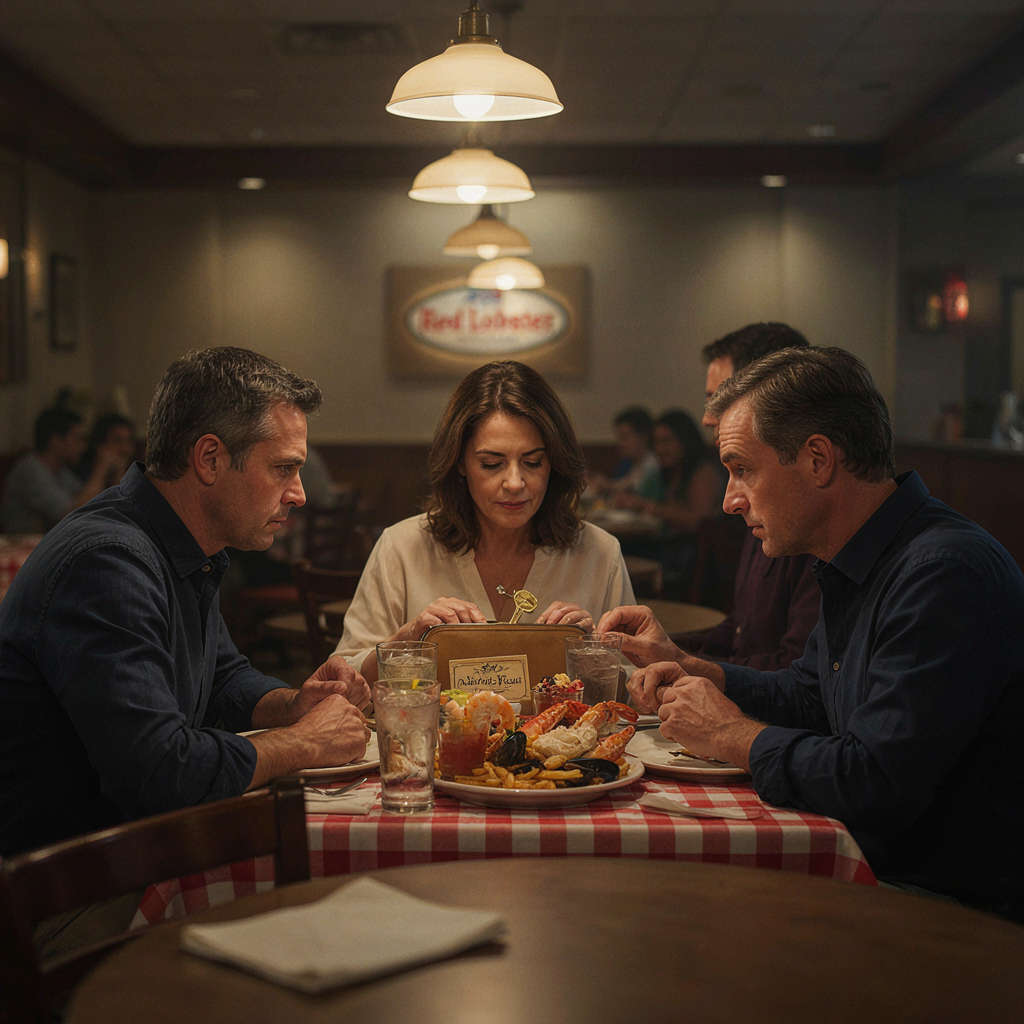
We were sitting in a corner booth at Red Lobster, the same restaurant chain where we’d celebrated our fifth anniversary, our fifteenth, and our twenty-fifth.Thirty years.
Three decades of mortgage payments, birthday cakes, sick days, Christmas mornings, arguments over paint colors, family vacations, and nights when we fell asleep angry and woke up pretending we weren’t.
I had rehearsed what I was going to say for six weeks.
I had planned to tell her after dinner.
But when she cracked open the first crab leg, I realized I couldn’t wait.
“Claire.”She looked up.”Yes?””I had an affair.”The crab cracker stopped in her hand.
I swallowed.”2016. Eight months.”
Claire didn’t drop the crab leg.
She didn’t gasp.
She didn’t cry.
She simply dipped the meat into melted butter and took a bite.
Then she chewed.
Slowly.
Calmly.
She wiped her fingers with a napkin.
“I know.”
For a moment, I honestly thought I’d misunderstood her.
“What?”
“I know.”
My chest tightened.
“You… knew?”
She nodded.
“I followed you once.”
I stared at her.
“Where?”
“Embassy Suites.”
My mouth went dry.
“Route 4.”
The restaurant suddenly seemed too loud.
Forks scraped plates. Children laughed at another table. Someone near the bar burst into laughter.
But I could hear only Claire.
“While you were in that room,” she continued, “I was in the lobby.”
She reached for another crab leg.
“Meeting a divorce lawyer.”
I couldn’t breathe.
“When?”
“That night.”
I stared at her hands.
They were the same hands that had held mine at our wedding.
The same hands that had packed lunches for our children.
The same hands that had rubbed my shoulders when I came home exhausted.
Eight years ago, she had sat downstairs while I destroyed our marriage upstairs.
“What did he say?”
Claire looked at me.
“He drew up papers that night.”
My heart sank.
“Divorce papers?”
“Yes.”
“For what?”
“For everything.”
She paused.
“Everything we owned was worth approximately $420,000 at the time.”
I looked down.
“Claire…”
“He divided it.”
My voice barely came out.
“Why didn’t you file?”
She smiled.
It wasn’t a happy smile.
“I wanted you to lose everything on my terms.”
Then she reached into her purse.
She pulled out a small brass key.
And placed it on the table.
“I never filed,” she said. “I wanted you to lose everything on my terms. Not hers.”
I stared at the key.
“What is that?”
“A safety deposit box.”
“What’s inside?”
She leaned back.
“Last Tuesday, I added something new to those papers.”
I felt a chill move through me.
“Would you like to know what I added?”
I couldn’t answer.
She picked up her glass of water.
“I changed the beneficiary.”
“Of what?”
“Our life insurance.”
I stared at her.
“We have life insurance?”
“You have life insurance.”
My stomach dropped.
Claire continued.
“I’ve been paying the premiums for twenty-two years.”
“How much?”
“Two hundred and fifty thousand dollars.”
I laughed nervously.
Not because anything was funny.
Because I didn’t know what else to do.
“You can’t be serious.”
“I am.”
She took another bite of crab.
“And there’s more.”
Of course there was.
There was always more.
Claire had spent eight years carrying a secret while I had spent eight years pretending mine was buried.
“What did you change?”
“Everything.”
She opened her purse again and removed a folded sheet of paper.
She didn’t hand it to me.
She simply placed it beside the key.
“I created a new estate plan.”
My heart began pounding.
“Claire, we’re married.”
“I know.”
“You can’t just…”
“I can.”
She looked directly at me.
“And I did.”
I felt anger rising.
“You’ve been planning this for eight years?”
“No.”
She shook her head.
“I spent eight years deciding whether you were worth saving.”
That hurt more than anything else she’d said.
“What did you decide?”
She looked down at the crab leg in her hands.
“I decided I didn’t want revenge.”
I blinked.
“Then what’s this?”
She pointed to the key.
“Closure.”
When Claire and I met, I was twenty-six.
She was twenty-four.
We met at a bookstore.
I was reaching for a book on the top shelf.
She reached for it from the other side.
Our hands touched.
She laughed.
“You can have it.”
I said, “No, you saw it first.”
She said, “Then we’ll share it.”
That became our pattern.
She was always willing to share.
I wasn’t always.
We married a year later.
Our first apartment was tiny.
The bedroom barely fit our bed.
The kitchen had one window.
The bathroom door didn’t close properly.
We loved it.
We ate cheap spaghetti on Friday nights.
We saved coins in a jar.
We bought secondhand furniture.
When our first daughter, Emily, was born, Claire cried so hard she couldn’t speak.
I remember holding that tiny baby and thinking I had everything.
And for a while, I did.
Then life became routine.
Work.
Bills.
Children.
School meetings.
Arguments.
Exhaustion.
Somewhere along the way, I stopped looking at Claire.
Not literally.
I saw her every day.
But I stopped seeing her.
She became the person who handled things.
The person who remembered appointments.
The person who knew where everything was.
The person who would always be there.
And when you start believing someone will always be there, you become careless with them.
In 2016, I met Rachel.
She worked in another department.
At first, we talked about work.
Then lunch.
Then messages.
Then things I shouldn’t have said.
Then things I should never have done.
I told myself it wasn’t serious.
That was the lie I repeated most often.
Eight months.
Eight months of lies.
Eight months of deleted messages.
Eight months of coming home and kissing my wife while carrying someone else’s secrets.
Until the night at Embassy Suites.
That night, I thought I was being clever.
I wasn’t.
Claire had followed me.
She didn’t confront me.
She didn’t scream.
She didn’t walk upstairs.
She went into the lobby.
And met a divorce lawyer.
Eight years later, I finally understood why that was so much worse.
She had seen everything.
And she had chosen silence.
“What happened to Rachel?” Claire asked.
Her question brought me back to the restaurant.
I looked at her.
“What?”
“Rachel.”
I swallowed.
“She left.”
“When?”
“2017.”
“After the affair?”
“Yes.”
Claire nodded.
“Why?”
I looked away.
“She wanted a real relationship.”
“And you didn’t?”
“I wanted my family.”
Claire gave a quiet laugh.
“No.”
I frowned.
“No?”
“You wanted both.”
I couldn’t argue.
Because she was right.
“I was selfish.”
“Yes.”
There was no hatred in her voice.
That somehow made it worse.
I looked at the key again.
“What happened after you met the lawyer?”
Claire’s eyes softened.
“I went home.”
“You didn’t tell me?”
“No.”
“Why?”
“Because Emily was still living at home.”
Our daughter had been seventeen.
“She was applying for college,” Claire continued. “I couldn’t bring our entire family into a war.”
I stared at her.
“So you stayed.”
“I stayed.”
“Why?”
She looked at me for a long moment.
“Because I wanted to see who you became when nobody was watching.”
I felt ashamed.
“And?”
“You stopped.”
I looked up.
“What?”
“You stopped.”
She folded her napkin.
“Rachel left. You ended the affair. You became a better father. You started coming home earlier. You went to therapy.”
“I never told you about therapy.”
“I knew.”
“How?”
“I knew you.”
That sentence nearly broke me.
She knew me.
After everything, she still knew me.
After dinner, we didn’t go home immediately.
We sat in the car.
Neither of us turned on the radio.
Rain tapped against the windshield.
Finally I asked, “What’s in the safety deposit box?”
Claire looked straight ahead.
“Your past.”
I frowned.
“My past?”
“Everything I collected.”
Photographs.
Messages.
Hotel receipts.
Copies of the divorce papers.
Bank statements.
Everything.
She had kept it all.
For eight years.
“Why?”
“Because I needed proof that I wasn’t imagining it.”
I reached for her hand.
She moved hers away.
Not dramatically.
Just enough.
“I don’t know what I expected tonight,” I said.
“You expected to confess and feel relieved.”
I looked at her.
She was right.
“I thought telling you would be the honest thing.”
“It was.”
“Then why doesn’t it feel like it?”
“Because honesty isn’t the same thing as forgiveness.”
I stared through the windshield.
“I love you.”
“I know.”
“I never stopped.”
“I know that too.”
“Do you love me?”
She didn’t answer immediately.
Then she said:
“I don’t know.”
Those four words hurt more than “I know.”
The next morning, Claire left before I woke up.
There was a note on the kitchen counter.
Not a goodbye.
Not a threat.
Just an address.
The bank.
And beneath it:
10:00 a.m.
I arrived ten minutes early.
Claire was already there.
She was sitting beside a banker.
The safety deposit box was opened.
Inside were folders.
Lots of folders.
She placed the first one on the table.
“These are the divorce papers.”
I opened them.
They were dated August 14, 2016.
Eight years ago.
The same night.
Every asset was listed.
The house.
The retirement account.
The savings.
The investments.
Even the furniture.
Everything.
Then I saw something that made me stop.
“Why does this say fifty percent?”
Claire looked at me.
“Because the lawyer told me I could take more.”
I stared at her.
“You could have.”
“Yes.”
“But you didn’t.”
“No.”
“Why?”
“Because I wanted you to know that I could destroy you.”
She paused.
“But I didn’t want to become someone who enjoyed doing it.”
I closed the folder.
The next one contained bank statements.
My stomach tightened.
“What are these?”
“Your debts.”
I flipped through them.
Credit cards.
Loans.
Old balances.
Everything I’d forgotten.
Claire had tracked them all.
Then she handed me another folder.
“This is where the story changes.”
Inside were receipts.
Medical bills.
College payments.
Mortgage statements.
And something else.
A letter.
I opened it.
It was from Emily.
My daughter.
I read the first sentence.
Mom, I know about Dad.
My hands started shaking.
Claire looked away.
“When did she find out?”
“2019.”
“She knew?”
“Yes.”
“Why didn’t she tell me?”
“Because I asked her not to.”
I looked up.
“Why?”
“Because I didn’t want my daughter carrying my anger.”
I couldn’t speak.
I read the rest.
Emily had written about how disappointed she was.
How she had almost stopped speaking to me.
How her mother had encouraged her not to punish me forever.
And then the final sentence:
If Dad ever tells you the truth, let him. But don’t let him buy forgiveness.
I closed my eyes.
Claire had protected me from my own daughter.
Even after I betrayed her.
“What did you add last Tuesday?” I asked.
Claire reached into the box.
She pulled out another document.
“This.”
I read the heading.
Family Trust Agreement.
I looked at her.
“What is this?”
“Our house.”
I scanned the pages.
The house was being placed into a trust.
For our grandchildren.
I looked up.
“We don’t have grandchildren.”
“We do now.”
I stared at her.
“Our son Daniel?”
“Daniel and his wife had a baby three months ago.”
I smiled despite myself.
“I didn’t know you were doing this.”
“Because you didn’t ask.”
That sentence landed hard.
She continued.
“I added the house to the trust.”
“So neither of us can sell it?”
“Correct.”
“Why?”
“Because it’s the only home our family has known for twenty-six years.”
She looked at me.
“I don’t want your mistakes to erase that.”
I felt tears forming.
“So you’re leaving me?”
She didn’t answer.
Instead, she pulled out one final document.
“This is the part I added last Tuesday.”
I read it.
My hands froze.
It was a new beneficiary designation.
The $250,000 life insurance policy.
Half would go to Emily.
Half to Daniel.
Nothing to Claire.
Nothing to me.
But there was a condition.
The children would receive the money only after Claire’s death.
I looked at her.
“You left yourself nothing.”
“I have my own savings.”
“Then why?”
“Because I don’t want your children fighting over money after we’re gone.”
I stared at her.
“Claire, what are you doing?”
She leaned back.
“Trying to end this marriage without destroying the family.”
My voice cracked.
“Are you divorcing me?”
She looked at me.
“Not today.”
“Why not?”
“Because I want you to understand what you’re actually losing.”
For the next six weeks, we lived in separate rooms.
Claire didn’t ask me to leave.
She didn’t ask me to stay.
She simply stopped pretending.
We ate separately.
We spoke about bills.
We spoke about the children.
We spoke about the grandchildren.
But not us.
Then one Sunday morning, I found Claire sitting in the garden.
She was holding an old photograph.
Our wedding day.
I sat beside her.
“I remember that dress,” I said.
“You spilled champagne on it.”
“I did?”
“You were nervous.”
“I was terrified.”
She smiled.
“I know.”
We sat quietly.
Then I said:
“I’ve spent eight years thinking I got away with it.”
Claire looked at me.
“You didn’t.”
“I know.”
“No.”
She shook her head.
“You don’t.”
“What don’t I know?”
“You think punishment means losing money, a house, or a marriage.”
She looked at the photograph.
“Punishment is waking up every day knowing you were loved by someone you hurt.”
I lowered my head.
“I deserve that.”
“Maybe.”
She sighed.
“But I don’t want to punish you anymore.”
I looked at her.
“Why?”
“Because I’m tired.”
Her voice broke.
“Do you know what it’s like to be angry for eight years?”
I shook my head.
“It consumes everything.”
She wiped a tear from her cheek.
“I don’t want to spend the rest of my life being the woman who got revenge.”
I reached for her hand.
This time she let me.
“I don’t know how to fix this,” I said.
“Neither do I.”
“Can we try?”
She looked at me.
“Try what?”
“Marriage.”
She didn’t answer.
“Not the old one,” I continued. “A new one.”
She squeezed my hand.
“You don’t get to ask me to trust you overnight.”
“I know.”
“You don’t get to demand forgiveness.”
“I know.”
“And you don’t get to decide how long this takes.”
“I know.”
She looked toward the house.
“Then maybe.”
Three months later, we returned to the same Red Lobster.
Same corner booth.
Same menu.
This time, Claire ordered the Admiral’s Feast again.
I ordered grilled salmon.
The waiter placed the check on the table.
$92.
I laughed.
Claire raised an eyebrow.
“What?”
“Nothing.”
“You’ve been staring at that bill for thirty seconds.”
“I was remembering.”
She smiled.
“That’s dangerous.”
I reached into my pocket.
I pulled out a small envelope.
Claire stared at it.
“What is that?”
“Something I should have given you eight years ago.”
She opened it.
Inside was a letter.
I had written it every night for three weeks.
No excuses.
No explanations.
No promises I couldn’t keep.
Just the truth.
She read it silently.
When she finished, she folded it carefully.
“Thank you.”
I nodded.
Then she reached into her purse.
My heart stopped.
She placed something on the table.
The brass key.
The safety deposit box key.
I looked at it.
“What’s this?”
“I don’t need it anymore.”
“You destroyed the papers?”
“No.”
She smiled.
“I gave them to the lawyer.”
My heart sank.
“For what?”
“To be destroyed.”
I stared at her.
“You’re sure?”
“No.”
She took my hand.
“But I’m choosing something different.”
“What?”
“You.”
I couldn’t speak.
She leaned closer.
“Not because I forgot.”
Her eyes were wet.
“Because I remember everything.”
I squeezed her hand.
She smiled.
“Thirty years ago, I told you I’ve been choosing you.”
She paused.
“Tonight, I’m choosing you again.”
The waiter came by with the check.
Claire picked it up.
She looked at the total.
“$92.”
I laughed.
She smiled.
“Some things never change.”
We walked out together.
But before we reached the door, Claire stopped.
She turned to me.
“One more thing.”
“What?”
“The key.”
She held it out.
“What about it?”
“Keep it.”
“Why?”
“Because trust isn’t about pretending the box never existed.”
She placed it in my palm.
“It’s about knowing what’s inside—and choosing not to open it.”
I closed my fingers around the key.
For the first time in eight years, it didn’t feel like a weapon.
It felt like a promise.
Not that our marriage was fixed.
It wasn’t.
Not that the past had disappeared.
It hadn’t.
And not that forgiveness was guaranteed.
It wasn’t.
But as we stepped into the cool night air, Claire slipped her hand into mine.
And I understood something I should have understood thirty years earlier.
Love isn’t proven by the years you stay.
It’s proven by what you do after you’ve given someone every reason to leave.
That night, my wife didn’t erase my betrayal.
She didn’t pretend it never happened.
She simply gave me something I had never earned.
Another chance.
And this time, I knew exactly what it was worth.